Synonyms for Some: 20+ Words With Examples
Some is one of the most overused words in English — it fills every gap in our sentences, from “some people” to “some water.” But precise writing needs sharper tools. This guide collects synonyms for some: 20+ alternatives like several, a few, and various, each with a clear meaning, a real example sentence, and a note on when it fits best. The Merriam-Webster thesaurus confirms these as genuine equivalents — grouped here by the kind of “some” you actually mean.
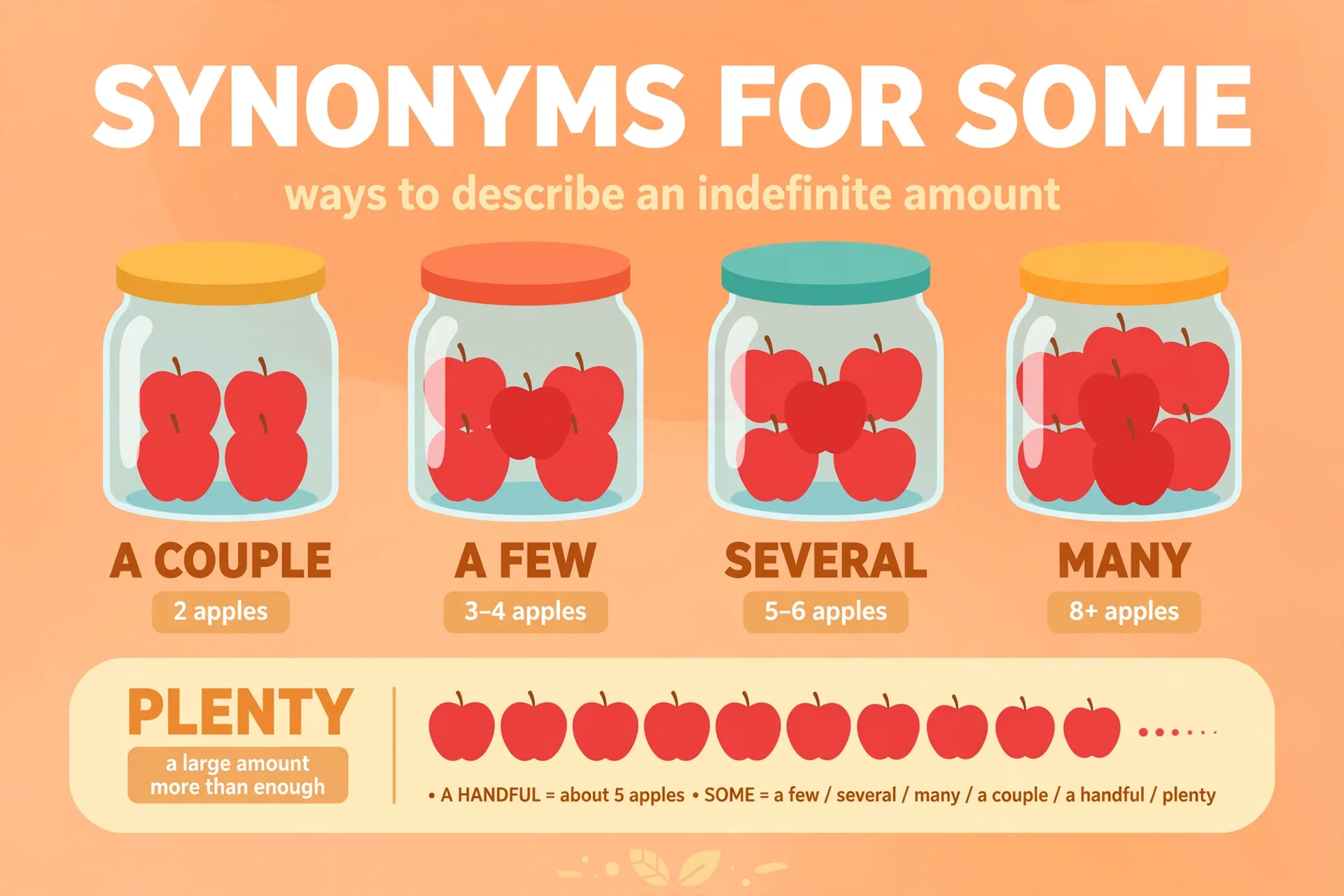
Table of Contents
Quick Answer
| Word | Nuance / When to use it |
|---|---|
| several | More than two but not many; countable things |
| a few | A small number; countable things |
| a handful of | A very small number you could almost count on one hand |
| a couple of | Two, or a very small number; informal |
| a number of | Several; slightly formal |
| certain | Specific but unnamed ones |
| various | Different kinds; diverse ones |
| any | One, some, or all — no matter which |
| particular | Specific ones singled out |
| a little | A small amount; uncountable things |
| part of | A fraction of a whole |
| a bit of | A small amount; informal |
Simple rule: use several or a few for small countable groups, a little for uncountable amounts, and various when the items differ — the groups below show you exactly which fits where.
Small Indefinite Amounts
When you mean “a small number of countable things,” these words are far more precise than a vague “some.”
several — more than two but not many; at least three or four. “Several students stayed after class to ask about the exam.” (Works only with countable nouns — you can’t say “several water.”)
a few — a small number of people or things. “I have a few ideas for the project that I’d like to share at the meeting.” (Notice the article: “a few” is positive — “few” without it is negative, meaning hardly any.)
a handful of — a very small number, small enough to imagine holding in one hand. “Only a handful of guests arrived before the rain started, so we moved the party indoors.”
a couple of — two, or informally a very small number. “Give me a couple of minutes and I’ll have the report ready.” (Casual; avoid in formal writing.)
a number of — several; more than a few. Slightly formal. “A number of studies have linked sleep deprivation to poor exam performance.”
Unspecified Ones
Sometimes “some” points at particular people or things without naming them. These synonyms capture that vagueness with more control.
certain — particular but unnamed; known but not specified. “Certain members of the committee opposed the budget, though no one would say who.”
various — of different kinds; diverse. “The museum displays various artifacts from ancient Egypt, Greece, and Rome.” (Use this when the items differ from each other — that variety is the point.)
any — one, some, or every — it doesn’t matter which. “If you have any questions, please raise your hand.” (Best in questions, negatives, and offers — “I don’t have any,” “Take any seat.”)
particular — relating to one specific person or thing among many. “She had a particular talent for calming nervous clients before big presentations.”
A Portion
When “some” means a slice of a larger whole — an amount rather than a number of items — reach for these.
a little — a small amount of something uncountable. “Add a little salt to the soup and taste it again.” (For countable things, the partner word is “a few” — “a little apples” is wrong.)
part of — a piece or fraction of a whole. “Part of the fence was damaged in the storm, but the rest held firm.”
a share of — a portion that belongs to someone or is allocated to them. “Each partner received a share of the profits at the end of the quarter.”
a bit of — a small amount; informal and friendly. “There’s a bit of traffic on the highway, so leave ten minutes early.” (Casual register — in formal writing, use “a little” or “somewhat.”)
Common Mistakes
These little quantity words cause outsized confusion — and small spelling slips matter too, as our guides on quite vs quiet and thier or their show.
Mistake 1: Using “some” where “any” belongs
❌ Wrong: “I don’t have some questions about the assignment.”
✅ Better: “I don’t have any questions about the assignment.”
Why: in negative sentences and most questions, any is the correct choice. Some appears in positives (“I have some questions”) and in offers that expect a yes (“Would you like some tea?”).
Mistake 2: Confusing “a few” with “few”
❌ Wrong: “I have few close friends who would help me move.” (Sounds like: almost none.)
✅ Better: “I have a few close friends who would help me move.”
Why: a few is positive — a small but real number. Few alone is negative — fewer than you’d expect. The tiny article “a” flips the meaning completely.
Mistake 3: Pairing “several” with uncountable nouns
❌ Wrong: “He drank several water during the marathon.”
✅ Better: “He drank several bottles of water during the marathon.”
Why: several only works with countable nouns. For uncountable nouns (water, advice, information), use a little, some, or add a countable container like “bottles of.”
Mistake 4: Using “various” when the items are identical
❌ Wrong: “Various identical chairs lined the hallway.”
✅ Better: “Several identical chairs lined the hallway.”
Why: various promises diversity — different kinds. If the items are all the same, several or a few is honest; various contradicts the sentence.

How to Choose the Right Synonym
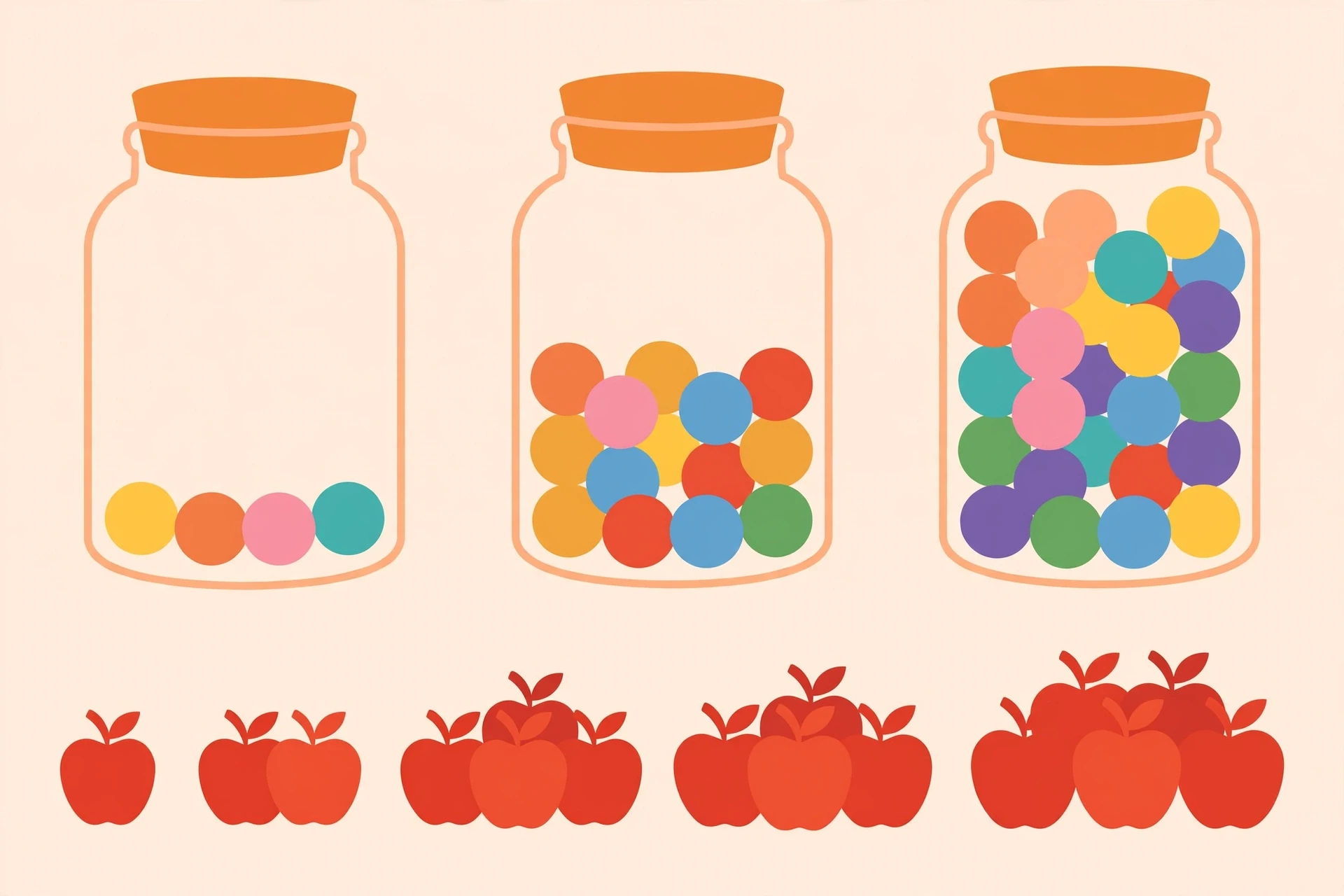
- Countable or uncountable? Use several, a few, or a handful of with countable nouns (apples, emails, people); use a little or a bit of with uncountable nouns (time, sugar, advice). This one test fixes half of all “some” errors.
- Positive or negative context? Use some in affirmative statements, any in negatives and questions. “I have some ideas” vs. “I don’t have any ideas.”
- Same or different? Reach for various only when the items genuinely differ; for identical items, several or a number of is more accurate.
- Formal or casual? A number of, several, and certain suit reports and essays; a couple of and a bit of belong in conversation and informal writing.
- How small is small? A handful of suggests you could almost count them on one hand; several suggests more than two but not many; a few sits between. Choose the one whose scale matches your facts.
Frequently Asked Questions
What is a synonym for some?
The most useful synonyms are several, a few, various, and a number of for countable things, and a little or a bit of for uncountable things. For unnamed specific ones, certain or particular work best.
What is the difference between “some” and “any”?
Some appears in positive statements (“I have some free time”) and offers (“Would you like some help?”). Any appears in negatives (“I don’t have any free time”) and questions (“Do you have any free time?”). Mixing them up is one of the most common ESL errors.
Is “several” more than “a few”?
Usually, yes — slightly. A few suggests a small number (around 2–4), while several suggests more than two but not many (around 3–7). Neither is exact, which is exactly why writers love them; the difference is one of impression, not arithmetic.
Can I use “some” in formal writing?
Yes, but sparingly. Formal writing prefers precise quantities or words like several, various, a number of, and certain. A report that says “some data was collected” sounds vague; “a number of surveys were collected” sounds professional.
How many is “several”?
There is no fixed number, but most dictionaries and style guides put it between three and seven — more than a couple, fewer than many. In practice it means “a modest number, more than you’d call ‘a few.'”
Conclusion
Some does a lot of quiet work in English, but it works too quietly — it blurs exactly the distinctions that good writing needs. Swap in several, a few, various, or a little, and your sentences suddenly carry real information about number, kind, and amount. The next time you type “some,” pause for a second and ask which word you actually mean.