Synonyms for Fake: 22+ Words With Examples
Fake covers a lot of ground — counterfeit money, artificial flowers, insincere smiles — and one blunt word rarely captures which kind of “not real” you mean. This guide collects 23 precise synonyms for fake, grouped by nuance, each with a clear meaning and a natural example sentence. From forged documents to feigned enthusiasm, you will find the word that fits the fraud, the imitation, or the act.
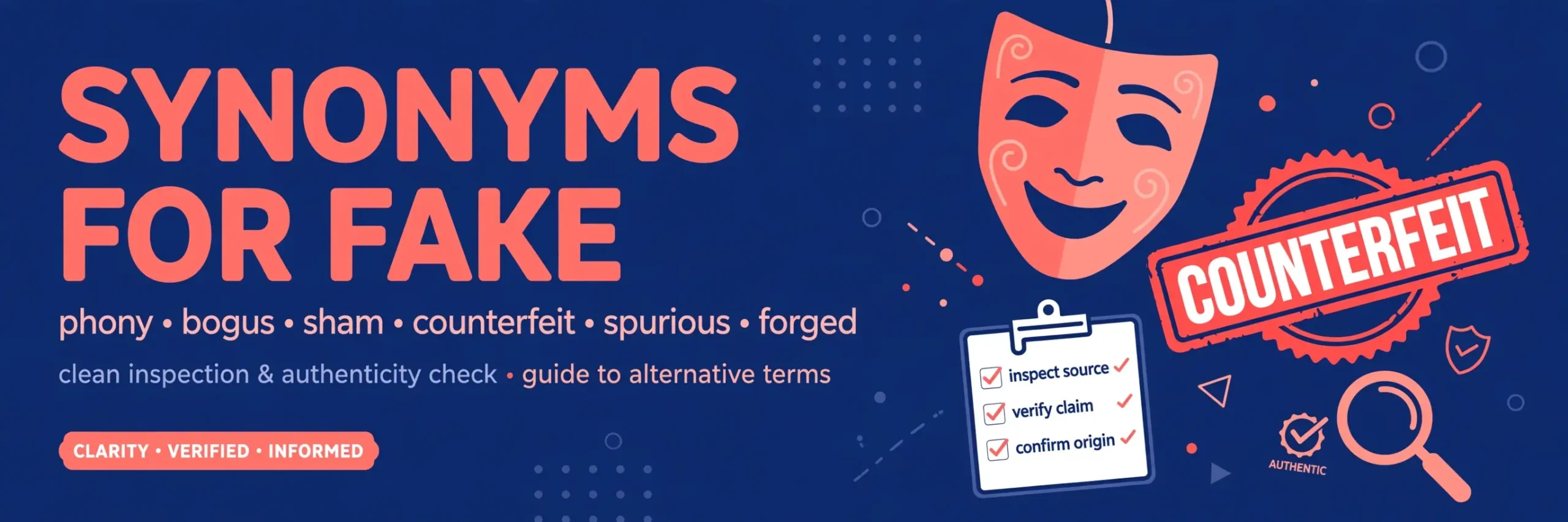
Table of Contents
Quick Answer: 12 Synonyms for Fake
| Word | Nuance / When to use it |
|---|---|
| counterfeit | Illegally copied to deceive; money, goods, documents |
| forged | Faked signature or document; fraud in writing |
| phony | Not genuine; people, accents, excuses (informal) |
| bogus | False or fraudulent; claims, charges, products |
| fraudulent | Formal/legal term for deliberate deception |
| artificial | Made by humans, not natural; neutral, not always bad |
| synthetic | Chemically or industrially made substitute |
| imitation | Copy of the real thing; openly sold as such |
| insincere | Not meaning what is said; hollow politeness |
| feigned | Pretended feeling; formal, literary |
| sham | A fraud dressed up as the real thing |
| deceptive | Designed or tending to mislead |
Simple rule: ask what is fake about it — made illegally (counterfeit, forged), made artificially (synthetic, imitation), or merely pretended (feigned, insincere). The motive and the material decide the word. Compare more shades on Merriam-Webster’s thesaurus page for “fake”.
Counterfeit
When something is deliberately copied to pass as genuine — money, goods, credentials — the law has words for it. These six name fraud and forgery precisely.
-
counterfeit — Made in imitation of the real thing with intent to deceive, usually illegally. Example: Police seized thousands of counterfeit watches from the warehouse.
-
forged — Fraudulently made or altered, especially signatures and documents. Example: The bank flagged the check because the signature looked forged.
-
phony — Not genuine or real; informal, covers people, accents, and excuses. Example: His phony British accent fooled nobody at the audition.
-
bogus — False, fraudulent, or not what it claims to be; informal. Example: The email contained a bogus link designed to steal passwords.
-
fraudulent — Characterized by deceit, especially in a legal or financial sense. Example: The company faced charges over fraudulent billing practices.
-
spurious — False or fake, but plausible on the surface; formal. Example: The report was based on spurious data that collapsed under review.

Artificial
Not all fakes are frauds. These words describe things made by humans instead of nature — often openly, usefully, and without any deception at all.
-
artificial — Made or produced by humans rather than occurring naturally; neutral in tone. Example: The stadium’s artificial turf holds up better than grass in winter.
-
synthetic — Made by chemical or industrial processes; a manufactured substitute. Example: Synthetic fabrics dry faster than cotton on long hikes.
-
imitation — A copy of something genuine, often sold openly as a cheaper alternative. Example: She wore imitation pearls that looked lovely with the dress.
-
simulated — Imitating the conditions or appearance of something real, especially for training. Example: Pilots log hundreds of hours in simulated cockpits before flying.
-
man-made — Created by people rather than nature; straightforward and plain. Example: The lake is man-made, built in the 1960s to supply the town.
-
faux — Artificial or imitation, usually decorative; from French, mildly elegant. Example: The boutique sold faux fur coats that felt surprisingly soft.
Insincere
Sometimes the fake thing is not an object but a feeling — a smile, praise, or sympathy that is performed rather than felt. These six describe pretense in people.
-
insincere — Not expressing genuine feelings; saying what is not truly meant. Example: His insincere apology only made the argument worse.
-
pretended — Claimed or displayed falsely; put on as an act. Example: She made a pretended effort to look surprised at the party.
-
feigned — Simulated or invented, especially an emotion; formal and literary. Example: He listened with feigned interest while checking his watch.
-
put-on — Deliberately assumed and not genuine; an affected manner. Example: Her put-on cheerfulness vanished the moment the guests left.
-
hollow — Empty of real meaning or sincerity; promises and praise with nothing behind them. Example: The company’s hollow promises about work-life balance fooled few employees.
-
affected — Artificially assumed to impress; a manner that is not natural. Example: He spoke in an affected drawl that nobody from his hometown recognized.
Deceptive & Sham
These words focus on the trick itself — things built to mislead the eye, the ear, or the judgment. Use them when the intent to fool is the point.
-
deceptive — Giving a misleading impression; tending to deceive. Example: The product’s deceptive packaging made the box look twice as full.
-
misleading — Causing someone to form a wrong idea, whether by design or accident. Example: The headline was technically true but deeply misleading.
-
sham — Something presented as genuine but actually a fraud; a bogus pretense. Example: The election was widely condemned as a sham.
-
mock — Imitation, not real; often used openly for practice or display. Example: Students debated in a mock trial held in the school auditorium.
-
ersatz — An inferior substitute, usually from necessity; from German. Example: During the shortage, cafes served an ersatz coffee made from roasted grain.
Common Mistakes With Fake Synonyms
These words look interchangeable until they are not — a precision problem a lot like the spelling traps in flakey vs flaky or shiney vs shiny. Watch for these four traps:
Mistake 1: Calling a false statement “fake”
❌ “His excuse was totally fake news.”
✅ “His excuse was totally false.”
Why: “Fake” describes things made to imitate; “false” describes statements that are untrue. A claim is false, a document is fake — mixing them blurs the meaning.
Mistake 2: Treating “artificial” as an insult
❌ “Ugh, this is artificial vanilla — it’s fake.”
✅ “This is artificial vanilla — it’s a manufactured flavoring.”
Why: “Artificial” is neutral: it means human-made, not deceitful. Artificial sweeteners and turf are openly labeled; save the fraud words for actual fraud.
Mistake 3: Using “counterfeit” for insincere people
❌ “He is such a counterfeit friend.”
✅ “He is such a phony friend.”
Why: “Counterfeit” belongs to objects illegally copied to deceive — money, goods, documents. For people, “phony,” “insincere,” or “two-faced” fit the crime.
Mistake 4: Confusing “faux” with “fake”
❌ “The painting was a faux — a worthless fake.”
✅ “The painting was a forgery — a worthless fake.”
Why: “Faux” means imitation decor (faux fur, faux marble), sold openly as imitation. It never means criminal fraud — “forgery” or “counterfeit” do that job.
How to Choose the Right Synonym
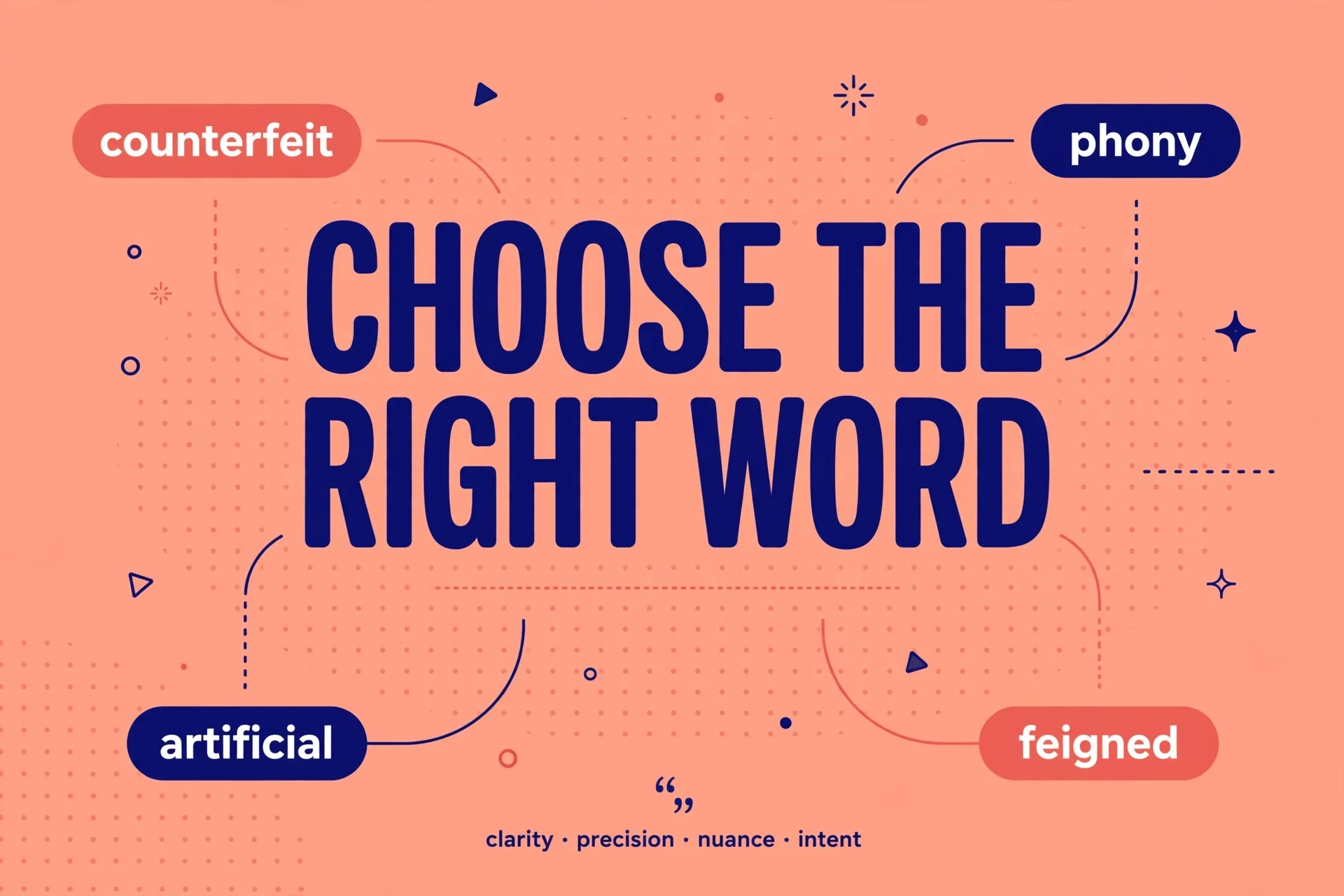
- Identify what is fake. An object illegally copied is “counterfeit” or “forged”; an emotion performed is “feigned” or “insincere”; a substitute openly sold is “imitation” or “faux.” Start with the category.
- Judge the intent. Deliberate deception calls for “fraudulent,” “bogus,” or “sham.” Neutral manufacturing calls for “synthetic” or “artificial.” The motive picks the word.
- Mind the legal weight. “Fraudulent” and “counterfeit” imply crimes; use them only when wrongdoing is real. For harmless copies, “imitation” or “mock” keep you accurate — and out of trouble.
- Match the formality. “Spurious,” “ersatz,” and “feigned” suit essays and reports; “phony” and “bogus” suit conversation and blogs. Formal fraud deserves formal words.
- Separate fake from false. Things are fake; statements are false. A “fake excuse” is sloppy phrasing — the excuse is “false” or “bogus,” not a manufactured object.
- Check the connotation of “artificial.” It is descriptive, not damning. If you mean to condemn, pair it with context — or choose “sham” or “hollow” instead.
Frequently Asked Questions
What is a synonym for fake?
The most common synonyms for “fake” are counterfeit, phony, bogus, artificial, and fraudulent. Use “counterfeit” for illegal copies, “artificial” for human-made things, and “phony” for informal use.
What is a formal synonym for fake?
“Counterfeit,” “fraudulent,” “spurious,” and “feigned” all work in formal writing. “Spurious” suits arguments and data; “fraudulent” suits legal and financial contexts.
What is the difference between fake and artificial?
“Artificial” means made by humans rather than nature — it is neutral and often openly labeled. “Fake” implies imitation meant to pass as genuine. Artificial turf is honest; a fake Rolex is not.
Is “phony” a synonym for fake?
Yes, in informal contexts. “Phony” covers fake people, accents, excuses, and documents. It is conversational rather than legal — court filings say “fraudulent,” not “phony.”
What do you call a fake smile?
A fake smile is best described as “forced,” “feigned,” “insincere,” or “put-on.” “Feigned” is the most literary; “forced” is the most common in everyday speech.
What is a synonym for fake news?
Alternatives include “misinformation,” “disinformation,” “fabrication,” and “bogus reporting.” “Misinformation” is false but possibly accidental; “disinformation” is deliberately deceptive.
Conclusion
“Fake” is a blunt instrument; its synonyms are scalpels. Counterfeit for the illegal copy, artificial for the honest imitation, feigned for the performed feeling. Name the kind of unreality, and your writing will cut exactly where you aim.