Synonyms for Research: 16 Words With Examples
People look for synonyms for research because the word covers everything from a doctoral dissertation to an afternoon of reading online reviews. The 16 synonyms for research below are grouped by nuance — formal investigation, open-ended exploration, and the verb forms — each with a precise meaning and a real example sentence, so you can pick the exact word your context needs.
Table of Contents
Quick Answer
The best synonym for research depends on the setting and the method. Academic and scientific work calls for investigation or analysis; open-ended discovery calls for exploration or survey; and as a verb, investigate or examine carry the seriousness research implies.
| Word | Nuance / When to use it |
|---|---|
| investigation | A systematic search for facts, often official |
| analysis | Breaking data or a topic down to understand it |
| examination | Careful, close inspection of something |
| study | Sustained learning or observation; the broadest option |
| exploration | Searching into something unfamiliar or new |
| survey | Gathering information across many people or cases |
| review | Summing up existing findings rather than adding new ones |
| inquiry | A formal question-driven search (US spelling of enquiry) |
| investigate | Verb: to systematically examine or probe |
| examine | Verb: to inspect closely and carefully |
| analyze | Verb: to break down in order to understand |
| delve into | Verb: to dig deeply into a topic |
Simple rule: use investigation or analysis for systematic academic work, exploration or survey for discovery and data gathering, and verb forms like investigate or examine when describing the act of researching itself.
Formal Investigation (Noun)
These synonyms suit serious, methodical research: labs, universities, courts, and official inquiries.
Investigation — a systematic search for facts, often official or scientific. “The investigation into the accident took six months.”
Inquiry — a formal, question-driven search for information. “The committee opened an inquiry into the failed project.”
Analysis — the careful study of data or a topic by breaking it into parts. “Her analysis of voting patterns revealed a clear generational shift.”
Examination — close, careful inspection of something in detail. “A thorough examination of the evidence overturned the first verdict.”
Study — sustained learning, observation, or consideration; the broadest and most neutral option. “The study tracked ten thousand patients over a decade.”

Exploring a Topic (Noun)
These synonyms fit research that is more open-ended: discovery, literature searches, and early-stage curiosity.
Exploration — searching into something unfamiliar or new. “His exploration of medieval trade routes became a bestselling book.”
Probe — a deep, focused examination that digs beneath the surface. “The journalist’s probe uncovered a pattern of ignored complaints.”
Survey — gathering information across many people or cases. “A survey of two thousand shoppers guided the redesign.”
Review — a careful summing-up of existing findings rather than new experiments. “The review of past studies found no consistent link.”
Delving — a deep dive into a subject, seeking what lies below the surface. “Her delving into family archives turned up a forgotten diary.”
To Research (Verb)
When research is the action — the doing of the work — these verbs say it with more precision. Merriam-Webster’s thesaurus entry for “research” lists explore, investigate, and study among the nearest verb matches, each carrying a slightly different method and intensity.
Investigate — to systematically examine or probe for facts. “Reporters investigated the company’s finances for a year.”
Explore — to search through something new or unfamiliar. “She spent the summer exploring archives across three cities.”
Examine — to inspect closely and carefully. “Doctors examined the scan frame by frame.”
Analyze — to break data or a topic down in order to understand it. “The team analyzed the survey results before launching.”
Look into — to begin finding out about something; informal but widely used. “I will look into flight prices tonight.”
Delve into — to dig deeply into a topic over time. “He delved into the records until the full story emerged.”
Common Mistakes
Spelling and word-choice traps sit side by side in writing: check the recieve or receive spelling before you write it, and know the whether vs weather difference before you use either. Near-synonyms of research need the same care:
Mistake 1: Using “search” to mean “research”
❌ “She searched the vaccine’s effectiveness.”
✅ “She researched the vaccine’s effectiveness.”
Why: search is looking for something, often quickly; research is systematic investigation. A Google search can be part of research, but it is not research on its own.
Mistake 2: Mixing up “inquiry” and “enquiry”
❌ “The enquiry uncovered fraud.” (in US writing)
✅ “The inquiry uncovered fraud.”
Why: in American English, inquiry covers both formal investigations and casual questions; enquiry is the British form used mostly for general questions. Use inquiry in US writing for both.
Mistake 3: Confusing “study” the verb with “study” the noun
❌ “Our study examined the data.” (meaning the act of studying)
✅ “Our studying examined the data.” / “Our study of the data was thorough.”
Why: the noun study names a completed piece of work, while the verb describes the ongoing process. “The study found” is fine — a finished study speaking through its results — but the process is studying.
Mistake 4: Calling a literature summary “research”
❌ “Her research proved nothing new, but summarized ten papers.”
✅ “Her review summarized ten papers.”
Why: a review gathers and evaluates existing findings; research in the strict sense generates new ones. Both matter, but they are different jobs.
How to Choose the Right Synonym
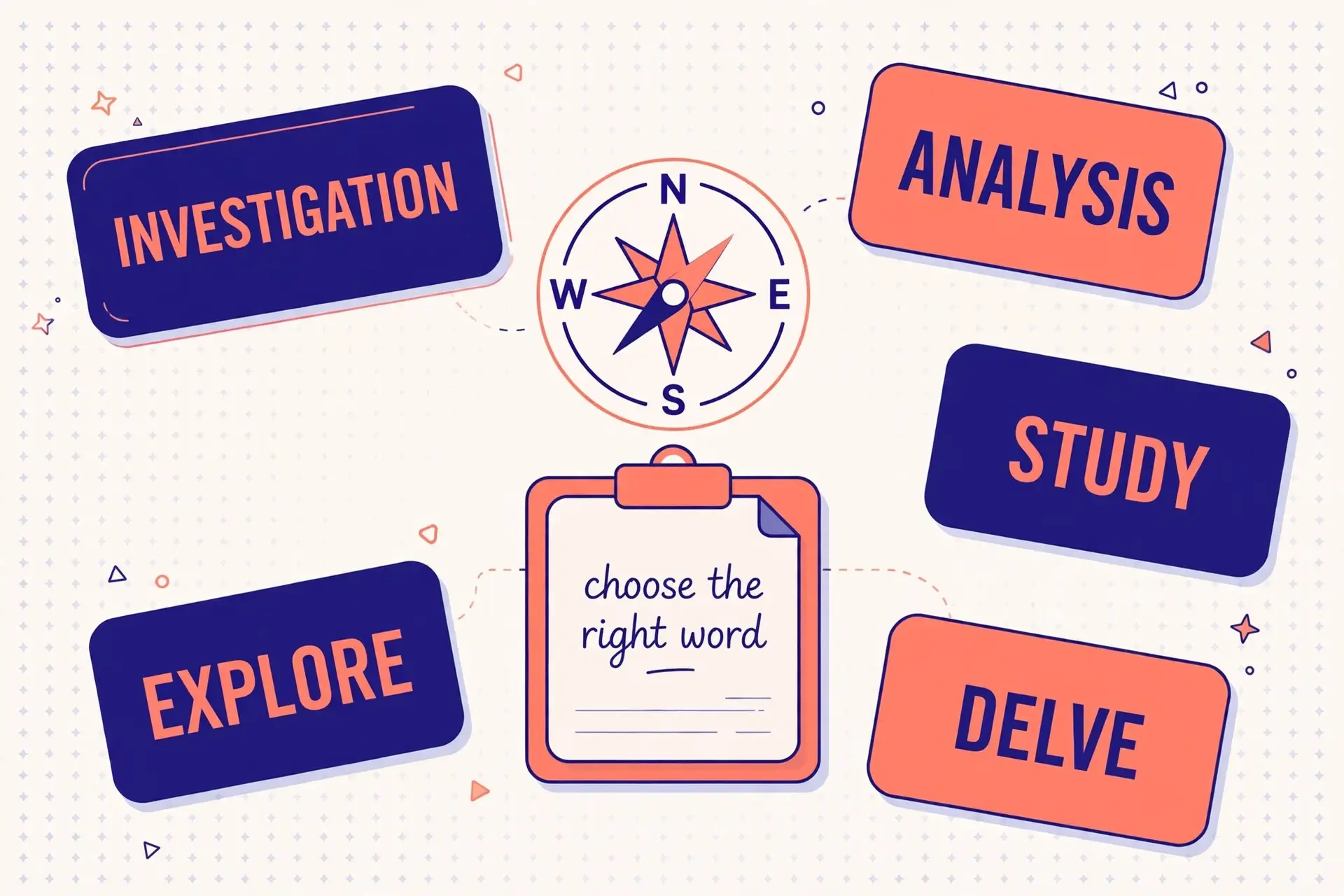
- Match the setting. Investigation, inquiry, and analysis suit academic, scientific, and official contexts; exploration and delving suit curiosity-driven and creative work.
- Check whether the work is new or a summary. New experiments and data gathering call for research, study, or survey; summing up existing work calls for review.
- Use verbs for actions, nouns for outputs. Say “we investigated the records” for the doing and “the investigation revealed” for the finished work.
- Mind the scale. Survey implies many cases or people; probe and examination imply a narrow, deep focus; exploration implies the unknown.
- Watch formality. Look into is casual and brief; inquiry, analysis, and examination are formal. A thesis uses the latter; an email to a colleague can use the former.
Frequently Asked Questions
What is a synonym for research?
If you need one all-purpose replacement, try study — it is the broadest noun, covering everything from a formal paper to sustained personal learning.
What is the difference between research and study?
Research is systematic investigation that usually produces new knowledge; study is broader, covering any sustained learning or observation, including learning what others already found.
Is “inquiry” or “enquiry” correct?
In American English, inquiry is correct for both formal investigations and casual questions. Enquiry is the British spelling, used mainly for general questions rather than formal investigations.
Can “research” be used as a verb?
Yes: “She researched the topic for weeks.” For more formal verb options, use investigate, examine, or analyze; for casual contexts, look into works well.
What is a formal synonym for research?
Investigation and inquiry suit official or legal contexts, while analysis and examination fit academic writing. All four carry more gravity than the casual look into.
Conclusion
Research spans the lab, the library, and the late-night web search, and the right synonym tells your reader which kind you mean. Keep investigation and analysis for systematic work, exploration and survey for discovery, and verbs like investigate or examine for the act itself. With 16 options grouped by nuance, you never have to repeat “research” again.