Synonyms for Despite: Words With Examples
“Despite” is one of the hardest-working words in English — it pushes a sentence forward past whatever obstacle stands in its way. But repeating it in every paragraph gets monotonous, and some contexts call for a lighter or more formal alternative. This guide gives you 16 synonyms for despite, grouped by how they work in a sentence, each with its exact nuance and an example.
Quick Answer
| Word | Nuance / When to use it |
|---|---|
| in spite of | The direct swap for “despite”; slightly more emphatic and conversational. |
| regardless of | Emphasizes that something had no effect on the outcome. |
| notwithstanding | Formal, legal, or academic register. |
| even with | Casual and conversational; pairs with a noun or noun phrase. |
| in the face of | Dramatic: standing firm against opposition or danger. |
| although | The standard conjunction for two clauses; the most common alternative. |
| even though | Stronger and more surprising than “although.” |
| albeit | Formal conjunction for short phrases, not full clauses. |
| despite the fact that | Wordy but safe: use when “despite” must introduce a full clause. |
| irrespective of | Formal way to say something was not influenced by something else. |
| in defiance of | Carries rebellion: deliberately going against rules or authority. |
| even if | Hypothetical: the obstacle may not even be real yet. |
Simple rule: if a noun follows, pick a preposition (“in spite of the rain”); if a full clause follows, pick a conjunction (“although it was raining”).
Prepositions
These work exactly like “despite” grammatically — they sit in front of a noun or noun phrase and push the sentence past it.
- in spite of — the closest possible equivalent of despite, with a touch more emphasis and a slightly more conversational feel. “In spite of the delay, we arrived before noon.”
- regardless of — stresses that something had no influence on what happened, regardless of how significant it seemed. “Regardless of the cost, she decided to finish her degree.”
- even with — casual and natural in speech; takes a noun or noun phrase and keeps the tone light. “Even with a sprained ankle, he finished the match.”
- in the face of — dramatic and vivid, suggesting courage against opposition, danger, or strong criticism. “In the face of harsh criticism, the director stood by her decision.”
- in defiance of — carries a note of rebellion: doing something deliberately against rules, orders, or expectations. “In defiance of the curfew, the crowds stayed in the square.”
- without regard for — emphasizes ignoring something that would normally matter, sometimes recklessly. “He invested his savings without regard for the obvious risks.”

Conjunctions and Longer Phrases
“Despite” cannot introduce a full clause on its own, which is where these alternatives earn their place — each one handles “despite + subject + verb” gracefully.
- although — the standard, all-purpose conjunction for contrast between two clauses; the most common substitute for “despite the fact that.” “Although it was raining, we went ahead with the picnic.”
- even though — stronger than although; it highlights that the result is genuinely surprising given the obstacle. “Even though she had never acted before, her performance was flawless.”
- albeit — a compact, formal conjunction that introduces a short phrase or adjective, never a full clause. “The plan was risky, albeit exciting.”
- despite the fact that — the safe, wordy bridge when you want to keep “despite” but a clause follows. “Despite the fact that he was exhausted, he kept working.”
- in spite of the fact that — the same construction built on “in spite of”; slightly more emphatic in tone. “In spite of the fact that prices had risen, sales remained steady.”
- even if — for hypothetical obstacles: the thing being pushed past may not even have happened yet. “Even if it rains tomorrow, the match will go on.”
Formal Alternatives
In legal, academic, or official writing, these carry the right weight — and they are the synonyms Merriam-Webster itself lists first.
- notwithstanding — the flagship formal synonym for despite, common in contracts, judgments, and academic prose; it can even trail its noun (“the weather notwithstanding”). “Notwithstanding the objections, the board approved the merger.”
- irrespective of — a formal way to say something was not influenced or limited by something else; frequent in policy and legal text. “Admission is open to all, irrespective of age or background.”
- regardless — as a sentence adverb it can open a sentence formally, though “regardless of” is more common. “Regardless, the team played to the final whistle.”
- disregarding — formal and slightly cold: deliberately paying no attention to something that would normally count. “Disregarding the warnings, the climbers pushed toward the summit.”
Common Mistakes
These small errors can leave a sentence stumbling instead of unfazed — the same attention to word pairs that separates principal vs principle applies here. Watch for these four.
Mistake 1: Writing “despite of”
❌ “Despite of the rain, we went out.”
✅ “Despite the rain, we went out.” / “In spite of the rain, we went out.”
Why: “despite” never takes “of” — only “in spite of” does. Mixing the two is one of the most common errors with this word.
Mistake 2: Using “irregardless”
❌ “Irregardless of the cost, he bought the car.”
✅ “Regardless of the cost, he bought the car.”
Why: “irregardless” is widely considered nonstandard (the “ir-” prefix makes it a double negative). Use “regardless of” or “irrespective of” instead.
Mistake 3: Giving “albeit” a full clause
❌ “Albeit it was raining, we went ahead.”
✅ “Although it was raining, we went ahead.”
Why: “albeit” introduces only a short phrase or adjective (“albeit reluctantly”), never a subject-plus-verb clause. For clauses, use “although” or “even though.”
Mistake 4: Putting a clause directly after “despite”
❌ “Despite he was tired, he kept working.”
✅ “Despite the fact that he was tired, he kept working.”
Why: “despite” is a preposition, so it needs a noun phrase after it. When a full clause follows, add “the fact that” or switch to “although.”
How to Choose the Right Synonym
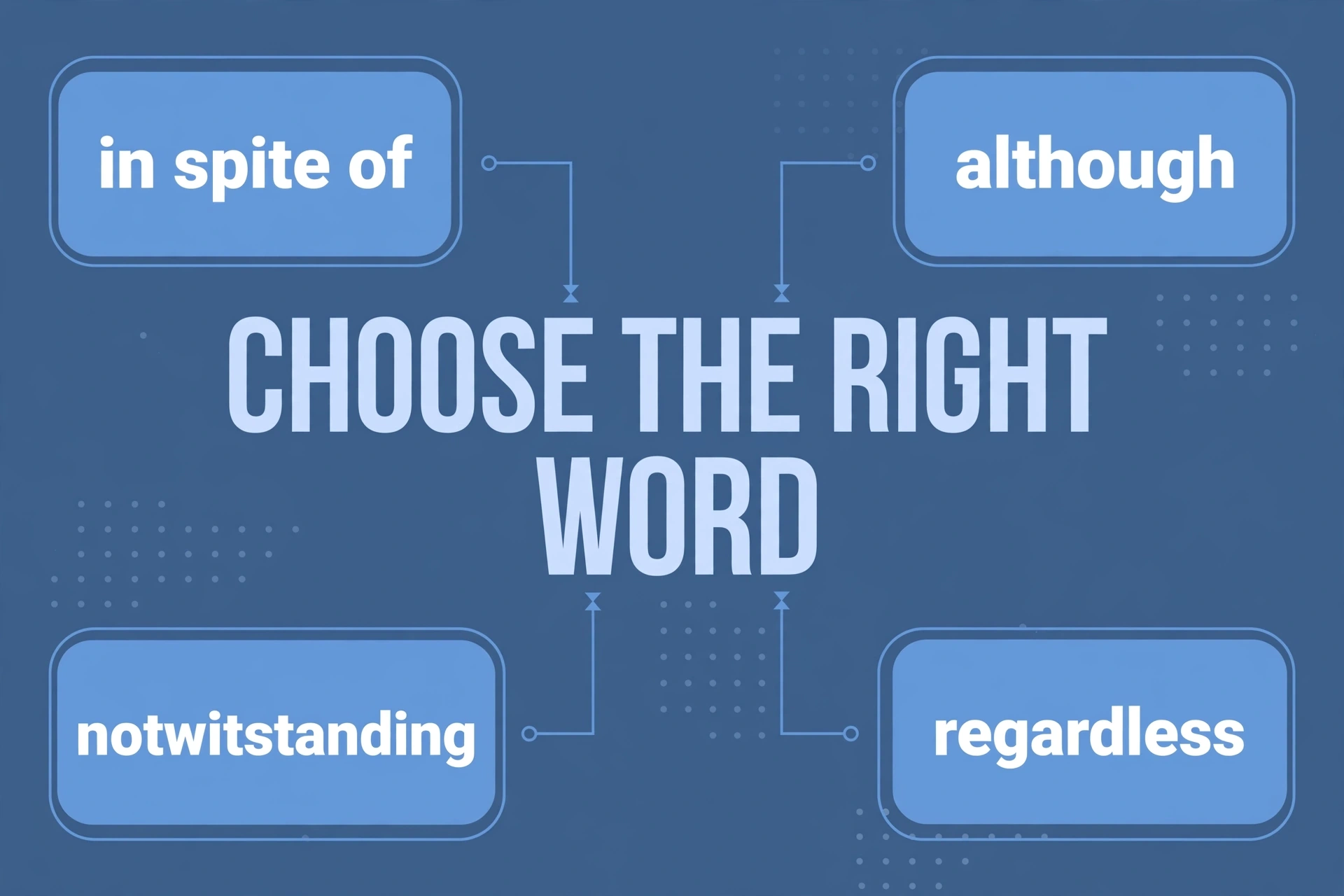
- Check what follows: noun phrase → preposition (in spite of, regardless of); full clause → conjunction (although, even though).
- Match the register: contracts and essays want “notwithstanding” or “irrespective of”; conversation wants “even with” or “although.”
- Set the emotional temperature: “in the face of” sounds brave, “in defiance of” sounds rebellious, “regardless of” sounds neutral.
- Flag surprise: when the outcome is unexpected, “even though” beats “although.”
- Keep “albeit” short: it shines before an adjective or brief phrase — never before a full clause.
Frequently Asked Questions
What is a synonym for despite?
“In spite of” is the nearest synonym and swaps in almost anywhere. “Notwithstanding” is the formal equivalent Merriam-Webster lists first.
Can I use “despite” and “in spite of” interchangeably?
Almost always, yes — they mean the same thing. “In spite of” is a touch more emphatic and conversational, while “despite” is slightly more compact and formal.
Is it “despite of” or “despite”?
Always “despite” alone before a noun (“despite the rain”). “Of” belongs only to the phrase “in spite of.”
What is the difference between “although” and “despite”?
They express the same contrast, but grammar differs: “although” is a conjunction that takes a full clause (“although it rained”), while “despite” is a preposition that takes a noun phrase (“despite the rain”).
When should I use “notwithstanding”?
In formal, legal, or academic writing where a weighty tone is wanted. In everyday writing it can sound stiff, so prefer “despite” or “in spite of.”
Conclusion
“Despite” is small but mighty, and its alternatives let you tune every sentence for grammar, tone, and emphasis. Keep the noun-or-clause rule in mind, and you will never misuse one again. For the full entry, see the Merriam-Webster thesaurus page for “despite”.