Synonyms for Yes: 22+ Ways to Say Yes
Most of us say yes dozens of times a day, and that one little word starts to sound thin — in emails, in dialogue, in everyday conversation. This guide collects 23 stronger synonyms for yes, grouped by tone and forcefulness, each with a clear meaning, a natural example sentence, and a tone note so you always pick the right level of formality. From boardroom certainly to texting yep, you will find a version of yes for every situation.

Table of Contents
Quick Answer: 12 Synonyms for Yes
| Word | Nuance / When to use it |
|---|---|
| affirmative | Formal and official; military, voting, announcements |
| certainly | Polite, confident agreement; works everywhere |
| indeed | Formal confirmation, adds quiet emphasis |
| absolutely | Strong, enthusiastic agreement; slightly formal |
| yeah | The standard casual yes; conversations, texts |
| yep | Cheerful, brisk casual agreement |
| sure | Easygoing agreement, often grants a request |
| definitely | Emphatic and certain; stresses conviction |
| exactly | Agrees that the other person is precisely right |
| agreed | Signals a decision or shared position |
| gladly | Warm, willing agreement; hospitable tone |
| of course | Confident, gracious; implies the answer was obvious |
Simple rule: use a formal synonym (certainly, affirmative, indeed) when the setting has stakes or hierarchy, and a casual one (yeah, yep, sure) when you are among equals; reach for an emphatic one (absolutely, definitely) only when you want your agreement to carry real weight. You can compare even more options on Merriam-Webster’s thesaurus page for “yes” to fine-tune your choice.
Formal Agreement
Meetings, interviews, customer service, and official documents call for polished agreement. These six sound professional and leave no doubt about your answer. Tone: formal.
-
affirmative — A formal, official “yes,” common in military, aviation, and voting contexts. Tone: formal, institutional. Example: The committee voted affirmative on the proposal after two hours of debate.
-
certainly — Polite, confident agreement that works in almost any professional setting. Tone: formal to neutral. Example: “Certainly,” she said, “I can have the report on your desk by noon.”
-
indeed — A measured confirmation that adds quiet emphasis, often in response to a statement. Tone: formal, composed. Example: “You finished the analysis early?” “I did indeed.”
-
absolutely — Strong, full agreement with enthusiasm; slightly more forceful than “certainly.” Tone: formal-leaning, emphatic. Example: “Will you be joining the panel?” “Absolutely — I would not miss it.”
-
of course — Gracious agreement that suggests the answer was never in doubt. Tone: formal-polite, warm. Example: “May I have a copy?” “Of course — I will email it right away.”
-
very well — A classic, slightly old-fashioned formal assent, often from a position of authority. Tone: formal, traditional. Example: “Very well,” the judge said, “the motion is granted.”

Everyday Casual
Texts, chats, friends, and casual office talk need relaxed agreement. These six keep things friendly without sounding stiff. Tone: casual.
-
yeah — The standard casual “yes” in spoken and written English. Tone: casual, neutral. Example: “Are you coming to dinner?” “Yeah, I will be there at seven.”
-
yep — A brisk, cheerful version of “yeah”; quick and upbeat. Tone: casual, upbeat. Example: “Did the package arrive?” “Yep, it is sitting on my desk.”
-
sure — Easygoing agreement, often used when granting a request or favor. Tone: casual, agreeable. Example: “Can you cover my shift on Friday?” “Sure, no problem.”
-
you bet — Friendly, confident agreement with an American flavor. Tone: casual, warm. Example: “Thanks for the ride!” “You bet — anytime.”
-
uh-huh — Spoken-only affirmation; works in conversation but never in writing. Tone: casual, spoken. Example: “So the meeting moved to three?” “Uh-huh, that is right.”
-
okay — Agreement mixed with acceptance; slightly cooler than “sure.” Tone: casual, neutral. Example: “We leave at six, okay?” “Okay, see you then.”
Emphatic
Some moments need more than a nod — you want your yes to land with conviction. These six remove every trace of doubt. Tone: emphatic, from neutral to formal.
-
definitely — Firm, certain agreement that stresses conviction. Tone: neutral to emphatic. Example: “Should we hire her?” “Definitely — she was the strongest candidate by far.”
-
exactly — Agrees that the other person’s point was precisely right. Tone: emphatic, conversational. Example: “So it is really about trust, not money.” “Exactly.”
-
precisely — A more formal version of “exactly,” with the same meaning. Tone: formal, emphatic. Example: “The issue is timing, not talent.” “Precisely.”
-
agreed — Signals a shared decision or settled position; common in negotiations. Tone: formal-neutral, decisive. Example: After an hour of discussion, both sides nodded: agreed.
-
undoubtedly — Agreement framed as beyond question; strong and formal. Tone: formal, emphatic. Example: “Is she the right person to lead?” “Undoubtedly.”
-
without a doubt — An emphatic phrase that removes all hesitation. Tone: emphatic, neutral. Example: “Will you recommend the book?” “Without a doubt — it changed how I think.”
Warm & Friendly
Invitations, hospitality, and good news deserve a yes with a smile. These five sound generous and glad-hearted. Tone: warm, friendly.
-
gladly — Willing, happy agreement; suggests genuine pleasure. Tone: warm, gracious. Example: “Could you show us around town?” “Gladly — I love visitors.”
-
with pleasure — A gracious, slightly formal acceptance of a request. Tone: warm-formal. Example: “Would you join us for dinner?” “With pleasure.”
-
happily — Cheerful agreement that signals enthusiasm. Tone: warm, casual. Example: “Can you help me move on Saturday?” “Happily — just tell me when.”
-
sounds good — Friendly acceptance of a plan or suggestion. Tone: casual, warm. Example: “How about lunch at noon?” “Sounds good — see you there.”
-
count me in — Enthusiastic agreement to join an activity or plan. Tone: casual, eager. Example: “We are hiking the ridge trail Sunday.” “Count me in!”
Common Mistakes With Yes Synonyms
A yes in the wrong register can confuse or even offend — much like the vote-counting tangle behind yea vs nay or the mix-up explained in yay or nay. Watch for these four traps:
Mistake 1: Saying “yea” when you mean “yeah”
❌ Texting a friend: “Yea, I can come.”
✅ “Yeah, I can come.”
Why: “Yea” is a formal voting word (pronounced “yay”), not the casual “yeah.” Using it in texts marks you as someone who mixed up the two — stick to “yeah” or “yes” in casual writing.
Mistake 2: Sounding stiff with “yes” in casual chats
❌ Friend: “Wanna grab coffee?” You: “Yes.”
✅ “Yeah, sounds great!”
Why: A bare “yes” in casual conversation can read as cold or curt. “Yeah,” “sure,” or “sounds good” carry the same meaning with a friendlier tone.
Mistake 3: Answering “no problem” as a plain yes
❌ “Can you send me the file?” “No problem.”
✅ “Sure — sending it now.”
Why: “No problem” technically accepts, but it frames your help as a potential burden. “Sure,” “gladly,” or “of course” agree without the awkward implication.
Mistake 4: Using “okay” when full agreement is needed
❌ “Do you fully support this decision?” “Okay.”
✅ “Do you fully support this decision?” “Absolutely.”
Why: “Okay” signals acknowledgment more than commitment. When someone needs a real yes — a promise, a vote, an approval — give them “absolutely,” “agreed,” or “definitely.”
How to Choose the Right Synonym
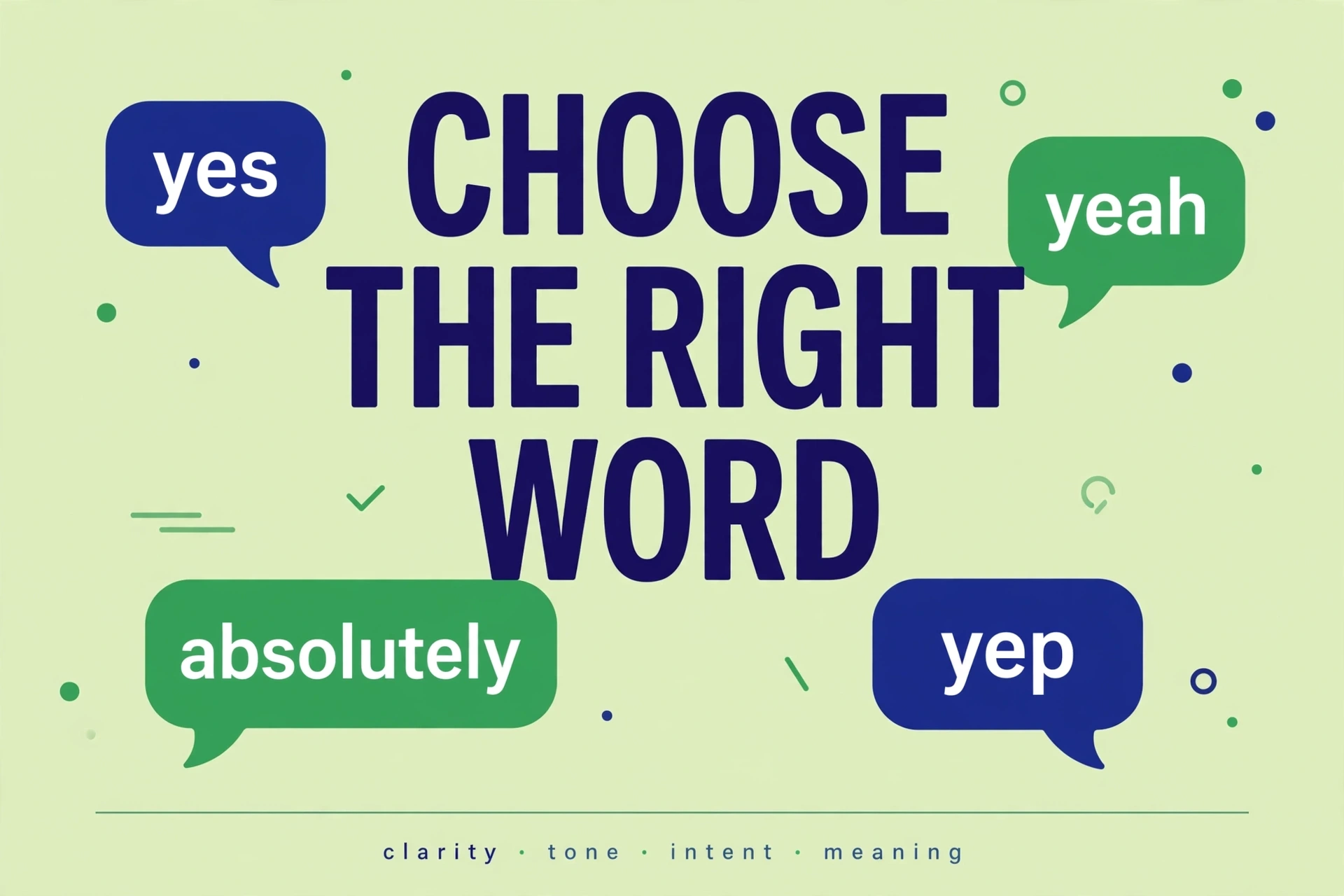
- Read the room’s formality first. A job interview wants “certainly” or “absolutely”; a group chat wants “yeah” or “yep.” Matching the setting’s register is the single biggest factor.
- Decide how much force you need. Mild interest takes “sure” or “sounds good”; real conviction takes “definitely” or “undoubtedly.” Overshooting on small matters sounds theatrical.
- Keep spoken-only words spoken. “Uh-huh” and “mm-hm” work fine face-to-face but look sloppy in writing. In text, use “yeah,” “yep,” or “yes.”
- Distinguish agreeing from merely acknowledging. “Okay” and “got it” confirm you heard; “agreed” and “absolutely” confirm you support. Pick the one that matches your actual position.
- Watch the warmth level. Invitations and favors deserve warm answers — “gladly,” “with pleasure,” “count me in.” A flat “yes” to a heartfelt invitation can sting.
- Consider the culture. “You bet” and “yep” feel natural in American English; “indeed” and “very well” read more British-formal. None are wrong, but the flavor shows.
Frequently Asked Questions
What is a synonym for yes?
The most common synonyms for “yes” are yeah, yep, sure, certainly, and absolutely. For formal settings, use “certainly” or “affirmative”; for casual ones, “yeah” or “yep” feel natural.
What is a formal synonym for yes?
“Affirmative,” “certainly,” “indeed,” and “of course” all work in formal writing and speech. “Affirmative” is the most official — it is the standard in military and voting contexts.
What is a casual synonym for yes?
“Yeah,” “yep,” “sure,” and “you bet” are the everyday options. They suit texts, social media, and friendly conversation without sounding stiff.
Is “yea” a synonym for yes?
Yes, but a special one: “yea” means yes in formal voting and parliamentary contexts, and it is pronounced “yay.” Do not use it as the casual “yeah” in texts or speech — they are different words.
What is the strongest way to say yes?
“Absolutely,” “definitely,” and “undoubtedly” sit at the top of the intensity scale. “Without a doubt” is the strongest phrase form. Reserve these for moments when your full conviction matters.
What is a polite way to say yes to a request?
“Gladly,” “with pleasure,” “of course,” and “happily” all agree warmly. “Of course” works almost everywhere; “with pleasure” adds a touch of gracious formality.
Conclusion
“Yes” gets the job done, but the right synonym does it better — certainly in the boardroom, yep in the group chat, gladly when a friend asks a favor. Match the word to the tone and the stakes, and your agreement will always land exactly as you mean it.