Yea or Nay: Meaning, Difference, and Examples
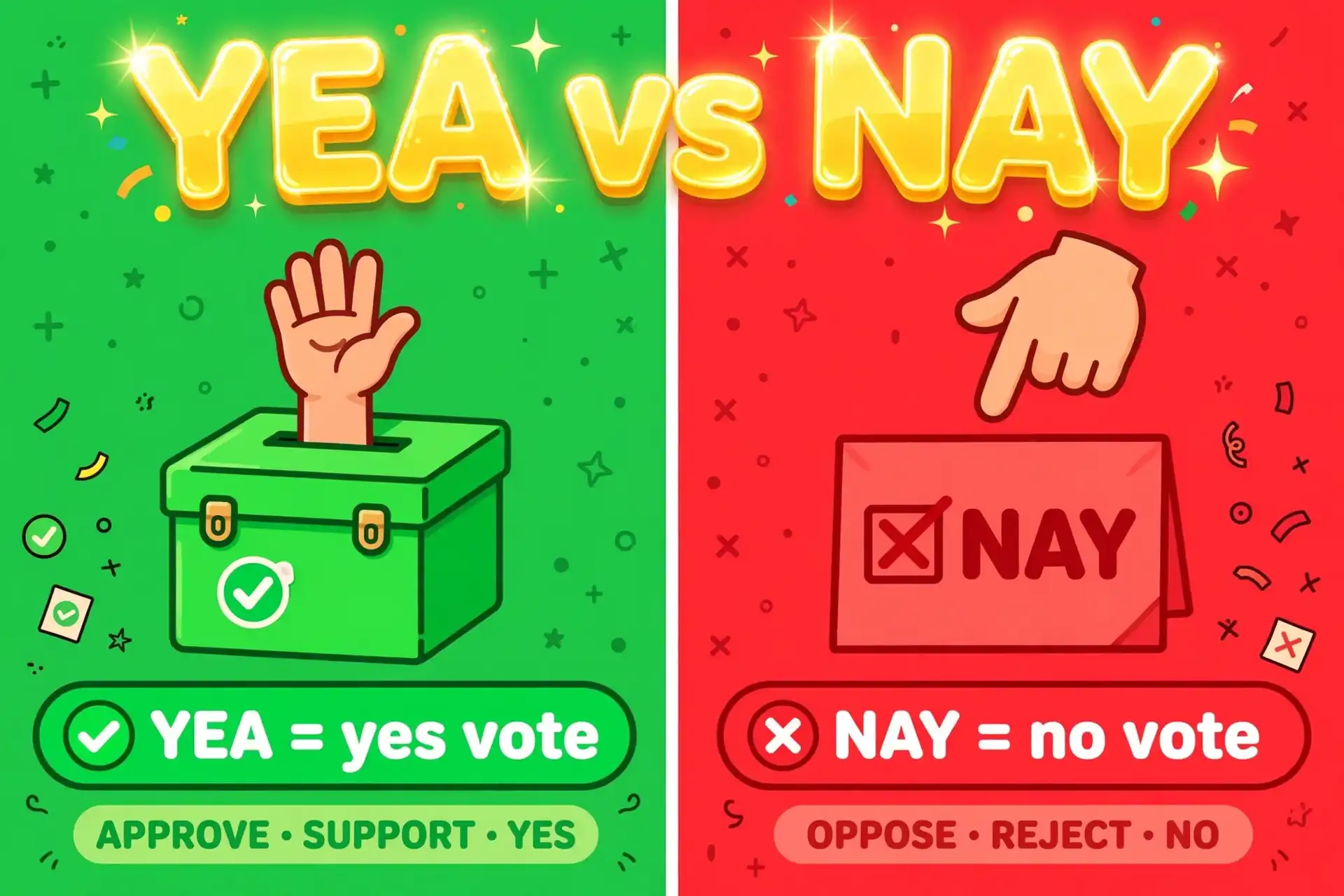
Yea and nay are the formal words for “yes” and “no” when a group takes a vote. Yea (pronounced “yay”) is an affirmative vote, and nay (pronounced to rhyme with “say”) is a negative vote. You will hear them in parliaments, boardrooms, and anywhere votes are counted: “All in favor, say yea.”
For example, “The motion passed with 40 yeas and 12 nays” means 40 people voted yes and 12 voted no. Outside of voting, nay is sometimes used as a playful, old-fashioned way to say no.
Quick Answer
| Word | Part of Speech | Main Meaning | Example |
|---|---|---|---|
| Yea | Noun / adverb | An affirmative vote; yes | She voted yea on the new policy. |
| Nay | Noun / adverb | A negative vote; no | He voted nay on the proposal. |
Simple rule: Voting yes? Say yea (pronounced “yay”). Voting no? Say nay.
What Does Yea Mean?
Yea means yes in a formal vote. It is pronounced “yay” (/jeɪ/), exactly like the cheer people shout when they win. As a noun, it names the vote itself: “a yea.” As an adverb, it means “indeed” or “truly” in older writing, as in “yea, though I walk through the valley.”
Examples:
- The committee recorded 15 yeas and 3 nays.
- “All those in favor, say yea.”
- The chair announced, “The yeas have it.”
- He cast his yea without hesitation.
- Each yea was counted by the clerk.
Do not confuse yea with yeah. Yeah is the casual, everyday “yes” you use in texts and conversation. Yea belongs to votes and formal decisions.
See yea on Merriam-Webster for the full dictionary entry.
What Does Nay Mean?
Nay means no in a formal vote. It is pronounced to rhyme with “say” and “day” (/neɪ/). Like yea, it works as both a noun (“a nay”) and an adverb (“vote nay”).
Examples:
- She voted nay on the budget increase.
- The nays outnumbered the yeas, so the motion failed.
- “Is there a second?” “Nay, let it die.”
- He answered with a firm nay.
- The clerk called for the nays after the yeas.
In casual speech, nay shows up as a humorous, mock-formal “no”: “Will you do the dishes?” “Nay, I shall not.” It is never the normal word for “no” in everyday conversation.

Yea vs. Nay: Key Differences
| Feature | Yea | Nay |
|---|---|---|
| Meaning | Yes (in a vote) | No (in a vote) |
| Pronunciation | “Yay” (/jeɪ/) | Rhymes with “say” (/neɪ/) |
| Plural | Yeas | Nays |
| Common setting | Parliaments, boards, clubs | Parliaments, boards, clubs |
| Casual twin | Yeah | No / nah |
| Example | The yeas have it. | The nays have it. |
The two words are a matched pair: every formal vote has its yeas and its nays, just as every question in these commonly confused word pairs has two sides worth telling apart.
Examples of Yea and Nay in Real Sentences
At a Meeting
Yea: “The board voted yea on the merger.”
Nay: “Two members voted nay, but the motion still passed.”
The first sentence records yes votes; the second records the no votes in the same meeting.
In Parliament
Yea: “The speaker called for the yeas first.”
Nay: “Then the clerk recorded the nays.”
Formal votes are taken in this order: yeas first, then nays.
In Everyday Jokes
Yea: “Yea! We won the match!” (cheer, pronounced “yay”)
Nay: “Nay, I refuse to watch another sequel.” (playful formal no)
Outside voting, yea survives mainly as the cheer “yay,” while nay survives as a joke-formal “no.”
Common Mistakes With Yea and Nay
Like other words that sound alike but work differently, these two trip people up in spelling and pronunciation.
Mistake 1: Writing “Yeah” for a Vote
❌ The yeahs have it.
✅ The yeas have it.
Why: In a vote, the word is yea (plural yeas). Yeah is the informal “yes” for casual conversation.
Mistake 2: Pronouncing “Yea” as “Yee”
❌ “All in favor, say yee.”
✅ “All in favor, say yay.”
Why: Yea is always pronounced “yay” (/jeɪ/), rhyming with “day.”
Mistake 3: Writing “Yea” in a Text Message
❌ Yea, I’ll be there at six.
✅ Yeah, I’ll be there at six.
Why: In casual writing, the informal yes is spelled yeah. Save yea for votes and formal settings.
Pronunciation: Yea vs. Nay
Yea is pronounced “yay” (/jeɪ/), rhyming with day, say, and play. Nay is pronounced /neɪ/, rhyming with say, day, and way.
Fun fact: the two words rhyme with each other. The difference is entirely in the first letter — and in the vote it records.
How to Remember the Difference
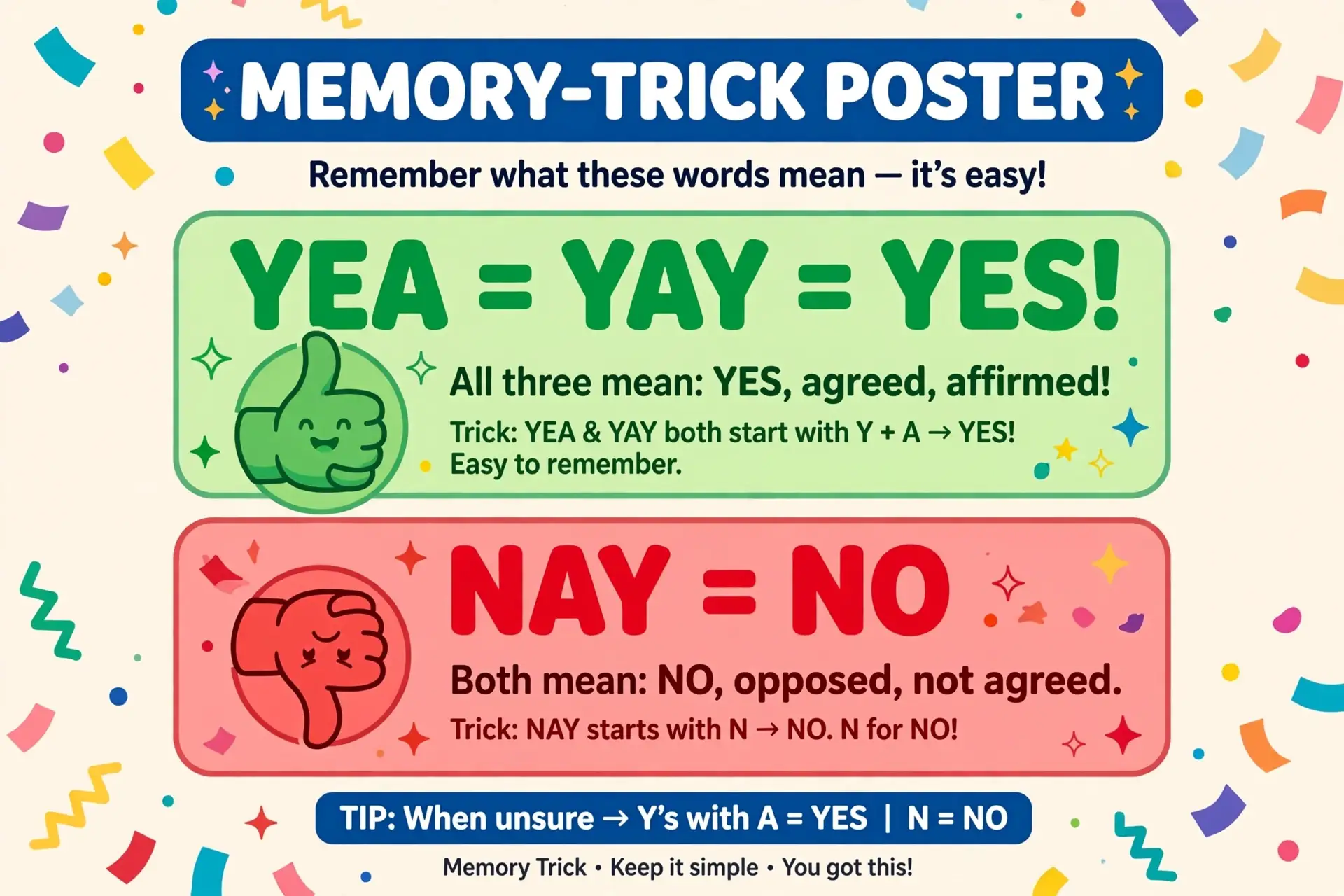
Memory trick: Yea sounds like YAY — the cheer people shout when their side wins a vote. Nay starts with N, like No.
- Yea = Yay = YES vote.
- Nay = No = NO vote.
- Plurals just add s: yeas, nays.
If you can shout it at a celebration, it is yea. If it starts with N, it is the no vote.
Frequently Asked Questions
Is it yea or nay for yes?
Yea means yes in a vote. Nay means no. “The yeas have it” means the yes votes won.
How do you pronounce yea?
Yea is pronounced “yay” (/jeɪ/), rhyming with “day.” It is never pronounced “yee.”
What does “the yeas and nays” mean?
It means a recorded vote where each person’s yes (yea) or no (nay) is counted by name, common in legislatures.
Is yea the same as yeah?
No. Yea is the formal voting word (pronounced “yay”). Yeah is the casual, everyday “yes.”
Can I use nay in everyday conversation?
You can, but it sounds deliberately old-fashioned or joking. In normal speech, just say “no.”
Conclusion
Yea (pronounced “yay”) is the formal yes vote; nay is the formal no vote. Remember “yea = yay” and “nay = N for no,” and use yeah instead when you are just texting a friend.