Synonyms for Chaos: Words With Examples
Chaos gets blamed for everything from messy desks to collapsing schedules, but not every mess is the same kind of mess. This guide gives you 20 precise synonyms for chaos — from disorder and clutter to mayhem and bedlam — each with a clear meaning and a natural example sentence. Learn the difference between a jumble and a pandemonium, and your writing gets instantly sharper.
Table of Contents
Quick Answer: 12 Synonyms for Chaos
| Word | Nuance / When to use it |
|---|---|
| disorder | Lack of order; the most neutral synonym |
| disarray | Things out of place; plans or rooms in disarray |
| mess | Informal; an untidy or bungled situation |
| jumble | Things mixed together with no order |
| shambles | Total mess; often of events or places (chiefly British) |
| confusion | Mental chaos; nobody knows what is happening |
| uproar | Loud public chaos, often with protest |
| turmoil | Deep, churning disorder, often emotional or political |
| pandemonium | Wild, noisy, uncontrollable uproar |
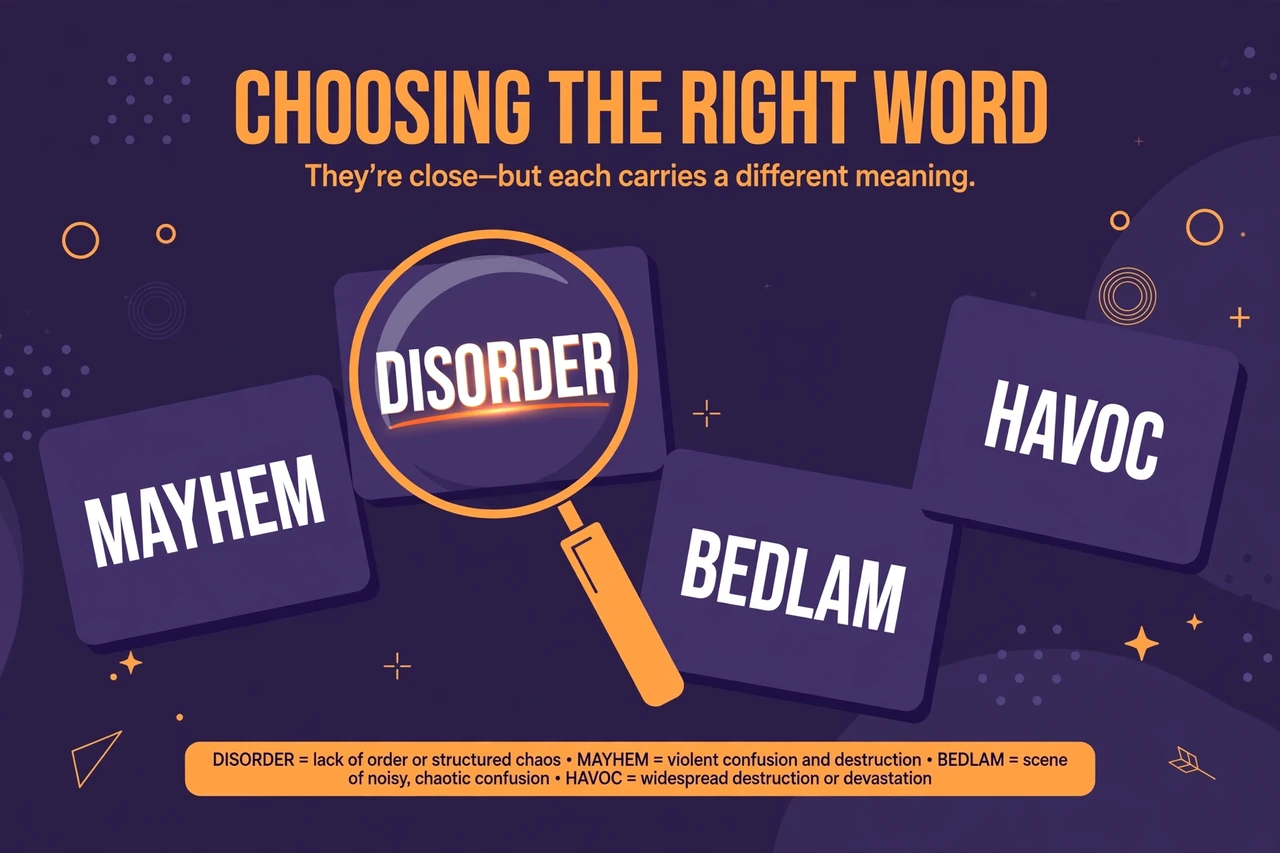
| bedlam | Scene of noisy, chaotic confusion |
| mayhem | Violent, destructive disorder |
| havoc | Widespread damage or disruption |
Simple rule: ask what kind of chaos it is — a mess (things out of place), an uproar (noise and confusion), or mayhem (violence and damage) — and the right synonym follows. You can compare more shades on Merriam-Webster’s thesaurus page for “chaos”.
Disorder: Chaos as a Messy State
This is the quiet, physical kind of chaos — drawers, desks, schedules, and plans that have lost their order. No noise required.
-
disorder — A lack of order or regular arrangement; the broadest synonym. Example: After the move, the whole apartment was in disorder.
-
disarray — A state of confusion with things scattered out of place. Example: The sudden resignation threw the department into disarray.
-
mess — An untidy, bungled, or embarrassing situation; informal and versatile. Example: The merger turned into a complete mess.
-
jumble — A confused mixture of things with no order. Example: The drawer was a jumble of old chargers and loose keys.
-
clutter — A crowded mess of unnecessary things. Example: She cleared years of clutter from the garage in one weekend.
-
shambles — A scene of total disorder; chiefly British in flavor. Example: The kitchen was a shambles after the dinner party.
-
muddle — A confused, tangled state of things. Example: The files were in such a muddle that nobody could find the contract.
-
disorganization — The condition of being badly planned or arranged. Example: The disorganization of the event left hundreds of guests waiting outside.

Confusion and Uproar: Chaos You Can Hear
When chaos has a soundtrack — shouting crowds, ringing phones, conflicting orders — these words capture the noise and bewilderment.
-
confusion — A state where nobody understands what is happening. Example: The last-minute gate change caused confusion among passengers.
-
uproar — A loud, public outburst of noise or protest. Example: The referee’s decision sparked an uproar in the stadium.
-
turmoil — Deep, churning disorder, often emotional, political, or organizational. Example: The company went through months of turmoil after the scandal.
-
pandemonium — Wild, noisy, uncontrollable chaos; the loudest word on this list. Example: Pandemonium broke out when the concert tickets went on sale.
-
bedlam — A scene of noisy, confused chaos. Example: The airport was bedlam during the holiday rush.
-
commotion — A noisy disturbance that draws attention. Example: A commotion in the hallway interrupted the exam.
-
tumult — A loud, confused noise, especially from a crowd; slightly literary. Example: The tumult of the protest could be heard three blocks away.
Mayhem: Chaos That Turns Violent
Reserve these five for the extreme end — chaos with damage, danger, or a breakdown of authority itself.
-
mayhem — Violent, destructive disorder; chaos with injuries or damage. Example: The riot left a trail of mayhem through the downtown shops.
-
havoc — Widespread destruction or great confusion. Example: The storm wreaked havoc on the coastal towns.
-
anarchy — A state with no governing authority or order. Example: After the blackout, some neighborhoods slipped toward anarchy.
-
lawlessness — Disregard for law and order. Example: The lawlessness of the frontier town shocked the new sheriff.
-
maelstrom — A powerful, violent whirlpool; figuratively, a scene of turmoil. Example: She was pulled into the maelstrom of the custody battle.
Common Mistakes With Chaos Synonyms
Chaos words get mixed up constantly — the same kind of small-word confusion that trips people up with the unfazed spelling trap or lose vs loose. Watch for these four traps:
Mistake 1: Calling a messy desk “mayhem”
❌ “My desk is absolute mayhem right now.”
✅ “My desk is a complete mess right now.”
Why: “Mayhem” implies violence and destruction. For an untidy desk, “mess,” “clutter,” or “shambles” are accurate — “mayhem” is comic overkill.
Mistake 2: Using “anarchy” for ordinary disorder
❌ “The birthday party descended into anarchy.”
✅ “The birthday party descended into bedlam.”
Why: “Anarchy” means the absence of governing authority — a political condition, not a loud party. “Bedlam” or “pandemonium” capture noisy chaos without the politics.
Mistake 3: “Bedlam” without the noise
❌ “The spreadsheet was pure bedlam.”
✅ “The spreadsheet was a total jumble.”
Why: “Bedlam” is a scene of noisy, chaotic confusion — it needs people and uproar. A confusing document is a “jumble,” a “muddle,” or a “mess.”
Mistake 4: “A disorder” instead of “disorder”
❌ “The playroom was a disorder.”
✅ “The playroom was in disorder.”
Why: As a countable noun, “a disorder” usually means a medical condition. For chaotic states, use “in disorder,” “in disarray,” or simply “a shambles.”
How to Choose the Right Synonym
- Listen first. If the chaos is loud — shouting, alarms, crowds — reach for “uproar,” “pandemonium,” or “bedlam.” If it’s silent — a messy room, a tangled plan — “disarray,” “jumble,” or “clutter” fit better.
- Check for damage. “Havoc” and “mayhem” require destruction or violence. If nothing is broken or hurt, stay in the disorder or confusion groups.
- Don’t spend the heavy words early. Calling a slow checkout line “pandemonium” leaves you nothing for a real emergency. Save the extremes for extremes.
- Mind the politics. “Anarchy” and “lawlessness” describe the collapse of authority. Using them for a noisy meeting or a messy garage sounds unserious — and sometimes offensive.
- Pair the word with its subject. Rooms are “in disarray”; crowds create “commotion”; storms “wreak havoc.” The natural pairing is what makes a synonym sound native instead of forced.
Frequently Asked Questions
What is a synonym for chaos?
The most common synonyms for “chaos” are disorder, mayhem, havoc, confusion, pandemonium, and bedlam. Each shades a different kind of disorder, from quiet messes to violent uproar.
What is a formal synonym for chaos?
“Disorder,” “disarray,” and “turmoil” are the most formal options. “Turmoil” works especially well for organizational or political chaos in serious writing.
What is the difference between “chaos” and “mayhem”?
“Chaos” is the general word for total disorder. “Mayhem” is narrower and darker — it implies violence, damage, or injury. A messy garage is chaos, not mayhem.
What is a funny synonym for chaos?
“Shambles,” “bedlam,” and “a hot mess” all bring humor to disorder. “The whole trip was a shambles” sounds self-deprecating rather than dire.
Is “pandemonium” stronger than “chaos”?
In a way, yes — “pandemonium” specifically means wild, noisy, uncontrollable uproar, while “chaos” can be quiet. A library can be in chaos; it takes a crowd to make pandemonium.
What is a synonym for chaos at work?
“Disarray,” “turmoil,” and “disorganization” fit professional settings. “The project is in disarray” sounds honest without the drama of “mayhem” or “pandemonium.”
Conclusion
Chaos is never just chaos — it is a jumble of papers, a pandemonium of crowds, or havoc after the storm. Match the word to the kind of disorder you actually mean, and your writing will describe the mess instead of just pointing at it.