Synonyms for Foster: Encourage, Advance, and Care Uses
Foster is a generous verb: it means to help something grow, whether a talent, a friendship, or a bold idea. It also names a specific kind of care — foster parents look after children temporarily, which is not the same as adopting them. This guide gathers the best synonyms for foster by sense, each with a clear meaning and a real example sentence.
Table of Contents
Quick Answer
| Word | Nuance / When to use it |
|---|---|
| encourage | give support or confidence to keep going |
| nurture | care for and help develop over time |
| cultivate | develop deliberately through steady effort |
| promote | push something forward into wider use |
| stimulate | spark activity or growth, often quickly |
| cherish | hold dear and protect with affection |
| advance | move something forward toward a goal |
| further | verb: help a cause or project progress |
| develop | grow something gradually into fuller form |
| support | back with help, money, or resources |
| boost | lift quickly: morale, sales, energy |
| guardian | the care sense: one with legal responsibility |
Simple rule: pick the sense first — growing something with care, pushing something forward, or temporary care of a child — then choose the word built for that job.
To Encourage Growth (Verb)
Encourage — to give support, confidence, or hope so someone continues or tries harder. Example: Good teachers encourage curiosity in every student.
Nurture — to care for and help develop over time, like a gardener with seedlings. Example: She nurtured the young writer’s talent for years before it found an audience.
Cultivate — to develop something deliberately through steady effort, used for skills, relationships, and habits. Example: He cultivated a network of mentors across the industry.
Promote — to actively push something forward into wider use, success, or public awareness. Example: The campaign promotes healthy eating in schools nationwide.
Stimulate — to spark activity or growth, often quickly and from the outside. Example: The tax cuts were meant to stimulate the local economy.
Cherish — to hold something dear and protect it with affection. Example: They cherished their friendship through decades spent on different continents.

To Advance (Verb)
Advance — to move something forward toward a goal or a more developed stage. Example: The discovery advanced cancer research by several years.
Further — as a verb, to help a cause, project, or interest progress (“further the cause”). Example: Volunteers furthered the charity’s mission across the region.
Develop — to grow or expand something gradually into a fuller, more complete form. Example: The startup developed its rough prototype into a finished product.
Support — to back something with help, money, or resources so it can continue and grow. Example: The grant supports young scientists doing field research.
Boost — to lift something up quickly — morale, sales, energy, confidence. It is punchy and businesslike. Example: The surprise win boosted the team’s confidence before the final.
Foster Care (Noun and Adjective Sense)
As a noun and adjective, foster describes a specific care arrangement: a foster parent looks after a foster child temporarily, usually while the child’s long-term situation is decided.
Adoptive — describes a parent or family after a legal adoption. This is the critical contrast: adoption is permanent legal parenthood, while fostering is temporary care. The two are not interchangeable. Example: After two years as his foster parents, they became his adoptive parents.
Guardian — a person with legal responsibility for a child, which may or may not involve daily care. Example: The court appointed her aunt as her legal guardian.
Caretaker — a general word for someone who looks after a person, place, or thing. Example: The caretaker checked on the children every evening.
Common Mistakes
Plenty of word pairs cause the same kind of slip — see principal vs principle and purposely vs purposefully for two classics — and foster has traps of its own:
Mistake 1: Confusing “foster” with “adopt”
❌ The agency helped them adopt a foster child into their permanent home.
✅ The agency placed a foster child in their home while the case was decided.
Why: foster means temporary care; adopt means permanent legal parenthood. A child can move from foster care to adoption, but the words describe different stages — never swap them.
Mistake 2: Using “nurture” where “promote” belongs
❌ The manager nurtured the product launch across three markets.
✅ The manager promoted the product launch across three markets.
Why: nurture is about care — people, talent, relationships. Promote is about advancement — products, causes, campaigns. Each has its own flavor; keep them on their own turf.
Mistake 3: Mixing up “further” the verb and “further” the adjective
❌ We must further information before the deadline.
✅ We must advance the project before the deadline.
Why: the verb “further” means to help something progress (“further the cause”). As an adjective it means “additional” (“further details”). The verb takes a cause or project as its object — never “information.”
Mistake 4: Using “cherish” in institutional contexts
❌ The corporation cherishes innovation across all departments.
✅ The corporation fosters innovation across all departments.
Why: cherish means to hold dear with personal affection — a feeling, not a policy. Organizations foster; people cherish. Keep the emotion with the humans.
How to Choose the Right Synonym
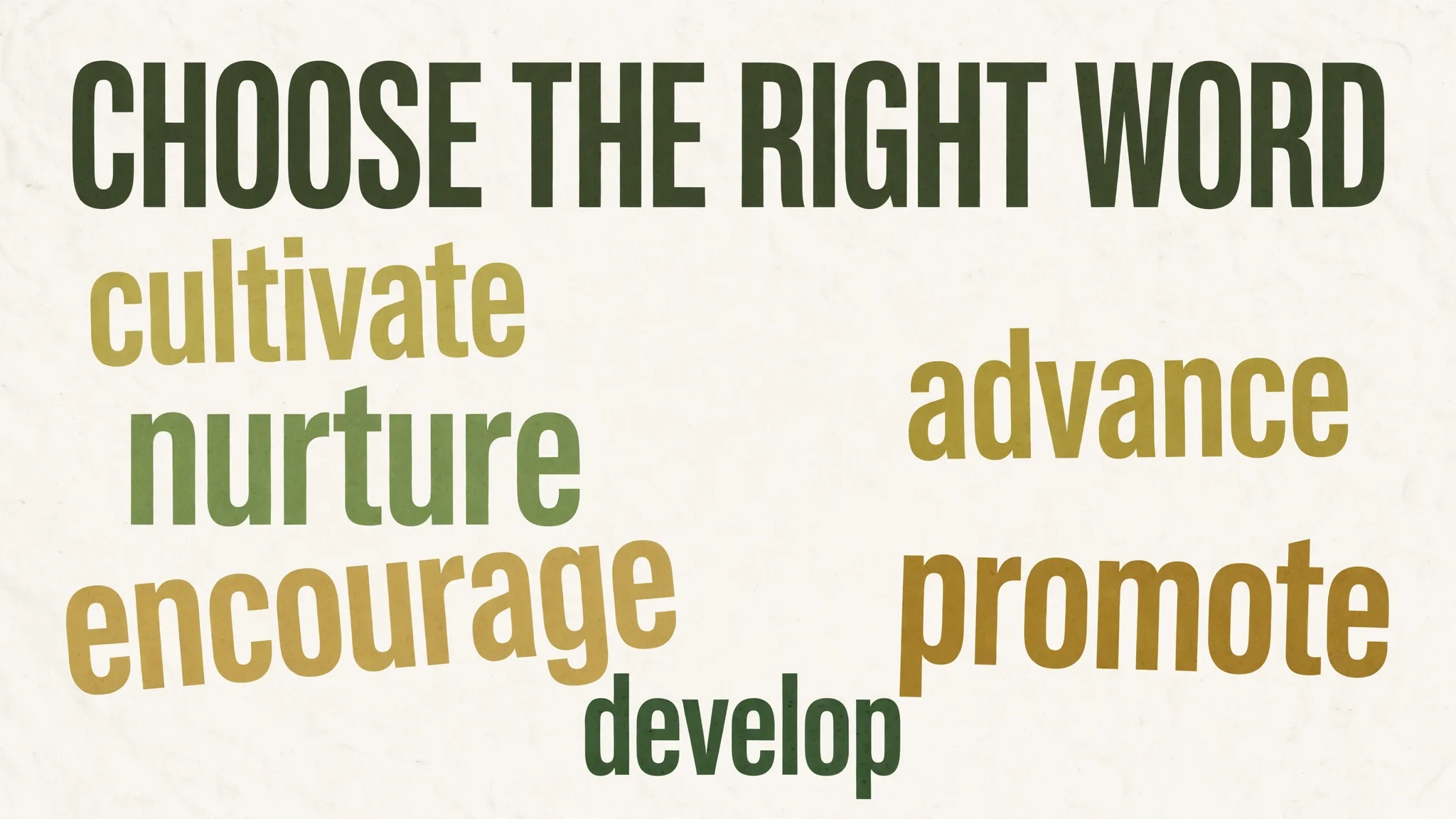
- Name the sense first. Growing something with care (nurture, cultivate), pushing something forward (advance, boost), or temporary care of a child (foster parent) — three jobs, three word families.
- Nurture is care; promote is advancement. You nurture talent and relationships; you promote products and causes. Crossing them sounds off to every native ear.
- Mind the register. Cultivate and foster suit formal and academic writing; boost and support suit business and everyday prose; cherish suits personal, emotional contexts.
- Foster is temporary; adoptive is permanent. In the care sense this distinction is legal, not stylistic. Getting it wrong misstates the facts.
- Use “further” the verb only for progress. “Further the cause,” “further negotiations” — never “further information” when you mean the verb.
- Test the swap. Put the synonym into your sentence: if a company suddenly sounds like it is hugging its products, you grabbed “cherish” instead of “foster.”
Frequently Asked Questions
What is a synonym for foster?
For encouraging growth: encourage, nurture, cultivate. For advancing something: advance, develop, boost. For the care sense, the related terms are foster parent, guardian, and — with a different meaning — adoptive.
What is the difference between foster and adopt?
Foster means temporary care — a foster parent looks after a child while a long-term plan is decided. Adopt means permanent legal parenthood. A child can move from foster care into adoption, but the words are never interchangeable.
Is “foster” only about children?
No. The verb applies far beyond childcare: you can foster talent, friendships, ideas, innovation, or debate. Only the noun and adjective forms refer to the care arrangement.
What is the difference between “nurture” and “promote”?
Nurture is about care — tending something patiently so it grows. Promote is about advancement — pushing something outward into wider use or success. Different flavors, different turf.
Can a company “foster” something?
Yes, and it is one of the verb’s most natural uses: “foster innovation,” “foster teamwork,” “foster a culture of safety.” It means the organization creates conditions for growth.
What does “further” mean as a verb?
It means to help something progress — “further the cause,” “further negotiations.” It is distinct from the adjective “further,” which means “additional,” as in “further details.”
Conclusion
Foster rewards precision: nurture the talent, advance the cause, and never confuse temporary care with adoption. Choose the sense first and the right word follows naturally. For more senses and related words, see the full entry in the Merriam-Webster thesaurus.