Synonyms for Normal: 18+ Words With Examples
Normal is one of the most overworked words in English — it describes weather, health, behavior, sizes, and situations, often several times in a single paragraph. This guide gives you 18 precise alternatives for normal, grouped by nuance, each with a one-line meaning and a natural example sentence. They cover the same range of meanings that Merriam-Webster’s thesaurus entry for “normal” lists, from the everyday to the formal.
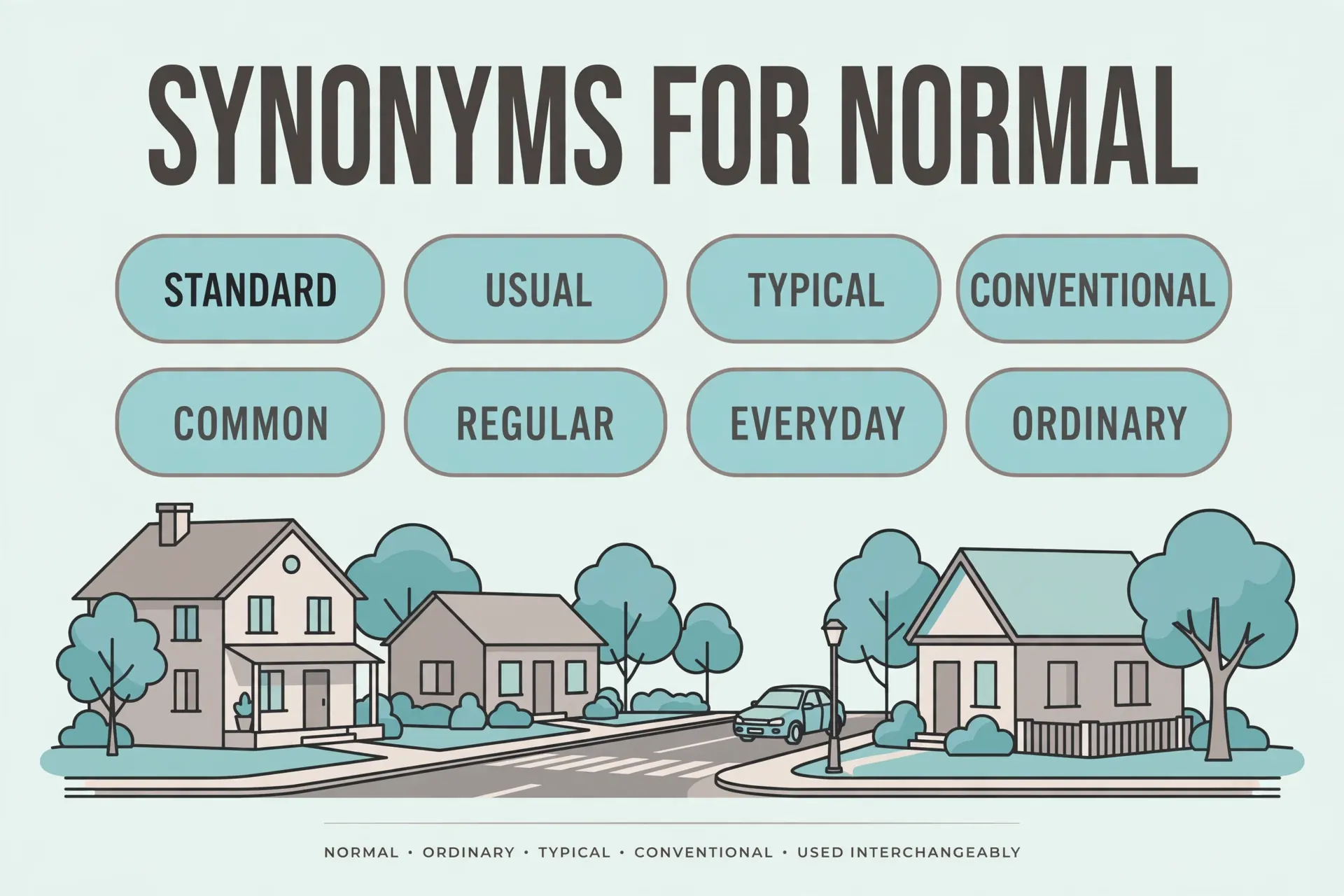
Table of Contents
Quick Answer
| Word | Nuance / When to use it |
|---|---|
| ordinary | The closest all-purpose swap — nothing special about it |
| typical | Representative of a type or group — “a typical Tuesday” |
| usual | What happens most of the time — routines and habits |
| average | Middle of the range — measurements, performance, sizes |
| regular | The standard option — sizes, schedules, customers |
| common | Frequently found — widespread, not rare |
| standard | The accepted baseline — procedures, equipment, contracts |
| conventional | Following accepted customs — sometimes with a stuffy edge |
| customary | Done by custom or tradition — greetings, rituals, courtesies |
| routine | Part of the regular procedure — checkups, inspections, tasks |
| everyday | Belonging to daily life — clothes, language, concerns |
| unremarkable | Not worth special notice — neutral, slightly dry |
Simple rule: Use ordinary or typical for the general sense, usual or routine for habits and procedures, and standard or conventional when something follows an accepted rule or custom.
Normal as Typical
When “normal” means representative of its kind — what you’d expect from this type of thing — these six words are more exact.
Ordinary — not special, unusual, or different in any way. It was an ordinary morning until the power went out.
Typical — showing the expected traits of a type or group. A typical workday starts with email and ends with a to-do list.
Usual — happening most often; the default expectation. She took her usual seat by the window.
Average — in the middle of the range; not high or low. The average response time was under two minutes.
Regular — the standard, expected version of something. He ordered a regular coffee and sat down with the newspaper.
Common — found frequently; not rare. Colds are common in winter, so the clinic stocks up early.

Normal as Standard and Accepted
When “normal” means conforming to an accepted rule, custom, or benchmark, these words carry more authority.
Standard — the accepted level or model everything is measured against. The hotel follows standard check-in procedures.
Conventional — following long-accepted customs or methods. He prefers conventional medicine over alternative treatments.
Customary — done according to tradition or habit. It is customary to remove your shoes before entering.
Routine — part of the regular, expected procedure. The pilot ran through the routine safety checks before takeoff.
Habitual — done so regularly it has become a habit. Her habitual morning walk keeps her energy up all day.
Established — settled and accepted over time. The clinic follows established protocols for every patient.
Normal as Everyday and Familiar
When “normal” means the familiar texture of daily life — nothing fancy, nothing strange — these words fit best.
Everyday — belonging to ordinary daily life. She wore simple, everyday clothes to the market.
Familiar — well known from experience; comfortable and expected. The familiar smell of fresh bread greeted them at the door.
Commonplace — so ordinary it barely registers. Smartphones have become so commonplace that we forget how new they are.
General — applying broadly rather than to special cases. The general rule is to arrive ten minutes early.
Plain — simple and without decoration; unpretentious. He prefers plain food and quiet evenings.
Unexceptional — not standing out in any particular way; neutral. The film was unexceptional — pleasant, forgettable, fine.
Common Mistakes
“Normal” quietly judges whatever it describes, so the wrong synonym can insult or mislead. The same care that untangles the worse-or-worst pair and the cold-or-flu comparison applies here: pick the word that matches your exact meaning.
Mistake 1: Ordering a “normal” coffee
❌ I’ll have a normal coffee, please.
✅ I’ll have a regular coffee, please.
Why: In ordering contexts, regular means the standard size or version; normal sounds as if other coffees are abnormal.
Mistake 2: Treating “common” as approval
❌ Cheating on exams is common, so it’s normal and fine.
✅ Cheating on exams is common, but that doesn’t make it acceptable.
Why: Common describes frequency, not rightness. Something can be widespread and still wrong.
Mistake 3: “Typical” for a stereotype
❌ A normal teenager is moody and glued to a phone.
✅ The stereotypical teenager is moody and glued to a phone.
Why: Typical describes what is genuinely representative; a lazy cliché is stereotypical, and calling real teenagers “abnormal” for differing is unfair.
Mistake 4: Calling a person “average” or “normal”
❌ She’s just a normal employee.
✅ Her performance is typical of the team this quarter.
Why: Applied to a person, normal or average sounds dismissive. Describe the performance or the situation, not the person.

How to Choose the Right Synonym
- Name what “normal” is doing. Representative of a type → typical/ordinary; a habit → usual/routine; a rule or benchmark → standard/conventional; daily-life texture → everyday/familiar.
- Check whether you’re judging. “Normal” often smuggles in approval or disapproval — if you only mean “frequent,” use common; if you mean “accepted,” use standard.
- Mind the register. Customary, established, and unexceptional suit formal writing; regular, plain, and everyday suit conversation.
- Avoid the person trap. Calling people “normal,” “average,” or “ordinary” can sound belittling — redirect the word at the behavior, result, or situation instead.
- Don’t overcorrect into jargon. If “normal” is clear and neutral in context (“normal body temperature”), keep it — a synonym should clarify, not decorate.
Frequently Asked Questions
What is a synonym for normal?
Ordinary is the closest all-purpose synonym for “normal.” For habits use usual, for rules and benchmarks use standard, and for daily life use everyday.
What is the difference between normal and typical?
They overlap, but typical means representative of a specific type or group (“a typical labrador”), while normal is broader — it can describe health, behavior, weather, or anything considered standard. “Typical” is usually the safer, more precise choice.
Is “normal” a positive or negative word?
It depends on context. Normal is positive when it means healthy or reassuring (“your results are normal”) and negative when it pressures conformity (“why can’t you be normal?”). If your meaning is purely descriptive, typical or usual avoids the judgment.
What is a formal synonym for normal?
In formal writing, standard, customary, established, and unexceptional work well. “The committee followed standard procedure” sounds more professional than “the committee followed normal procedure.”
Can “normal” describe a person?
Grammatically yes, but it often lands badly — “a normal person” implies others are abnormal. Describe the trait instead: “she has a typical sleep schedule” rather than “she’s a normal sleeper.”
Conclusion
Normal does too many jobs at once, which is why it so often says less than you intend. Reach for ordinary or typical for the general sense, usual for habits, and standard for rules — and your writing will sound both kinder and more precise.