Synonyms for Throughout: 14 Words With Examples
Writers lean on “throughout” whenever they mean a whole stretch of time or an entire area — but one word for both senses blurs your meaning. These 14 synonyms for “throughout” separate the two jobs (time vs. place), each with a plain meaning and a natural example sentence.
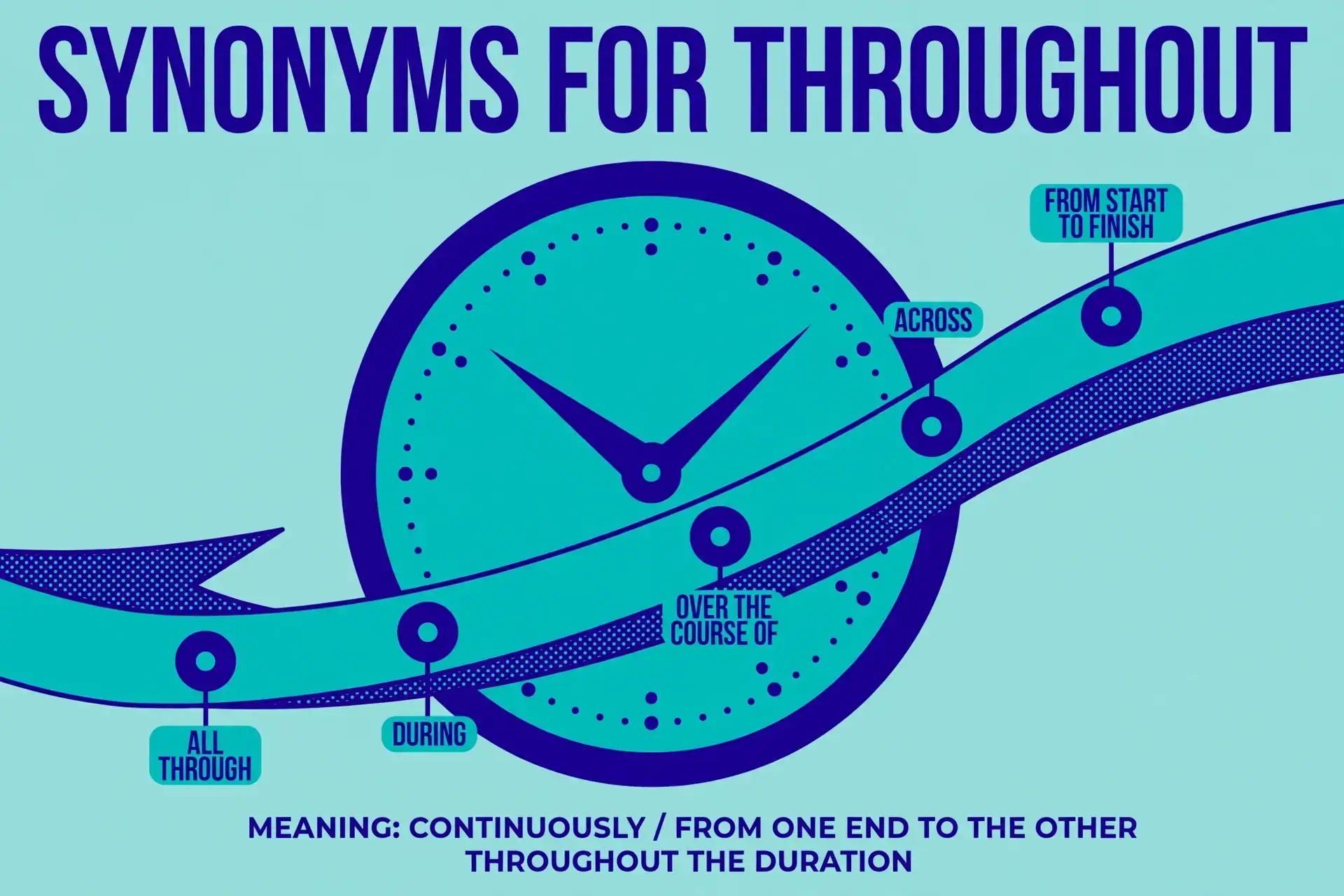
Table of Contents
Quick Answer: 12 Synonyms for “Throughout”
| Word | Nuance / When to use it |
|---|---|
| during | Within a period; the simplest time-sense swap |
| all through | Continuous from beginning to end of a period |
| over the course of | Formal; a span in which things unfolded |
| for the duration of | Formal; the entire length of an event |
| across | From one side of an area to the other |
| everywhere | In every place; casual and sweeping |
| all over | Informal; scattered across an area |
| in every part of | Formal and precise for places |
| from start to finish | Emphatic; the entire process, nothing skipped |
| from beginning to end | Formal twin of “from start to finish” |
| end to end | The full length of something physical |
| all along | The whole time, often with hindsight |
Simple rule: if you mean a span of time, use during or all through; if you mean every part of a place, use across or everywhere; if you want the full sweep with emphasis, use from start to finish. Merriam-Webster’s thesaurus entry for “throughout” lists the word’s full range of time and place senses if you want to compare more options.
Throughout = During (Time)
When “throughout” describes a period — a meeting, a decade, a storm — these five time-sense alternatives tell the reader exactly how the event filled the span.
-
during — Within a stated period; the simplest and most common swap. Example: The phone rang twice during the meeting. (Note: “during” can mean at some point within the period, not necessarily the whole of it.)
-
all through — Continuous from the start of a period to its end. Example: It rained all through the night, drumming on the tin roof.
-
over the course of — Formal; across a span in which things happened or changed. Example: Over the course of the year, the startup grew from four people to forty.
-
for the duration of — The entire length of an event or condition; slightly formal. Example: For the duration of the flight, the seatbelt sign stayed on.
-
the whole time — Informal and emphatic; every moment of the period. Example: She was nervous the whole time the results were being read out.

Throughout = Across (Place)
When “throughout” describes an area — a city, a building, a country — these place-sense words paint space, not time.
-
across — From one side of an area to the other; clean and versatile. Example: Posters for the festival appeared across the city overnight.
-
everywhere — In every place under discussion; sweeping and casual. Example: After the announcement, reporters were everywhere.
-
all over — Informal; scattered across an area, sometimes messily. Example: The kids had left toys all over the living room.
-
in every part of — Formal and precise; no corner excluded. Example: Volunteers were stationed in every part of the stadium.
-
in all corners of — Emphatic and slightly literary; the farthest reaches included. Example: The story was being retold in all corners of the country.
Emphatic & Complete: The Full Sweep
When you want to stress that nothing was skipped — the whole process, the whole length — these four add deliberate, emphatic completeness.
-
from start to finish — The entire process with nothing left out; energetic and emphatic. Example: She managed the project from start to finish without missing a deadline.
-
from beginning to end — The formal twin; suits books, films, and histories. Example: I read the novel from beginning to end in a single weekend.
-
end to end — The full physical length of something. Example: The parade stretched end to end down the main avenue.
-
all along — The whole time, usually with the sense that the truth was there in hindsight. Example: He had known the answer all along but said nothing.
Common Mistakes With “Throughout” Synonyms
Time and place senses get tangled easily — the same precision that sorts out modeling vs. modelling or judgment vs. judgement keeps these four traps from weakening your sentences:
Mistake 1: Using “during” when you mean the whole span
❌ “It rained during the night.” (when it never stopped)
✅ “It rained all through the night.”
Why: “during” only promises at some point within the period. If the rain never let up, “all through” or “throughout” is the honest word.
Mistake 2: Using “all over” in formal writing
❌ “The policy was discussed all over the committee report.”
✅ “The policy was discussed throughout the committee report.”
Why: “all over” is colloquial and can even mean “finished” — “the meeting is all over.” In formal prose, “throughout” or “in every part of” keeps the register steady.
Mistake 3: Using “all around” for “every part of”
❌ “Graffiti covered the walls all around the station.”
✅ “Graffiti covered the walls throughout the station.”
Why: “all around” describes a perimeter — the outside edges. “Throughout” means every part, inside included.
Mistake 4: Writing “throughout the entire”
❌ “The outage lasted throughout the entire week.”
✅ “The outage lasted throughout the week.”
Why: “throughout” already means the entire span, so “entire” adds nothing. Cut it and the sentence gets leaner without losing meaning.
How to Choose the Right Synonym
- Ask: time or place? This is the single most important fork. Time → during, all through, over the course of. Place → across, everywhere, in every part of. Getting this right fixes most “throughout” problems.
- Decide how continuous it was. If the thing happened nonstop, use all through or the whole time. If it just happened somewhere inside the period, plain during is more accurate.
- Match the register. Formal writing favors over the course of, for the duration of, and in every part of. Casual writing is fine with all over, everywhere, and the whole time.
- Watch “all over” in print. It is vivid in speech but loose on the page — and in British English it can read as “finished.” When in doubt, swap it for throughout or across.
- Use emphatic forms sparingly. “From start to finish” is powerful once; used three times in a paragraph it starts to sound like a slogan. Save it for the moment that deserves the sweep.
Frequently Asked Questions
What is a synonym for throughout?
The most common synonyms are during, all through, across, everywhere, and from start to finish. Use “during” for time, “across” for place, and “from start to finish” for emphatic completeness.
What is the difference between “during” and “throughout”?
“During” means at some point within a period; “throughout” means across the whole of it. “It snowed during the night” allows for dry hours; “it snowed throughout the night” does not.
Is “throughout” a formal word?
Somewhat — it is neutral to slightly formal. In casual speech, “all through,” “everywhere,” and “the whole time” are the natural replacements.
Can “throughout” mean both time and place?
Yes, and that is exactly why synonyms help. “Throughout the night” is time; “throughout the building” is place. Swapping in “all through” or “across” removes the ambiguity.
What is a shorter synonym for “throughout”?
“During” (time) and “across” (place) are the shortest clean swaps; “all through” covers the continuous-time sense.
Can “throughout” start a sentence?
Yes: “Throughout the summer, the lake stayed perfectly calm.” It works as a fronted prepositional phrase in both time and place senses.
Conclusion
“Throughout” does double duty for time and place, which is exactly why sharper words often serve better. Whether you mean all through the night, across the country, or from start to finish, naming the sense precisely gives your sentence more force. Split the meanings, match the register, and the word stops blurring your point.