Curb or Kerb: US vs UK Spelling Explained
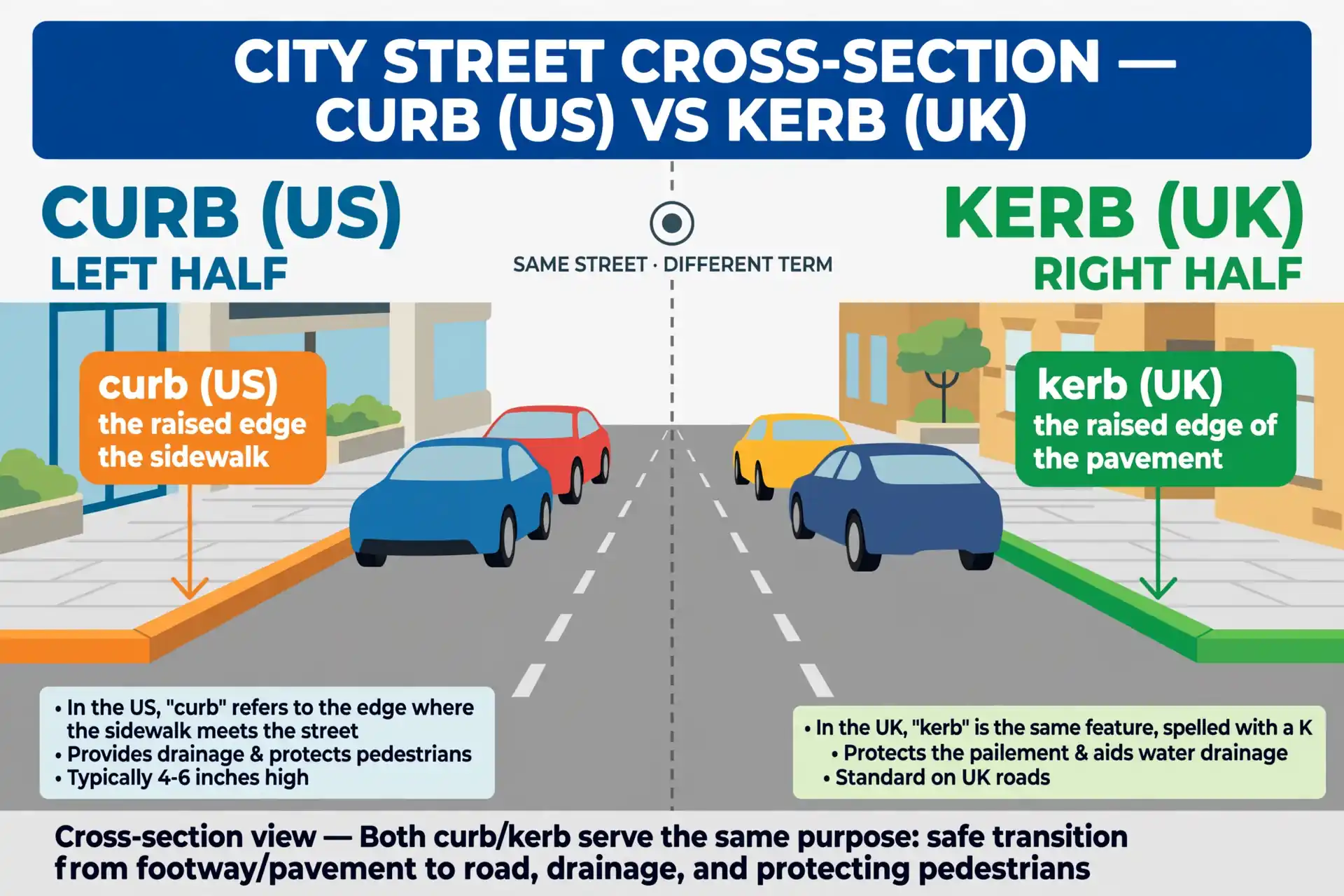
Both curb and kerb are correct — the difference is geography. In the United States, curb means the raised edge of the street and the verb “to restrain.” In the United Kingdom, the two meanings split: kerb with a K is the street edge, while curb survives only as the verb. An American parks at the curb; a Londoner parks at the kerb — but both of them curb their enthusiasm.
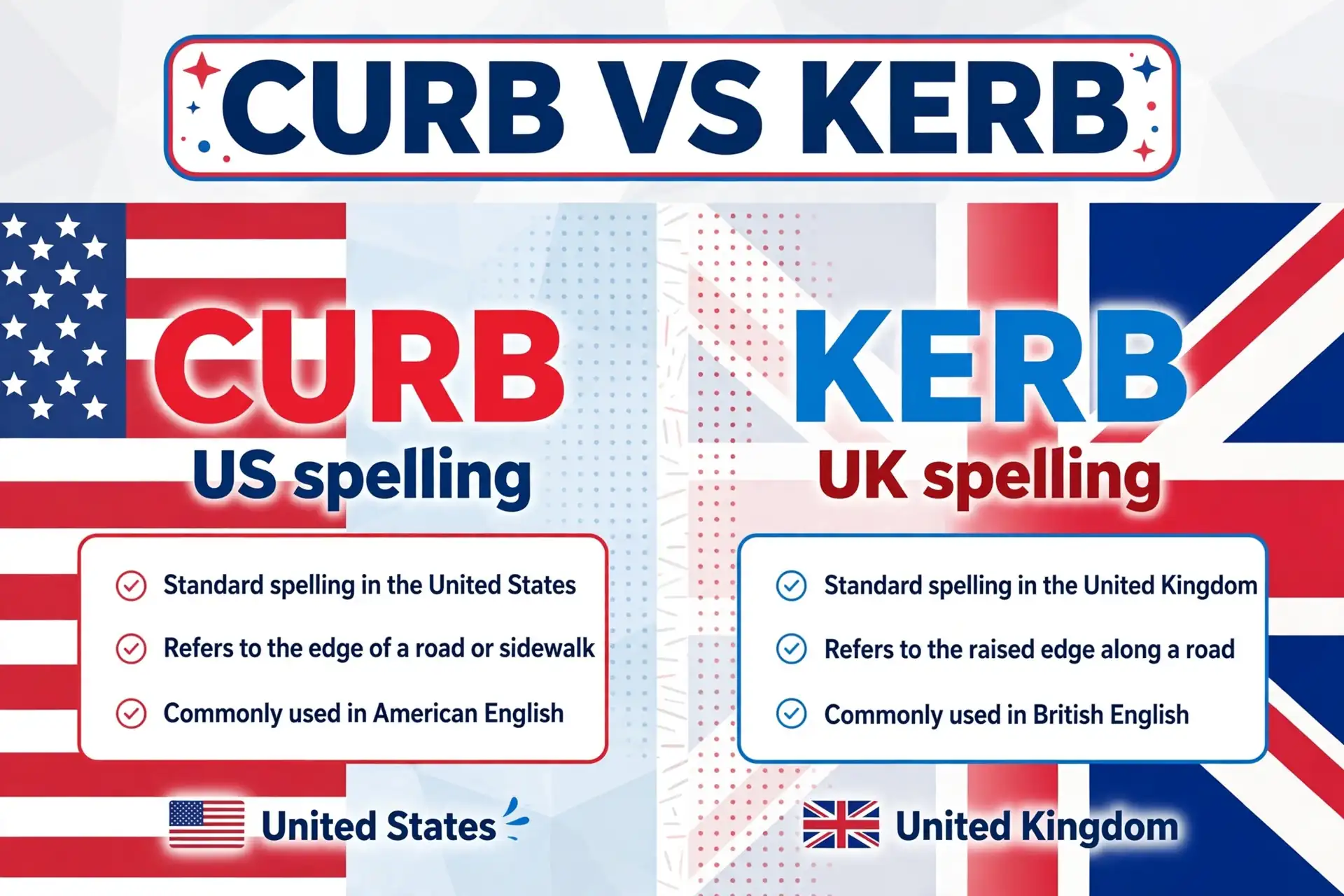
Table of Contents
Quick Answer
| Word | Spelling | Main Meaning | Example |
|---|---|---|---|
| Curb | US (noun + verb) | The raised edge of a street; to restrain or hold back | “Don’t hit the curb.” / “Curb your spending.” |
| Kerb | UK (noun) | The raised edge of a street | “Don’t hit the kerb.” |
| Curb | UK (verb only) | To restrain or hold back | “Curb your spending.” |
Simple rule: in American English, always write curb; in British English, write kerb with a K for the street edge and curb only when you mean “restrain.”
What Does Curb Mean?
In American English, curb does two jobs. As a noun it is the raised concrete edge where the sidewalk meets the road. As a verb it means to restrain, control, or hold back: to curb spending, to curb pollution, to curb one’s temper.
Examples:
- She scraped the curb while parallel parking downtown.
- The city is planting trees along every curb in the neighborhood.
- The new law aims to curb distracted driving.
- Step up onto the curb before the light changes.
What Does Kerb Mean?
In British English, kerb with a K is the noun for the raised edge of the pavement — the stone or concrete border between the footway and the road. It has no verb form: when a Briton means “to restrain,” the spelling reverts to curb.
Examples:
- Mind the kerb when you step off the pavement.
- The taxi pulled up tight against the kerb.
- They painted the kerb stones red and white near the crossing.
- She dropped her keys in the gutter by the kerb.
- Efforts to curb traffic in the city centre continue. (verb — note the C)
Why Two Spellings?
The verb curb comes from the Old French courbe, a strap that restrained a horse, and has meant “to restrain” in English since the 1400s. The street-edge sense grew out of it in the 1600s: the raised border “curbs” — restrains — carriages and water from leaving the road.
British English later respelled the noun as kerb to keep the two meanings visually distinct, a quirk it applied to a handful of words. American English never adopted the K spelling: Merriam-Webster’s entry for curb lists the street edge and the verb under one headword, while Oxford keeps separate entries for kerb (noun) and curb (verb).
Curb vs. Kerb: Key Differences
| Feature | Curb (US) | Kerb / Curb (UK) |
|---|---|---|
| Street-edge noun | Curb — always with a C | Kerb — always with a K |
| “Restrain” verb | Curb — also with a C | Curb — with a C, never a K |
| Pronunciation | Identical to the UK versions | Identical to the US version |
| Typical phrase | “parked at the curb” | “parked at the kerb” |
| Related terms | curbside pickup, curb appeal | kerbside collection, kerb appeal |
| What’s wrong | “Kerb” looks like a typo in the US | “Kerb” as a verb is wrong everywhere |
Britain gave the street edge its own spelling, while America kept one word for both the concrete and the restraint.
Related US vs UK Word Pairs
| Pair | US | UK |
|---|---|---|
| Color or Colour | color | colour |
| Theatre vs Theater | theater | theatre |
| Donut vs Doughnut | donut | doughnut |
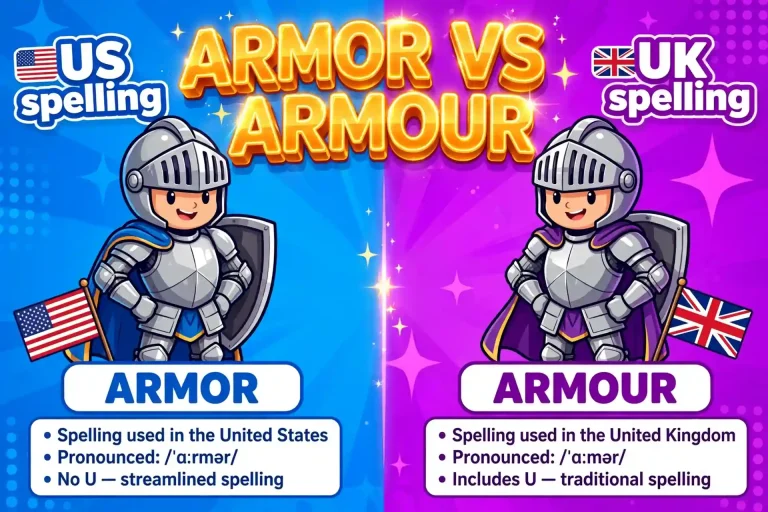
| Armor vs Armour | armor | armour |
| Defense vs Defence | defense | defence |
Curb and Kerb in Real Sentences
At Home
US: “The delivery driver left the package on the curb — go grab it before it rains.”
UK: “The delivery driver left the package on the kerb — go grab it before it rains.”
The contrast: only the first letter changes across the ocean.
At Work
US: “Management wants to curb overtime, so the curb outside the office is now a no-parking zone.”
UK: “Management wants to curb overtime, so the kerb outside the office is now a no-parking zone.”
The contrast: the verb stays curb on both sides, while the concrete edge gains a K in Britain.
In Conversation
US: “Just pull up to the curb and I’ll hop in.”
UK: “Just pull up to the kerb and I’ll hop in.”
The contrast: the most ordinary sentence in the pair — and still the spelling gives away the speaker’s country.
Common Mistakes
British writers are used to the K, Americans to the C — and crossing the streams causes the same confusion as other Atlantic pairs like color or colour and theatre vs theater. Watch for these:
Mistake 1: Using “kerb” as a verb
❌ “The council hopes to kerb late-night noise.”
✅ “The council hopes to curb late-night noise.”
Why: kerb is a noun only — the verb “to restrain” is curb in every variety of English.
Mistake 2: Writing “curb” for the street edge in British English
❌ “He tripped on the curb outside the station.”
✅ “He tripped on the kerb outside the station.”
Why: a British reader expects the street edge spelled with a K; the C spelling signals the verb instead.
Mistake 3: Using “kerb” in American English
❌ “They offer kerbside pickup for online orders.”
✅ “They offer curbside pickup for online orders.”
Why: American English has no K spelling at all — “curbside” is the standard US form, from real estate’s “curb appeal” to airport “curbside check-in.”
Mistake 4: Confusing “curb appeal” with “kerb appeal”
❌ UK estate agent writing: “This cottage has wonderful curb appeal.”
✅ “This cottage has wonderful kerb appeal.”
Why: the property phrase follows the same rule as the noun — Britain spells it kerb appeal, America curb appeal.
Pronunciation
Curb and kerb sound exactly alike: “kurb,” rhyming with verb and (in American pronunciation) herb. The K-versus-C distinction exists only on the page, so no one will hear your mistake — but readers on each side of the Atlantic will certainly see it.
How to Remember the Difference
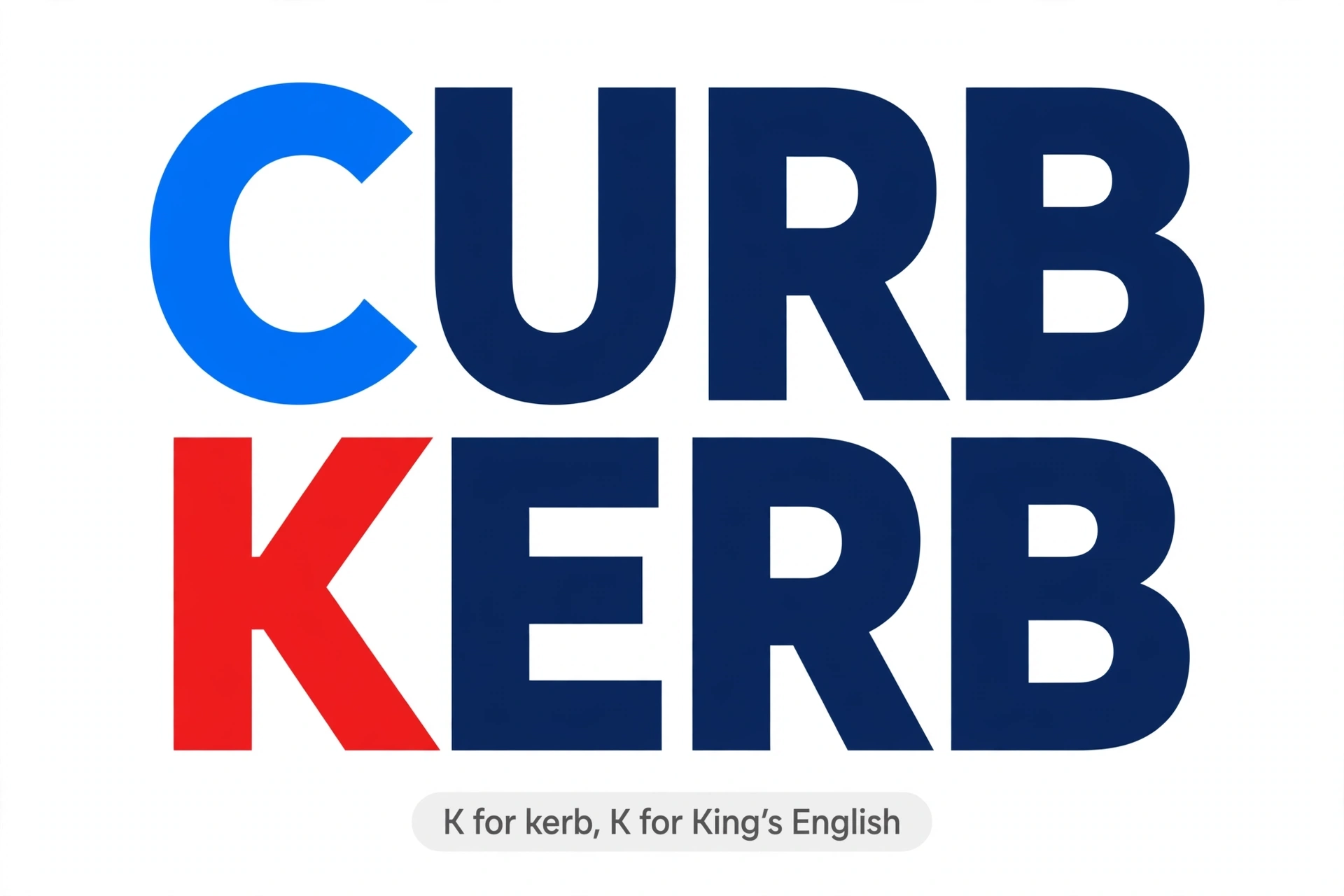
Think K for kerb, K for King’s English: the British street edge starts with the same letter as the kingdom that named it. And the verb is easy — curb with a C means to control or check something, in every country.
- Kerb (K) = the street edge in British English — K for King’s English.
- Curb (C) = the verb “restrain” everywhere — C for control.
- In American English, curb with a C covers both meanings.
Frequently Asked Questions
Is it curb or kerb?
Both are correct. Americans always write curb. Britons write kerb for the raised edge of the street and curb only for the verb meaning “restrain.”
Is kerb ever correct in American English?
No. US dictionaries list only curb, so kerb with a K reads as a misspelling to American readers — including in compounds like “curbside pickup.”
Can kerb be used as a verb?
Never. Kerb is strictly a noun. The verb meaning “to restrain or hold back” is always curb with a C, in Britain and America alike.
What is “kerb appeal”?
How attractive a property looks from the street. Estate agents in the UK write kerb appeal; American realtors write curb appeal.
Is it “kerbside” or “curbside”?
British: “kerbside collection.” American: “curbside pickup.” The compound follows the same convention as the base noun in each country.
Where does the K spelling come from?
British English respelled the noun in the 19th century to distinguish the street edge from the verb “to restrain.” American English, shaped by Webster’s simplifications, kept the original C spelling for both.
Conclusion
Curb with a C is the American all-rounder — the street edge and the verb in one word. Kerb with a K is the British street edge, while the verb stays curb. Remember: K for the King’s English kerb, C for the verb that controls — and you’ll always pick the right one.