Sale or Sell: What’s the Difference? (With Examples)
Only one of these is right — sale and sell are different words, not spelling variants. Sale is a noun: the event of selling, or goods offered at reduced prices. Sell is a verb: the act of giving something in exchange for money. You write “The store is having a sale” but “They sell fresh bread.”
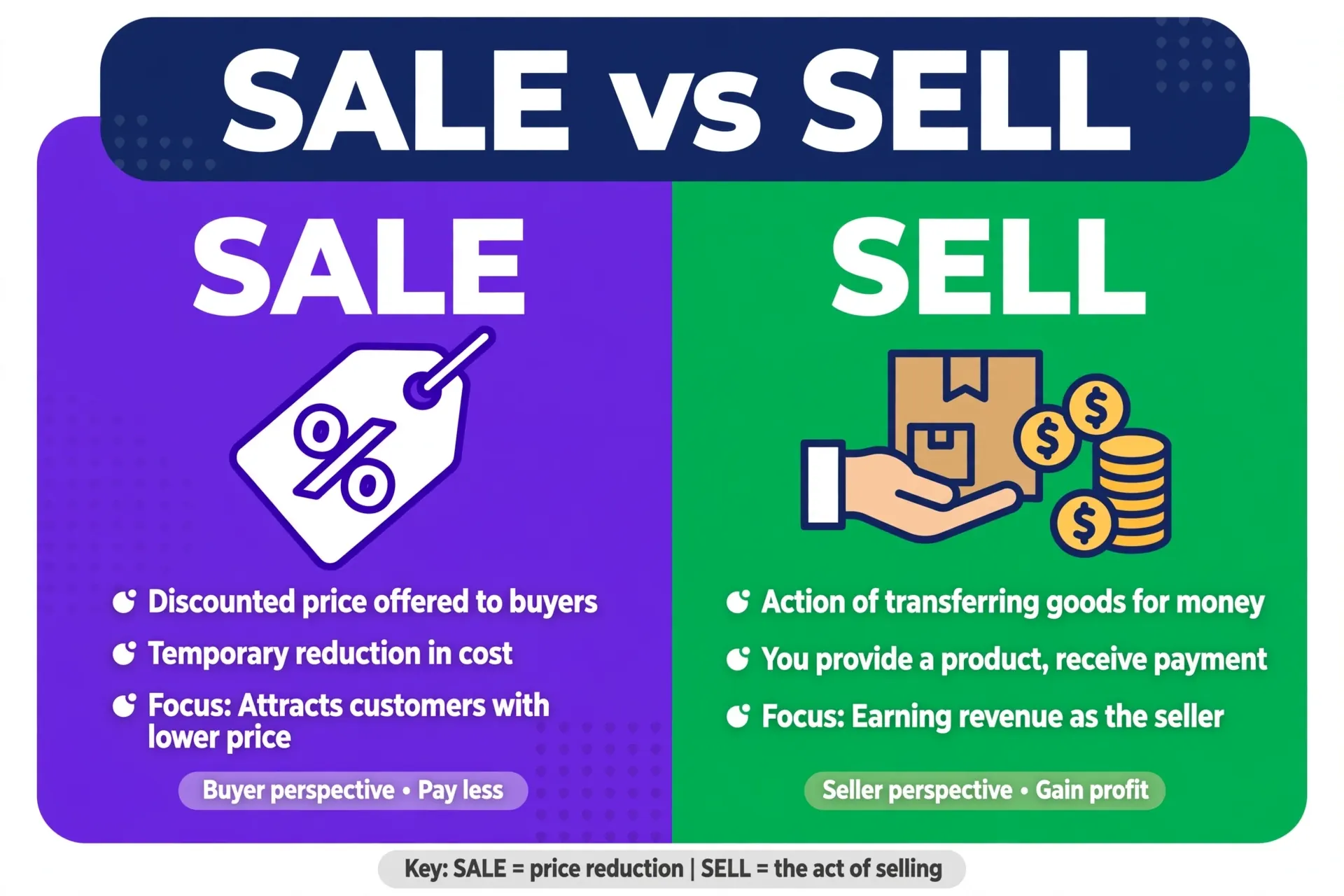
Table of Contents
Quick Answer
| Word | Part of Speech | Main Meaning | Example |
|---|---|---|---|
| Sale | Noun | The selling event; discounted prices | “Everything is 50% off in the summer sale.” |
| Sell | Verb | To give something for money | “We sell handmade candles online.” |
Simple rule: sale is the thing (noun); sell is the action (verb).
What Does “Sale” Mean?
Sale is a noun with two main senses: the act or event of selling (“the sale of the house”) and a special event where goods are offered at reduced prices (“a clearance sale”). It names a thing or an occasion, never an action. Check Merriam-Webster’s definition of sale for both noun senses.
Examples:
- Everything is 50% off in the summer sale.
- The sale of their house closed last Friday.
- She bought the dress on sale for half price.
- The charity held a bake sale to raise money.
- Car sales always rise at the end of the year.
What Does “Sell” Mean?
Sell is a verb meaning to give something to someone in exchange for money. It describes what a person or business does, and it changes form with tense: sell, sold, sold, selling. It can never sit where a noun belongs.
Examples:
- We sell handmade candles online.
- He sold his old bike for two hundred dollars.
- The bakery sells out of croissants by nine.
- They are selling their apartment and moving abroad.
- She sells vintage clothes at the weekend market.
Sale vs. Sell: Key Differences
| Feature | Sale | Sell |
|---|---|---|
| Part of speech | Noun | Verb |
| Core meaning | The event or the discounted prices | The action of exchanging for money |
| Changes with tense | No (plural: sales) | Yes (sell, sold, sold, selling) |
| Common phrases | “On sale,” “for sale,” “garage sale” | “Sell out,” “sell off,” “hard sell” |
| Test | Can you put “the” before it? | Can you put “to” before it? |
| Typical mistake | Used as a verb (“I sale cars”) | Used as a noun (“big sell”) |
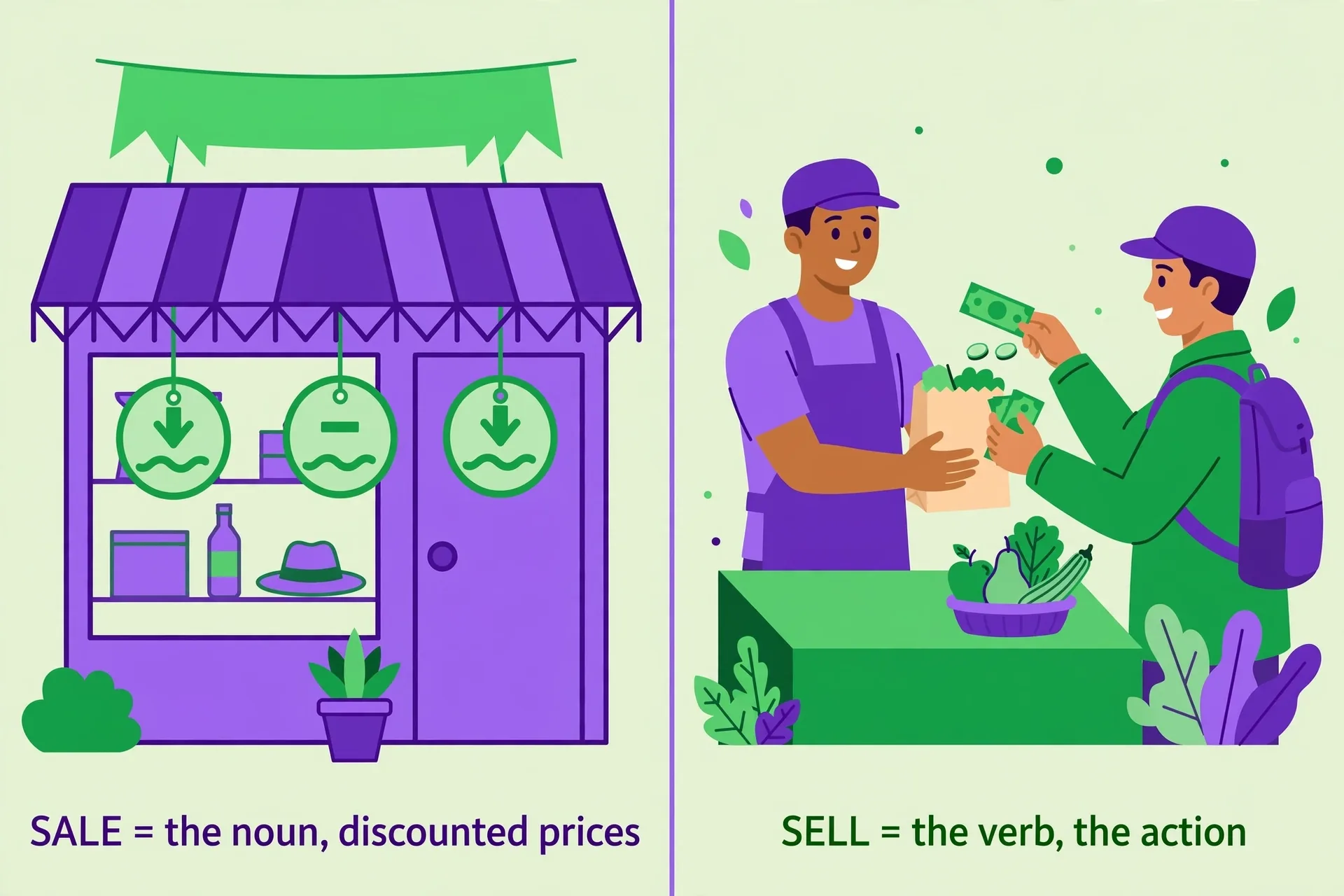
Think of it this way: the sale is the stage, and sell is what the actors do on it.
Sale and Sell in Real Sentences
At Home
Sale: “Mom found the sofa on sale and saved three hundred dollars.”
Sell: “We plan to sell the old sofa before the move.”
The sale is the bargain you found; sell is what you do with the furniture you no longer need.
At Work
Sale: “The quarterly sales report shows a 20% increase.”
Sell: “Our team sells software to small businesses.”
Business writing uses both constantly: sales are the numbers, sell is the activity that creates them.
While Shopping
Sale: “The entire shoe department is on sale this weekend.”
Sell: “This shop sells shoes you cannot find anywhere else.”
Shoppers hunt for a sale; shops sell the goods.
In Conversation
Sale: “Is your bike for sale, or are you keeping it?”
Sell: “I might sell it if the price is right.”
“For sale” describes availability; “sell it” describes the action you would take.
Common Mistakes with Sale and Sell
Swapping these two is one of the most frequent errors in English writing, right up there with other confused word pairs like “loose or lose” and “desert or dessert”. The noun-verb test below fixes nearly every case.
Mistake 1: “For sell” instead of “for sale”
❌ “The house is for sell.”
✅ “The house is for sale.”
Why: “for” needs a noun, and the noun is sale — “for sell” is never correct.
Mistake 2: “On sell” instead of “on sale”
❌ “These jackets are on sell this week.”
✅ “These jackets are on sale this week.”
Why: the fixed phrase for discounted prices is “on sale“; “on sell” does not exist in standard English.
Mistake 3: Using “sale” as a verb
❌ “I sale handmade soap at craft fairs.”
✅ “I sell handmade soap at craft fairs.”
Why: the action of exchanging goods for money is always the verb sell (sold, selling).
Mistake 4: Using “sell” as a noun
❌ “The store announced a big sell.”
✅ “The store announced a big sale.”
Why: the event itself is the noun sale; “sell” can only be the action.
Pronunciation
Sale is pronounced “sayl” — it rhymes with “fail,” “mail,” and “tale.” Sell is pronounced “sel” — it rhymes with “bell,” “tell,” and “well.” The long “a” versus the short “e” is the sound difference to listen for.
How to Remember the Difference
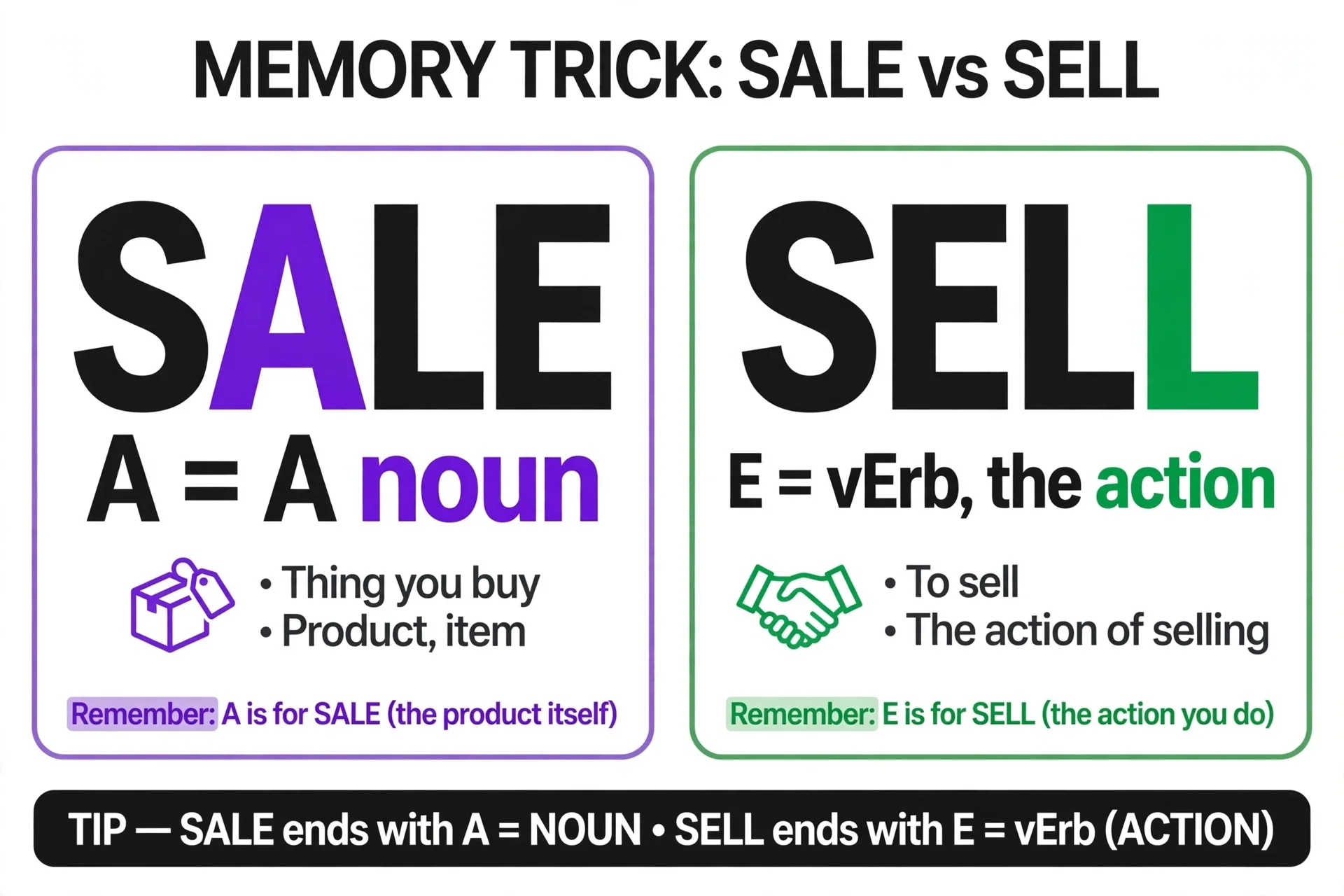
SAle is A noun — the A’s match. SEll is the vErb — the E’s match, and E stands for the action you Execute when money changes hands.
- Sale = A noun (the event, the bargain)
- Sell = the vErb (the action; sell, sold, selling)
- Quick test: “the ___” needs sale; “to ___” needs sell
Frequently Asked Questions
Is it sale or sell?
It depends on the job in the sentence. Use sale for the noun (the event or the discount) and sell for the verb (the action).
Is “for sell” ever correct?
No. The correct phrase is always “for sale,” as in “The car is for sale.”
What is the past tense of sell?
Sold: “She sold her car yesterday.” Sale has no past tense because it is a noun.
Can “sale” be plural?
Yes — sales, as in “Holiday sales broke records this year.” Sell as a verb takes an -s in third person: “He sells cars.”
What does “on sale” mean?
It means goods are offered at reduced prices: “These boots are on sale for $40.”
Is “sell out” one word?
As a verb phrase it is two words (“The concert sold out”), while the noun/adjective form is often hyphenated or one word (“a sellout crowd”).
Conclusion
Sale names the event or the bargain; sell does the work of exchanging goods for money. Match the A’s for the noun and the E’s for the verb, and this pair will never trip you up again.