Is Good Morning One Word or Two?
The answer is short: two words. “Good morning” is written with a space between “good” and “morning”, and that space is part of the correct spelling. The one-word version, “goodmorning”, is not standard English, and no major dictionary lists it. This page looks at the dictionary evidence, explains why the phrase has stayed two words, and covers the one real exception — the hyphenated form “good-morning”, which is correct in a specific job as an adjective.
Quick Answer: “Good morning” is two words. It is never written as one word (“goodmorning”) in standard English. The hyphenated form “good-morning” exists, but only as an adjective directly before a noun, as in “a good-morning text”.
Table of Contents
The Answer: Two Words
“Good morning” is two words because it is built from two words doing two jobs. “Good” is an adjective, and “morning” is a noun. The adjective describes the noun, in the same way it does in “good day”, “good afternoon”, and “good night”. The phrase works as a greeting, but its grammar never changed: it is still an adjective followed by a noun, with a space between them.
That structure is why the space matters. In “good morning”, each word keeps its own meaning and its own spelling. Squashing them into “goodmorning” hides the structure and creates a word that English does not recognize. It would be like writing “goodday” or “goodnight” as single words — readers would understand you, but the spelling would still be wrong.
The two-word rule holds everywhere the greeting is used: at the start of an email, in the middle of a sentence, in a text message, and in formal writing. Position changes the capital letter, never the number of words.
What the Dictionaries Say
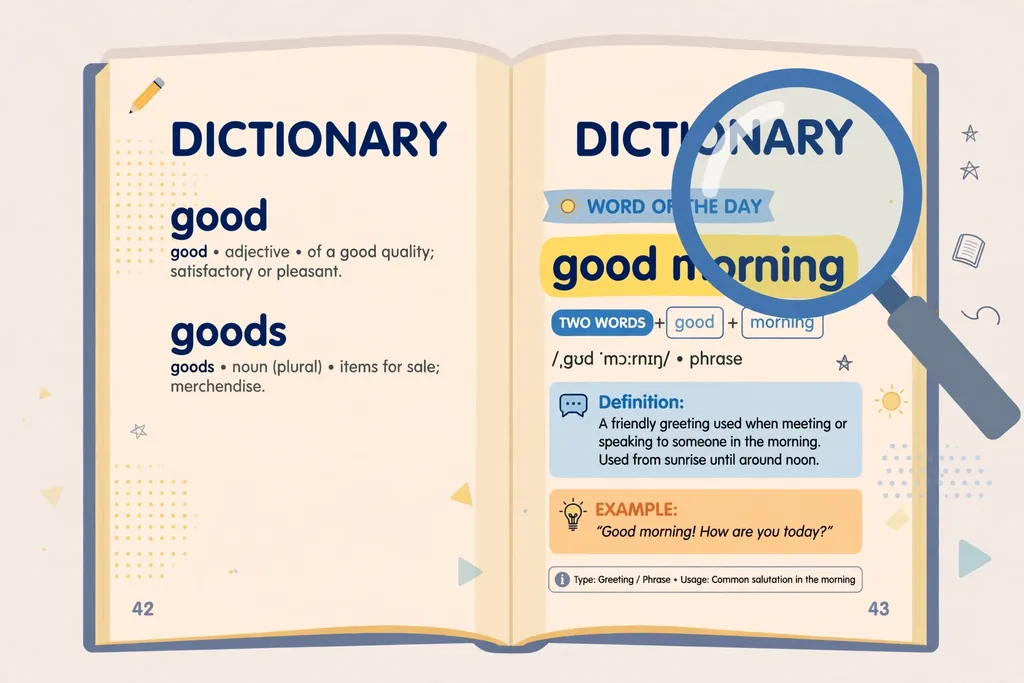
Dictionaries settle this question quickly. The Oxford Advanced Learner’s Dictionary lists “good morning” as a two-word exclamation, defined as a polite way to say hello when people first see each other in the morning. Cambridge lists it the same way, and Merriam-Webster also enters it as two words. Three major dictionaries, one spelling — and that spelling has a space in it.
Just as telling is what the dictionaries do not list. Search any of them for “goodmorning” and you will find no entry. Dictionaries record the words a language actually uses in its standard form, so the absence of “goodmorning” is strong evidence. It is not a rare variant or a regional spelling. It is simply not a word. Dictionaries also record cases where two spellings genuinely exist — gray vs grey is one such pair — which makes the absence of “goodmorning” all the more telling.
You can run this check yourself any time you are unsure about a spelling. Type the exact form into a dictionary site. If the dictionary has an entry, the spelling exists. If it redirects you to a different spelling or finds nothing at all, the form you typed is not standard. For “good morning”, the entry is there. For “goodmorning”, it is not.
One Word, Two Words, or Hyphenated?
English compounds come in three forms, and “good morning” sits firmly in the first. An open compound is two separate words, like “good morning”, “high school”, and “post office”. A hyphenated compound joins words with a hyphen, like “well-known” and “mother-in-law”. A closed compound is a single word, like “goodbye”, “notebook”, and “sunflower”. All three forms are correct English — the question is always which form a particular phrase uses.
Some open compounds do close up over time. “Today” was once written “to day”, “tonight” was once “to night”, and “goodbye” began as the phrase “God be with ye” before centuries of use squeezed it into one word. These changes happen slowly, over hundreds of years, and only when almost everyone starts writing the closed form. “Good morning” has not gone through that change. After centuries of daily use, it is still written as two words, and there is no sign of it closing up.
That history also explains why the question comes up at all. Because “goodbye” closed up, it is reasonable to wonder whether “good morning” did the same. It did not. The two greetings took different paths, and only the dictionary record shows which path each one took. “Goodbye” is one word. “Good morning” is two.
When “Good-Morning” Takes a Hyphen
The hyphenated form “good-morning” is real, but it does a different job from the greeting. It works as an adjective that describes a noun, placed directly before that noun. “She sent a good-morning text” uses the hyphen because “good-morning” modifies “text”. “He left a good-morning note on the table” works the same way: the hyphen joins the two words into a single describing unit before the noun.
The rule is about position. When the phrase comes before a noun and describes it, use the hyphen: “a good-morning email”, “good-morning wishes”, “a good-morning call”. When the phrase stands on its own as a greeting, use two words with no hyphen: “Good morning! How are you?” The greeting never takes a hyphen, and the adjective before a noun never drops it.
The same rule applies to other time-of-day phrases. “A good-night kiss” takes a hyphen before the noun, while “Good night, sleep well” does not. The hyphen is a signal that the words are working together as one description. Once you see the pattern, the choice between “good morning” and “good-morning” becomes a question of where the phrase sits in the sentence, not a question of preference.
One caution: the hyphenated form is less common than the plain greeting, and some writers avoid it entirely by rewording — “a text saying good morning” instead of “a good-morning text”. Both are acceptable. What is never acceptable is writing the greeting itself with a hyphen, as in “Good-morning, everyone.” That is not a standard form in any style guide.
Capitalization: Good Morning or good morning?
“Good morning” is not a proper noun, so it follows ordinary capitalization rules. At the start of a sentence, capitalize the first word only: “Good morning, everyone.” In the middle of a sentence, both words are lowercase: “He said good morning and went back to his desk.” The lowercase “g” in the middle of a sentence is correct, even if it looks plain next to the capital version people usually see.
Email greetings follow the same rule. “Good morning,” at the top of an email takes a capital “G” because it begins the line. The “m” stays lowercase. Subject lines and titles are the one place both words take capitals, because titles use title case: an email with the subject “Good Morning, Team” is correct, and so is a song or book called “Good Morning”. Title case is a rule about titles, not about the greeting.
A common error is capitalizing both words in the middle of a sentence, as in “She wished him Good Morning.” That looks respectful, but it is wrong in standard writing. Only proper nouns and the first word of a sentence take capitals, and “good morning” is neither. Keep the second word lowercase unless a title demands otherwise.
“Good Morning” vs. “Goodmorning” in Real Use
In everyday writing, “goodmorning” shows up a lot — in texts, comments, and social media posts. Seeing it often does not make it standard. Informal writing is full of spellings that would fail in a formal setting, and “goodmorning” is one of them. The standard stays the same whether the message is a text to a friend or a letter to a client: two words.
Hashtags and usernames are the main exception, and they are not really exceptions. A hashtag cannot contain a space, so #goodmorning is the only way to tag the phrase, and a username like “goodmorning_sara” follows the same limit. These are labels built under technical rules, not spellings. Copying hashtag style into a sentence is like copying a license plate into an essay — the format belongs to its own system.
Brand names and song titles sometimes use “Goodmorning” as a single word too. A company can name a product whatever it likes, and a band can title a song “Goodmorning” if it wants to. Those are creative choices, not evidence about standard spelling. A single missing space can change how a word reads, just as one letter changes the meaning in loose or lose, and the standard spelling is what dictionaries and style guides use.
Autocorrect is worth a mention as well. Most phones and word processors flag “goodmorning” and suggest the two-word form. If your keyboard has learned the mistake and stopped flagging it, removing the learned word from the keyboard dictionary fixes the problem. The tool was right the first time.
How to Remember It
Three quick tests make the two-word rule easy to keep. First, compare it with its family: “good afternoon”, “good evening”, and “good night” are all two words. “Good morning” belongs to the same family and follows the same rule. If you would not write “goodafternoon”, do not write “goodmorning”.
Second, try the insertion test. Because “good” and “morning” are separate words, another word can fit between them: “a very good morning”, “a bright good morning”. You cannot insert a word into a single word, so the fact that the insertion works proves the space belongs there. Try the same test on a real one-word greeting — “a very goodbye” makes no sense, because “goodbye” is genuinely one word.
Third, think of the meaning. “Good” describes “morning” the way it describes “day” in “good day”. The adjective and the noun stay separate, and the space between them is part of the spelling. Remember the pair “good day” and the greeting takes care of itself.
FAQ
Is “goodmorning” ever correct?
Not in standard English. “Goodmorning” has no dictionary entry and is not accepted in any major variety of English. The only places the one-word form appears are usernames, hashtags, and brand or song titles, where different rules apply.
Is it “good-morning” or “good morning”?
Both exist, but they do different jobs. Use “good morning” — two words, no hyphen — for the greeting itself. Use “good-morning” with a hyphen only as an adjective directly before a noun, as in “a good-morning text”.
Why is “goodbye” one word but “good morning” two?
“Goodbye” is a contraction of the old phrase “God be with ye” that closed into a single word over centuries of use. “Good morning” never went through that change — it stayed an open compound of an adjective and a noun, and dictionaries still list it as two words.
Do you capitalize “good morning” in an email?
Capitalize the “G” when the greeting opens the email, as in “Good morning, Ms. Chen,”. Keep “morning” lowercase. In the middle of a sentence, both words are lowercase. Both words take capitals only in a title or subject line.
Is “good morning” one word in British English?
No. “Good morning” is two words in British, American, Canadian, and Australian English. No major variety writes it as one word, and no major dictionary lists “goodmorning” as a correct form in any variety.