Synonyms for Loud: Words With Examples
“Loud” does triple duty in English — it describes a thunderclap, a neon jacket, and a forceful opinion, often in the same paragraph. When writers lean on the one word for all three jobs, their writing flattens. This guide gives you 21 real synonyms for loud — grouped into noisy sounds, piercing sounds, flashy looks, and forceful voices — each with a meaning note and an example sentence. For the full thesaurus range, Merriam-Webster’s thesaurus entry for “loud” lists even more, but the twenty-one below are the ones working writers actually reach for.
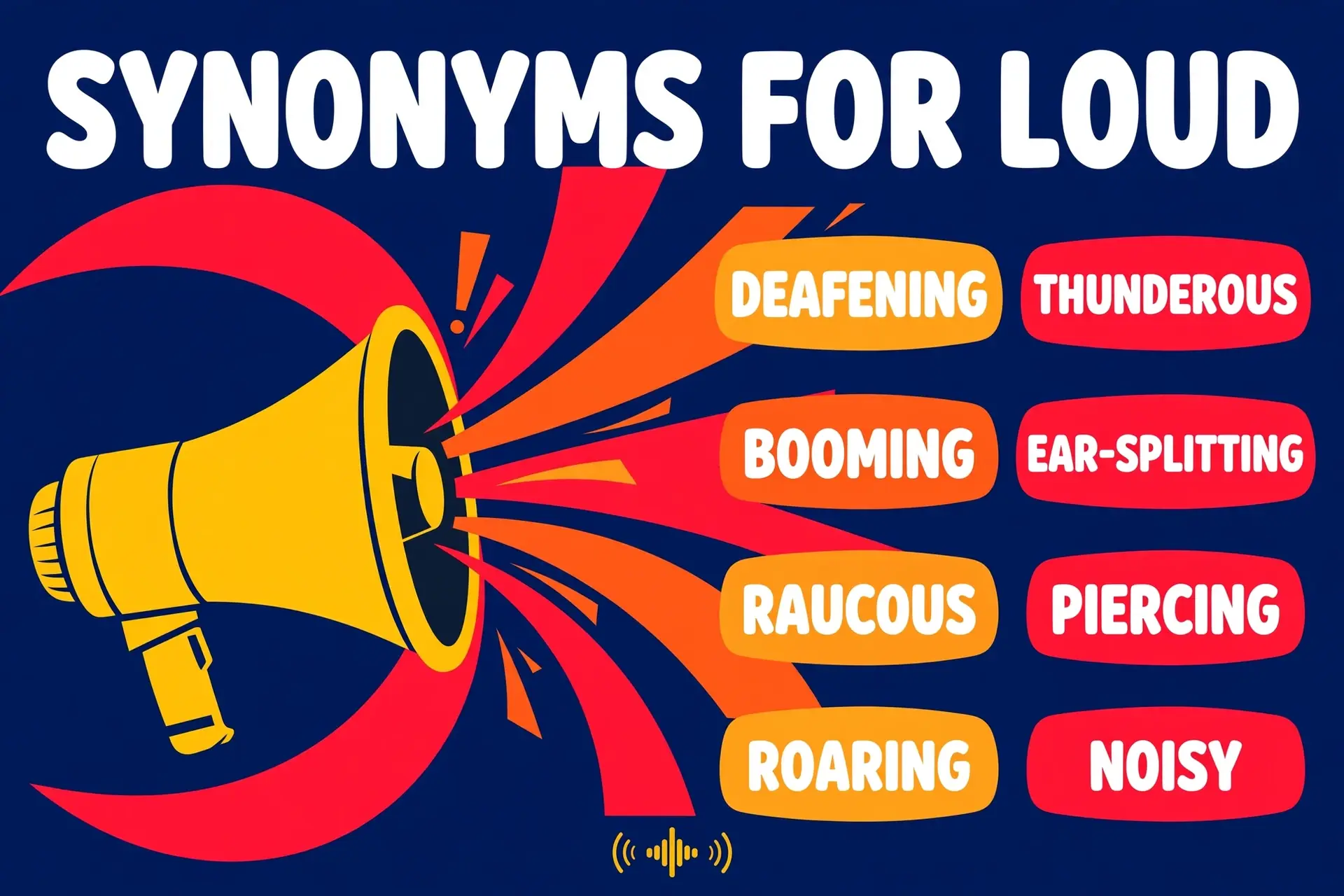
Table of Contents
Quick Answer
| Word | Nuance / When to use it |
|---|---|
| deafening | So loud it hurts or overwhelms hearing — maximum intensity |
| thunderous | Deep, rolling power like thunder — applause, storms, engines |
| blaring | Harsh, intrusive sound you can’t ignore — horns, speakers, alarms |
| booming | Deep and resonant — voices, fireworks, bass |
| roaring | Continuous powerful sound — crowds, fires, waterfalls |
| noisy | The neutral everyday word — simply full of sound |
| piercing | High and sharp enough to cut through everything else |
| shrill | High-pitched and unpleasant — whistles, screams, alarms |
| garish | Visually too bright or showy — colors, clothes, decor (never sounds) |
| flashy | Showy and attention-grabbing — style, cars, jewelry |
| vehement | Forceful and passionate — denials, protests, opinions |
| outspoken | Frank and direct in speech — people who say what they think |
Simple rule: Match the word to the sense — use sound words (deafening, blaring, roaring) for volume, look words (garish, flashy) for colors and clothes, and voice words (vehement, outspoken) for forceful speech.
Noisy Sounds
These eight are the core volume words — reach for these when something is simply making a lot of sound.
Noisy — full of sound; the neutral, everyday synonym. The noisy construction site made afternoon naps impossible.
Deafening — so loud it overwhelms hearing; the strongest of the group. The deafening roar of the jet engines drowned out every announcement.
Thunderous — deep and rolling like thunder; powerful rather than harsh. The actor received thunderous applause that lasted five minutes.
Blaring — harsh, intrusive sound that forces itself on you. Car horns were blaring in every direction across the intersection.
Booming — deep, full, and resonant; a voice or sound with weight behind it. His booming laugh filled the entire restaurant.
Roaring — a continuous, powerful rush of sound. The roaring waterfall could be heard from half a mile away.
Rowdy — loud in a wild, disorderly way; describes people, not just sound. The rowdy crowd spilled out of the stadium chanting songs.
Clamorous — a loud, confused uproar of many voices at once. The clamorous debate in the hall showed no sign of ending.

Sharp, Piercing Sounds
These four describe sounds that are high, sharp, or physically uncomfortable — loudness with an edge.
Piercing — so high and sharp it seems to cut through everything. A piercing whistle from the referee stopped play immediately.
Shrill — high-pitched and unpleasant to the ear. The shrill alarm sent everyone filing out of the building.
Strident — harsh and grating; a formal word for an aggressively loud sound or voice. Her strident tone made even a simple request sound like a demand.
Ear-splitting — painfully loud; the informal cousin of deafening. The ear-splitting screech of the brakes made us all wince.
Flashy / Gaudy Looks
“Loud” has described showy clothes and colors since the 1800s. These four are its visual synonyms — never use them for sounds.
Garish — excessively bright and in poor taste; the classic visual synonym. The restaurant’s garish neon sign clashed with the historic street.
Gaudy — showy and tastelessly ornate; slightly stronger than garish. She wore a gaudy bracelet that caught the light from across the room.
Flashy — designed to attract attention; showy but not always tasteless. He arrived in a flashy sports car that turned every head.
Flamboyant — vividly colorful and confident; often admiring rather than critical. The designer’s flamboyant patterns made the collection unforgettable.
Emphatic / Forceful Voices
When “loud” means forceful rather than high-volume — strong opinions, commanding voices — these five do the job.
Emphatic — said with strong feeling or conviction. She gave an emphatic “no” when asked to work the weekend.
Vehement — intensely passionate and forceful; stronger than emphatic. The senator issued a vehement denial of the corruption charges.
Outspoken — frank and direct; says what others only think. The outspoken critic never softened her reviews for anyone.
Vocal — freely expressing opinions, especially in public. He has been vocal about the need for safer cycling lanes.
Stentorian — an extremely powerful, commanding voice; from Stentor, the legendary loud-voiced herald. The coach’s stentorian commands carried across the entire field.
Common Mistakes
“Loud” shifts meaning with context, so its synonyms are easy to misfire. Keeping volume words, look words, and voice words separate is the same precision habit behind quiet vs quite and speech vs speach: close isn’t correct.
Mistake 1: Calling a mild sound “deafening”
❌ The office air conditioner was deafening.
✅ The office air conditioner was noisy.
Why: Deafening means loud enough to overwhelm hearing — using it for a hum or buzz is hyperbole that weakens the word for when you truly need it.
Mistake 2: Writing “loud personality” for direct people
❌ She has a loud personality, so meetings run long.
✅ She is outspoken, so meetings run long.
Why: A “loud personality” suggests volume, not directness. Outspoken or vocal describe people who speak their minds — volume has nothing to do with it.
Mistake 3: Using “garish” for a sound
❌ The garish music from next door kept us awake.
✅ The blaring music from next door kept us awake.
Why: Garish is strictly visual — colors, clothes, decor. Sounds get blaring, shrill, or deafening; swapping senses reads as a mistake.
Mistake 4: Using “loud” for disruptive behavior
❌ The loud customers were asked to leave the bar.
✅ The rowdy customers were asked to leave the bar.
Why: Loud only says they were making noise; rowdy says they were wild and disorderly — which is why they were asked to leave.
How to Choose the Right Synonym
- Identify the sense first. Is it volume (deafening, blaring), looks (garish, flashy), or forceful speech (vehement, outspoken)? Mixing senses is the most common error.
- Scale the intensity honestly. Noisy → roaring → thunderous → deafening is a ladder; don’t stand on the top rung for a kitchen blender.
- Check the pitch. Deep sounds take booming or thunderous; high sharp ones take piercing, shrill, or strident.
- Watch the judgment. Gaudy and garish carry disapproval; flamboyant and flashy can be admiring. Pick the one whose attitude matches yours.
- Prefer the precise voice word. When someone is forceful in speech, vehement, emphatic, outspoken, or vocal almost always beats “loud.”
Frequently Asked Questions
What is a synonym for loud?
Noisy is the most direct everyday synonym for “loud.” For stronger volume use deafening; for showy looks use garish; for forceful speech use vehement.
What is a stronger word for loud?
Deafening is the strongest common option — it means loud enough to overwhelm hearing. Thunderous and ear-splitting sit just below it on the intensity ladder.
What is a synonym for loud colors?
Garish is the standard word for excessively bright colors or clothes. Gaudy is close but more critical; flamboyant works when the boldness is meant as praise.
Is noisy a synonym for loud?
Yes — noisy is the closest neutral synonym, meaning simply “full of sound.” It lacks the intensity of deafening or blaring, which makes it the safe default.
What is a formal synonym for loud?
Clamorous (for uproar) and strident (for harsh voices) are the formal options. For forceful speech in formal writing, vehement is the strongest choice.
What is the opposite of loud?
Quiet is the direct opposite for sound. For the visual sense, subdued or muted opposes garish; for forceful speech, reserved or soft-spoken opposes outspoken.
Conclusion
“Loud” is really three words in one — volume, look, and voice — and its synonyms split along exactly those lines. Pick from the right group, scale the intensity honestly, and your writing will sound sharper than “loud” ever could.