Synonyms for Mad: Words With Examples
Few English words do triple duty like mad — it can mean furious, crazy, or wildly out of control, and the wrong sense in the wrong sentence confuses everyone. This guide gives you 21 sharper synonyms for mad, grouped by the three meanings, each with a clear definition and a natural example sentence.
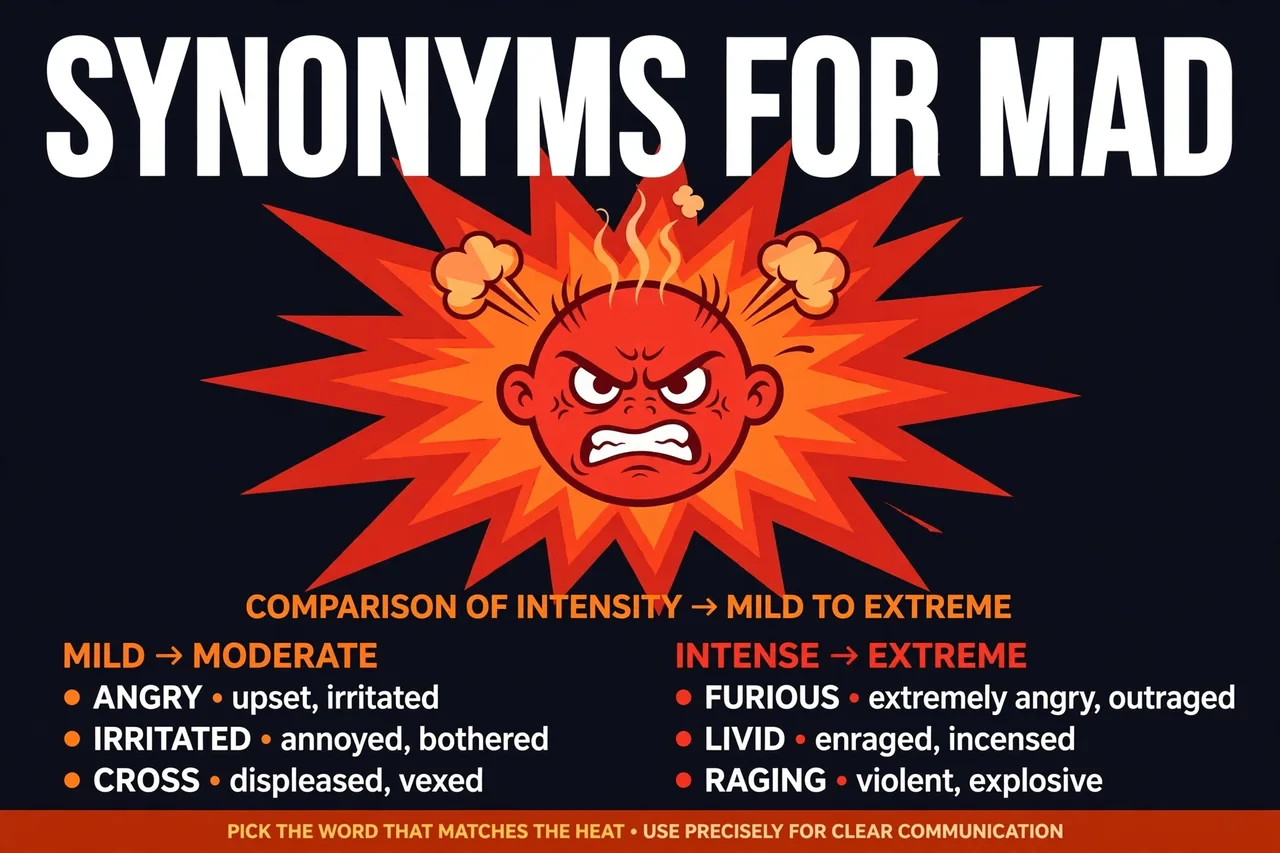
Table of Contents
Quick Answer: 12 Synonyms for Mad
| Word | Nuance / When to use it |
|---|---|
| furious | Intense, burning anger; the top everyday choice |
| livid | So angry your face changes color; extreme rage |
| irate | Angry, often in formal complaints or news writing |
| enraged | Provoked into a violent level of anger |
| incensed | Anger sparked by injustice or unfairness |
| fuming | Visibly steaming with anger, barely contained |
| insane | Not thinking clearly; the “crazy” sense of mad |
| crazy | Informal; strange, erratic, or wild behavior |
| unhinged | Mentally unstable; dangerously out of control |
| wild | Uncontrolled energy; the “frantic” sense of mad |
| frantic | Desperate, hurried activity under pressure |
| manic | Frenzied, obsessive bursts of energy |
Simple rule: decide which “mad” you mean — furious (angry), unhinged (crazy), or frantic (wild) — and choose the synonym that lives in that same sense. You can compare even more shades of meaning on Merriam-Webster’s thesaurus page for “mad”.
Angry: When Mad Means Furious
This is the most common use of “mad” — someone’s temper has flared. These ten words rank the heat from a slow simmer to a full boil.
-
angry — Feeling strong displeasure or hostility. Example: She was angry when she saw the scratch on her car.
-
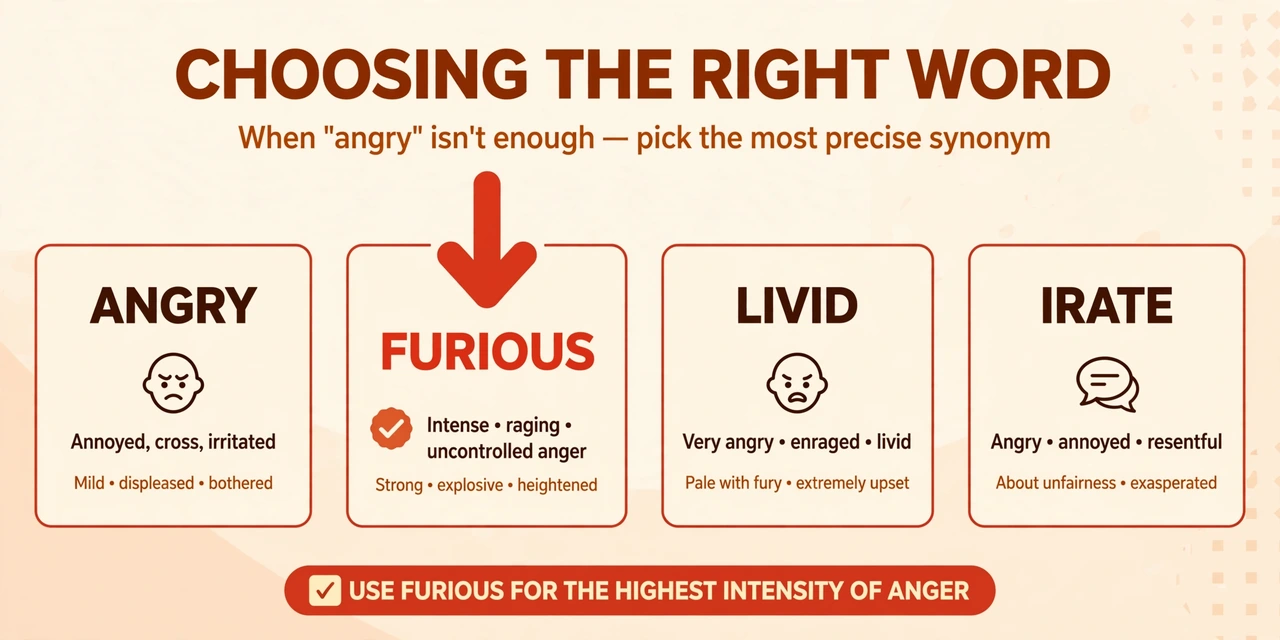
furious — Extremely angry; the strongest everyday word for rage. Example: He was furious after waiting three hours for the repairman.
-
enraged — Provoked into violent or uncontrollable anger. Example: The unfair ruling left the entire crowd enraged.
-
livid — Furious to the point of physical reaction; pale or red with rage. Example: Mom went livid when she saw the broken window.
-
irate — Very angry, often used in formal or news contexts. Example: Irate customers demanded refunds after the concert was cancelled.
-
incensed — Angered by something perceived as unjust or unfair. Example: Workers were incensed by the sudden pay cuts.
-
fuming — Showing anger openly, like steam rising; barely holding it in. Example: He sat fuming in the waiting room for another hour.
-
seething — Boiling with anger beneath a calm surface. Example: She was seething but kept smiling through the meeting.
-
outraged — Shocked and angered by something offensive or immoral. Example: Citizens were outraged by the corruption scandal.
-
indignant — Angry because of unfair treatment; carries a sense of wounded dignity. Example: He felt indignant at being blamed for someone else’s mistake.
Insane or Crazy: When Mad Means Unhinged
British speakers use “mad” this way constantly — “Are you mad?” means “Are you crazy?” These words describe minds and behavior that have come loose from reason.
-
insane — Unable to think clearly or sensibly; seriously mentally unsound. Example: Driving 120 mph on that icy road was insane.
-
crazy — Informal; wildly strange, erratic, or unpredictable. Example: My crazy neighbor keeps a parrot that recites football scores.
-
deranged — Disturbed in mind; behaving in a wild and irrational way. Example: The deranged plan involved robbing the bank with water pistols.
-
unhinged — Mentally unbalanced; no longer rational or stable. Example: His unhinged rant about the moon landing alarmed everyone at dinner.
-
bonkers — Playfully informal British slang for crazy. Example: You spent how much on concert tickets? That’s bonkers.
-
loony — Informal; silly to the point of seeming unbalanced. Example: The tabloids ran the loony story about a UFO landing in Ohio.
-
demented — Suffering from serious mental decline or irrational behavior. Example: The demented old miser hid cash inside the walls of his house.
Wild or Frantic: When Mad Means Chaotic
The third “mad” is about energy, not emotion — a mad dash, a mad rush. These words capture speed, desperation, and barely controlled motion.
-
wild — Lacking discipline or control; untamed in behavior or energy. Example: The fans went wild when the home team scored in overtime.
-
frantic — Desperately hurried, driven by fear or urgency. Example: She made a frantic call to the airline before the gate closed.
-
frenzied — Wildly excited or uncontrolled; chaotic activity. Example: A frenzied crowd rushed the stage after the final song.
-
manic — Marked by frenzied, obsessive energy; wildly busy. Example: He worked with manic intensity to finish the project overnight.
Common Mistakes With Mad Synonyms
Mixing the three senses of “mad” is the same kind of small-word confusion that trips people up with dammit vs damnit or the classic unfazed spelling trap. Watch for these four traps:
Mistake 1: Using “insane” for strong anger
❌ “My boss was insane about the missed deadline.”
✅ “My boss was furious about the missed deadline.”
Why: “insane” belongs to the crazy sense of mad. For anger, use “furious,” “livid,” or “enraged” — readers will picture the wrong emotion otherwise.
Mistake 2: Spending “livid” on mild annoyance
❌ “I was livid that my coffee was lukewarm.”
✅ “I was annoyed that my coffee was lukewarm.”
Why: “livid” describes extreme rage that shows on your face. Using it for small irritations sounds melodramatic and drains its power.
Mistake 3: Dropping “bonkers” into formal writing
❌ “The bonkers market swings rattled investors.”
✅ “The frenzied market swings rattled investors.”
Why: “bonkers” is playful slang. In business or academic writing it reads as flippant; “frenzied,” “erratic,” or “volatile” keep the tone professional.
Mistake 4: Saying “wild” when you mean angry
❌ “She was wild at him for forgetting her birthday.”
✅ “She was furious at him for forgetting her birthday.”
Why: “wild” describes uncontrolled behavior or energy, not the feeling of anger itself. A person can act wild because they are furious — the words are not interchangeable.
How to Choose the Right Synonym
- Lock the sense first. Angry (furious, livid), crazy (insane, unhinged), or wild (frantic, manic) — this single decision eliminates two-thirds of the list.
- Rank the intensity. “Annoyed” sits far below “livid,” and “eccentric” far below “deranged.” Undershoot and you sound flat; overshoot and you sound unserious.
- Mind the register. “Bonkers” and “loony” belong in banter, not boardrooms. “Irate” and “incensed” fit formal complaints; “irate customers” is a headline phrase for a reason.
- Watch the target. People are “furious”; plans and ideas are “insane”; crowds and rushes are “frantic.” The wrong word on the wrong subject reads as a mistake, not style.
- Handle mental-health words with care. “Insane,” “deranged,” “demented,” and “unhinged” carry real clinical weight — avoid them as casual insults for people behaving oddly.
- Test the swap. Replace the synonym with plain “mad” and check the sentence still makes sense. If “She was mad at the delay” works, “furious” works; if it doesn’t, your synonym came from the wrong sense.
Frequently Asked Questions
What is a synonym for mad?
The best synonyms for “mad” are furious (angry), insane (crazy), and frantic (wild) — each covers one of the word’s three main senses. Pick the one that matches the meaning you intend.
What is a strong synonym for mad when angry?
“Furious,” “livid,” “enraged,” and “irate” are the strongest anger synonyms. “Livid” and “enraged” sit at the extreme end; “irate” sounds slightly more formal.
Is “mad” the same as “crazy”?
Often, yes — especially in British English, where “Are you mad?” means “Are you crazy?” In American English, “mad” usually means angry first, so “crazy” is the clearer choice for the insanity sense.
What is a polite synonym for mad?
For anger, try “upset,” “displeased,” or “indignant” — “indignant” sounds dignified rather than explosive. For the crazy sense, “eccentric” or “unusual” soften the judgment.
What is a slang synonym for mad?
“Bonkers,” “loony,” and “nuts” are the common slang options for the crazy sense. For anger, slang runs to “ticked off,” “fuming,” or “seeing red” — all casual, none for formal writing.
Conclusion
“Mad” packs three words into one — angry, crazy, and wild — which is exactly why it misfires so often. From livid tempers to unhinged schemes to frantic deadlines, naming the sense first lets you land the perfect synonym every time.