Realize or Realise: US vs UK Spelling Explained
Realize is the American spelling and realise is the British spelling of the same verb — meaning to become aware of something, or to make something real. One-line distinction: write realize with a Z for a US audience, realise with an S for a UK audience. “I realize my mistake” is American; “I realise my mistake” is British.
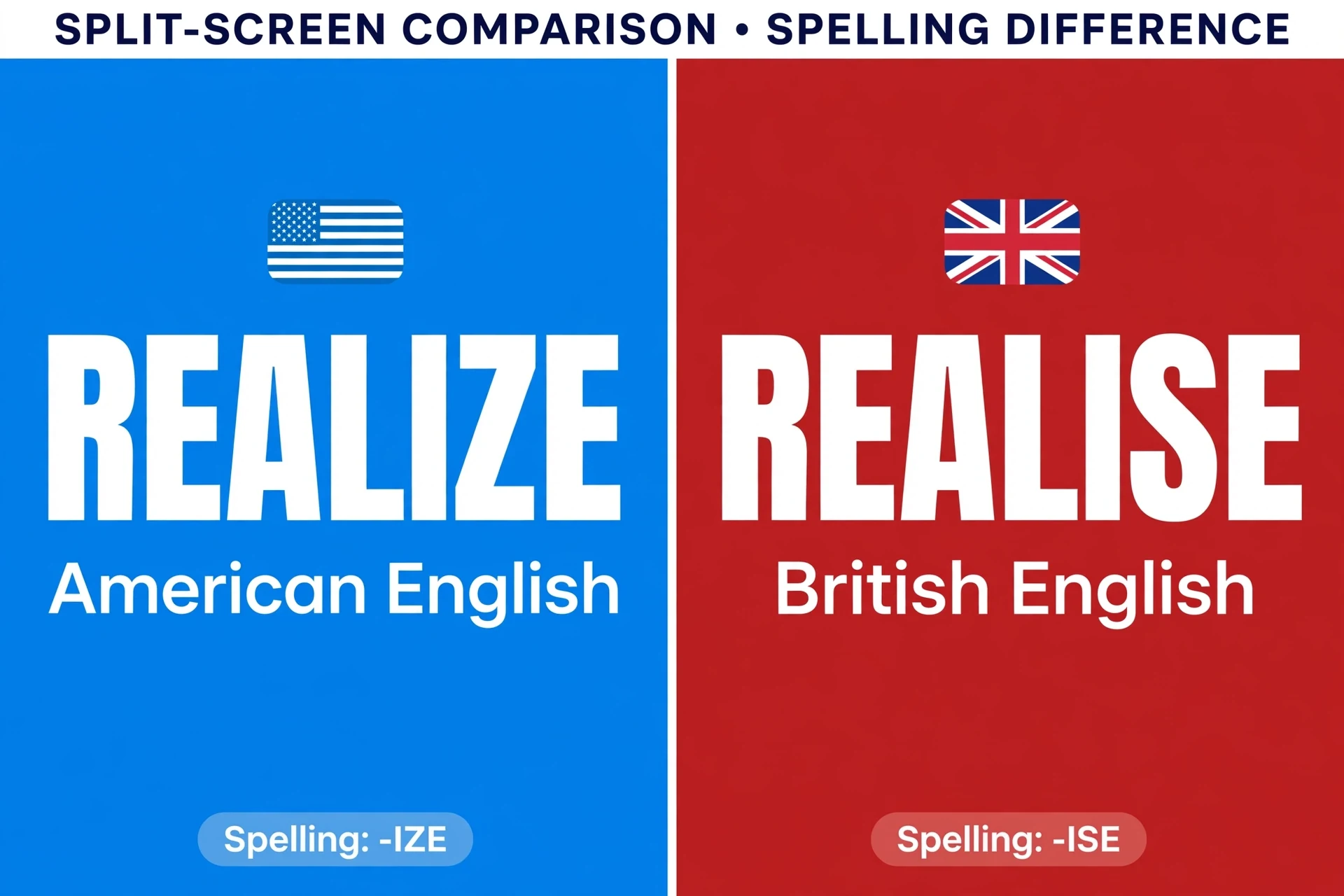
Table of Contents
- Quick Answer
- What Does Realize Mean?
- What Does Realise Mean?
- Why Two Spellings?
- Realize vs. Realise: Key Differences
- Related US vs UK Word Pairs
- Realize in American and British Writing
- Usage Examples in Real Sentences
- Common Mistakes
- Pronunciation
- How to Remember the Difference
- Frequently Asked Questions
- Conclusion
Quick Answer
| Word | Region | Main Meaning | Example |
|---|---|---|---|
| Realize | United States | To become aware of; to make real | I realize I was wrong. |
| Realise | UK, Canada, Australia | To become aware of; to make real | I realise I was wrong. |
Simple rule: same verb, same meaning — realize with a Z for American readers, realise with an S for British readers.
What Does Realize Mean?
Realize is the standard American spelling of a common verb with three main senses: to become aware of something (“she realized the truth”), to make something real or achieve it (“he realized his dream”), and in finance, to convert an asset into cash (“they realized a profit”). It’s one of the most common -ize verbs in American English, and Merriam-Webster lists realize as its headword spelling.
Examples:
- I suddenly realize I’d left my keys at home.
- She worked hard to realize her dream of opening a bakery.
- The company realized record profits last quarter.
- He didn’t realize how late it was.
- They realized their savings plan ahead of schedule.
What Does Realise Mean?
Realise is the standard British spelling — identical in meaning, grammar, and pronunciation to the American form. In the UK, Ireland, Australia, and most of the Commonwealth, this is the only accepted spelling in schools, newspapers, and government documents. British style guides treat realize as the American variant, though the Oxford dictionaries historically preferred -ize forms.
Examples:
- I suddenly realise I’d left my keys at home.
- She worked hard to realise her dream of opening a bakery.
- The firm realised record profits last quarter.
- He didn’t realise how late it was.
Why Two Spellings?
The -ize ending comes from the Greek suffix -izein via Latin, and it was the dominant English spelling for centuries. Noah Webster’s 1828 American dictionary locked in realize with a Z as the US standard. In Britain, 19th-century printers began favoring the French-influenced realise with an S, and that became the UK norm — the same Webster-driven split behind analyze and analyse. Curiously, Oxford University Press still prefers -ize spellings (“Oxford spelling”), so realize isn’t unknown in Britain — but in everyday UK writing, realise with an S is what readers expect. Neither spelling is wrong; each is the standard on its side of the Atlantic.
Realize vs. Realise: Key Differences
| Feature | Realize | Realise |
|---|---|---|
| Region | United States | UK, Ireland, Australia, Canada |
| Spelling | -ize (with Z) | -ise (with S) |
| Meaning | Become aware; make real; cash in | Exactly the same |
| Pronunciation | “REE-uh-lyze” | “REE-uh-lyze” (same) |
| Part of speech | Verb (regular) | Verb (regular) |
| Noun form | realization | realisation |
One letter changes — Z for America, S for Britain — and everything else about the verb stays identical.
Related US vs UK Word Pairs
| American (US) | British (UK) |
|---|---|
| realize | realise |
| organize | organise |
| recognize | recognise |
| apologize | apologise |
| analyze | analyse |
| criticize | criticise |
| memorize | memorise |
| emphasize | emphasise |
The -ize/-ise split is one of the most consistent patterns in US/UK spelling: hundreds of verbs follow it.
Realize in American and British Writing
The split shows up everywhere. American newspapers, textbooks, and business emails use realize — a New York editor would flag realise as a typo. British newspapers like The Guardian and the BBC use realise — a London sub-editor would flag realize the same way. Students take note: exam boards mark against the wrong regional form, so match your spelling to the curriculum you’re tested on. And if you’re writing for an international audience, pick one form and apply it to every -ize/-ise verb in the document — mixing realize with organise looks sloppy in both countries.
Usage Examples in Real Sentences
At Home
US: “I realize we need more milk.” — UK: “I realise we need more milk.” Same fridge, different letter.
At Work
An American manager writes “We realized our quarterly goals,” while a British manager writes “We realised our quarterly goals.” The achievement is identical.
In Conversation
“Do you realize what time it is?” and “Do you realise what time it is?” are the same question — the Z/S swap is invisible in speech.

Common Mistakes
The danger with -ize/-ise verbs is inconsistency — and realize belongs to the same family as other -ize verbs like apologize and apologise, so the same rules apply.
Mistake 1: Mixing -ize and -ise in one document
❌ “We realize the deadline moved, so please organise your files.”
✅ “We realize the deadline moved, so please organize your files.”
Why: choose the American set or the British set — never mix them in one document.
Mistake 2: Writing “relize” (missing the A)
❌ “She relized the error too late.”
✅ “She realized the error too late.” (US) / “She realised the error too late.” (UK)
Why: relize is a misspelling in every variety of English.
Mistake 3: Using “realize” as a noun
❌ “The realize of the situation hit him hard.”
✅ “The realization of the situation hit him hard.”
Why: the noun form is realization (US) or realisation (UK) — never realize itself.
Mistake 4: Writing the wrong form for the exam or publisher
❌ A UK student writing “I realise” as “I realize” in a GCSE essay.
✅ A UK student writing “I realise” in a GCSE essay.
Why: examiners and publishers mark the foreign regional spelling as an error — match your audience.
Pronunciation
Both are pronounced “REE-uh-lyze” — three syllables, stress on the first, with a Z sound at the end regardless of spelling. The word rhymes roughly with finalize and penalize. British speakers write realise but still say it with a Z sound, so the spelling difference never reaches the ear.
How to Remember the Difference
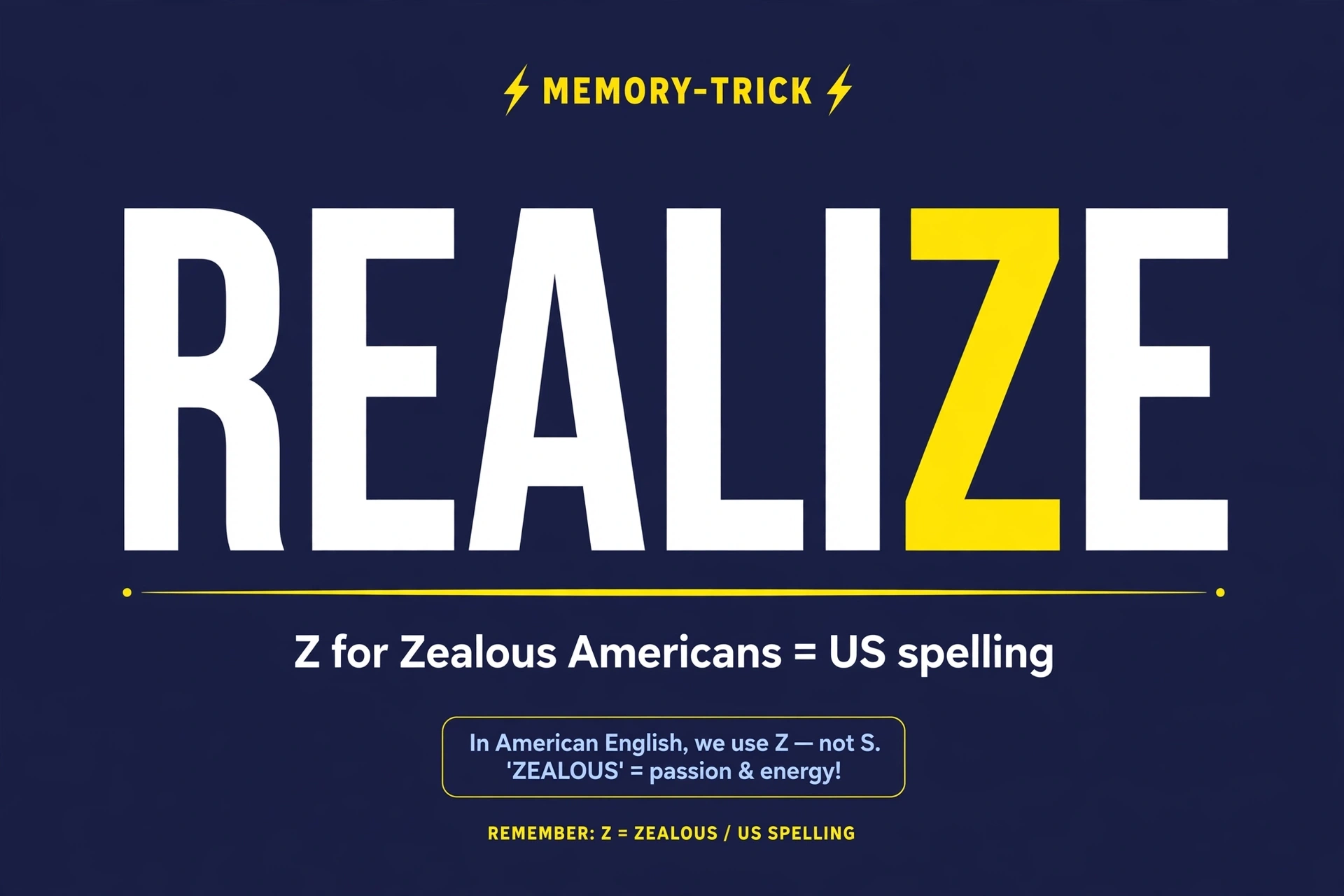
American spelling loves the letter Z — think “Z for Zealous Americans” to remember realiZe. British spelling uses S — think “S for Sovereign” to remember realiSe. Quick recap:
- Realize = American spelling (bold Z, “Z for Zealous Americans”)
- Realise = British spelling (bold S, “S for Sovereign”)
- Same verb, same Z sound — match the spelling to your audience and keep every -ize/-ise verb consistent
Frequently Asked Questions
Is it realize or realise?
Both are correct. Realize is the American spelling; realise is the British spelling of the same verb.
Does Oxford University use -ize or -ise?
Oxford University Press famously prefers “Oxford spelling” — realize with a Z — even in British texts. But most UK newspapers, schools, and publishers use realise with an S.
Which spelling is used in Canada?
Canada is mixed: government and education usually use realise, but realize is common thanks to American influence. Pick one and stay consistent.
Is “realize” ever a noun?
No. The noun is realization (US) or realisation (UK). “The realize of the problem” is always wrong.
What are the three meanings of realize?
To become aware of something, to make something real (achieve it), and in finance, to convert an asset into cash — all three senses work with either spelling.
Is “relize” a word?
No — relize is a common misspelling of realize/realise in all varieties of English.
Conclusion
Realize and realise are the same verb in different regional dress — American with a Z, British with an S. Choose the spelling your audience expects, apply it to every -ize/-ise verb in your document, and remember: Z for Zealous Americans, S for Sovereign Britain.