Irregardless or Regardless: What’s the Difference?
Irregardless or regardless — only one of these words belongs in standard English. Regardless is the correct choice, an adverb meaning “despite everything” or “in spite of the circumstances.” Irregardless is a widely heard but nonstandard blend of irrespective and regardless that editors, teachers, and style guides consistently reject.
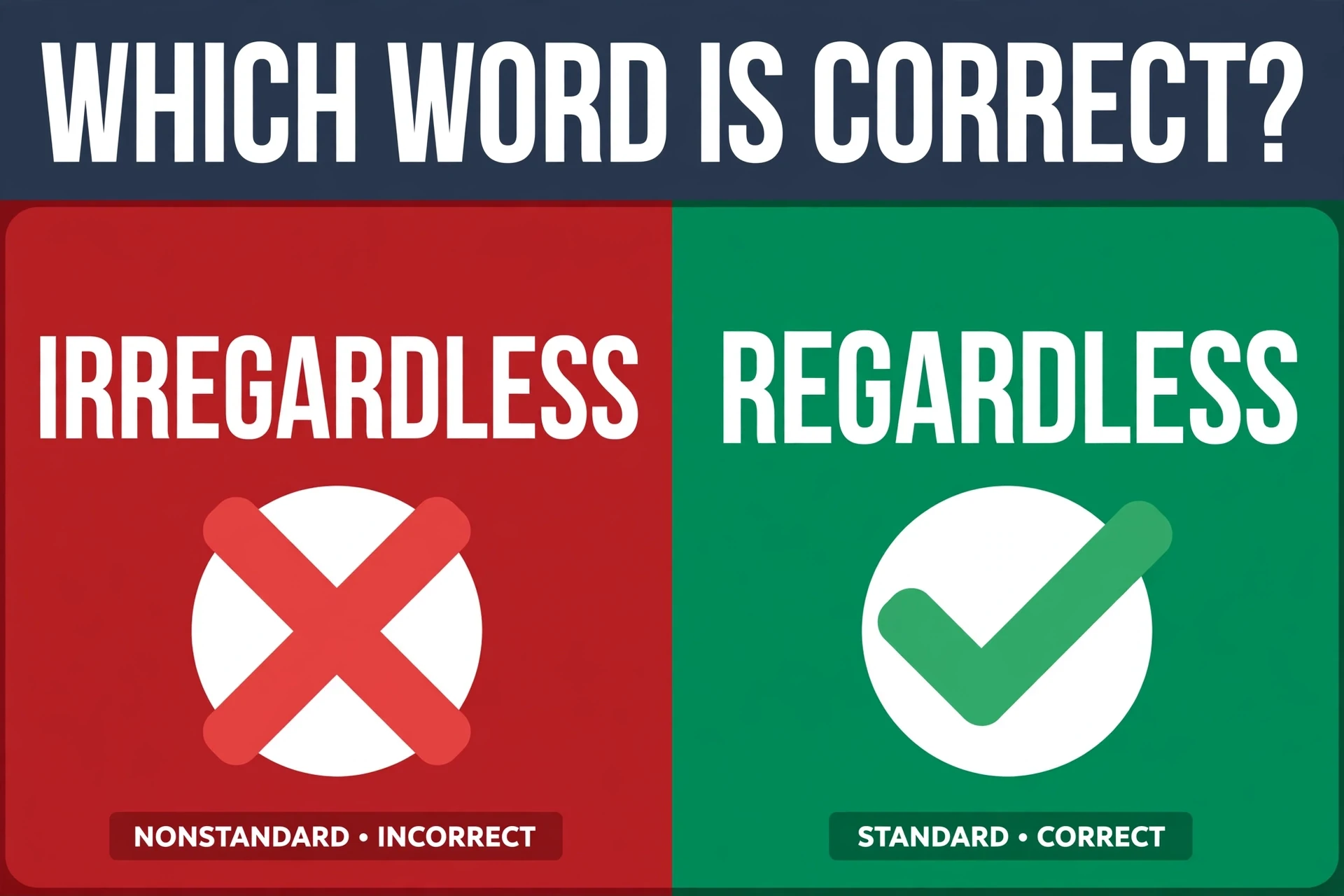
Table of Contents
Quick Answer
| Word | Part of Speech | Main Meaning | Example |
|---|---|---|---|
| Regardless | Adverb | Despite everything; in spite of the circumstances | “The trains were canceled, but we traveled regardless.” |
| Irregardless | Nonstandard adverb | Intended to mean the same as regardless, but considered incorrect in standard English | “Irregardless of the cost, we booked the tickets.” (avoid this) |
Simple rule: If you want to sound correct in any setting — an email, an exam, a speech — use regardless and strike irregardless from your vocabulary.
What Does Regardless Mean?
Regardless is an adverb meaning “despite what has happened or been said” — essentially “anyway” or “nevertheless.” It most often appears in the phrase “regardless of,” which works like “no matter what” and can attach to almost any noun or situation.
- The forecast promised storms, but the wedding went ahead regardless.
- She had a sprained ankle and still finished the race regardless.
- “You are grounded,” her father said. “I’m going regardless,” she muttered.
- Regardless of the final score, the team played brilliantly.
- Ticket prices doubled, yet fans queued for hours regardless.
What Does Irregardless Mean?
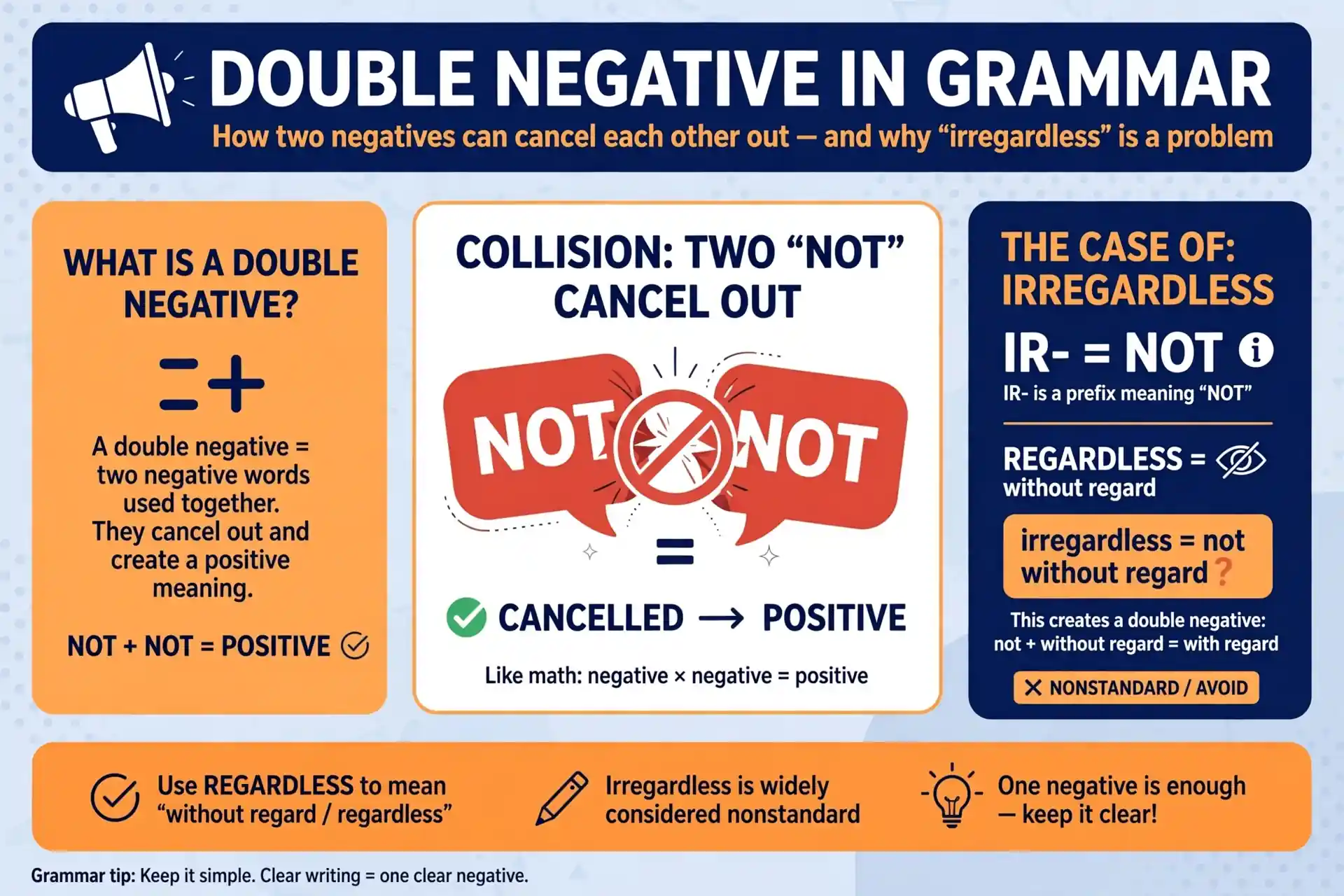
Irregardless is meant to mean exactly the same thing as regardless — but it carries a warning label. It is a nonstandard word, a blend of irrespective and regardless that surfaced in American speech in the early 1900s and never earned a place in edited English. The problem is grammatical: the prefix ir- means “not” (as in irregular, irresponsible, irrelevant), so irregardless literally reads as “not without regard” — a double negative that means the opposite of what the speaker intends.
Merriam-Webster does list irregardless, but the entry is marked “nonstandard,” with usage notes explaining that it is widely considered an error. A dictionary listing describes how people actually talk; it does not certify the word as correct.
You will mostly hear it in casual conversation, where it usually passes without comment:
- “Irregardless of what the critics say, I loved the movie.” (casual speech — avoid in writing)
- “We hit the deadline irregardless of the staffing problems.”
- “Irregardless, the fundraiser was a huge success.”
- “He showed up irregardless of the invitation.”
Why the double negative matters
Word parts carry meaning even when speakers forget them: irregardless smuggles in a negation that cancels the word’s own meaning. Nobody intends to say “not regardless” — but that is what the letters spell.
Irregardless vs. Regardless: Key Differences
| Feature | Regardless | Irregardless |
|---|---|---|
| Status in standard English | Correct and fully standard | Nonstandard — widely considered an error |
| Dictionary label | Standard entry, no warning | Listed as “nonstandard” with usage notes |
| Literal meaning of the parts | “Without regard” — exactly as intended | “Not without regard” — an accidental double negative |
| Safe in formal writing | Yes — essays, emails, reports, applications | No — undermines the writer’s credibility |
| Common in casual speech | Yes, everywhere | Yes, especially in American English |
| What editors recommend | Use freely | Replace with regardless every time |
The takeaway is blunt: regardless works everywhere from a text message to a job application, while irregardless can make even a strong argument sound careless.
Irregardless and Regardless in Real Sentences
At Work
Regardless: “Regardless of the budget cuts, the launch stays on schedule.” — confident and professional.
Irregardless (avoid): “Irregardless of the budget cuts, the launch stays on schedule.” — the nonstandard word distracts from the message.
In a workplace email, one stray ir- can quietly cost you credibility with a new manager or client.
In Conversation
Regardless: “It was pouring rain, but we went hiking regardless.”
Irregardless (avoid): “It was pouring rain, but we went hiking irregardless.”
Friends won’t correct you at the dinner table, but the habit follows you into rooms where people will notice.
In Formal Writing
Regardless: “Regardless of the study’s limitations, the findings are significant.”
Irregardless (avoid): “Irregardless of the study’s limitations, the findings are significant.”
Examiners, admissions officers, and hiring managers treat irregardless as a red flag for careless writing.
In Arguments and Debates
Regardless: “Regardless of your objections, the policy takes effect Monday.” — firm and grammatical.
Irregardless (avoid): “Irregardless of your objections, the policy takes effect Monday.” — hands your opponent an easy opening.
When you want to sound unshakable, don’t give the other side a grammar mistake to seize on.
Common Mistakes
Word mix-ups like this one are everywhere — the same instinct that builds irregardless also produces the principal vs principle confusion and the momento vs memento spelling slip. Here are the four traps to avoid:
Mistake 1: Using irregardless in formal writing
❌ “Irregardless of the results, we recommend expanding the program.”
✅ “Regardless of the results, we recommend expanding the program.”
Why: Reports, applications, and exams are judged on precision — a nonstandard word stands out immediately to any careful reader.
Mistake 2: Thinking the ir- prefix adds emphasis
❌ “I want it done irregardless — no excuses!”
✅ “I want it done regardless — no excuses!”
Why: The prefix ir- doesn’t intensify anything; it negates, turning the word into a logical double negative.
Mistake 3: Assuming a dictionary listing means approval
❌ “It’s in the dictionary, so irregardless must be fine.”
✅ “Dictionaries also record nonstandard usage — with an explicit warning label.”
Why: Merriam-Webster includes the word to describe real speech while clearly marking it nonstandard.
Mistake 4: Reaching for irregardless to sound formal
❌ Opening a cover letter with “Irregardless of my limited experience…”
✅ Opening with “Regardless of my limited experience…”
Why: Longer is not fancier — irregardless impresses nobody and worries everybody who reads carefully.
Pronunciation
Regardless is pronounced rih-GARD-luss: three syllables with the stress on the middle one, rhyming roughly with “regard” plus “less.” Irregardless adds one unstressed syllable at the front: ih-rih-GARD-luss. Say both aloud and you’ll hear the extra syllable adding effort without adding meaning.
How to Remember the Difference
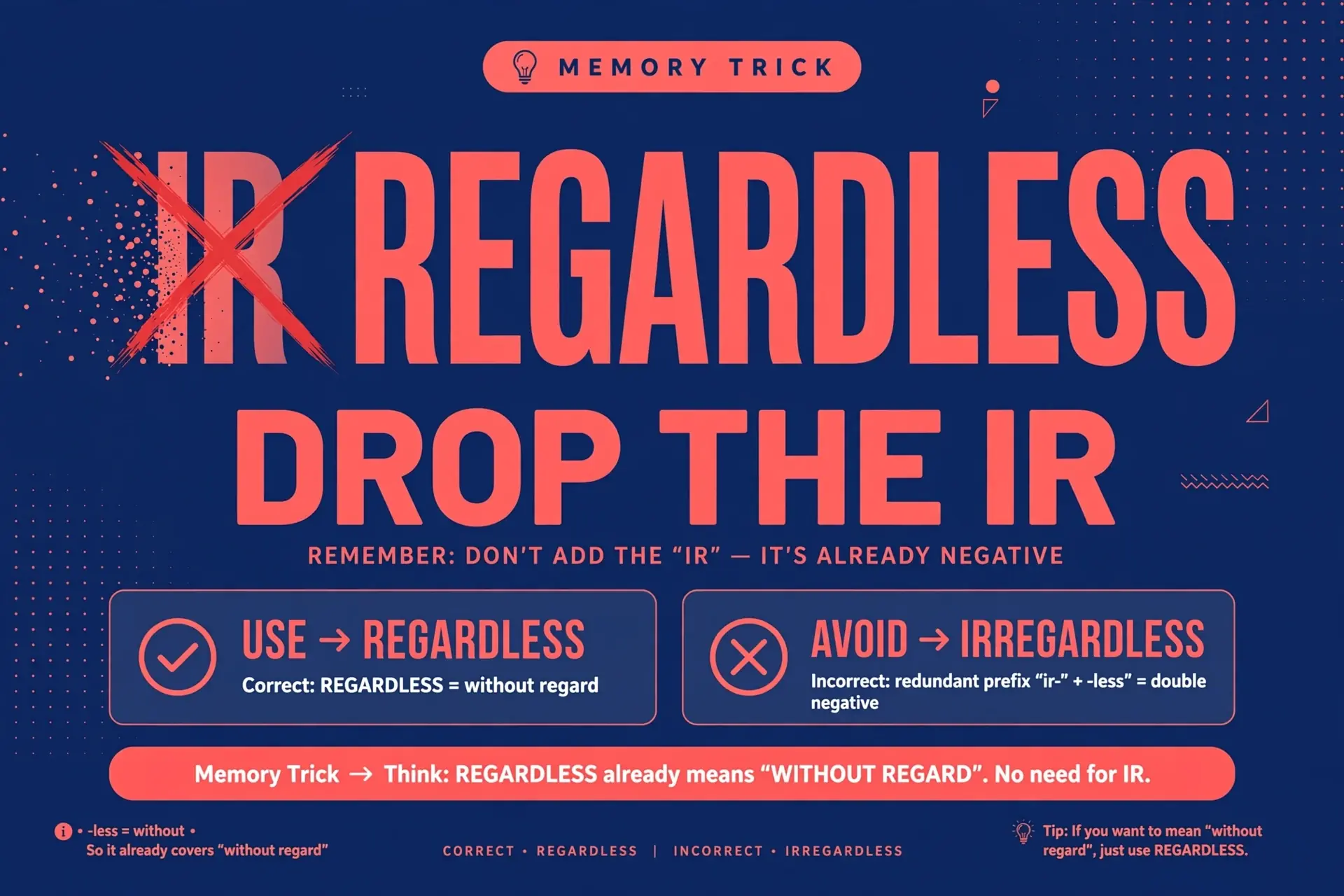
The trick is subtraction: regardless is already complete, so cross out the IR and throw it away.
- IR means “not” — irregular, irresponsible, irrelevant. “Not regardless” is nonsense, so the prefix has to go.
- REgardless starts with RE like “real English” — the version that belongs in real writing.
- Remember the phrase “no irritating extras”: if a word needs a bonus prefix to feel important, it probably doesn’t.
Frequently Asked Questions
Is it irregardless or regardless?
Use regardless. It is the standard, correct word in every context, from casual texts to legal briefs. Irregardless is nonstandard and best avoided entirely.
Is irregardless a real word?
It appears in some dictionaries, including Merriam-Webster, but always with the label “nonstandard.” That means people genuinely say it — not that it is correct. Dictionaries record slang and errors too; the label is the whole point.
Why do people say irregardless?
It is a blend of irrespective and regardless that caught on in American speech about a century ago. The extra ir- probably felt emphatic to early users, even though it accidentally creates a double negative.
Will I lose marks for using irregardless in an exam?
Very likely, yes. Examiners, editors, and hiring managers overwhelmingly treat it as an error, which makes it one of the costliest small mistakes in English — a single word that can color a reader’s view of your whole piece.
What can I say instead of irregardless?
Regardless is the direct replacement and fits every sentence where irregardless appears. Alternatives include “irrespective of,” “no matter what,” “anyway,” and “nevertheless.”
Do any style guides accept irregardless?
None — Chicago, AP, MLA, and Oxford all recommend regardless, making this one of the rare usage questions with a unanimous answer.
Conclusion
Regardless is the word you want — correct, versatile, and welcome everywhere from group chats to boardrooms. Irregardless may survive in casual speech, but in writing it only invites correction. Drop the ir-, keep your credibility, and never look back.