Conscience or Consience: What’s the Difference?
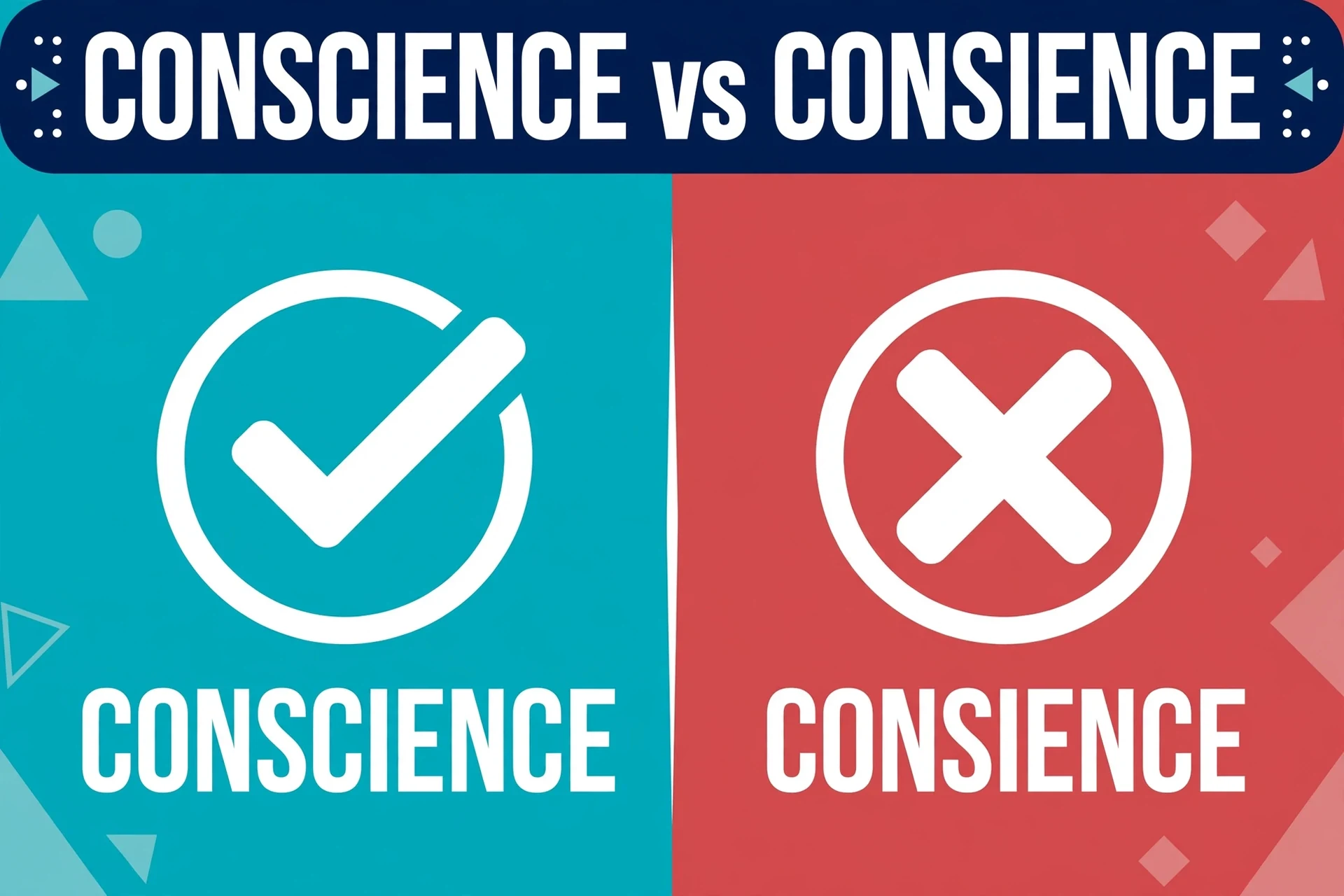
Conscience is the correct spelling — your inner sense of right and wrong. Consience is a misspelling, born the moment a fast typist drops one N too many from the middle of a long word. The distinction matters more than most typos: “She acted with a clear conscience,” while “consience” has never been correct anywhere.
Quick Answer
| Word | Part of Speech | Main Meaning | Example |
|---|---|---|---|
| conscience | Noun | The inner sense of right and wrong that guides behavior | ✅ “His conscience wouldn’t let him lie.” |
| consience | Not a word | A misspelling of “conscience” | ❌ “His consience wouldn’t let him lie.” |
Simple rule: Conscience is spelled C-O-N-S-C-I-E-N-C-E — with an SC in the middle, not a single S.
What Does Conscience Mean?
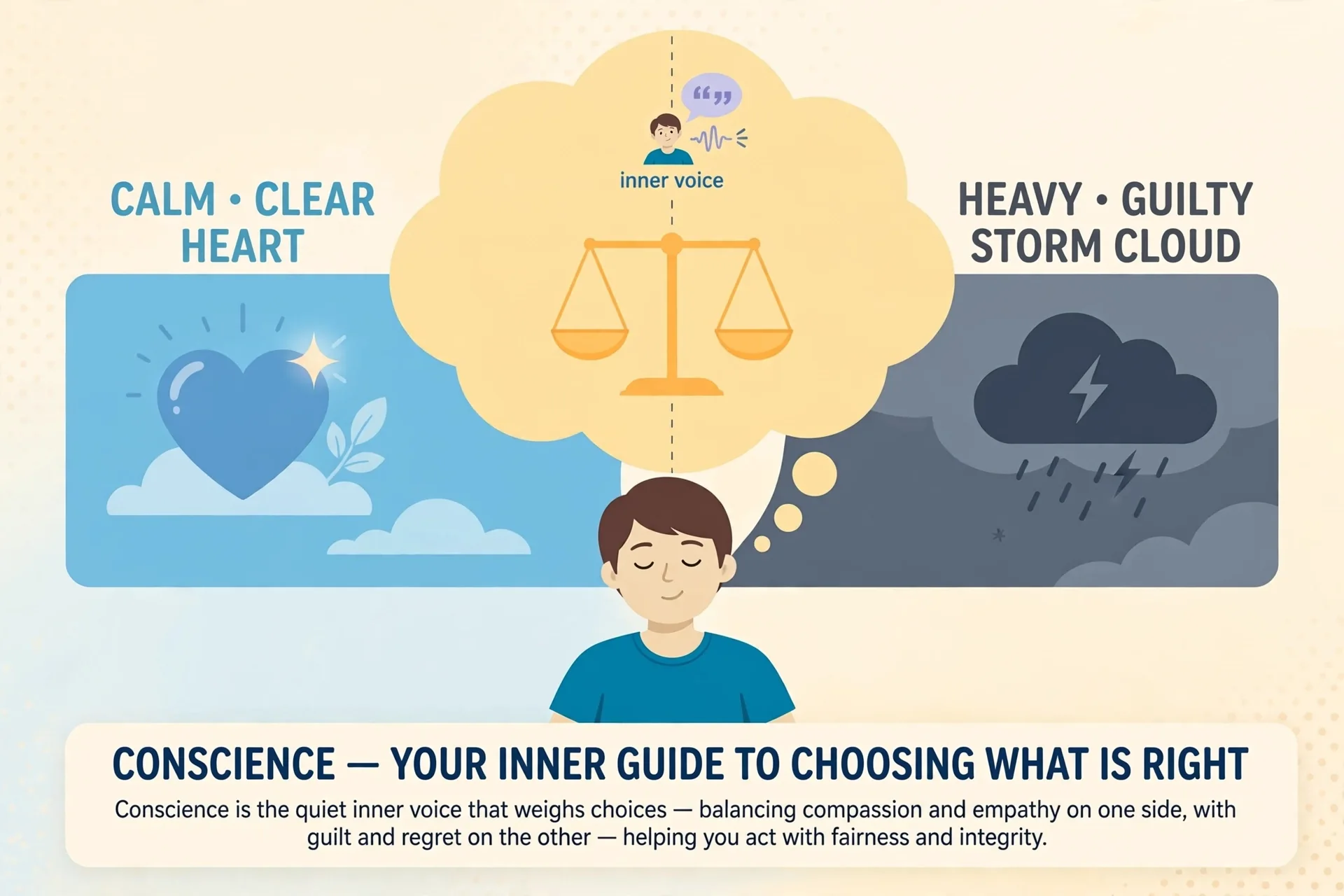
Conscience is a noun naming the inner voice that judges your own actions — the part of you that approves when you do right and nags you when you don’t. It comes from Latin conscientia, “knowledge within oneself,” which explains the unusual SC in the middle: the word literally contains “science” (scientia, knowledge). Merriam-Webster’s entry for “conscience” defines it as the sense of the moral goodness or blameworthiness of one’s own conduct.
The inner moral voice
This is the everyday sense — guilt, pride, and the quiet verdicts we pass on ourselves. It shows up in fixed phrases like “a clear conscience,” “a guilty conscience,” and “in all conscience.”
- “Her conscience told her to return the lost wallet.”
- “He couldn’t enjoy the prize with a guilty conscience.”
- “She slept well because her conscience was clear.”
- “In all conscience, I can’t recommend this product.”
- “His conscience wrestled with the decision for days.”
Moral principle in action
Beyond personal guilt, “conscience” names the faculty of moral judgment itself — the reason societies talk about “freedom of conscience” and “prisoners of conscience.”
- “The law protects freedom of conscience for all citizens.”
- “He was called a prisoner of conscience by human rights groups.”
- “Voting against the bill was a matter of conscience for her.”
- “Doctors may refuse on grounds of conscience in some countries.”
What Does Consience Mean?
Consience means nothing — it is “conscience” with the C dropped from the SC cluster, and it appears in no dictionary. The mistake is easy to make: the SC in the middle is pronounced like a plain S (“KON-shens”), so your ears tell you one letter is enough while the spelling demands two. Everyone who writes “consience” meant conscience.
The misspelling turns up constantly in forums, social posts, and even student essays — here is what it was meant to be:
- “My consience is killing me.” (meant: conscience)
- “He has no consience at all.” (meant: conscience)
- “Listen to your consience.” (meant: conscience)
- “A clear consience helps you sleep.” (meant: conscience)
- “She acted out of consience.” (meant: conscience)
Because “consience” looks plausible at a glance, it slips past proofreaders who are reading fast — which is why it pays to know the SC cluster by heart.
Conscience vs. Consience: Key Differences
| Feature | conscience | consience |
|---|---|---|
| Status | Correct, standard spelling | Misspelling — not a word |
| Meaning | Inner sense of right and wrong | None (meant as “conscience”) |
| Middle letters | SC (con-SC-ience) | Single S (the dropped letter) |
| Origin | Latin conscientia (“inner knowledge”) | Typo, not an etymology |
| Pronunciation | KON-shens | Same — pronounced identically |
| Example | ✅ “a guilty conscience” | ❌ “a guilty consience” |
The spelling keeps the SC from its Latin root even though the ear hears only S — spell the history, not the sound.
Conscience and Consience in Real Sentences
At Home
✅ “Let your conscience be your guide when you find that lost phone.”
❌ “Let your consience be your guide when you find that lost phone.”
Family advice about honesty deserves the honest spelling — this is the word’s natural habitat.
At Work
✅ “The whistleblower said her conscience left her no choice.”
❌ “The whistleblower said her consience left her no choice.”
In a professional report or ethics complaint, “consience” undercuts the very credibility the sentence is claiming.
In Conversation
✅ “I couldn’t in all conscience ask them to pay more.”
❌ “I couldn’t in all consience ask them to pay more.”
Spoken, nobody can tell — which is exactly why the mistake hides until the words hit the page.
In Formal Writing
✅ “The declaration protects every prisoner’s freedom of conscience.”
❌ “The declaration protects every prisoner’s freedom of consience.”
Legal and academic writing is where “conscience” appears most, and where the misspelling costs the most.
Common Mistakes
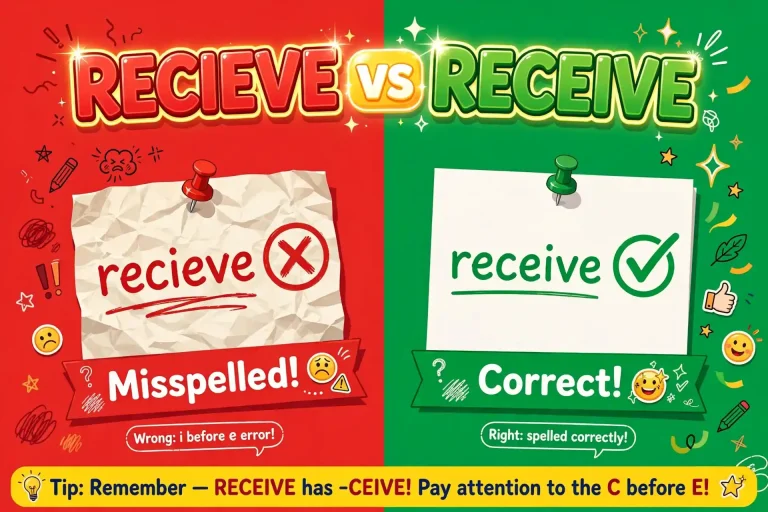
Dropped and doubled letters cause the same slips across the dictionary — the “loose” vs “lose” mix-up shows how one letter changes meaning entirely, and the “recieve” vs “receive” spelling trap shows how silent letters get shuffled. The conscience traps:
Mistake 1: Dropping the C from SC
❌ “My consience won’t allow it.”
✅ “My conscience won’t allow it.”
Why: The SC is pronounced as a plain S, so the hand writes what the ear hears. But the spelling keeps both letters from the Latin root scientia — the same “science” hiding inside the word.
Mistake 2: Confusing “conscience” with “conscious”
❌ “He was conscience of the danger.” (meant: aware of it)
✅ “He was conscious of the danger.”
Why: The two words share a root and almost a spelling, but they do different jobs: “conscious” means awake or aware; “conscience” is the moral voice. The endings differ — -ous for the adjective, -ence for the noun.
Mistake 3: Doubling the wrong letter
❌ “consscience”
✅ “conscience”
Why: Overcorrecting the dropped-C mistake, some writers double the S instead. The word has one C followed by one S: con-SC-ience, never SS.
Mistake 4: Swapping the IE ending
❌ “conscince,” “conscinse”
✅ “conscience”
Why: Long words invite ending drift, especially under the pull of the i-before-e rhyme. The ending is -IENCE: think of “science” again, which ends exactly the same way.
Pronunciation
Conscience is pronounced KON-shens — three syllables collapsing toward two in fast speech, with the stress on the first. The SC sounds like SH, the final E is silent. Consience would sound identical, which is precisely why the spelling has to be learned rather than sounded out.

How to Remember the Difference
Your conscience contains science — C-O-N-SCI-E-N-C-E. The inner voice that knows right from wrong carries “knowledge” inside it, and “science” means knowledge. Once you see the hidden word, the SC cluster is impossible to drop.
- The science trick: break it as con-SCI-ence — the SCI of “science” sits in the middle, so both letters stay.
- Knowledge link: “science” means knowledge, and your conscience is knowledge of right and wrong — the spelling tells the story.
- The -IENCE ending: like “science,” it ends in -IENCE, never -INCE or -ISE.
- Don’t confuse with “conscious”: conscious (aware) ends in -OUS like other adjectives; conscience (the moral voice) ends in -ENCE like other nouns.
Frequently Asked Questions
Is it conscience or consience?
It is “conscience” — C-O-N-S-C-I-E-N-C-E. “Consience” is a misspelling with the C dropped from the SC cluster.
What does “conscience” mean?
Your inner sense of right and wrong — the part of you that approves good actions and produces guilt over bad ones. It also appears in phrases like “freedom of conscience” and “matter of conscience.”
What is the difference between “conscience” and “conscious”?
“Conscience” is a noun meaning the moral inner voice; “conscious” is an adjective meaning awake, alert, or aware. You are conscious of your conscience — the words are related but not interchangeable.
Why is “conscience” spelled with SC?
It comes from Latin conscientia, “knowledge within oneself,” built on scientia (knowledge) — the root of the English word “science.” The spelling preserves that history even though modern ears hear only an S.
How do you pronounce “conscience”?
KON-shens — stress on the first syllable, SC pronounced like SH, final E silent.
Is “consience” ever correct?
No. It is not listed in any dictionary and is not a regional variant — always a typo for “conscience.”
Conclusion
Conscience is your inner moral voice, spelled with the hidden word science inside it; consience is simply that word with a letter missing. Keep the SC, and your conscience — and your spelling — stay clear.