Synonyms for Scary: 24+ Words With Examples
Writers reach for the word “scary” when something frightens, startles, or unsettles them — but repeating it drains the feeling from your sentences. A haunted house story, a thriller review, and a news report all need different shades of fear. Below you will find 24 synonyms for scary grouped by nuance, each with a clear meaning and a real example sentence.
Quick Answer
Here are the 12 most useful synonyms for scary at a glance — pick the one that matches your exact shade of fear.
| Word | Nuance / When to use it |
|---|---|
| frightening | General, safe default for almost any scary situation. |
| terrifying | Extreme fear; stronger than frightening. |
| creepy | Uneasy, skin-crawling dread rather than shock. |
| spooky | Light-hearted supernatural fear (ghosts, haunted houses). |
| eerie | Strange, quiet, unnatural atmosphere. |
| horrifying | Shock mixed with disgust or revulsion. |
| alarming | Fear triggered by sudden danger or bad news. |
| intimidating | Fear of a person, task, or authority — not monsters. |
| chilling | Literary; fear that runs cold down your spine. |
| menacing | A threat that promises harm, like a storm or a stranger. |
| daunting | Fear of starting something difficult. |
| petrifying | Fear so strong it freezes you in place. |
Simple rule: ask what is frightening — if it is a shock or threat, choose terrifying or alarming; if it is a weird atmosphere, choose eerie or creepy.
Mildly Frightening
Creepy — causing a sick, uneasy feeling, like something is wrong but you cannot name it. The old caretaker gave us a creepy smile that made us back away slowly.
Spooky — playfully or mildly scary in a supernatural way. The abandoned cabin looked spooky in the moonlight, but the kids loved it.
Eerie — strange and mysterious in a way that raises goosebumps. An eerie silence settled over the empty hallway.
Unsettling — making you feel slightly anxious or on edge. There was something unsettling about the way the lights flickered at midnight.
Hair-raising — thrillingly scary; makes your hair stand on end. He told a hair-raising story about getting lost in the woods at night.
Nerve-wracking — scary because of tension and anticipation. Waiting for the test results was a nerve-wracking experience.
Deeply Frightening
Frightening — the neutral all-purpose word for something that causes fear. The news of the earthquake was frightening for everyone in the city.
Terrifying — extremely frightening; fills you with terror. It was terrifying to hear the tornado sirens so close to our street.
Horrifying — shocking and deeply disturbing, often with disgust. The documentary showed the horrifying conditions inside the collapsed mine.
Petrifying — so frightening that it leaves you frozen and unable to act. She felt a petrifying panic when the stage lights suddenly went out.
Dreadful — full of dread; a strong, formal word for fear-inducing. They faced the dreadful possibility that the bridge would not hold.
Supernatural and Spooky
Haunting — staying in your mind like a ghost; hard to forget. The haunting melody from the music box drifted through the attic.
Ghostly — like a ghost: pale, faint, otherworldly. A ghostly figure appeared at the end of the corridor and vanished.
Phantom-like — resembling something that is not really there. He felt a phantom-like presence behind him in the dark cellar.
Macabre — disturbing and horror-like because it involves death. The museum’s macabre collection of skulls fascinated and repelled visitors.
Sinister — evil-looking or suggesting something bad will happen. The sinister shape moved across the window just before midnight.
Ghastly — causing great horror or fear; shockingly dreadful. The ghastly scream echoed through the empty hotel.
Formal and Strong
Alarming — causing sudden fear or worry, often from news. The alarming rise in cases forced the school to close for a week.
Intimidating — frightening someone into feeling nervous or small. The professor’s stern manner was intimidating to first-year students.
Menacing — threatening; suggesting harm is about to happen. Dark, menacing clouds gathered over the stadium as the match ended.
Chilling — coldly frightening; fear felt physically down the spine. His chilling warning stayed with her all the way home.
Daunting — frightening because of difficulty or scale. Learning a new language at forty seemed daunting at first.
Dismaying — causing worry, sadness, and fear at once. The dismaying report showed the forest fire spreading toward the village.
Common Mistakes
People often confuse near-synonyms with true synonyms — a word can feel scary-adjacent without actually meaning “scary.” The same kind of mix-up happens with spelling: many writers confuse dieing or dying and dyeing or dying, which sound alike but mean different things.
Mistake 1: Using “dreaded” as a synonym for scary
❌ The clown movie was so dreaded that we left early.
✅ The clown movie was so terrifying that we left early.
Why: “dreaded” means feared in advance, not frightening in the moment — you dread an exam, but the horror scene itself is terrifying.
Mistake 2: Using “scared” where the subject causes fear
❌ The movie was scared.
✅ The movie was frightening — we were scared.
Why: “scared” describes how a person feels, not what the thing is. The cause is frightening; the person is scared.
Mistake 3: Using “nervous” for genuinely scary things
❌ The haunted house was really nervous.
✅ The haunted house was really spooky.
Why: “nervous” describes a person’s state, not the scary thing. People get nervous; houses are spooky.
Mistake 4: Using “awful” as a pure fear word
❌ The storm outside sounded awful.
✅ The storm outside sounded menacing.
Why: “awful” mainly means very bad, and its fear sense is vague. “Menacing” pins down the threatening feeling.
How to Choose the Right Synonym
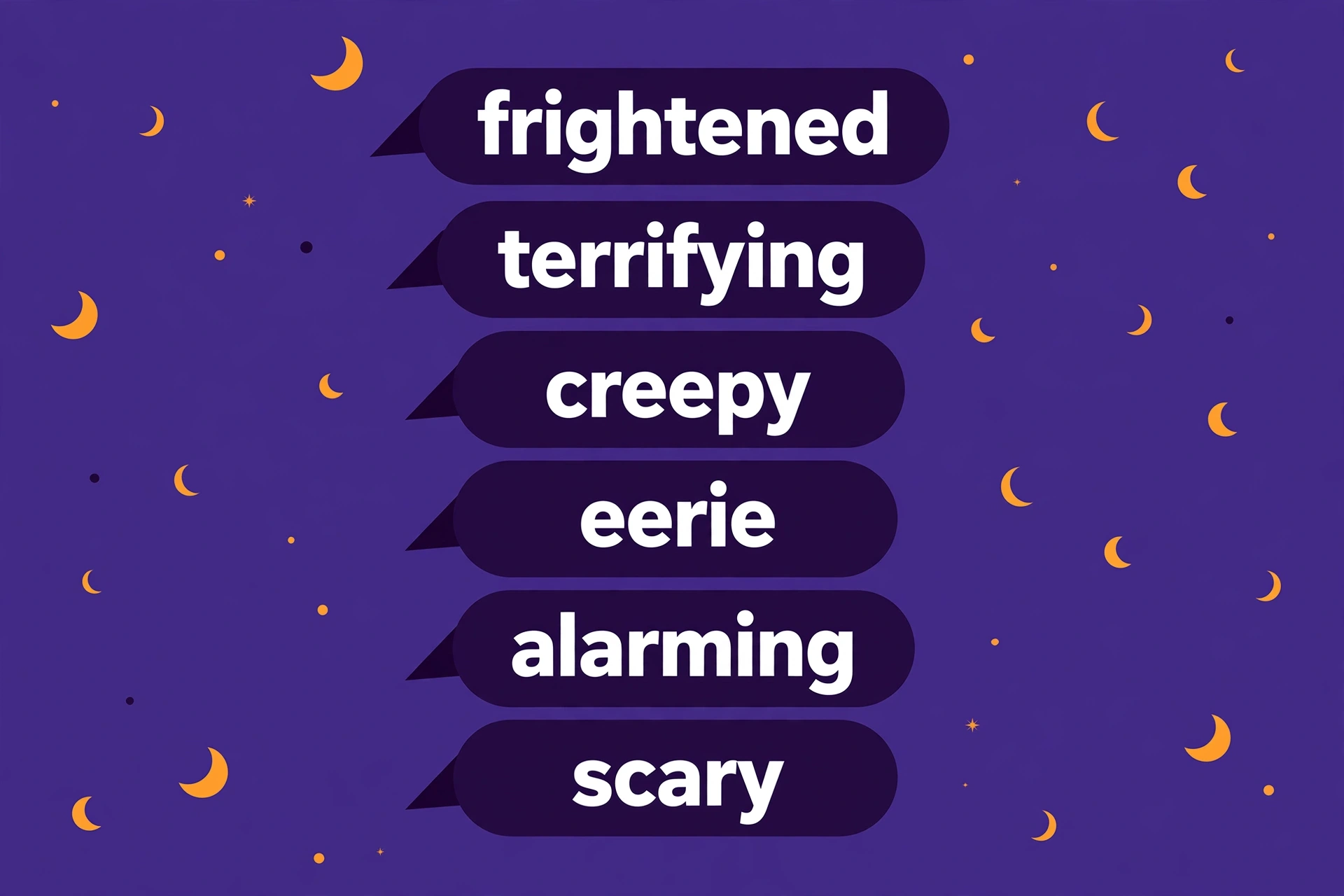
- Match the intensity: use creepy or spooky for mild fear and terrifying or horrifying for extreme fear.
- Check the cause: supernatural things suit eerie, ghostly, or macabre; real-world danger suits alarming, menacing, or intimidating.
- Mind the register: in formal writing prefer alarming, dreadful, or dismaying; in casual speech creepy, spooky, and hair-raising feel natural.
- Watch the subject: “scared” and “nervous” describe people, never the scary thing itself — use frightening or spooky instead.
- Keep connotation clean: sinister and macabre carry evil or deathly overtones — avoid them for merely startling moments.
Frequently Asked Questions
What is a synonym for scary?
The best all-purpose synonyms for scary are frightening (neutral), terrifying (intense), creepy (uneasy), eerie (strange atmosphere), and spooky (playful supernatural fear). Pick the one that matches your exact shade of fear.
What is a stronger word for scary?
Terrifying, horrifying, and petrifying are all stronger than scary. Terrifying emphasizes extreme terror, horrifying adds shock and revulsion, and petrifying suggests fear that freezes you in place.
What is a synonym for scary that is not too intense?
Use creepy, spooky, or unsettling for mild fear. Spooky is the lightest and often playful; creepy and unsettling describe a quiet uneasiness rather than a shock.
Is “frightening” a synonym for scary?
Yes — frightening is the closest neutral synonym for scary and works in almost any sentence where scary would fit, including formal writing.
What is a formal synonym for scary?
Alarming, dreadful, dismaying, and chilling are formal options. Alarming suits reports and news, while chilling and dreadful fit literary writing.
What is a synonym for scary in horror writing?
Horror writing leans on visceral words: chilling, macabre, ghastly, haunting, and sinister. They carry atmosphere and dread that “scary” cannot.
Conclusion
From the mild unease of creepy to the full shock of terrifying, English gives you a whole spectrum of words for fear. For more options, browse the Merriam-Webster thesaurus entry for scary. Match the word to the intensity, cause, and tone of the moment, and your writing will send a shiver instead of a yawn.