Synonyms for Information: 16 Words With Examples
Information is one of the most overused nouns in modern writing — reports, essays, and emails repeat it until the prose turns gray. These 16 synonyms for information are grouped by nuance, each with a clear meaning and a natural example, and the Merriam-Webster thesaurus entry for information confirms every one of them as a genuine synonym.
Quick Answer
| Word | Nuance / When to use it |
|---|---|
| facts | Verified, true pieces of knowledge; the most neutral replacement |
| data | Collected figures and measurements; technical and research contexts |
| info | The casual short form; fine for conversation, never for formal reports |
| knowledge | What is held in the mind; broader and more personal than information |
| news | Reports of recent events; time-sensitive by definition |
| intelligence | Facts gathered through effort or secrecy; formal, often official |
| details | The small, specific parts of a larger picture |
| particulars | Precise facts about a case or person; formal, often legal or official |
| specifics | Exact points as opposed to generalities; direct and modern |
| word | A single piece of news or rumor; informal and singular in feel |
| tidings | News, usually pleasant; literary and slightly old-fashioned |
| report | An organized account of findings; official and structured |
Simple rule: use facts or details in everyday and academic writing, data for research and numbers, news when the facts are fresh, and info only in casual speech.
Facts and Knowledge
- facts — pieces of knowledge known to be true, verified rather than assumed. Example: Check the facts before you quote them in the presentation.
- data — facts collected for analysis, often numbers and measurements. Example: The data shows that most readers visit the site on their phones.
- knowledge — understanding held in the mind, built from experience or study. Example: Her knowledge of local history impressed the whole tour group.
- evidence — facts presented to support a claim or conclusion. Example: The evidence points to a steady rise in online sales.

News and Updates
- news — reports of recent events or newly learned facts. Example: The evening news carried fresh details about the highway project.
- tidings — news, usually welcome, with a literary or old-fashioned flavor. Example: She brought glad tidings of her brother’s recovery.
- word — a single piece of news, often passed by rumor or message. Example: Word of the merger spread through the office by lunchtime.
- scoop — exclusive news obtained before anyone else. Example: The young reporter landed the scoop of the year with that interview.
Details and Specifics
- details — the small parts that make up the whole picture. Example: Send me the details of the trip so I can book the hotel.
- particulars — precise facts about a person, case, or event. Example: The form asks for your particulars: name, address, and date of birth.
- specifics — exact points, as opposed to vague generalities. Example: Let us skip the small talk and get down to the specifics.
- findings — information discovered through investigation or research. Example: The study’s findings were published in the medical journal last week.
Formal and Casual Registers
- intelligence — information gathered through effort, often secret or official. Example: The agency acted on intelligence about the planned protest.
- briefing — a concise set of facts given before an event or task. Example: The pilot read the weather briefing before takeoff.
- dossier — a file of documents about one person or subject. Example: The lawyer built a thick dossier on the company’s finances.
- info — the everyday short form of information, relaxed and spoken. Example: I will text you the info about the party tonight.
Common Mistakes
Near-synonyms of information are easy to misuse — knowledge and news look interchangeable but are not. Word pairs like jist or gist and cue vs queue prove that small swaps can change meaning entirely, and the same is true here.
Mistake 1: knowledge
❌ I emailed him the knowledge about the schedule change.
✅ I emailed him the information about the schedule change.
Why: knowledge lives in a mind; information is what you transmit. You send information, and it becomes knowledge once someone absorbs it.
Mistake 2: news
❌ The news in the user manual was very helpful.
✅ The information in the user manual was very helpful.
Why: news means reports of recent events. A manual contains stable facts, not fresh events, so “news” misleads the reader.
Mistake 3: intelligence
❌ The travel intelligence in the guidebook was excellent.
✅ The travel information in the guidebook was excellent.
Why: intelligence suggests facts gathered secretly or by agencies. Using it for ordinary guidebook facts sounds dramatic and out of place.
Mistake 4: word
❌ We need more word on this topic for the research paper.
✅ We need more information on this topic for the research paper.
Why: “word” as information means a single rumor or update — it is singular and informal. Research needs the full, neutral weight of “information.”
How to Choose the Right Synonym
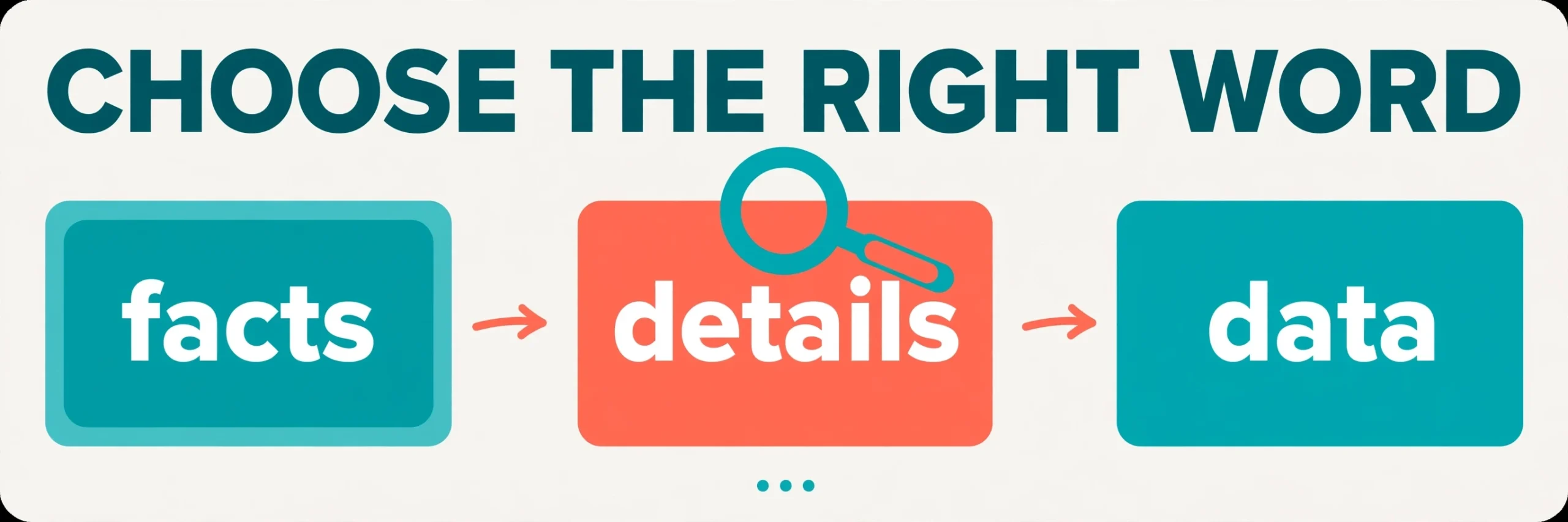
- Match the register. Facts, details, and data suit formal writing; info and scoop belong in conversation and journalism.
- Check freshness. If the facts are new and time-sensitive, news or tidings fits. If they are stable, choose facts or data.
- Count the scope. Details and specifics zoom in on small parts; knowledge and intelligence describe a broader body of facts.
- Mind the source. Evidence and findings imply research or proof behind the facts; use them only when that is true.
- Avoid spy-talk. Intelligence and dossier carry secret-agent flavor — reserve them for security, official, or playful contexts.
- Remember “information” has no plural. When you need a plural noun, switch to facts, details, or findings instead of writing “informations.”
Frequently Asked Questions
What is a synonym for information?
The most useful synonyms for information are facts, data, details, knowledge, news, intelligence, particulars, specifics, findings, report, word, and info — each suited to a different context.
What is the difference between information and knowledge?
Information is raw material you receive; knowledge is what it becomes once you understand and absorb it. A textbook gives you information; studying it builds knowledge.
Is “info” too informal for a business email?
In most cases, yes. “Info” is fine in chat and casual speech, but business emails and reports read more professional with “information,” “details,” or “data.”
What is the plural of information?
There is none — information is uncountable. For plural contexts, use facts, details, pieces of information, or findings instead.
What is the most formal synonym for information?
Intelligence, particulars, and findings are the most formal, common in legal, military, and academic writing. Facts and data are formal without sounding stiff.
Conclusion
Information has a rich bench of synonyms, from the neutral reliability of facts and data to the color of news, scoop, and tidings. Match the word to your register, your subject, and how fresh the facts are. A careful choice keeps your writing sharp — and gives “information” a break it has earned.