Masters or Master’s: What’s the Difference?
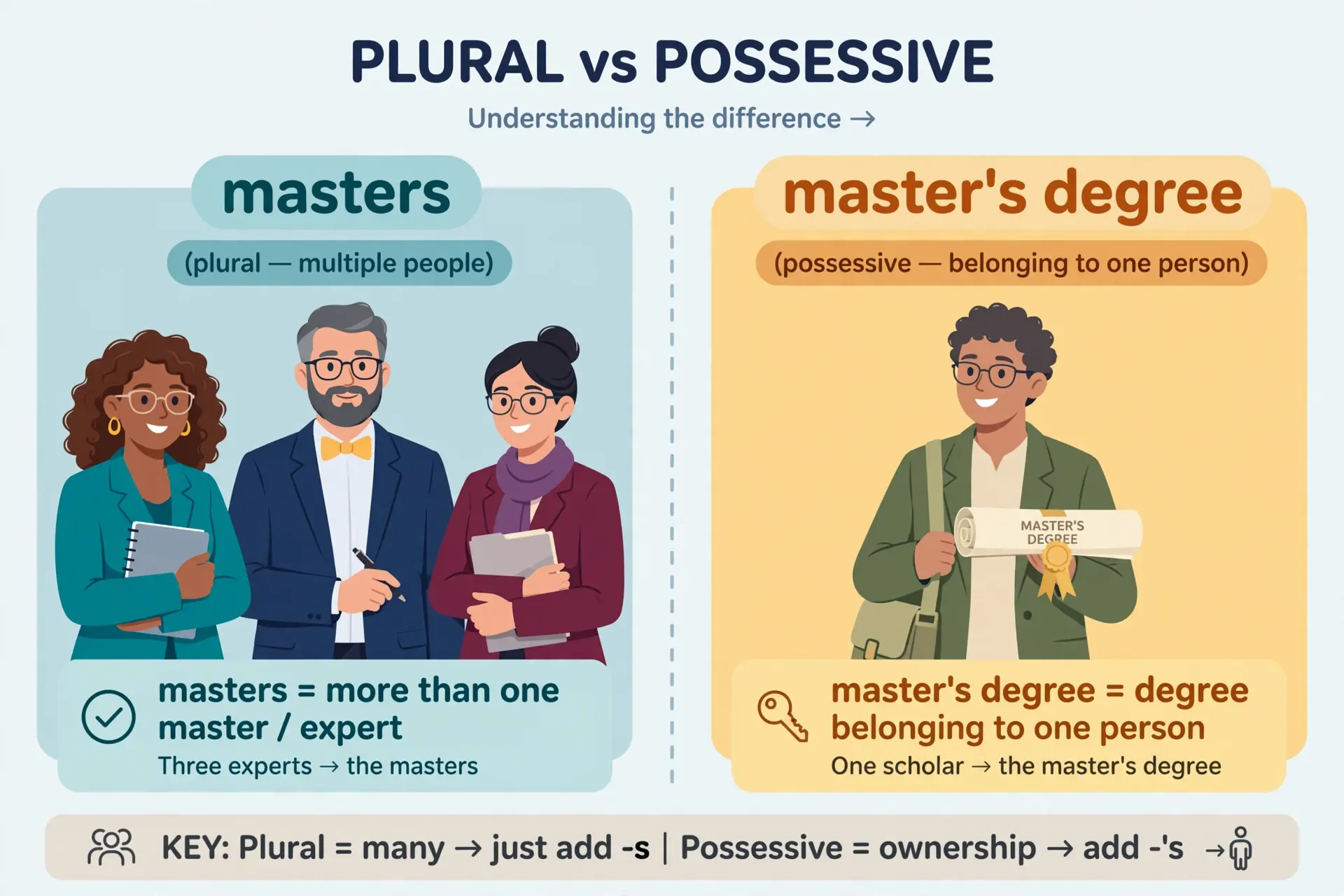
One tiny apostrophe is the whole difference between masters and master’s — and it decides whether you are talking about several skilled experts or something that belongs to one of them. “The masters gathered in the hall” means a group of experts; “the master’s voice echoed in the hall” means the voice belonging to a single master. Mix them up and your sentence quietly says something you never meant.

Quick Answer
| Word | Part of Speech | Main Meaning | Example |
|---|---|---|---|
| masters | Noun (plural) | More than one master — skilled experts, or holders of authority | ✅ “The chess masters studied the board in silence.” |
| master’s | Noun (possessive) | Belonging to one master — most famously, a master’s degree | ✅ “She earned her master’s in linguistics last spring.” |
Simple rule: Use masters when you mean more than one master, and master’s (with the apostrophe) when something belongs to a master — including the famous master’s degree.
What Does Masters Mean?
Masters is the plain plural of master: two or more people who have great skill, knowledge, or authority in something. Renaissance painting had its masters, orchestras answer to their masters of old, and every trade once organized itself around masters who trained apprentices. The word carries weight — a “master” is not merely competent but commanding.
Examples:
- “The old masters hang in the east wing of the museum.”
- “She interviewed three masters of the craft before choosing a teacher.”
- “The ship’s masters met to discuss the new shipping routes.”
- “Kung fu films love the trope of rival masters settling old scores.”
- “The committee consulted economic masters from four universities.”
Note the capital-M special case: the Masters is also the name of the famous annual golf tournament in Augusta — always capitalized, never with an apostrophe.
What Does Master’s Mean?
Master’s is the possessive form: it means “of the master” or “belonging to the master.” Its most common job in modern English is naming the postgraduate degree — a master’s degree, literally “a master’s degree,” the degree of a master. Merriam-Webster’s entry for “master” covers the noun and its inflected forms, including the possessive.
Examples:
- “He finished his master’s in computer science in 2022.”
- “The master’s instructions were written on the back of the envelope.”
- “A master’s thesis is shorter than a doctoral dissertation.”
- “She hung the master’s portrait above the fireplace.”
- “The dog obeyed its master’s whistle instantly.”
The apostrophe does real grammatical work here: it signals ownership. Remove it and the meaning collapses — “masters degree” reads as a degree belonging to several people at once, which is never what anyone means.
Masters vs. Master’s: Key Differences
| Feature | Masters | Master’s |
|---|---|---|
| Grammar | Plural noun | Possessive (singular) noun |
| Meaning | Several masters | Something belonging to one master |
| Apostrophe | None | Required — it marks possession |
| Most common use | Experts, authorities (“the masters”) | Academic degree (“master’s degree”) |
| Example | ✅ “The masters disagreed.” | ✅ “The master’s decision was final.” |
The whole distinction lives in that apostrophe: masters counts people, while master’s claims ownership for one of them.
Masters and Master’s in Real Sentences
At School
✅ “Three of our teachers hold master’s degrees in education.”
✅ “The university invited several masters of the violin for the workshop.”
On a campus you meet both forms constantly — the degree on the wall is a master’s, while the distinguished guests are masters.
At Work
✅ “The project needs sign-off from the team’s masters of data security.”
✅ “Her master’s in business administration opened doors in finance.”
Resumes and job postings are where the “masters degree” error does the most damage — hiring managers notice the missing apostrophe.
In Conversation
✅ “The dog never left its master’s side.”
✅ “The documentary profiled the masters of early jazz.”
Spoken aloud the two sound identical, which is exactly why the confusion survives — only writing exposes it.
Common Mistakes
Apostrophe errors follow the same instincts everywhere — the “hers” vs “her’s” apostrophe rule shows how possessive pronouns refuse the apostrophe, while the “wont” vs “won’t” contraction spelling shows where the apostrophe genuinely belongs. With masters, the traps look like this:
Mistake 1: Writing “masters degree” without the apostrophe
❌ “She earned a masters degree in psychology.”
✅ “She earned a master’s degree in psychology.”
Why: The degree belongs to the rank of master — it is a master’s degree, possessive. This is the single most common error with this pair, and it appears on real resumes.
Mistake 2: Using “master’s” for a plural
❌ “The master’s of the craft gathered in Florence.”
✅ “The masters of the craft gathered in Florence.”
Why: Several experts = plural = no apostrophe. The apostrophe can never make a noun plural in standard English.
Mistake 3: Putting the apostrophe after the S
❌ “She earned her masters’ degree last year.”
✅ “She earned her master’s degree last year.”
Why: “Masters'” would be the possessive of a plural — the degree of several masters. The degree belongs to the rank itself (one master), so the apostrophe goes before the S.
Mistake 4: Confusing “master’s” with “masters” in speech-based writing
❌ “The master’s attended the ceremony.” (meant: several experts)
✅ “The masters attended the ceremony.”
Why: Because both sound identical, writers type whichever form their fingers remember. Slow down on this pair and ask: one owner, or many people?
Pronunciation
Masters and master’s are pronounced exactly the same: MASS-terz, rhyming with “plasters” and “disasters.” The apostrophe is silent — it changes grammar and meaning but never sound. This is why the error is invisible in speech and only matters in writing.
How to Remember the Difference
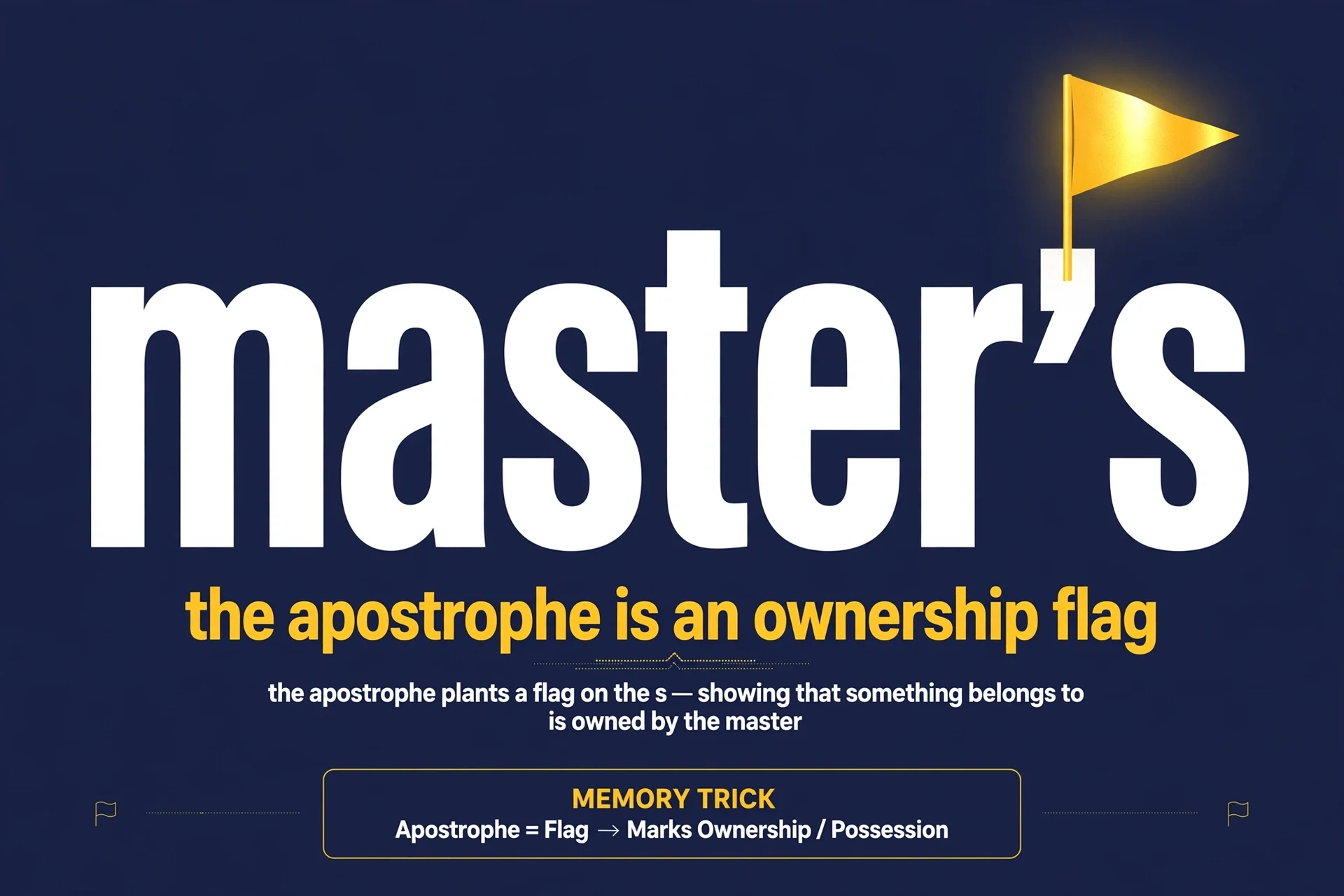
Think of the apostrophe as a tiny flag planted on something owned: master’s always points at a possession — the degree, the voice, the house. No flag, no ownership: masters is just a headcount of experts.
- Ownership test: can you rephrase it as “the X of the master”? Then you need the apostrophe — master’s.
- Counting test: can you put a number in front (“three ___”)? Then it is the plural — masters.
- Degree shortcut: the academic degree is always “master’s” — memorize that one phrase and half the battle is won.
Frequently Asked Questions
Is it masters or master’s?
Both are correct in different roles: “masters” is the plural (several experts), and “master’s” is the possessive (belonging to a master, as in “master’s degree”).
Is it “masters degree” or “master’s degree”?
Always “master’s degree” with the apostrophe. The most authoritative style guides and every university on earth write it that way.
Why is there an apostrophe in “master’s degree”?
It is a possessive: historically “a master’s degree” meant the degree belonging to the rank of master, just like “a bachelor’s degree.” The apostrophe marks that ownership.
Can “master’s” ever be plural?
No. An apostrophe-S never forms a plural in standard English. For several degree-holders you would write “master’s degrees” — the S after the apostrophe belongs to “degrees,” not to “master.”
Is “the Masters” golf tournament related?
Only by spelling. The Masters is a proper name (always capitalized, no apostrophe) for the golf tournament — it has nothing to do with the plural or possessive.
Do “masters” and “master’s” sound different?
No — they are homophones. The distinction exists only in writing, which is why proofreading matters.
Conclusion
Masters counts the experts; master’s claims something for one of them. Keep the apostrophe as your ownership flag — especially in “master’s degree” — and this tiny mark will never trip you again.