Hanged or Hung: What’s the Difference? (With Examples)
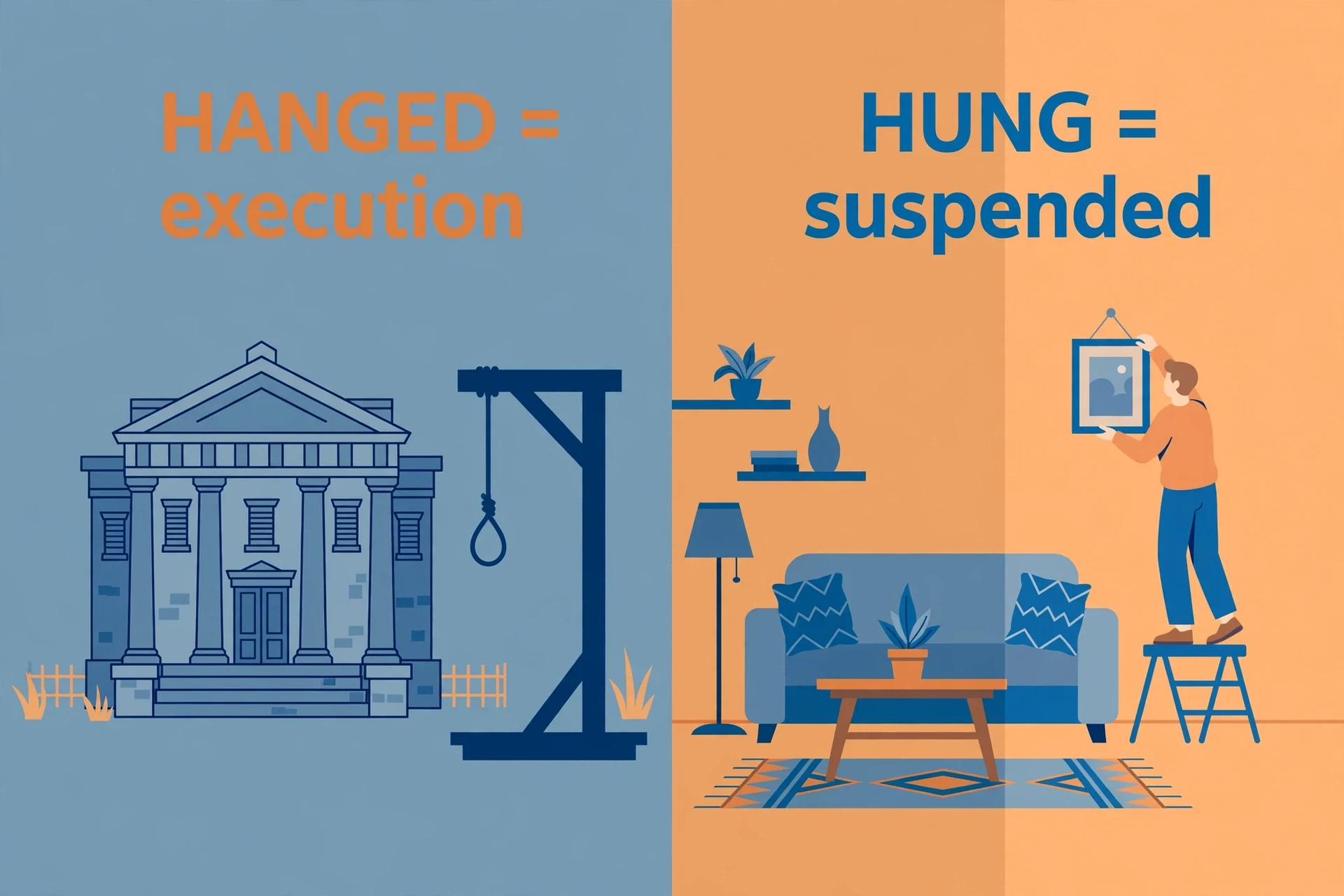
Both hanged and hung are correct past forms of “hang,” but they are not interchangeable. Hanged is reserved for executions by hanging, while hung covers everything else that gets suspended, attached, or put up. You would write “The outlaw was hanged at dawn” but “She hung the portrait above the fireplace.”

Table of Contents
Quick Answer
| Word | Part of Speech | Main Meaning | Example |
|---|---|---|---|
| Hanged | Verb (past tense and past participle) | Executed by hanging | “The traitor was hanged for his crimes.” |
| Hung | Verb (past tense and past participle) | Suspended, attached, or displayed | “We hung the curtains yesterday.” |
Simple rule: if it is an execution, write hanged; for everything else, write hung.
What Does “Hanged” Mean?
Hanged is the past tense and past participle of “hang” used only when someone is put to death by hanging. It belongs to history books, crime reports, and courtroom language — never to everyday objects. English kept this special form so that executions are never described with the same word we use for pictures and laundry.
Examples:
- The pirate was hanged on the docks as a warning to others.
- Historians say the rebel leader was hanged in 1804.
- The judge sentenced the murderer to be hanged.
- She shuddered reading about the prisoners who were hanged during the war.
- Old newspapers reported that the outlaws had been hanged at sunrise.
What Does “Hung” Mean?
Hung is the past tense and past participle of “hang” for every non-execution sense: suspending, attaching, displaying, or putting something up. It also powers common phrasal verbs like “hung up” and “hung out.” For the full dictionary entry, see Merriam-Webster’s definition of hang, which lists both forms and explains when each applies.
Examples:
- We hung the new curtains in the living room.
- He hung his jacket on the hook by the door.
- The gallery hung her painting in the main hall.
- She hung up before I could finish the sentence.
- They hung out at the park until sunset.
Hanged vs. Hung: Key Differences
| Feature | Hanged | Hung |
|---|---|---|
| Meaning | Put to death by hanging | Suspended, attached, or put up |
| Usage | Legal, historical, criminal contexts | Everyday life, home, art, idioms |
| Typical subject | A person being executed | Objects: pictures, clothes, phones |
| Tone | Grim and formal | Neutral and casual |
| Phrasal verbs | Never used in phrasal verbs | “Hung up,” “hung out,” “hung on” |
| Common mix-up | Wrongly used for objects | Wrongly used for executions |
The two words look like twins, but they live in completely different worlds — one belongs to the courtroom and the history book, the other to your living room.
Hanged and Hung in Real Sentences
At Home
Hanged: “Centuries ago, horse thieves were sometimes hanged in frontier towns.”
Hung: “We hung the new shelves in the garage last weekend.”
Around the house you will almost always need hung; hanged only appears if the topic turns to a historical execution.
At Work
Hanged: “The documentary explained how pirates were hanged under maritime law.”
Hung: “The team hung the project banner in the lobby.”
Workplace writing calls for hung unless the document deals with criminal history.
In the News
Hanged: “The report confirmed that the dictator was hanged after the trial.”
Hung: “The mayor hung the championship banner from city hall.”
News stories about capital punishment use hanged, while stories about displays and decorations use hung.
In Conversation
Hanged: “He joked, ‘I will be hanged for this pun’ — exactly the kind of line where hanged fits.”
Hung: “I tried calling, but she hung up on me.”
Everyday idioms always take hung; nobody says “hanged up the phone.”
Common Mistakes with Hanged and Hung
Mix-ups between these two are common because both come from the same verb. The same careful attention helps with other confused word pairs like “loose or lose” and “desert or dessert”, where context decides the spelling.
Mistake 1: Using “hanged” for objects
❌ “We hanged the picture in the hallway.”
✅ “We hung the picture in the hallway.”
Why: pictures are suspended, not executed, so hung is the only correct choice.
Mistake 2: Using “hung” for executions
❌ “The outlaw was hung at dawn.”
✅ “The outlaw was hanged at dawn.”
Why: English keeps hanged as the special form for executions; “hung” here sounds like the outlaw was put on a hook.
Mistake 3: “Hanged up” the phone
❌ “He hanged up before answering.”
✅ “He hung up before answering.”
Why: phrasal verbs built on “hang” always use hung — “hung up,” “hung out,” “hung on every word.”
Mistake 4: “Have hanged” for decorations
❌ “They have hanged the lights for the party.”
✅ “They have hung the lights for the party.”
Why: the past participle follows the same rule: hung for objects, hanged only for executions.
Pronunciation
Hanged is pronounced “hangd” — it rhymes with “banged,” “changed,” and “ranged.” Hung is pronounced “huhng” — it rhymes with “sung,” “rung,” and “stung.” The vowel sound is the quickest way to tell them apart in speech.
How to Remember the Difference
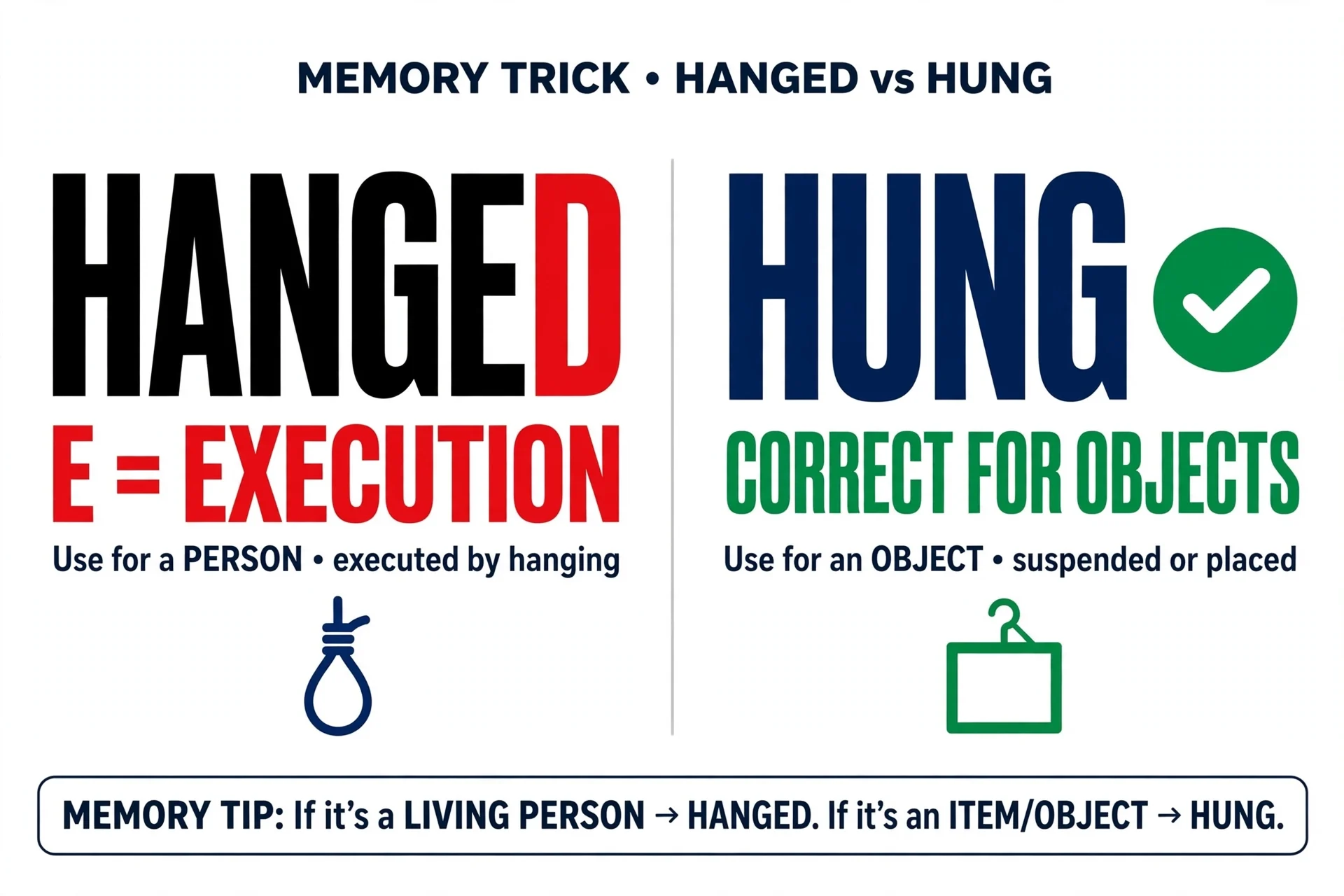
Link the extra E in hangEd to Execution — the one grim context where it appears. No execution, no E: just write hung.
- Hanged = Execution (grim, legal, historical)
- Hung = everything else (pictures, curtains, phones, idioms)
- When in doubt, ask: “Was someone put to death?” If yes, hanged. If no, hung.
Frequently Asked Questions
Is it hanged or hung?
Both are correct. Use hanged for executions by hanging and hung for everything else.
Can you say “hung” about a person?
Yes, when the person suspended something: “He hung his head in shame.” For an execution, though, the correct form is hanged.
Is “hanged” ever used for objects?
No. Objects are always hung: hung pictures, hung curtains, hung laundry.
What about “hung out” and “hung up”?
These idioms always use hung. “Hanged out” and “hanged up” are incorrect in standard English.
Which form is the past participle?
Both. “He has hanged” only works in an execution context; in normal use it is “She has hung the keys by the door.”
Why does English have two forms?
Centuries ago, “hang” had competing past forms, and usage settled on hanged for the specific, solemn sense of execution while hung took over all ordinary senses.
Conclusion
Hanged and hung share a root but serve very different sentences. Keep hanged for the courtroom and the history book, use hung everywhere else, and the execution-E trick will keep them straight for good.