Principal or Principle: Meaning, Difference, and Examples
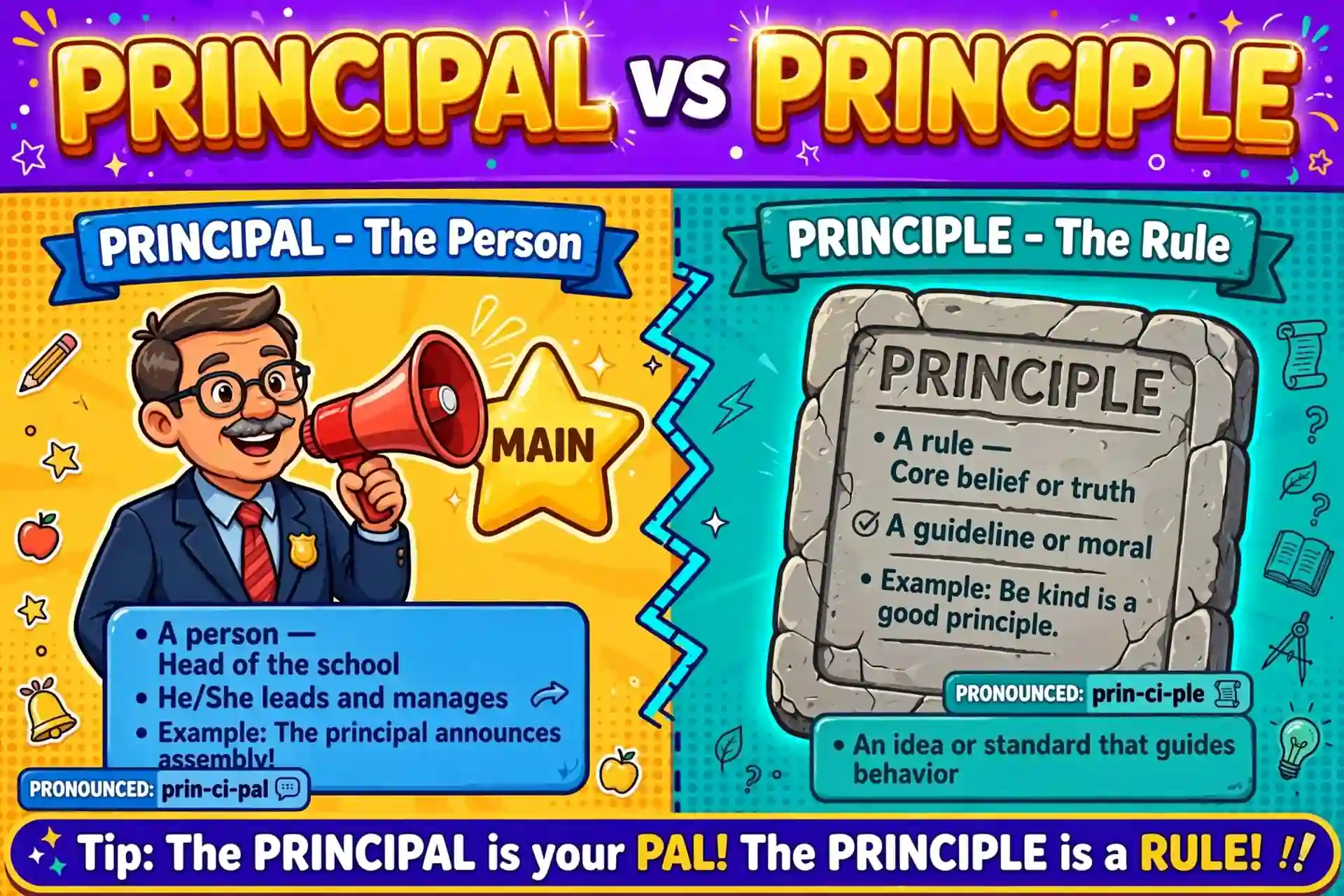
Principal means the main or most important thing, and it is also the title for the head of a school. Principle means a fundamental rule, belief, or truth. Both are always correct words — the mistake is using one where the other belongs.
For example, the principal reason for the delay was rain, but honesty is a principle she lives by. This pair confuses writers as often as desert vs dessert does.
Quick Answer
| Word | Part of Speech | Main Meaning | Example |
|---|---|---|---|
| Principal | Adjective / noun | Main, chief; head of a school; invested sum of money | She is the school principal. |
| Principle | Noun only | A fundamental rule, belief, or truth | He acted on principle. |
Simple rule: Principal is about people and importance; principle is about rules and beliefs.
What Does Principal Mean?
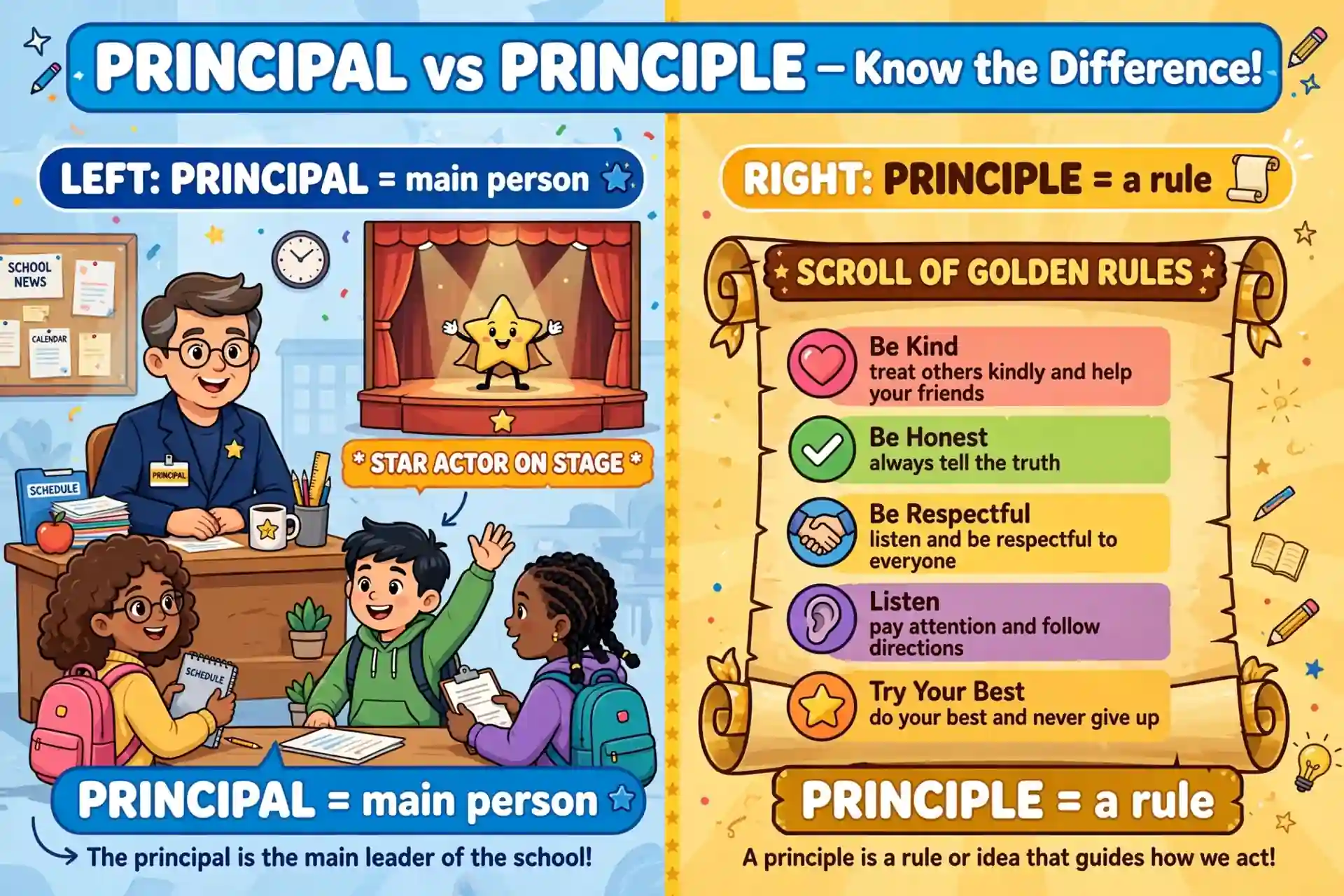
Principal works as both an adjective and a noun. As an adjective it means main or most important. As a noun it means the head of a school, or a sum of money invested (as opposed to the interest it earns).
Examples:
- The principal cause of the outage was a fallen power line.
- Ms. Alvarez has been our school principal for six years.
- He refused to touch the principal and lived off the interest.
- The principal actors took their bows first.
- Safety is our principal concern on this project.
What Does Principle Mean?
Principle is only ever a noun. It means a fundamental rule, law, belief, or code of conduct — something a person or system is guided by.
Examples:
- She refused the bribe as a matter of principle.
- The Archimedes principle explains why ships float.
- He is a man of strong moral principles.
- The club operates on the principle of equal membership.
- In principle, I agree — but the details worry me.
Principal vs. Principle: Key Differences
| Feature | Principal | Principle |
|---|---|---|
| Part of speech | Adjective or noun | Noun only |
| Core idea | Main, chief, leading | Rule, belief, truth |
| Refers to people? | Yes (school head) | No |
| Ends in | -pal | -ple |
| Example | The principal dancer. | A guiding principle. |
Notice the endings: principal ends in -pal, and principle ends in -ple. That one-letter difference carries the whole distinction.
Examples of Principal and Principle in Real Sentences
At School
Principal: “The principal announced the new library hours.”
Principle: “The school runs on the principle that every child can learn.”
The first names the head of the school; the second names the belief guiding it.
At Work
Principal: “Our principal client renewed the contract.”
Principle: “She resigned over a matter of principle.”
Principal marks the most important client; principle marks a moral stand.
With Money
Principal: “He invested the principal and spent only the interest.”
Principle: “The principle of compound interest rewards patience.”
Finance uses both: the principal is the sum invested, while the principle is the rule describing how it grows.
Common Mistakes With Principal and Principle
Writers swap these as readily as they swap whose vs who’s — the fix is always to check whether you mean a person/importance or a rule.
Mistake 1: “Principle” for a School Head
❌ Our school principle gave a speech.
✅ Our school principal gave a speech.
Why: The head of a school is always the principal — “your pal”.
Mistake 2: “Principal” for a Moral Rule
❌ He has strong moral principals.
✅ He has strong moral principles.
Why: Beliefs and rules are principles. A person cannot be a “moral principal” in this sense.
Mistake 3: “Principle” for “Main”
❌ The principle reason was cost.
✅ The principal reason was cost.
Why: When you mean “main” or “chief”, the adjective is principal.
Pronunciation: Principal vs. Principle
Both words are pronounced identically: /ˈprɪnsəpəl/, with the stress on the first syllable. They are true homophones, which is exactly why the spelling distinction matters so much in writing.
How to Remember the Difference
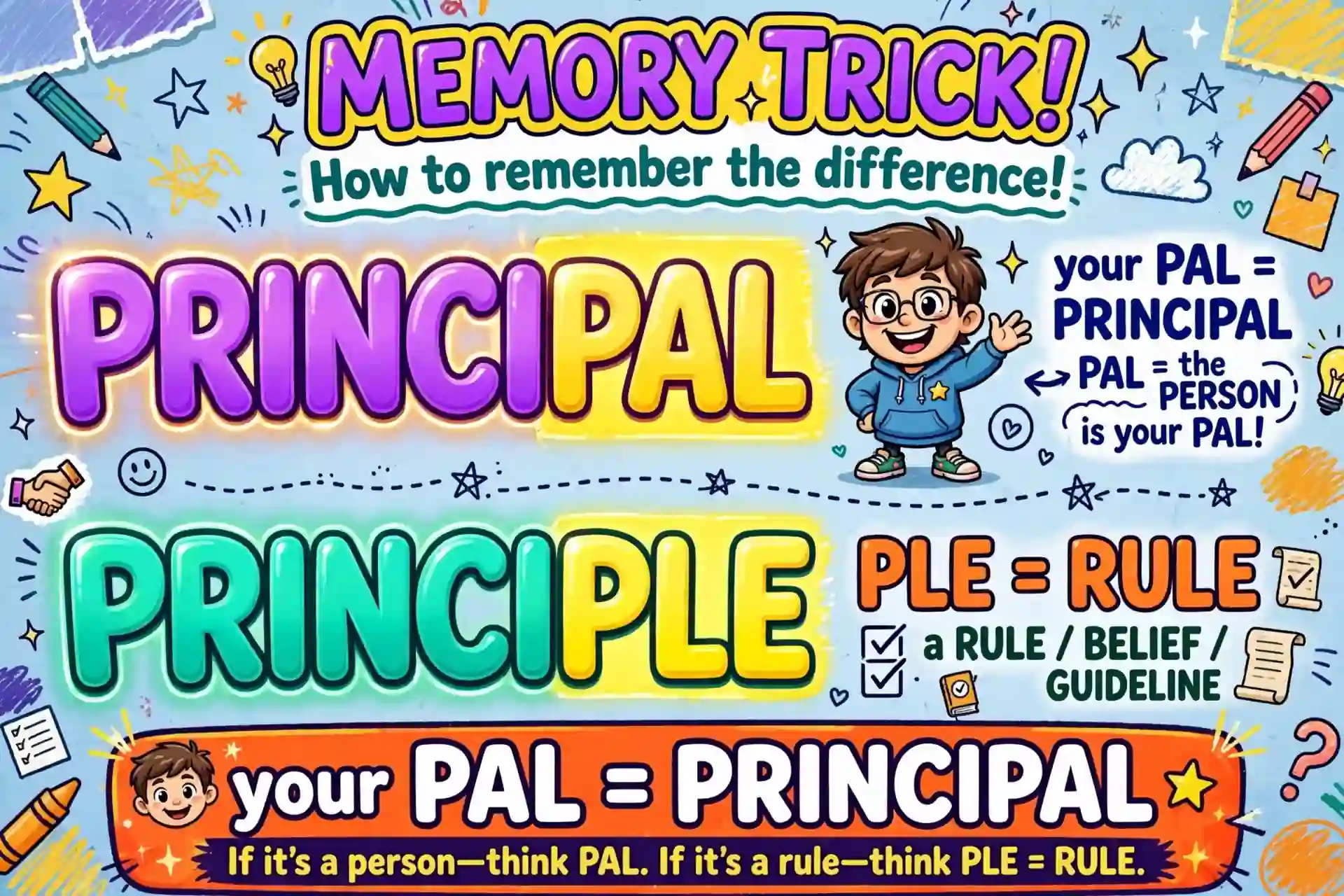
Memory trick: The principal is your pal. The school head — and the “main” sense — end in -pal.
- Principal ends in pal → a person (your pal) or the main thing.
- Principle ends in ple → a rule; think “a principle is a rule“.
Pal = principal. Rule = principle. Two tricks, zero confusion.
Frequently Asked Questions
Is it principal or principle?
Use principal for the main thing or the head of a school, and principle for a rule or belief. Check your meaning first, then pick the spelling.
What is the “principal is your pal” trick?
It is the classic memory aid: principal ends in -pal, and the school principal is your pal. That leaves principle for rules.
Can “principle” be an adjective?
No. Principle is only a noun. If you need the “main/chief” adjective, it is always principal.
What does “principal” mean in finance?
The original sum of money invested or lent, as opposed to the interest it earns. “He never touched the principal.”
What does “in principle” mean?
It means “in theory” or “as a general rule” — always with principle: “In principle, I agree with the plan.”
Conclusion
Principal covers the main thing, the school head, and invested money; principle covers rules, beliefs, and truths. Keep “your pal” and “a rule” in mind, and this classic pair will never trip you up. For the full dictionary entry, see principal on Merriam-Webster.