Engrained or Ingrained: Which Spelling Is Correct?
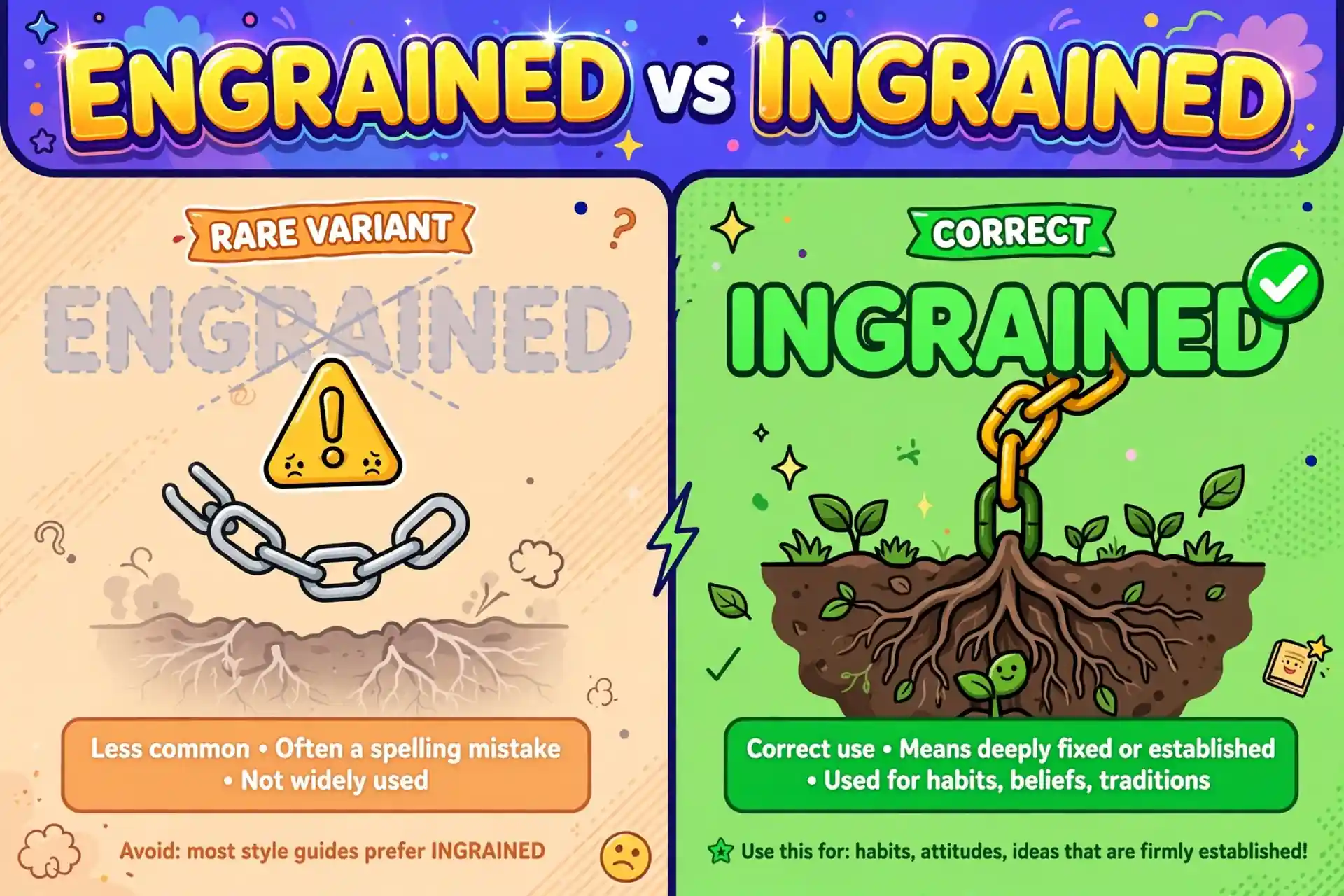
Ingrained is the standard spelling. Engrained appears in some dictionaries as a rare variant, but virtually every style guide and editor expects ingrained. In practice, always write ingrained.
For example, “ingrained habits” and “ingrained dirt” are correct. Choosing engrained will look like a mistake to most readers — similar to the variant confusion in dyeing vs dying.
Quick Answer
| Word | Status | Meaning | Example |
|---|---|---|---|
| Ingrained | ✅ Standard | Deeply fixed; worked into the texture | An ingrained habit. |
| Engrained | ⚠️ Rare variant | Same meaning | Avoid in modern writing. |
Simple rule: Always write ingrained. Treat engrained as a spelling to avoid.
What Does Ingrained Mean?
Ingrained is an adjective meaning deeply fixed or established — literally worked into the grain of something (like dirt ground into fabric), and figuratively describing habits, beliefs, or attitudes that are hard to change.
Examples:
- Old habits are deeply ingrained and hard to break.
- The shirt had ingrained stains that would not wash out.
- Respect for elders is ingrained in their culture.
- Years of training gave him ingrained discipline.
- The prejudice was ingrained over generations.
What About “Engrained”?
Engrained is listed in a few dictionaries as a variant spelling of ingrained. It comes from the same root — the en- prefix once competed with in- in words like this (compare ensure/insure, enquire/inquire).
But unlike those pairs, engrained never caught on. Modern usage overwhelmingly favors ingrained — by a huge margin in published books and edited writing. Using engrained today will strike most readers, teachers, and editors as an error, so there is no reason to choose it.

Ingrained vs. Engrained: Key Differences
| Feature | Ingrained | Engrained |
|---|---|---|
| Status | Standard spelling | Rare variant |
| Accepted by editors | Always | Almost never |
| Meaning | Deeply fixed | Same |
| Recommendation | Use this | Avoid |
| Example | Ingrained dirt. | — |
This is not a case of two equal options. Ingrained won the spelling contest centuries ago; engrained is a leftover.
Examples of Ingrained in Real Sentences
Habits
✅ Punctuality was ingrained in him from childhood.
⚠️ Punctuality was engrained in him from childhood.
For habits and behavior, ingrained is the only safe choice.
Physical Things
✅ The mechanic scrubbed the ingrained grease from his hands.
⚠️ The mechanic scrubbed the engrained grease from his hands.
The literal sense — worked into the grain — also takes ingrained.
Culture and Beliefs
✅ The tradition is ingrained in the community.
⚠️ The tradition is engrained in the community.
Beliefs and cultural practices are ingrained, never engrained in edited writing.
Common Mistakes With Ingrained
Variant spellings trip writers up the way the tricky pairs in loose vs lose do — when in doubt, pick the standard form.
Mistake 1: Writing “Engrained Habits”
❌ Old engrained habits are hard to break.
✅ Old ingrained habits are hard to break.
Why: Ingrained is the standard spelling every reader expects.
Mistake 2: Assuming Both Are Equal
❌ “Engrained” and “ingrained” are interchangeable.
✅ “Ingrained” is standard; “engrained” is a rare variant best avoided.
Why: Dictionaries may list the variant, but editors and readers treat it as an error.
Mistake 3: Writing “Ingraned” (One N)
❌ The dirt was ingraned in the fabric.
✅ The dirt was ingrained in the fabric.
Why: The word keeps the double n from grain — in + grained.
Pronunciation: Ingrained
Ingrained is pronounced /ɪnˈɡreɪnd/ — “in-GRAYND”, with the stress on the second syllable. The rare variant engrained is pronounced the same way, which is part of why the spelling confusion persists.

How to Remember the Difference
Memory trick: Ingrained starts with IN — the habit is inside you, worked into the grain.
- Ingrained → worked in → the standard spelling.
- Engrained → the outdated variant → leave it out.
If the habit is in you, spell it with in.
Frequently Asked Questions
Is it engrained or ingrained?
Use ingrained. Engrained is a rare variant that most readers will read as a mistake.
Is “engrained” a real word?
Technically yes — some dictionaries list it as a variant. But it is so rare in modern writing that using it is never advisable.
What does “ingrained” mean?
Deeply fixed or established — literally (dirt worked into fabric) or figuratively (habits, beliefs).
Where does “ingrained” come from?
From grain — the texture of wood or cloth. Something ingrained is worked into the grain itself, not just sitting on the surface.
Can I use “engrained” in formal writing?
You should not. Editors, teachers, and spell-checkers expect ingrained, and engrained may be marked wrong.
Conclusion
Ingrained is the standard spelling; engrained is a rare variant to avoid. Remember “in” — the habit is inside you — and you will always pick the right form. For the full dictionary entry, see ingrained on Merriam-Webster.