Synonyms for Alone: 16 Words With Examples
Writers lean on alone for everything from peaceful solitude to heartbreaking loneliness — two very different feelings packed into one word. This guide gives you 16 synonyms for alone, grouped by sense, each with a one-line meaning and a natural example sentence. See the full entry in the Merriam-Webster thesaurus to explore even more options.
Table of Contents
Quick Answer
| Word | Nuance / When to use it |
|---|---|
| solo | Doing something by yourself — trips, performances, projects |
| unaccompanied | Formal — traveling or attending without companions |
| by oneself | Neutral phrase for doing something without help or company |
| on one’s own | Casual, independent — managing without assistance |
| lonely | Feeling sad about being alone — emotional, not just factual |
| lonesome | Softer, poetic version of lonely — homesickness, missing people |
| isolated | Cut off from others — places, people, communities |
| solitary | Preferring or existing alone — habits, lifestyles, quiet figures |
| forlorn | Hopelessly lonely and abandoned-looking — literary tone |
| sole | The only one of its kind — responsibility, rights, survivors |
| lone | Attributive only — “a lone figure,” never “he felt lone” |
| single | One and only — “the single reason,” one item among many |
Simple rule: Use solo or on one’s own for peaceful independence, lonely or solitary for emotional isolation, and sole or lone when you mean “the only one.”
By Oneself (Not Lonely)
When “alone” describes being by yourself without any sadness attached — independence, not isolation — these six words fit.
Solo — done by one person, without partners or companions. She went on a solo trip across the country last summer.
Unaccompanied — without anyone going along; slightly formal. Unaccompanied minors must check in at the special desk.
By oneself — without help or company from anyone else. He fixed the sink by himself in under an hour.
On one’s own — independently, managing without assistance. After college she learned to live on her own.
Single-handed — accomplished by one person with no help at all. She organized the entire event single-handed.
Independently — without relying on others; self-sufficiently. He has worked independently as a freelancer for five years.

Lonely and Isolated
When “alone” carries the emotional weight — sadness, distance, disconnection — reach for these five.
Lonely — feeling sad because you have no company or friends. He felt lonely during his first month in the new city.
Lonesome — lonely in a softer, almost poetic way; often about missing people. The old house felt lonesome after the children moved out.
Isolated — separated from others, physically or socially. The village is isolated by the mountains for most of the winter.
Solitary — living or existing alone, often by choice or habit. She led a solitary life, painting in her cottage by the sea.
Forlorn — pitifully sad and abandoned; literary and dramatic. The forlorn puppy waited by the gate for its owner.
The Only One
“Alone” also means “the only one” — exclusivity rather than company. These five handle that sense.
Sole — the one and only; no others share the role. She is the sole owner of the bakery.
Only — no other; the single exception. You are the only person I trust with this secret.
Single — one item standing apart from the rest. A single mistake cost him the championship.
Lone — standing apart from others; used before a noun. A lone streetlight flickered at the end of the road.
Exclusive — restricted to one person or group; the only one with access. Members get exclusive access to the rooftop lounge.
Common Mistakes
Mixing up near-synonyms is a classic precision error — the same careful habit that resolves the naive-vs-nieve spelling mix-up and the journeys-vs-journies plural question applies here: check whether the word means company, a feeling, or exclusivity.
Mistake 1: Using “alone” when you mean “lonely”
❌ After moving away, she felt alone and cried every night.
✅ After moving away, she felt lonely and cried every night.
Why: Alone is neutral — it just means without company. Lonely is the sad feeling about it. Writing “felt alone” when you mean the emotion undersells the sentence.
Mistake 2: Using “lone” as a feeling
❌ He felt lone in the big office.
✅ He felt lonely in the big office.
Why: Lone is attributive only — it goes before a noun (“a lone wolf,” “a lone traveler”). After verbs like “feel” or “seem,” use lonely or alone.
Mistake 3: Using “single” (unmarried) for “alone”
❌ She has lived single for ten years.
✅ She has lived alone for ten years.
Why: “Single” here reads as “unmarried” — a completely different sense. Alone describes her living situation without implying anything about her relationships.
Mistake 4: Using “isolated” for a chosen quiet evening
❌ She spent an isolated evening reading by the fire.
✅ She spent a solitary evening reading by the fire.
Why: Isolated suggests being cut off against your will. A peaceful evening by choice is solitary — or simply alone.
How to Choose the Right Synonym
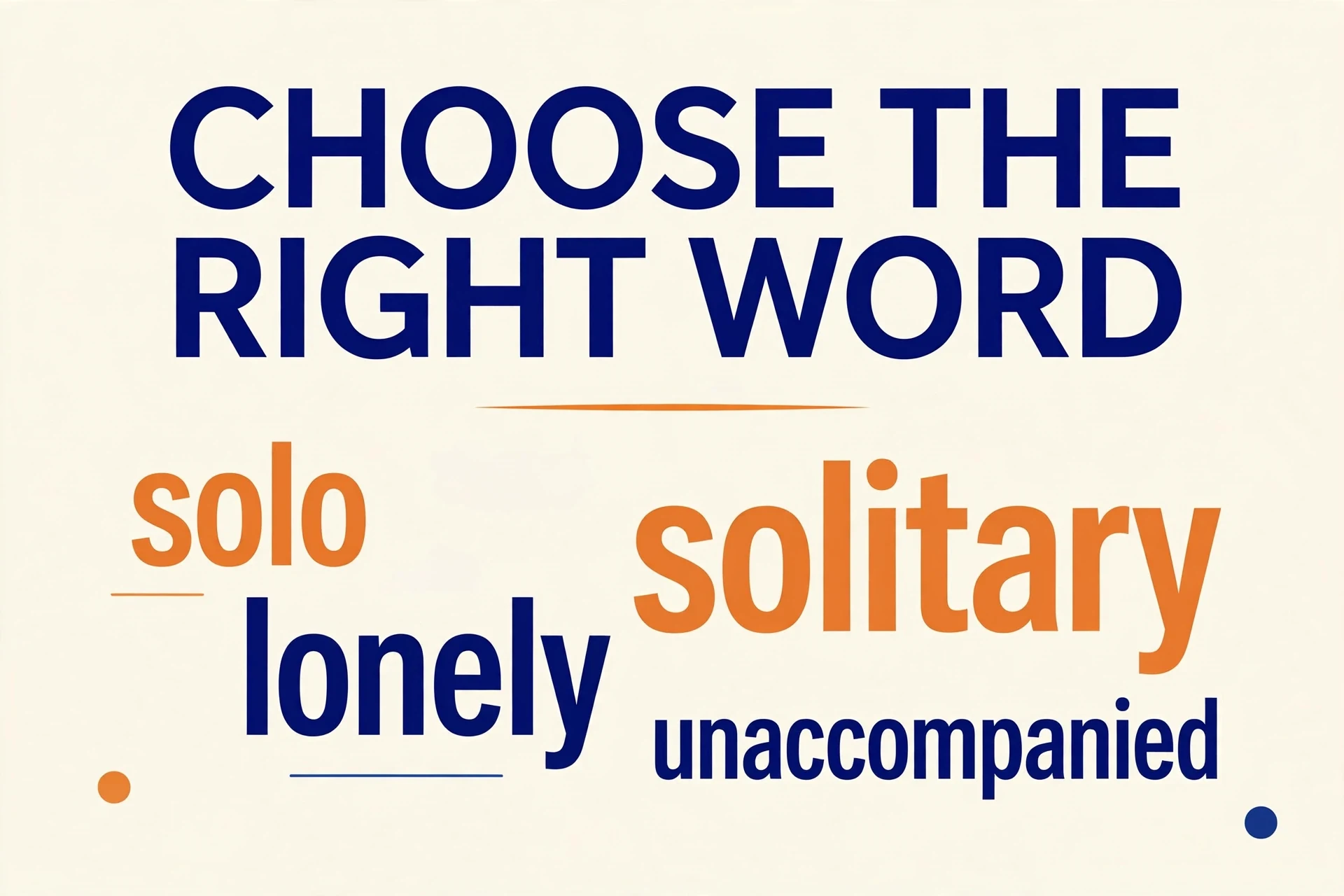
- Name the sense first. No company → solo, unaccompanied, on one’s own; sad about it → lonely, lonesome, forlorn; the only one → sole, lone, single.
- Check the emotion. If the sentence is happy or neutral, stay in the “by oneself” group. Dragging in lonely or forlorn adds sadness the writer may not want.
- Respect the grammar. Lone and sole sit before nouns (“a lone figure,” “the sole survivor”); lonely and alone work after verbs (“felt lonely,” “lived alone”).
- Mind the register. Unaccompanied suits forms and announcements; on one’s own suits conversation; forlorn suits literature.
- Don’t force a fancy word. “She lives alone” is perfectly clear — solitary or unaccompanied only earn their place when they add meaning.
Frequently Asked Questions
What is a synonym for alone?
Solo is the closest neutral synonym for “alone.” For the emotional sense use lonely, for the “only one” sense use sole, and for independence use on one’s own.
What is the difference between alone and lonely?
Alone describes a fact — nobody else is present — and can be positive or neutral. Lonely describes a feeling — sadness about the absence of company. You can be alone without being lonely, and lonely in a crowd.
Can “alone” mean “only”?
Yes. “You alone can decide” means “only you can decide.” In that sense, the synonyms are sole, only, and single — not the company-based words like solo.
Is “lonesome” the same as “lonely”?
Nearly. Lonesome is a softer, more poetic word that often suggests missing someone specific or missing home. Lonely is the everyday, broader term.
What is a formal synonym for alone?
Unaccompanied is the most formal option for the by-oneself sense (“unaccompanied passengers”). Solitary and isolated are the formal choices for the emotional and physical senses.
Conclusion
“Alone” covers a lot of ground — peaceful independence, emotional isolation, and being the only one. Match the sense to the synonym: solo for independence, lonely for the feeling, sole for exclusivity. Pick the word that says exactly what you mean, and your sentences will land harder.