Synonyms for Challenging: 18+ Words With Examples
Challenging has become the default euphemism for “hard” — in job ads, school reports, and corporate emails, everything is “challenging” and nothing is ever just difficult. This guide gives you 18 sharper alternatives for challenging, grouped by nuance, each with a one-line meaning and a natural example sentence. They cover the same ground that Merriam-Webster’s thesaurus entry for “challenging” maps under difficult and demanding, from physical effort to intellectual puzzles.
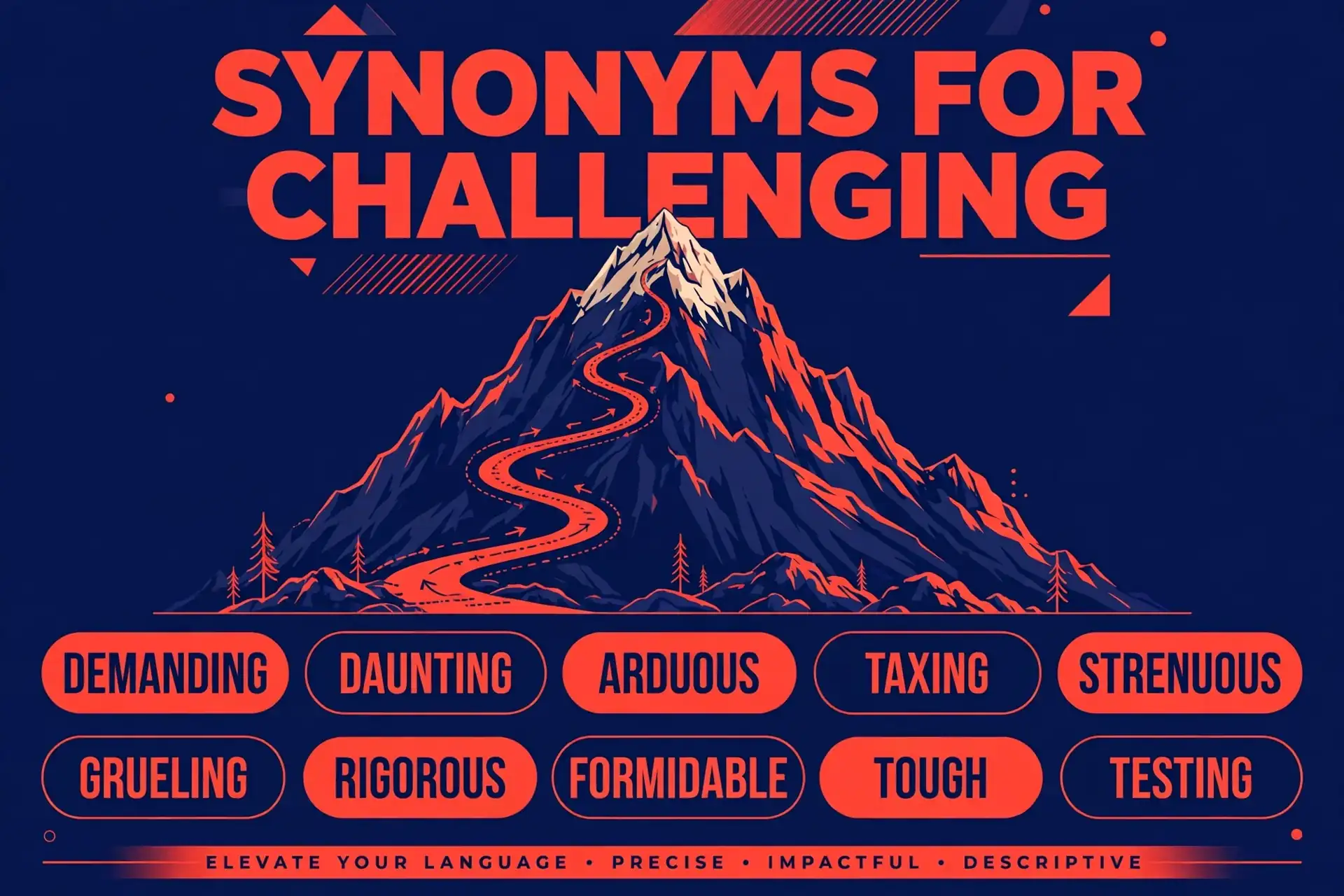
Table of Contents
Quick Answer
| Word | Nuance / When to use it |
|---|---|
| difficult | The honest all-purpose swap — neutral, never wrong |
| hard | Casual and direct — conversation, not formal reports |
| tough | Hard with grit — situations that test resilience |
| demanding | Requires sustained attention and energy — jobs, courses, roles |
| formidable | Impressively hard — opponents, obstacles, reputations |
| trying | Hard to endure — patience-testing people and situations |
| arduous | Long, strenuous effort — journeys, climbs, campaigns |
| grueling | Exhausting to the limit — marathons, training, schedules |
| strenuous | Physically intense — exercise, labor, hikes |
| taxing | Draining your resources — mentally or physically |
| knotty | Intellectually tangled — problems, questions, plots |
| thorny | Difficult and delicate — issues with no easy answer |
Simple rule: Use difficult when you want honesty, demanding for things that drain time and attention, arduous or grueling for physical ordeals, and knotty or thorny for problems of the mind.
Challenging as Plain Difficult
When “challenging” is just a polite way of saying “hard,” these six say it straight — and usually better.
Difficult — not easy; requiring effort or skill. The neutral, always-safe choice. The first year of medical school is famously difficult.
Hard — the casual, direct word; best in speech and informal writing. That exam was really hard.
Tough — hard in a way that tests resilience or grit. It was a tough decision, but the right one.
Demanding — requiring sustained time, energy, or attention. Her new role is far more demanding than the old one.
Formidable — so difficult it inspires respect or apprehension. The defending champions are a formidable opponent.
Trying — difficult to endure; tests patience rather than skill. The delayed flight made for a trying afternoon.

Challenging as Requiring Effort
When “challenging” means the task will drain you — physically or mentally — these words describe the effort honestly.
Arduous — requiring prolonged, strenuous effort; formal and dignified. The rescue team completed an arduous climb to reach the stranded hikers.
Grueling — exhausting to the point of punishment. The marathon’s final miles were grueling in the midday heat.
Strenuous — demanding great physical effort. Doctors advise against strenuous exercise right after surgery.
Laborious — slow, heavy work; effortful and plodding. Restoring the old manuscript was laborious, page by page.
Taxing — draining your mental or physical resources. Back-to-back meetings are mentally taxing by Friday.
Backbreaking — brutally hard physical labor; vivid and informal. Clearing the field by hand was backbreaking work.
Challenging as Intellectually Hard
When “challenging” means a puzzle for the mind — a problem, question, or dilemma — these words are far more precise.
Knotty — tangled and complicated; hard to unravel. The detective faced a knotty problem with three contradictory witnesses.
Thorny — difficult and sensitive, with no painless answer. Immigration remains the thorniest issue in the campaign.
Tricky — deceptively difficult; casual and conversational. The last question on the quiz was surprisingly tricky.
Exacting — demanding great precision and care. Watch repair is exacting work — one slip ruins the mechanism.
Rigorous — thorough, strict, and intellectually demanding. The program is known for its rigorous training in statistics.
Herculean — requiring enormous strength or effort, like the labors of Hercules. Cleaning up the river will be a herculean task.
Common Mistakes
“Challenging” is corporate comfort language, and its synonyms each have sharp edges. The same precision that settles the dyeing-or-dying pair and the whether-vs-weather mix-up applies here: match the word to the kind of difficulty.
Mistake 1: “Challenging” for genuine suffering
❌ Living through the drought was challenging for the village.
✅ Living through the drought was devastating for the village.
Why: Challenging sounds like an exciting obstacle; real hardship deserves words like devastating, grueling, or harrowing — not motivational-poster language.
Mistake 2: “Demanding” for a simple puzzle
❌ The crossword was demanding.
✅ The crossword was tricky.
Why: Demanding implies something that requires sustained effort and attention from a person — a job, a toddler, a course. A puzzle is just tricky or knotty.
Mistake 3: Confusing “trying” with “tiring”
❌ The lecture was tiring to sit through — no, wait, trying?
✅ The lecture was trying — three hours of statistics with no break.
Why: Trying means difficult to endure (it tries your patience); tiring just means it makes you sleepy. A boring lecture can be both, but they’re different complaints.
Mistake 4: “Problematic” for “difficult”
❌ The math homework is problematic.
✅ The math homework is difficult.
Why: Problematic means raising doubts or objections — a morally questionable policy is problematic; a hard equation is just difficult or challenging.
How to Choose the Right Synonym
- Name the kind of difficulty. Plain hard → difficult/hard; drains energy → demanding/taxing; physical ordeal → arduous/grueling; mental puzzle → knotty/thorny.
- Check your tone. “Challenging” is upbeat by design — if the situation isn’t positive, difficult, grueling, or devastating is more honest.
- Watch the register. Arduous, rigorous, and herculean suit formal writing; hard, tough, tricky, and backbreaking suit conversation.
- Don’t use “challenging” as armor. In job ads and reports it’s fine, but in writing about real hardship it sounds evasive — say what the difficulty actually is.
- Reserve “demanding” for effort over time. A person, role, or schedule can be demanding; a single question or moment usually can’t — use tricky or trying instead.
Frequently Asked Questions
What is a synonym for challenging?
Difficult is the closest all-purpose synonym for “challenging.” For sustained effort use demanding, for physical ordeals use arduous or grueling, and for mental puzzles use knotty or tricky.
What is the difference between “challenging” and “difficult”?
Challenging frames difficulty as stimulating — an invitation to rise to the occasion. Difficult is neutral: it just means not easy. “A challenging puzzle” sounds fun; “a difficult year” sounds honest. Choose based on the feeling you want.
Is “challenging” a positive word?
Mostly, yes — it’s the polite, motivational cousin of “hard.” That’s exactly why it misfires on genuine suffering: calling a famine “challenging” trivializes it. Match the word’s optimism to the situation’s reality.
What is a formal synonym for challenging?
In professional writing, demanding, arduous, rigorous, and formidable carry formal weight. “The project faced formidable obstacles” sounds more serious than “the project faced challenging obstacles.”
Can “challenging” describe a person?
Yes, but carefully — “a challenging child” or “a challenging colleague” means difficult to deal with, and it can sound judgmental. Demanding (“a demanding boss”) is often the kinder, more accurate choice.
Conclusion
Challenging is a useful word that has been stretched thin by overuse in offices and classrooms. Say difficult when you mean hard, demanding when it drains you, grueling when it exhausts you, and knotty when it puzzles you — and your writing will regain its edge.