Synonyms for Comfortable
Writers reach for synonyms for comfortable when “comfortable” starts sounding flat — whether describing a chair, a home, or a state of mind. This guide gives you 20 alternatives, grouped by nuance, each with a plain meaning and a natural example sentence. Merriam-Webster’s thesaurus entry for comfortable spans physical ease, mental calm, and quiet satisfaction — and this article covers all three senses.

Table of Contents
Quick Answer
| Word | Nuance / When to use it |
|---|---|
| cozy | Warm, sheltered, friendly comfort — the classic swap |
| snug | Comfort in a small, enclosed, just-right space |
| restful | Comfort that brings rest and relaxation |
| easy | Comfort as the absence of strain or constraint |
| relaxed | Mental comfort; free of tension or worry |
| comfy | Casual, friendly short form of comfortable |
| cushy | Soft and luxurious; also an easy job or deal |
| plush | Rich, thick, luxurious softness |
| homey | Comfort that feels like home (US: homey; UK: homely) |
| at ease | Comfortable socially; no awkwardness |
| contented | Quietly satisfied; wanting nothing more |
| convenient | Comfortable in the practical, well-arranged sense |
Simple rule: Use cozy or snug for physical warmth, relaxed or at ease for mental calm, restful for sleep and recovery — and check whether you mean comfort or just convenience.
Cozy and Physical
When comfort means warmth, softness, and shelter, these five deliver it.
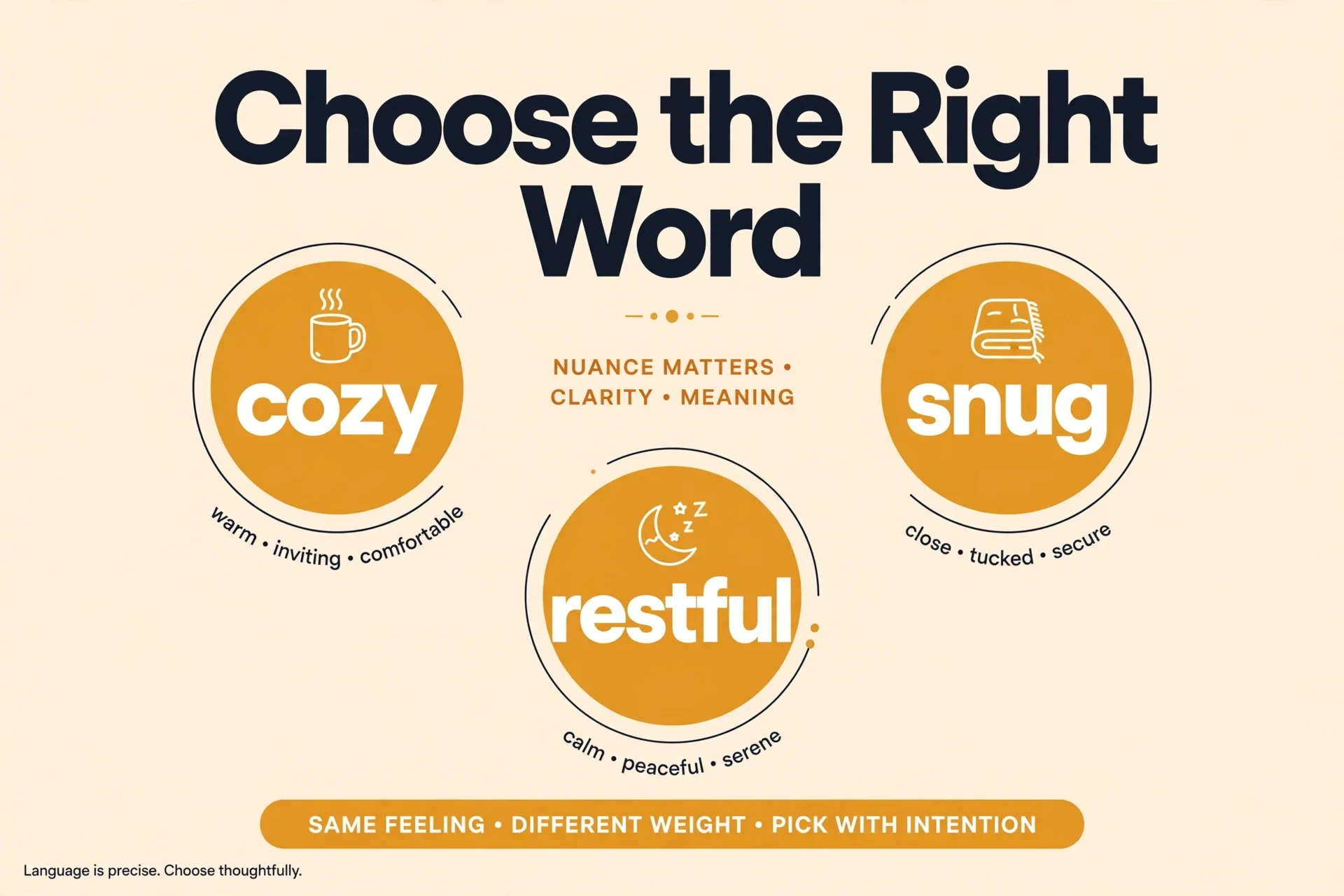
Cozy — warm, sheltered, and friendly; the best all-purpose swap. The cafe’s cozy corner with the fireplace is my favorite reading spot.
Snug — comfortably small, with just enough space. The baby slept snug in her blanket, completely still.
Cushy — soft and well-padded; also used for easy jobs or deals. He landed a cushy office job with flexible hours.
Plush — richly soft and luxurious. The hotel lobby had plush carpets and deep armchairs.
Comfy — the casual, friendly form of comfortable. These are the comfiest shoes I own — I walk miles in them.

Relaxed and At Ease
When comfort is a state of mind rather than a chair, reach for these.
Relaxed — free of tension, calm and unhurried. After the exam, she felt relaxed for the first time in weeks.
At ease — socially comfortable; no awkwardness or fear. The host’s warmth put every guest at ease within minutes.
Contented — quietly satisfied, wanting nothing more. He sat on the porch with a contented smile, watching the rain.
Carefree — comfortable because nothing is weighing on you. Those carefree summer evenings felt like they would never end.
Unworried — comfortable through absence of anxiety. With the bills paid, she was finally unworried about money.
Restful and Soothing
For comfort that restores — sleep, recovery, calm spaces — these are the words.
Restful — inducing rest; calm and undisturbed. They booked a restful weekend at a quiet lakeside cabin.
Soothing — easing pain, stress, or agitation. The nurse’s soothing voice calmed the frightened child.
Tranquil — deeply calm and peaceful. The garden was a tranquil escape from the noisy street.
Inviting — comfort that draws you in. The bed looked so inviting that she lay down fully dressed.
Homey — comfort that reminds you of home. The little restaurant had a homey feel, with checkered tablecloths and fresh bread.
Adequate and Formal
In formal or business writing, “comfortable” often means “sufficient” — and these fit better.
Satisfactory — good enough to meet needs; formally comfortable. The hotel room was satisfactory, with a firm bed and a hot shower.
Adequate — sufficient in quality or amount. The salary was adequate for a single person living modestly.
Convenient — comfortable in the practical sense: well-arranged, easy to use. The apartment’s convenient location cut her commute in half.
Easy — free from discomfort or constraint. After years of night shifts, she finally had easy working hours.
Pleasant — agreeable and enjoyable, without the physical emphasis. We had a pleasant evening chatting on the terrace.
Common Mistakes
Comfort words get tangled with near-neighbors more than you’d expect — the same precision that settles the cloths-vs-clothes mix-up and couch-vs-coach keeps these straight too.
Mistake 1: “Comforting” when you mean “comfortable”
❌ This is a very comforting chair.
✅ This is a very comfortable chair.
Why: Comforting means giving emotional solace (“comforting words”). A chair can’t comfort you — it can only be comfortable.
Mistake 2: “Homely” in American English
❌ She has such a homely apartment. (said to an American)
✅ She has such a homey apartment.
Why: In British English, homely means cozy like home. In American English, homely means unattractive. Use homey in the US to avoid an accidental insult.
Mistake 3: “Convenient” for “comfortable”
❌ The sofa is very convenient.
✅ The sofa is very comfortable.
Why: Convenient means practical and well-placed, not soft. A sofa is comfortable; its location near the TV is convenient.
Mistake 4: “Comfy” in formal writing
❌ The hotel offers comfy accommodations for business travelers.
✅ The hotel offers comfortable accommodations for business travelers.
Why: Comfy is a real word, but it’s casual slang. In reports, reviews, or business copy, write it out as comfortable.
How to Choose the Right Synonym
- Ask: body or mind? Cozy, snug, plush, and cushy describe physical comfort; relaxed, contented, and at ease describe mental comfort. Mixing them sounds off.
- Check the register. Comfy and cushy are casual; satisfactory and adequate are formal. Cozy works almost everywhere in between.
- Watch the US/UK split. Homey (US) vs. homely (UK) for “like home” — and remember cozy is spelled cosy in British English.
- Don’t confuse comfort with convenience. Convenient means practical; comfortable means at ease. A well-placed chair is convenient; a soft one is comfortable.
- Consider the audience. “Plush interiors” sells a car; “a restful ward” reassures a patient; “satisfactory conditions” belongs in a contract.
- Keep it simple when it counts. In instructions and reviews, plain “comfortable” is often clearest — synonyms should add flavor, not fog.
Frequently Asked Questions
What is a synonym for comfortable?
Cozy is the closest all-purpose synonym for “comfortable.” For mental calm use relaxed or at ease; for rest use restful; for formal writing use satisfactory or adequate.
What is the difference between comfortable and comforting?
Comfortable describes being at ease (“a comfortable bed”). Comforting describes giving solace (“comforting news”). A blanket is comfortable; a hug after bad news is comforting.
Is it cozy or cosy?
Both are correct — cozy is the American spelling and cosy is the British one. Use the spelling that matches your audience, and stay consistent throughout your text.
What is a formal synonym for comfortable?
Satisfactory and adequate are the most formal options, especially when “comfortable” means “sufficient” — as in “a comfortable income” becoming “an adequate income” in a financial report.
Is “comfy” a real word?
Yes — comfy is a legitimate informal shortening of “comfortable,” recognized by every major dictionary. It’s perfect for conversation, reviews, and casual writing, but too slangy for formal documents.
What is the opposite of comfortable?
Uncomfortable is the direct opposite. For nuance, use uneasy (mental), awkward (social), or cramped (physical spaces).
Conclusion
“Comfortable” is a fine word, but its synonyms let you be exact: cozy for warmth, relaxed for calm minds, restful for recovery, and satisfactory when formality calls. Just keep comforting, convenient, and American homely out of the mix.