Synonyms for Also: 22 Words With Examples
Also is the glue word of English writing — useful, but repeated ten times per page it becomes invisible. This guide collects 22 real synonyms for also, grouped by function: casual additions, formal connectors, and the special case of “also” meaning “likewise.” Every word comes with a definition and a natural example sentence, so each addition lands exactly where you want it.
Table of Contents
Quick Answer: 12 Synonyms for Also
| Word | Nuance / When to use it |
|---|---|
| too | Casual; usually at the end of a sentence |
| as well | Casual; slightly more formal than “too” |
| additionally | Neutral and professional addition |
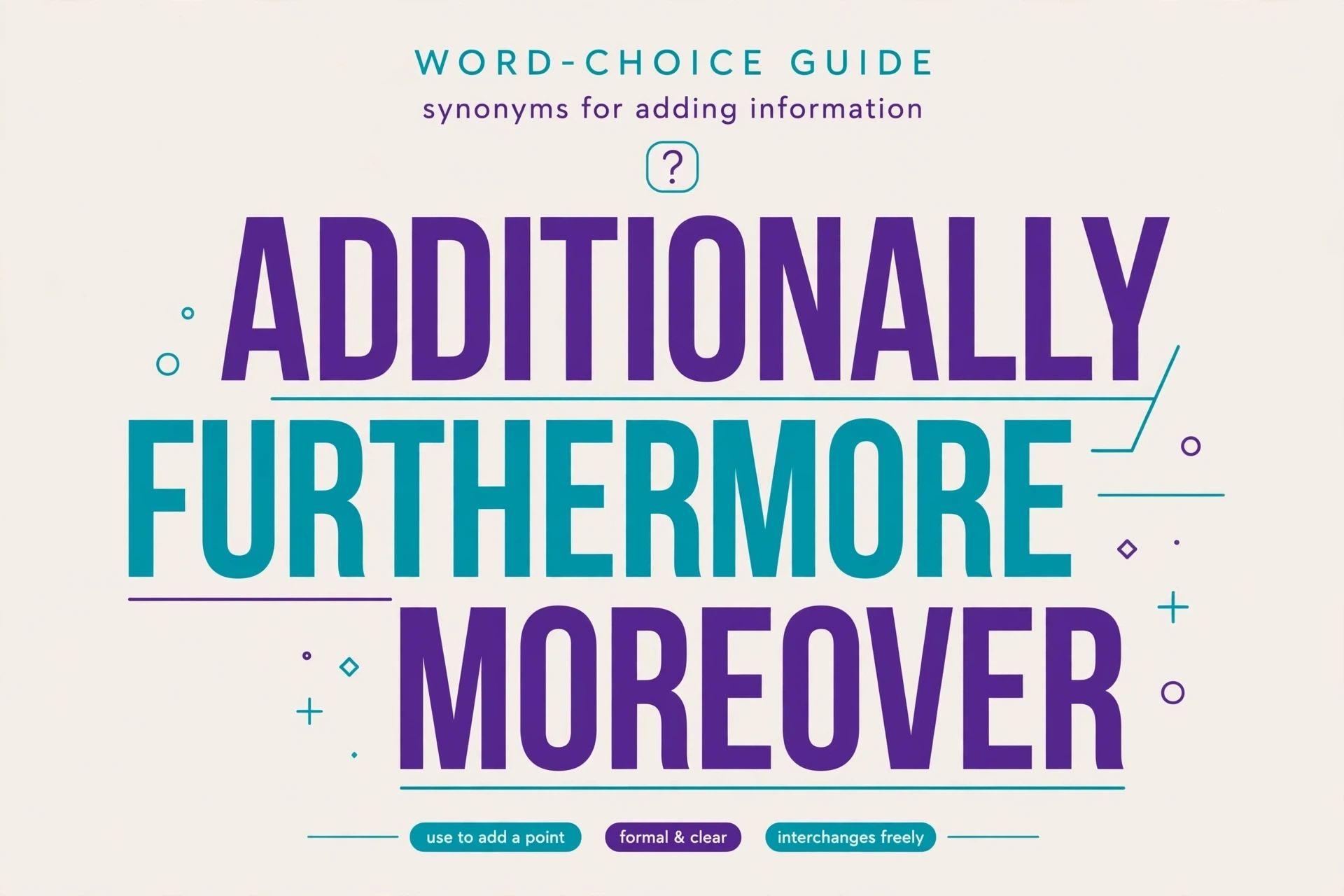
| furthermore | Formal; builds an argument |
| moreover | Formal; adds a stronger point |
| besides | Conversational; adds a supporting reason |
| in addition | Standard written connector |
| plus | Informal; adds a bonus fact |
| likewise | “In the same way”; shared action or trait |
| similarly | Compares two parallel situations |
| along with | Joins items in a list or group |
| not to mention | Emphatic addition; the new point is big |
Simple rule: use too and as well in conversation, additionally and in addition in professional writing, and furthermore or moreover when building a formal argument. Browse the full range of options on Merriam-Webster’s thesaurus page for “also” for even more choices.
Casual Additions
Everyday speech and informal writing need light, natural connectors. These six slot in without sounding stiff.
-
too — Adds a parallel fact, usually at the sentence’s end. Example: We all ordered dessert too.
-
as well — Same meaning as “too,” a touch more polished. Example: The gift shop was packed as well.
-
plus — Informally adds a bonus or benefit. Example: The apartment is cheap, plus it is near the station.
-
besides — Adds a supporting reason, often in argument. Example: I cannot go out tonight; besides, I have an early meeting.
-
along with — Joins extra items to a list. Example: Along with her degree, she earned two professional certificates.
-
not to mention — Emphatic addition where the new point matters a lot. Example: The house needs a new roof, not to mention the plumbing.

Formal Connectors
Essays, reports, and business writing call for weightier addition words. These six keep professional prose flowing.
-
additionally — Neutral, professional way to add a point. Example: Additionally, the report includes data from three new regions.
-
furthermore — Formal addition that extends an argument. Example: Furthermore, the study’s sample size was the largest to date.
-
moreover — Adds a point, often a stronger one than what came before. Example: The policy is costly; moreover, it has never been tested.
-
in addition — Standard written connector for a new point. Example: In addition to the raise, she received an extra week of leave.
-
what is more — Formal emphasis on the added point. Example: The service is fast; what is more, it is free.
-
on top of that — Adds a further point, often with mild complaint. Example: The flight was delayed; on top of that, my luggage went missing.
Adding Emphasis & Surprise
Sometimes “also” does not just add — it underlines. These five give the extra point weight, surprise, or a sense of “as if that weren’t enough.”
-
even — Adds something surprising or extreme. Example: She finished the marathon — even with a sprained ankle.
-
let alone — Adds a harder case to prove the point. Example: He can’t boil an egg, let alone cook dinner.
-
to boot — Informal; adds a bonus on top. Example: She got the promotion, and a company car to boot.
-
into the bargain — British-tinged phrase for an extra, often unexpected, addition. Example: He was rude, and wrong into the bargain.
-
for good measure — Adds something extra beyond what is required. Example: She proofread it twice, and ran spell-check for good measure.
Also as “Likewise”
When “also” means “in the same way” — a shared trait, action, or opinion — these five fit better than a plain addition word.
-
likewise — In the same way; does or feels the same. Example: He wished me luck, and I did likewise.
-
similarly — In a comparable way; parallels two situations. Example: The first trial failed; similarly, the second produced no results.
-
correspondingly — In a matching or proportional way. Example: Prices rose, and correspondingly, demand for discounts grew.
-
by the same token — For the same reason; conversational logic link. Example: Hard work earns respect; by the same token, laziness earns none.
-
in the same way — Direct, clear parallel. Example: She treated every customer in the same way — with patience and a smile.
Common Mistakes With Also Synonyms
Addition words look simple, but placement and formality trip writers up — the same kind of quiet mix-up as etc vs ect or further vs farther. Steer clear of these four errors:
Mistake 1: Starting every sentence with “Also,”
❌ “Also, the results improved. Also, costs fell.”
✅ “Additionally, the results improved. Moreover, costs fell.”
Why: Stacking “also” at sentence starts reads as flat. Rotate through “additionally,” “moreover,” and “in addition” for variety.
Mistake 2: Using “too” mid-sentence
❌ “She too went to the store early.”
✅ “She went to the store early too.”
Why: In modern usage, “too” belongs at the end of the clause. Mid-sentence “too” sounds archaic or awkward.
Mistake 3: Writing “furthermore” in casual text
❌ “The pizza was great; furthermore, the garlic bread rocked.”
✅ “The pizza was great, plus the garlic bread rocked.”
Why: “Furthermore” is a formal argument-builder. In casual writing it sounds pompous — “plus” or “and” does the job.
Mistake 4: Confusing “besides” with “beside”
❌ “Beside, I was too tired to argue.”
✅ “Besides, I was too tired to argue.”
Why: “Beside” means “next to”; “besides” means “in addition.” One letter changes the whole meaning.
How to Choose the Right Synonym
- Match the formality. “Too” and “plus” suit texts and blogs; “furthermore” and “moreover” suit essays and reports. A formal word in a casual sentence sounds as wrong as a casual word in a formal one.
- Check the sentence position. “Too” goes last; “additionally” and “furthermore” usually start the sentence; “as well” trails at the end. Each word has a favorite seat — learn it.
- Decide what kind of “also” you mean. Adding a fact (“additionally”), drawing a parallel (“similarly”), or emphasizing (“even”) are different jobs. Name the job before picking the word.
- Don’t stack additions. “Also, additionally, moreover” in three consecutive sentences is one “also” too many. Vary your connectors and give each paragraph breathing room.
- Consider punctuation. Sentence adverbs like “furthermore” and “moreover” need a comma after them when they open a sentence. “Too” at the end often needs a comma before it.
- Read for rhythm. “She sings; moreover, she dances” marches. “She sings, and she dances too” swings. Pick the word whose rhythm matches your paragraph.
Frequently Asked Questions
What is a synonym for also?
The most common synonyms for “also” are too, as well, additionally, furthermore, moreover, and besides. Casual writing favors “too” and “as well”; formal writing favors “additionally” and “furthermore.”
What is a formal synonym for also?
“Additionally,” “furthermore,” “moreover,” and “in addition” are the standard formal options. “Furthermore” and “moreover” work best when building an argument point by point.
What is the difference between “also,” “too,” and “as well”?
They mean the same thing but sit differently: “also” goes before the verb (“I also swim”), “too” and “as well” go at the end (“I swim too”). “As well” sounds slightly more formal than “too.”
Can “furthermore” replace “also” anywhere?
No. “Furthermore” adds a new point in formal, argumentative writing. Using it for simple additions (“I like tea; furthermore, I like coffee”) sounds stiff — “too” or “also” is better.
Is “moreover” the same as “furthermore”?
Nearly. Both add formal points, but “moreover” often introduces a stronger or more decisive point than the one before it, while “furthermore” simply continues the argument.
Conclusion
“Also” will always have a place in English, but variety is what keeps readers engaged. Whether you choose the casual too, the professional additionally, or the emphatic not to mention, matching the word to your tone turns a plain addition into a deliberate one. Your paragraphs will thank you.