Foreign or Foriegn: What’s the Difference?
Foreign is the correct spelling — foriegn with I before E is always a misspelling. Like “seize,” this word breaks the “i before e” rule on purpose, so writers who trust the classroom rhyme produce the wrong version with total confidence. “She speaks three foreign languages” is right; “foriegn” appears in no dictionary.
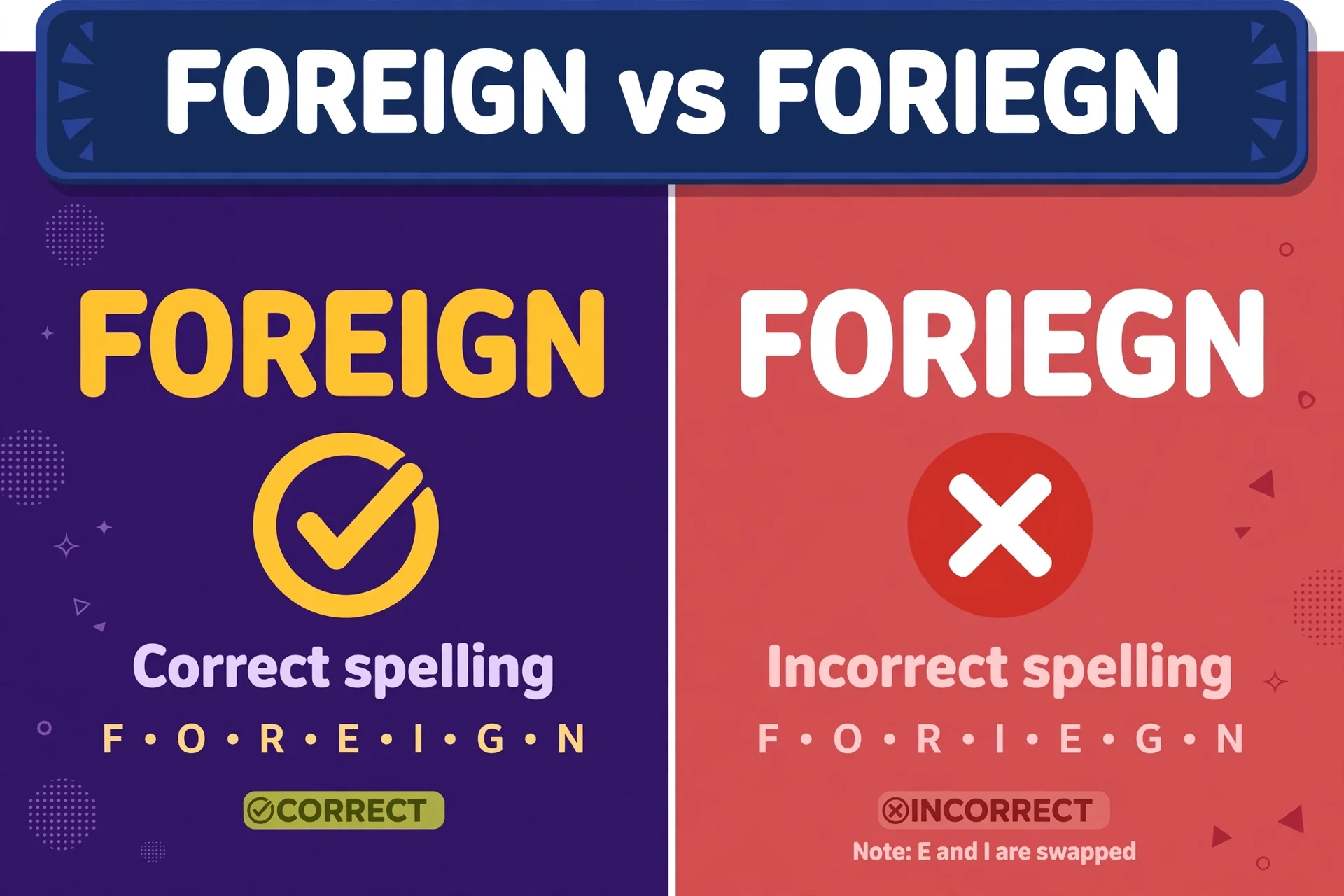
Quick Answer
| Word | Part of Speech | Main Meaning | Example |
|---|---|---|---|
| foreign | Adjective | From another country; unfamiliar | ✅ “They tried foreign cuisine.” |
| foriegn | — (misspelling) | Not a standard English word | ❌ “They tried foriegn cuisine.” |
Simple rule: Foreign ends like reign — E-I-G-N. Foriegn “fixes” it to I-E and is never correct.
What Does Foreign Mean?
Foreign means coming from another country, or simply unfamiliar and strange — foreign languages, foreign policy, foreign objects, “a foreign concept.” It stretches from geography to anything outside one’s experience. Merriam-Webster’s entry for “foreign” covers both the “situated outside one’s own country” sense and the “not familiar” sense.
Examples:
- “She collects foreign coins.”
- “The company expanded into foreign markets.”
- “He felt like a foreigner at the formal dinner.”
- “That idea is completely foreign to me.”
- “Foreign aid arrived within days.”
The noun foreigner and the phrase “foreign affairs” both keep the same E-I-G-N core — the whole word family agrees on the spelling.
What Does Foriegn Mean?
Nothing in standard English. Foriegn is a misspelling of “foreign,” created by writers applying “i before e except after c” with textbook precision. There is no C in the word, so the rule seems to demand I-E — and the writer produces a confident, rule-abiding error. “Foreign” joins “seize” and “weird” on the short list of famous exceptions.
Examples of the misspelling (all incorrect):
- ❌ “He works for a foriegn company.”
- ❌ “She is fluent in three foriegn languages.”
- ❌ “Foriegn films often have subtitles.”
- ❌ “The foriegn exchange student arrived today.”
Because the “corrected” version follows the famous rule, even good spellers fall for it — the error wears a disguise of correctness.
Foreign vs. Foriegn: Key Differences
| Feature | Foreign | Foriegn |
|---|---|---|
| Spelling status | Correct standard spelling | Misspelling — not a real word |
| Ending | E-I-G-N (“-eign”) | I-E-G-N (“-iegn”) — wrong |
| The rule | Breaks “i before e” (exception) | What the rule predicts |
| Rhymes with | reign, deign | Nothing (not a word) |
| Example | ✅ “foreign trade” | ❌ “foriegn trade” |
The ending tells the story: foreign rhymes with reign because it shares the EIGN spelling, while foriegn rhymes with nothing because it exists nowhere.
Foreign and Foriegn in Real Sentences
At Home
✅ “We tried cooking a foreign recipe tonight.”
❌ “We tried cooking a foriegn recipe tonight.”
Recipe blogs and travel shows use the word constantly — always with EIGN.
At Work
✅ “Our team handles foreign clients.”
❌ “Our team handles foriegn clients.”
In international business emails, “foriegn” is the kind of typo that makes readers question the sender’s polish.
In Conversation
✅ “That custom seems foreign to me.”
❌ “That custom seems foriegn to me.”
The “unfamiliar” sense is just as common as the “abroad” sense — and spelled the same way.

Common Mistakes
The IE/EI war never ends — the “thier” vs “their” ie/ei spelling shows the rule working, and the “speach” vs “speech” spelling confusion shows the same flipped pair elsewhere. “Foreign” is the ambush:
Mistake 1: “Fixing” foreign to foriegn
❌ “She studied foriegn policy.”
✅ “She studied foreign policy.”
Why: No C precedes the pair, so “i before e” seems to apply — but “foreign” is a classic exception. Rules have exceptions; memorize this one.
Mistake 2: Writing “foriegner”
❌ “He is a foriegner.”
✅ “He is a foreigner.”
Why: The noun keeps the adjective’s EIGN. Fix the root and the -er form follows.
Mistake 3: Confusing with “foregoing”
❌ “The foriegn conclusions…” (meant: previous)
✅ “The foregoing conclusions…”
Why: “Foregoing” (previous) starts with FORE- too, but it is a different word entirely — don’t let the prefix confuse you.
Mistake 4: Pronouncing the G
❌ “FOR-ee-gun” (with a hard G)
✅ “FOR-in” (G silent)
Why: The G is silent, which is part of why the spelling feels untrustworthy. Trust the EIGN anyway.
Pronunciation
Foreign is pronounced FOR-in — two syllables, the G completely silent, rhyming with “reign” minus the R. The silent G makes the spelling feel arbitrary, which is exactly why writers reach for the “rule” and produce “foriegn.”

How to Remember the Difference
Foreign ends exactly like reign — F-O-R-E-I-G-N, R-E-I-G-N. A foreign king’s reign: the two words share their strange EIGN ending, and if you can spell one, you can spell the other.
- Reign anchor: foreign = for + eign, just like reign. Same ending, same silence of the G.
- Exception trio: weird, seize, foreign — the three famous “i before e” rebels worth memorizing.
- Sound test: say “FOR-in” — the G is silent, so don’t let it bully you into rearranging the vowels.
Frequently Asked Questions
Is it foreign or foriegn?
Foreign. “Foriegn” is a misspelling and is never correct in standard English.
Why doesn’t “foreign” follow “i before e”?
It is one of the rule’s famous exceptions, along with “seize” and “weird.” The rule is a guideline with known rebels — “foreign” is one of them.
Is the G in “foreign” silent?
Yes — “foreign” is pronounced “FOR-in.” The silent G is part of what makes the spelling feel untrustworthy.
What’s the noun form?
“Foreigner” — someone from another country. It keeps the EIGN spelling.
Does “foreign” only mean “from abroad”?
No — it also means unfamiliar or strange, as in “the idea was foreign to him.”
How is “foreign” related to “reign”?
Only by spelling — both end in EIGN with a silent G. The shared ending is a handy memory anchor, not a shared meaning.
What other words end in EIGN?
“Sovereign” and “reign” are the most common. All three are pronounced with a silent G, which is exactly why they trip spellers up. Grouping them together — foreign, sovereign, reign — makes the odd EIGN ending feel like a family instead of a one-off trick.
Will spellcheckers catch “foriegn”?
Yes — every major spellchecker flags “foriegn” as a misspelling and suggests “foreign.” But spellcheckers are not everywhere: handwritten notes, quick chat messages, and timed exams are where this error actually appears. Knowing the spelling cold means you are safe even when no red squiggle is watching.
Conclusion
Foreign breaks the “i before e” rule the same way reign does — and sharing that rebel ending is the easiest way to remember it. Write foriegn and you’ve followed the rule into an error; write foreign and you’re in the company of everyone who knows the exceptions.