Beginning or Begining: What’s the Difference?
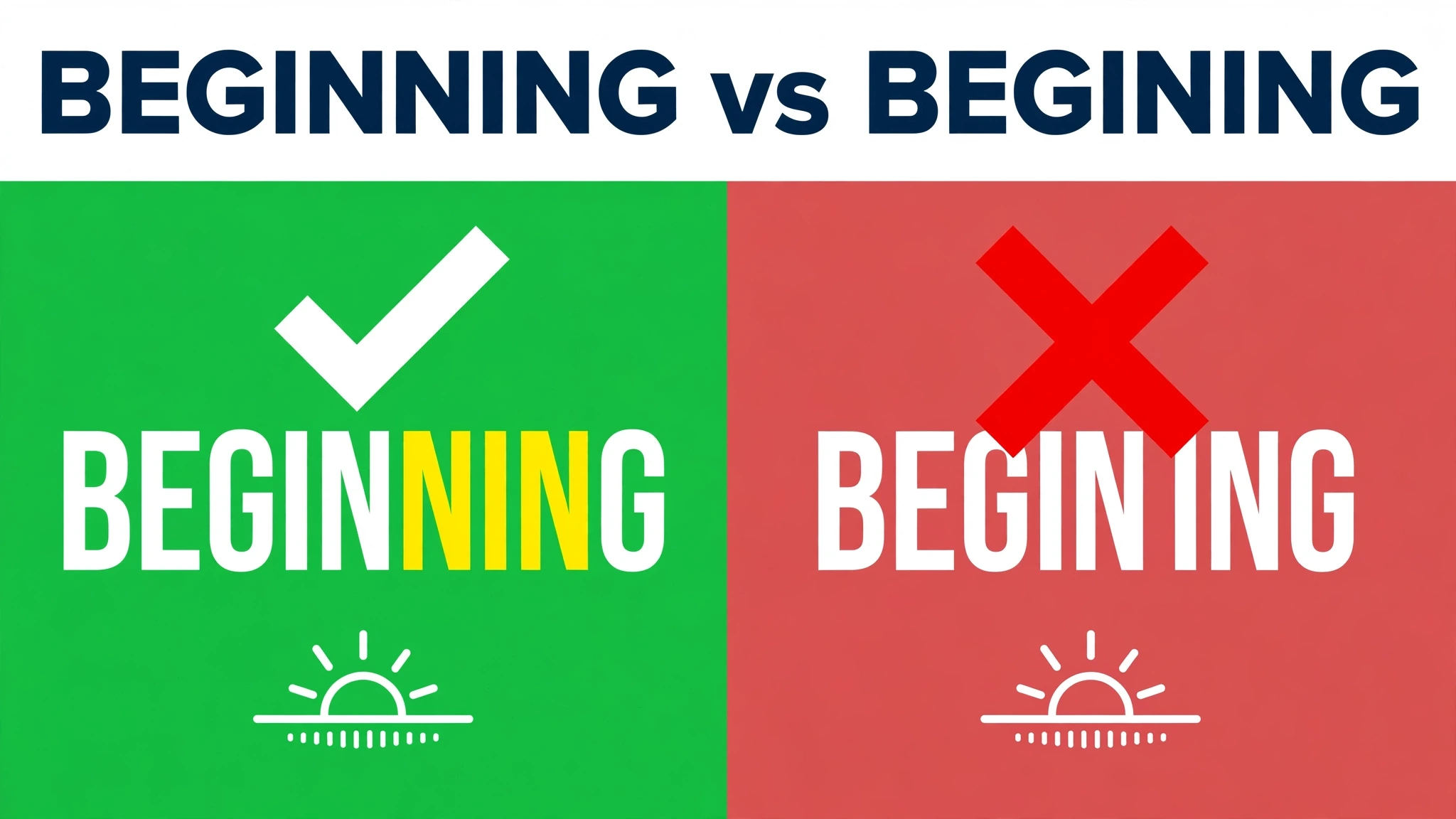
Beginning with a double N is the correct spelling — the start of something, or the -ing form of “begin.” Begining with a single N is always a misspelling. The extra N follows a real rule, not a whim, and once you learn it, you’ll spell a whole family of words correctly.
Quick Answer
| Word | Part of Speech | Main Meaning | Example |
|---|---|---|---|
| beginning | Noun / adjective / verb form | The start of something; the -ing form of “begin” | ✅ “The beginning of the book was slow.” |
| begining | — | Not a word; a misspelling of “beginning” | ❌ “The begining of the book was slow.” |
Simple rule: “Begin” doubles its N before -ing — beginning, never “begining.”
What Does Beginning Mean?
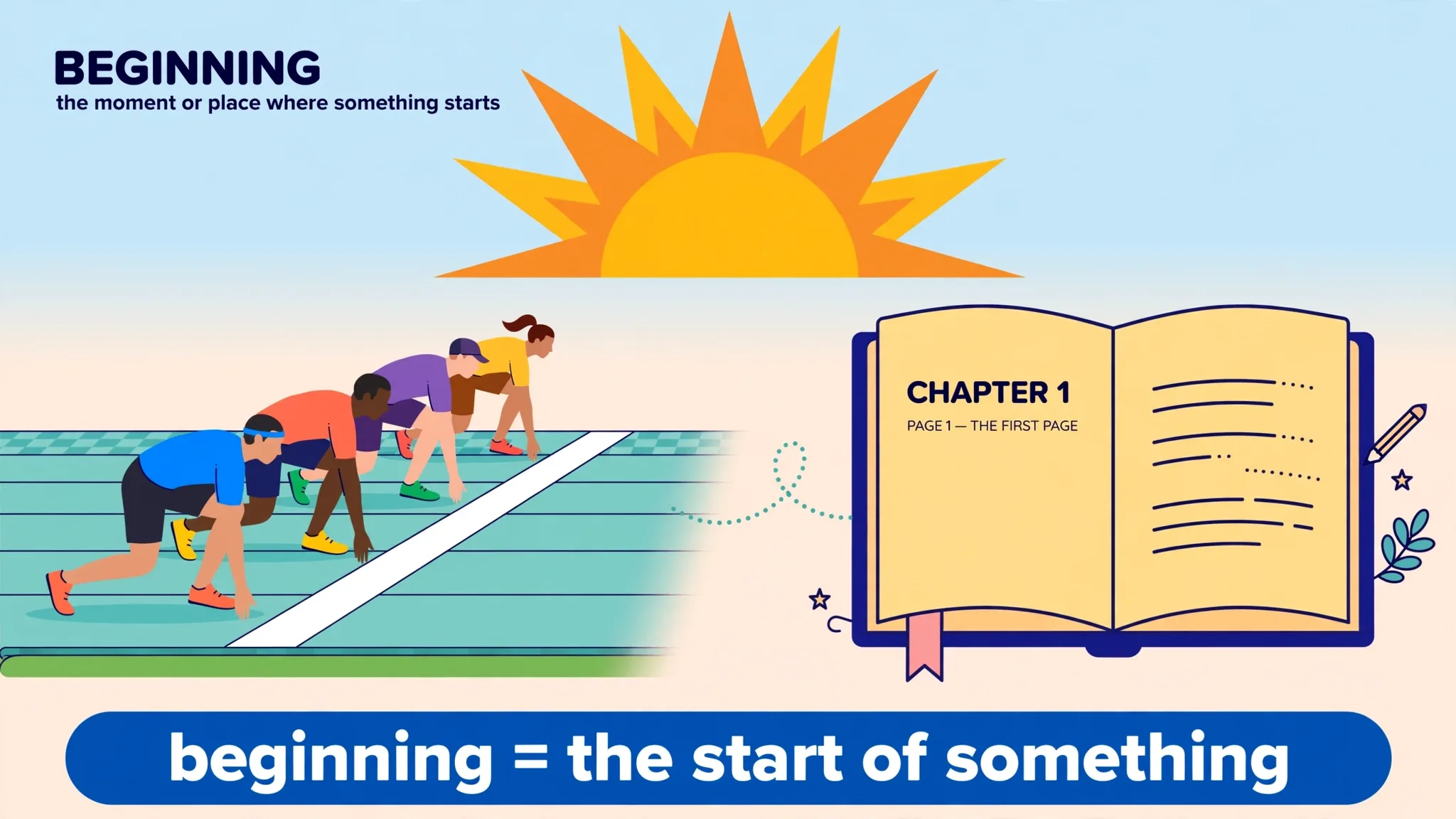
Beginning works three ways. As a noun, it means the start of something: the beginning of a story, a career, a year. As an adjective, it describes an early stage: “a beginning reader,” “beginning Spanish.” As a verb form, it’s the present participle of “begin”: “She is beginning to understand.” Merriam-Webster lists all three uses under “beginning,” always with the double N.
Examples:
- “The beginning of the movie explains everything.”
- “He’s taking a beginning photography class.”
- “The baby is beginning to walk.”
- “In the beginning, the startup had three employees.”
- “I’m just beginning to learn the guitar.”
Beginning as the start
As a noun, beginning is the opposite of “end.” It points to the first part of any stretch of time, text, or process — the beginning of the week, the beginning of chapter one, a new beginning after a move. It’s one of the most common nouns in English, which makes its spelling worth nailing.
Beginning as a verb form
As the -ing form of “begin,” beginning shows action in progress: “We are beginning now.” The double N comes from a spelling rule, not from the root word changing — “begin” stays “begin,” and the N simply doubles to protect the short I sound before the -ing ending.
What Does Begining Mean?
Begining means nothing — it’s the single-N misspelling of “beginning.” No dictionary lists it, and spellcheckers flag it instantly. It appears when writers add -ing to “begin” the way they’d add it to “open” (opening) or “listen” (listening): just stick the ending on and move on. But “begin” belongs to a different family — short words ending in one vowel plus one consonant double that consonant, giving “beginning,” “running,” and “swimming.”
The single-N version also misleads the reader’s ear. English readers expect a single consonant before -ing to lengthen the vowel (“dining,” “hoping”), so “begining” looks like it should rhyme with “dining.” The double N keeps the short I of “begin” intact — it’s doing pronunciation work, not just sitting there.
Beginning vs. Begining: Key Differences
| Feature | beginning | begining |
|---|---|---|
| Spelling status | Correct, standard spelling | Misspelling — not a word |
| The N’s | Double N (beginning) | Single N |
| Meaning | The start; the -ing form of “begin” | None |
| Part of speech | Noun, adjective, verb form | — |
| In dictionaries | Listed everywhere | Not listed |
| Follows the rule | Yes — 1-1-1 doubling rule | Breaks it |
One letter separates a correct, hardworking word from an error: the doubled N is required, never optional.
Beginning and Begining in Real Sentences
At Home
✅ “The beginning of the school year is always chaotic.”
Writing “begining” here would trip every spellchecker — the noun form of “the start” always carries the double N.
At Work
✅ “We’re beginning the rollout next Monday.”
As a verb form, the double N marks ongoing action; the single-N version isn’t an alternative spelling, just a mistake.
In Conversation
✅ “‘I’m only beginning,’ she laughed, ‘give me time.'”
Speech hides the difference completely — both versions sound identical, so the spelling has to be memorized, not heard.
In Writing
✅ “A strong beginning carries the whole essay.”
Editors notice this one fast: “begining” in a manuscript reads as a basic spelling slip, whatever the sentence around it says.
Common Mistakes
The doubled consonant is a serial troublemaker — it sits behind the “dieing” or “dying” spelling rule and the “cancelled” vs “canceled” doubling rule. “Beginning” trips writers for the same reason: the rule is invisible in speech, so it has to be learned as a pattern.
Mistake 1: The single N
❌ “The begining was rough.”
✅ “The beginning was rough.”
Why: “Begin” ends in one vowel + one consonant with stress on the last syllable, so the N doubles before -ing. Single N breaks the rule.
Mistake 2: Doubling the wrong letter
❌ “The beggining was rough.”
✅ “The beginning was rough.”
Why: Only the final consonant doubles — the N, not the G. The pattern is begin → beginning, just like run → running.
Mistake 3: Treating “begin” like “open”
❌ “They are begining to see results.” (by analogy with “opening”)
✅ “They are beginning to see results.”
Why: “Open” has two syllables with stress on the first, so its N stays single. “Begin” is stressed on the last syllable, which triggers doubling — the words follow different rules.
Mistake 4: Dropping the N in “beginner” too
❌ “She’s a begginer at chess.”
✅ “She’s a beginner at chess.”
Why: The same doubling applies before -er: begin → beginner. Learn the pattern once and it covers the whole word family.
Pronunciation
Beginning is pronounced “bih-GIN-ing” (/bɪˈɡɪn.ɪŋ/) — three syllables, with the stress on the middle one. The double N is pronounced as a single N sound; it changes the spelling, not the sound. That’s the trap: because “begining” and “beginning” would sound identical, the ear can’t tell you which is right. The misspelling has no pronunciation of its own — it’s simply the correct word with a letter missing.
How to Remember the Difference
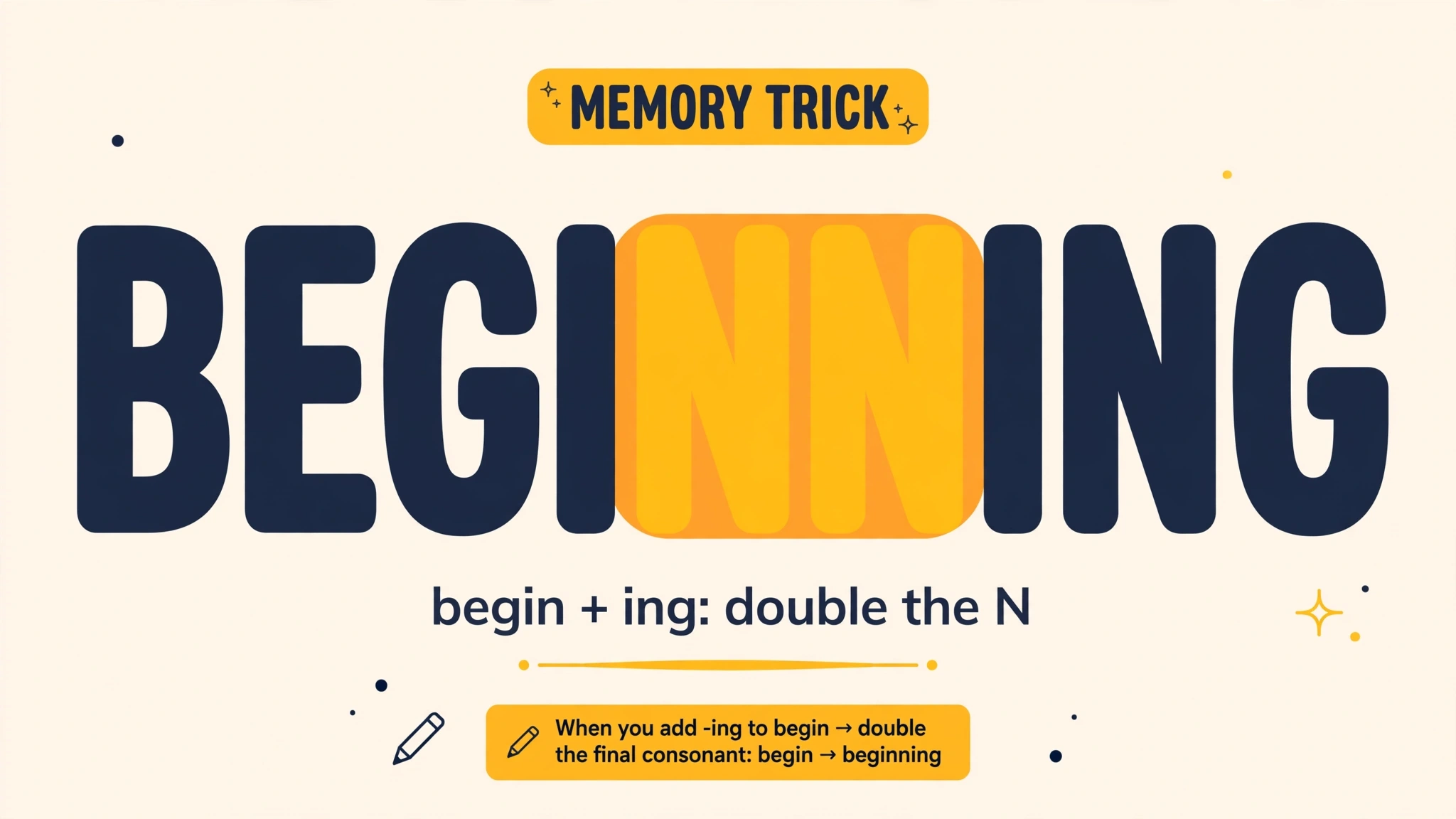
Think begin + ing = begiNNing: the little word “begin” ends in one vowel and one consonant, and short words like that double the final consonant before -ing. The two N’s sit together in the middle, guarding the short I sound.
- The 1-1-1 rule: 1 syllable stressed at the end + 1 vowel + 1 consonant → double it: begin → beginning, run → running, swim → swimming.
- NN in the middle: picture the two N’s holding hands in the center of the word — “begining” with one N looks underdressed.
- Test with “running”: if you’d never write “runing,” don’t write “begining” — same rule, same double letter.
- Sound check fails here: both spellings sound identical, so trust the rule, not your ear.
Frequently Asked Questions
Is it beginning or begining?
It’s beginning with a double N. “Begining” is always a misspelling — no dictionary recognizes it.
Why does beginning have two N’s?
The 1-1-1 doubling rule: a word ending in one vowel + one consonant, stressed on the final syllable, doubles that consonant before a vowel suffix. “Begin” fits perfectly, so begin + ing becomes “beginning.”
Is it “beginner” with two N’s as well?
Yes — beginner follows the same rule (begin + er). One pattern covers the whole family: beginning, beginner, beginnings.
What is the plural of beginning?
Beginnings — add S to the correct double-N spelling. “She’s had many new beginnings in her career.”
Do all -ing words double the consonant?
No — only words matching the 1-1-1 pattern. “Open” becomes “opening” (stress on the first syllable), “rain” becomes “raining” (two vowels), and “fix” becomes “fixing” (X never doubles). The rule is specific, which is what makes it reliable.
Conclusion
Beginning always carries a double N, thanks to the 1-1-1 doubling rule — begining is never correct. Remember “begin + ing = begiNNing,” and the whole word family (beginner, beginnings) falls into place.