Allie or Ally: What’s the Difference?
Allie with a capital A and an -ie ending is a person’s name — short for Alison, Alexandra, or Allison. Ally with a lowercase a and a -y ending is a common noun (and verb) meaning a friend, partner, or supporter. They sound identical, which is why birthday cards sometimes thank an “ally” and essays sometimes describe a wartime “Allie” — both wrong, both avoidable.
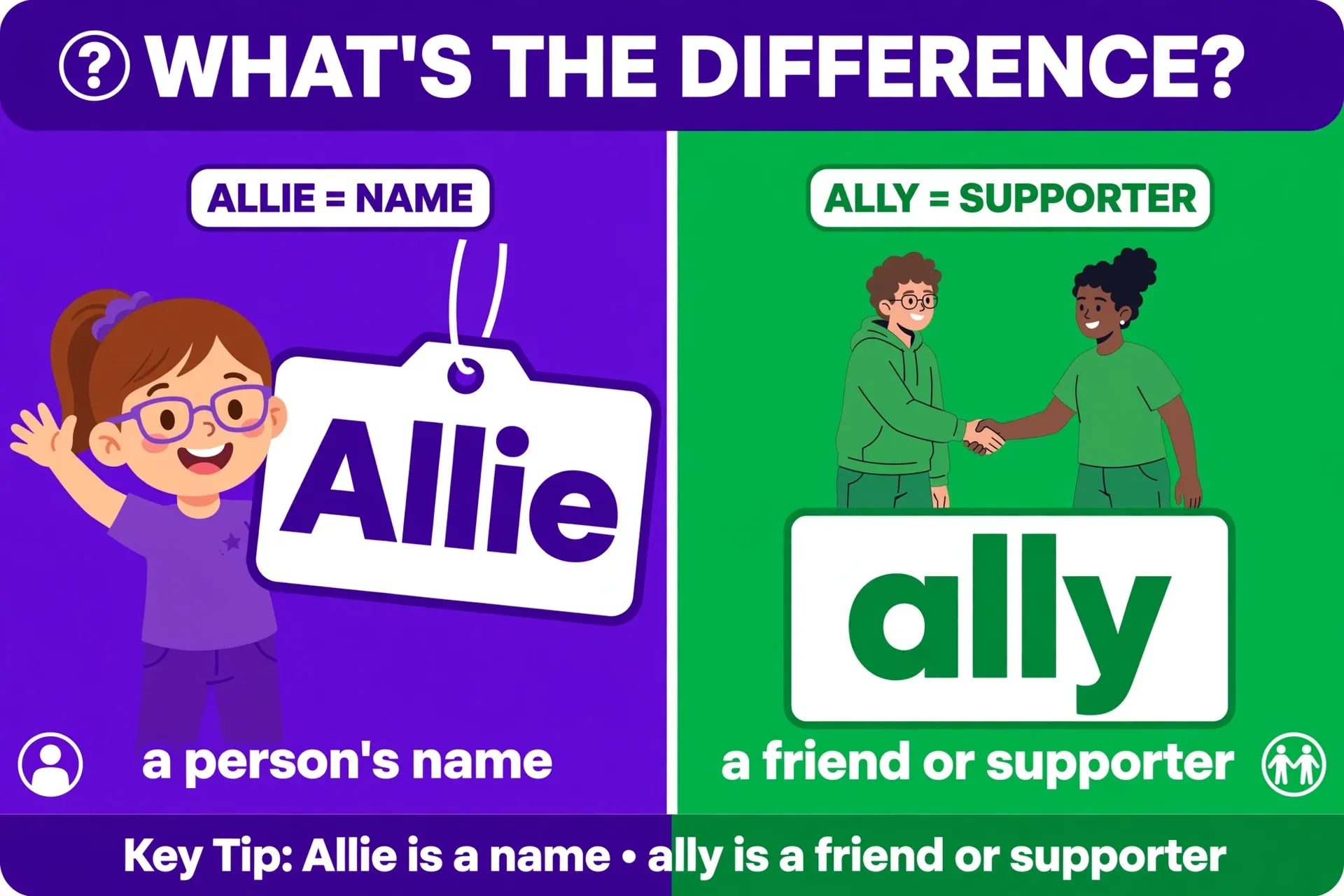
Quick Answer
| Word | Part of Speech | Main Meaning | Example |
|---|---|---|---|
| Allie | Proper noun | A personal name — nickname for Alison, Alexandra, Allison | ✅ “Allie scored the winning goal.” |
| ally | Noun / verb | A friend or supporter; to join forces with | ✅ “She has been a loyal ally for years.” |
Simple rule: If it names a person, capitalize it and spell it Allie; if it means a friend, supporter, or the act of joining one, write lowercase ally.
What Does Allie Mean?
Allie is a given name — most often a nickname for Alison, Alexandra, Allison, or Alice, though it stands on its own on plenty of birth certificates. Like all proper nouns, it is always capitalized, and its -ie ending is the familiar English nickname pattern (think Charlie, Jamie, Ellie). It refers to a specific person and nothing else.
Examples:
- “Allie is coming over for dinner tonight.”
- “Have you met Allie? She just moved here from Denver.”
- “Allie, please pick up your shoes.”
- “The award goes to Allie Thompson.”
- “Little Allie learned to ride her bike yesterday.”
Because it is a name, “Allie” has no plural, no verb form, and no meaning beyond the person it points to — which is precisely what separates it from “ally.”
What Does Ally Mean?
Ally is a common noun meaning a friend, partner, or supporter — someone (or some country) joined with you in a cause. It also works as a verb meaning to join forces: nations ally, colleagues ally, activists ally with movements. Merriam-Webster’s entry for “ally” covers both the noun and verb senses, from wartime coalitions to everyday friendships.
Examples:
- “She proved herself a true ally during the campaign.”
- “The two countries have been allies for decades.”
- “He allied himself with the reformers.”
- “Every newcomer needs an ally in the office.”
- “The charity allied with local businesses to fund the shelter.”
Note the plural: one ally, two allies — the Y changes to IE, the standard rule for nouns ending in consonant-Y.
Allie vs. Ally: Key Differences
| Feature | Allie | Ally |
|---|---|---|
| Word type | Proper noun (a name) | Common noun / verb |
| Capitalization | Always capitalized | Lowercase (unless starting a sentence) |
| Ending | -ie (nickname pattern) | -y (standard noun/verb ending) |
| Plural | None (names don’t pluralize) | allies |
| Meaning | A specific person | A friend, supporter; to join forces |
| Example | ✅ “Allie called.” | ✅ “An ally called.” |
Capital letter plus -ie means a person; lowercase plus -y means a friend or the act of befriending.
Allie and Ally in Real Sentences
At Home
✅ “Allie, dinner’s ready!”
✅ “The cat has become an unlikely ally in the war against mice.”
One calls a daughter to the table; the other drafts the pet into pest control.
At Work
✅ “Allie from accounting approved the budget.”
✅ “Find an ally in another department before proposing the change.”
Offices run on both — colleagues named Allie, and colleagues who act as allies.
In Conversation
✅ “I ran into Allie at the store.”
✅ “He’s been a great ally to the neighborhood project.”
Context usually rescues the meaning in speech, but writing has to get the letters right.
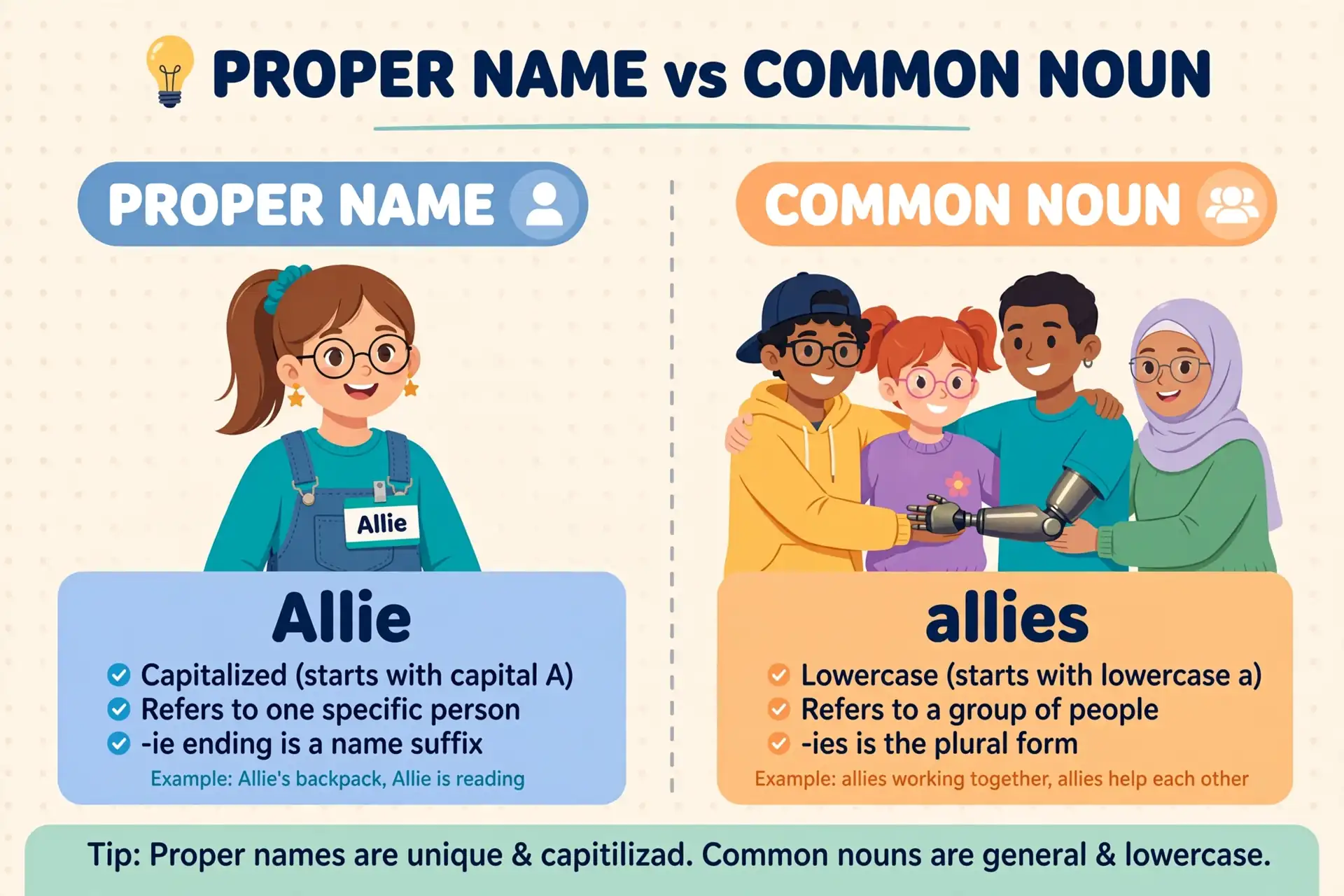
Common Mistakes
Name spellings and lookalike words cause the same slip — the “momma” vs “mama” name spelling shows how one letter changes a familiar word, and the “jewelry” vs “jewellery” spelling variants show how endings drift between forms. The Allie/ally traps:
Mistake 1: Writing “ally” when you mean the name
❌ “Happy birthday, ally!”
✅ “Happy birthday, Allie!”
Why: Lowercase “ally” means “friend” — so the card accidentally says “happy birthday, friend.” Sweet sentiment, wrong word.
Mistake 2: Capitalizing the common noun
❌ “France was a loyal Ally during the war.”
✅ “France was a loyal ally during the war.”
Why: Common nouns stay lowercase mid-sentence. Capital-A “Ally” reads as someone’s name — as if France befriended a woman.
Mistake 3: Using “allie” as the plural or verb
❌ “The two nations became allie’s.”
✅ “The two nations became allies.”
Why: The plural of “ally” is “allies” (Y → IES), and the verb is “ally/ allied.” “Allie” can never do grammatical work — it only names.
Mistake 4: Assuming every “-ie” name works the same
❌ “Her Allie signed the treaty.” (meant: her friend/partner)
✅ “Her ally signed the treaty.”
Why: Not every friendly -ie word is a name, and not every name ends in -ie. Check the job the word is doing: naming a person, or describing a relationship?
Pronunciation
Allie and ally are pronounced identically: AL-eye, rhyming with “rally” and “tally.” No stress difference, no vowel shift — the distinction is purely visual, living in the capital letter and the final -ie vs -y.

How to Remember the Difference
Names wear capitals like name tags: Allie introduces herself with a big A and the friendly -ie nickname ending. The ordinary word ally stays lowercase and keeps its workmanlike -y — it has a job to do, not an identity to announce.
- Capital test: would you capitalize it mid-sentence? Then it is the name — Allie.
- Ending test: -ie is the nickname ending (Ellie, Charlie, Allie); -y is the worker ending (ally, enemy, family).
- Plural test: can you make it “allies”? Then it was never a name — ally.
Frequently Asked Questions
Is it Allie or ally?
Both are correct words with different jobs: “Allie” (capitalized) is a personal name, while “ally” (lowercase) means a friend, supporter, or the verb “to join forces.”
Is “Allie” short for anything?
Usually Alison, Alexandra, Allison, or Alice — though many parents now use Allie as the full given name.
What is the plural of “ally”?
“Allies” — the Y changes to IE before adding S, following the standard consonant-Y rule.
Can “ally” be a verb?
Yes: “to ally” means to join or unite, as in “the groups allied against the proposal.” Its past tense is “allied.”
Should “ally” ever be capitalized?
Only at the start of a sentence, like any common noun. Mid-sentence capitals turn it into the name Allie.
Are “Allie” and “ally” homophones?
Yes — they sound exactly the same. Only spelling and capitalization tell them apart.
Conclusion
Allie is someone you know; ally is someone on your side. Capitalize the person, lowercase the partner, and the two will never get mixed up again.