Dragged or Drug: What’s the Difference? (With Examples)
Dragged is the standard past tense of drag — “He dragged the suitcase upstairs.” Drug is also a real word, but using it as the past tense of drag (“He drug the suitcase”) is dialectal and nonstandard. In standard English, drug is a noun or verb about medicine: “a new drug,” “to drug a patient.”
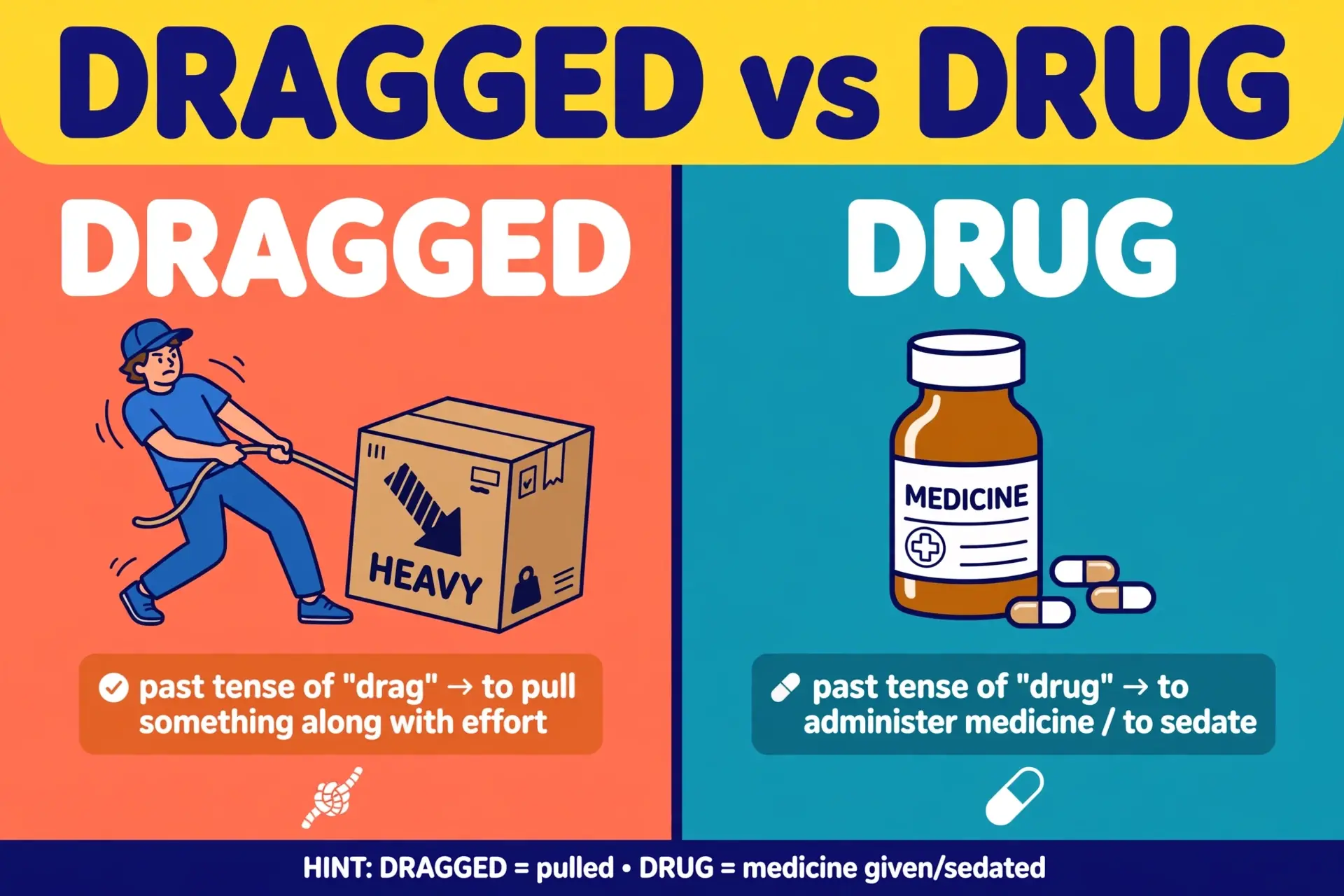
Table of Contents
Quick Answer
| Word | Part of Speech | Main Meaning | Example |
|---|---|---|---|
| dragged | Verb (simple past / past participle) | Pulled something in the past; the standard past tense of drag | “She dragged the chair closer.” |
| drug | Noun / verb | A medicine or substance; to give drugs to someone | “The doctor prescribed a new drug.” |
Simple rule: for the past tense of drag, always write dragged in standard English.
What Does Dragged Mean?
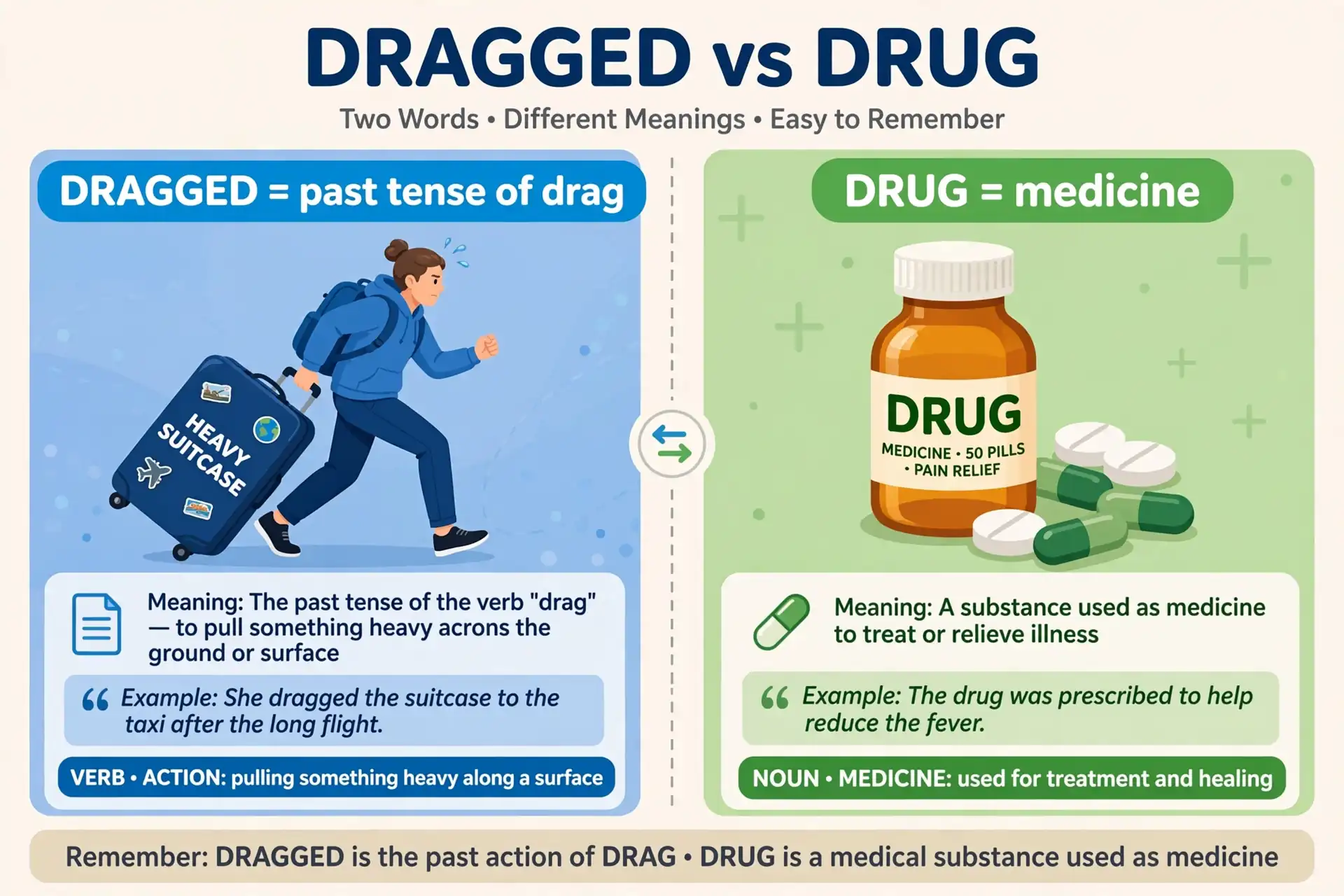
Dragged is the simple past tense and past participle of drag, meaning something was pulled along, moved slowly, or felt tedious. Check Merriam-Webster’s entry for “drag” for the full definition and forms.
Beyond literal pulling, dragged covers reluctant movement — “he dragged his feet on the decision” — and time that crawls: “the meeting dragged on for hours.” It also works for being pulled into something against your will: “she got dragged into the argument.”
Examples:
- He dragged the heavy box across the garage.
- She dragged herself out of bed at six.
- The movie dragged on for three hours.
- They had dragged the boat onto the sand before the storm hit.
- The toddler dragged his blanket everywhere he went.
- He dragged his feet on signing the contract.
What Does Drug Mean?
Drug is a completely different word in standard English. As a noun it means a medicine or substance; as a verb (“to drug”) it means to give someone drugs, usually secretly — and its past tense is drugged, with a double g.
Examples:
- The doctor prescribed a new drug for his blood pressure.
- Police believe the drink had been drugged.
- She keeps a drug reference book at the pharmacy.
- They drugged the guard dog to get past it.
- The new drug still needs approval.
- He was drugged with sleep after the long flight.
That last example shows the verb used figuratively — “drugged with sleep” means overwhelmed by it, not literally medicated. Either way, the past tense keeps its double g.
You’ll hear “He drug the boat to shore” in some regional speech, but that’s dialect, not standard English.
Dragged vs. Drug: Key Differences
| Feature | Dragged | Drug |
|---|---|---|
| Past tense of “drag” | Yes — the standard form | No — dialectal and nonstandard |
| Noun meaning | None | A medicine or substance |
| Verb meaning | “drag” in the past (pulled) | “to drug”: to give drugs to someone |
| Past participle use | “had dragged” ✓ | “had drug” ✗ |
| Register | Standard everywhere | As a past tense of drag, regional speech only |
They share some letters but belong to different families entirely: one is about pulling, the other about medicine.
Usage in Real Sentences
At Home
Dragged: “I dragged the laundry basket down the stairs.”
Drug: “Keep every drug in the house out of the kids’ reach.”
The first is about pulling; the second is about medicine — different worlds.
At Work
Dragged: “The negotiation dragged into the evening.”
Drug: “The company tests each new drug for years before release.”
One describes something tedious; the other belongs in a pharmacy or a lab.
In Conversation
Dragged: “We dragged our feet on the decision.”
Drug: “The vet had to drug the anxious cat for the flight.”
Notice drugged with the double g — that’s the real past tense of the medicine verb.
Dragged: “They dragged the old couch out to the curb.”
Drug: “Each new drug on the market passed years of trials.”
One is a past-tense verb of pulling; the other is a noun you’d find on a pharmacy shelf.
Common Mistakes
The usual error is importing a regional “drug” into writing — the same kind of verb-form confusion as dieing or dying and sound-alike traps like desert or dessert.
Mistake 1: Using “drug” as the past tense of drag
❌ “He drug the box across the floor.”
✅ “He dragged the box across the floor.”
Why: Drug isn’t the past tense of drag in standard English — that job belongs to dragged.
Mistake 2: “Had drug” in perfect tenses
❌ “She had drug it for miles.”
✅ “She had dragged it for miles.”
Why: The past participle of drag is dragged, so it follows had in the past perfect.
Mistake 3: Writing “druged” for the medicine verb
❌ “The nurse druged the patient.”
✅ “The nurse drugged the patient.”
Why: The verb “to drug” doubles its g in the past: drugged.
Mistake 4: Dropping a g from “dragged”
❌ “He draged the sled up the hill.”
✅ “He dragged the sled up the hill.”
Why: One-syllable verbs ending in consonant-vowel-consonant double the final consonant: drag → dragged.
Pronunciation
Dragged is pronounced “dragd,” rhyming with bagged, flagged, and tagged. Drug is “druhg,” rhyming with rug, hug, and mug.
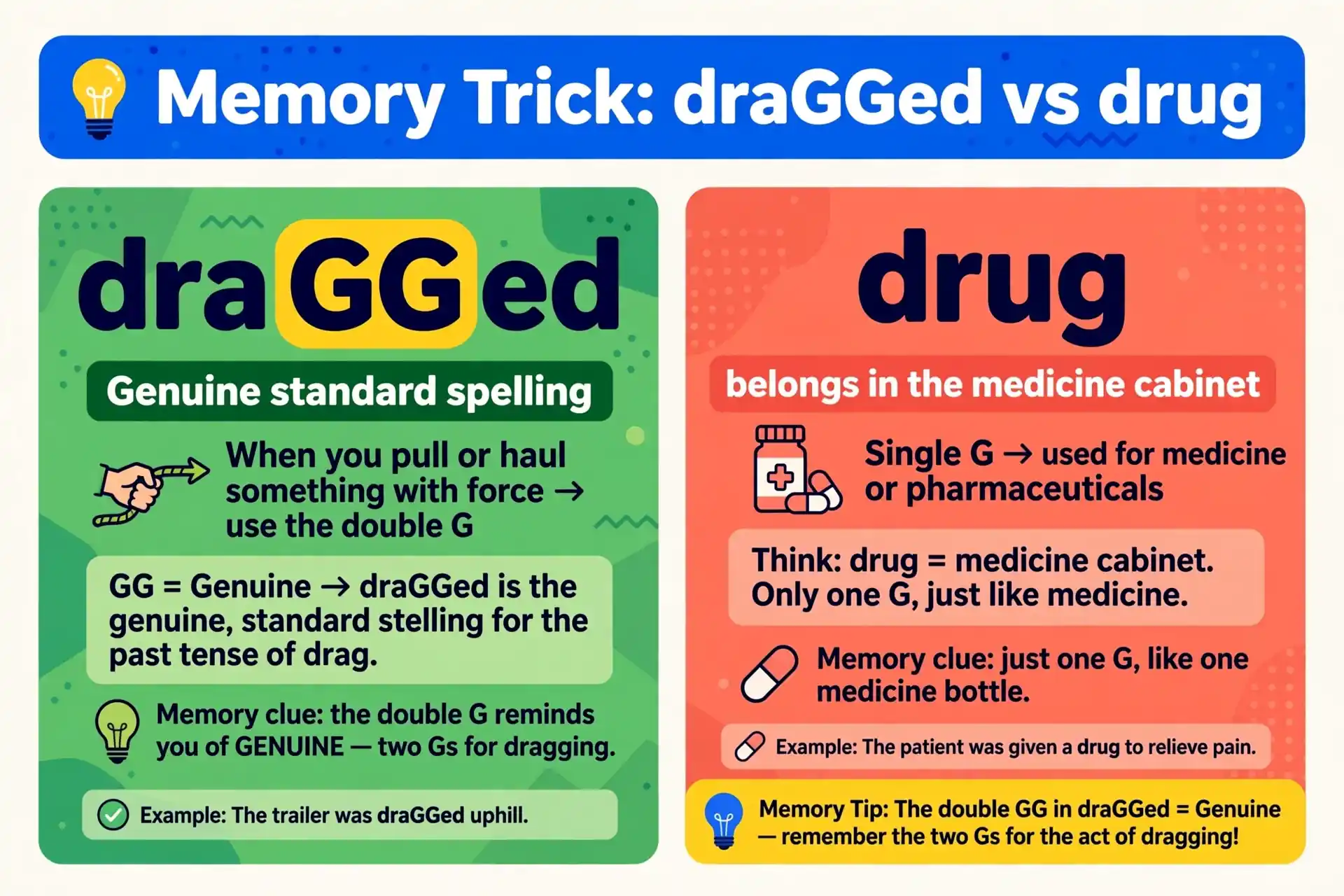
How to Remember the Difference
DRAGGED — the double G is your guarantee of standard English. Keep drug in the medicine cabinet: it’s for pills and prescriptions, not for the past tense of drag.
- Dragged = pulled in the past; the standard past tense of drag.
- Drug = medicine (noun) or to give medicine (verb); past tense is drugged.
- “He drug it” may sound familiar in some regions, but in writing it’s dragged every time.
Frequently Asked Questions
Is it dragged or drug?
In standard English, it’s dragged. “He dragged the trunk to the car.” Drug as a past tense of drag is dialectal and nonstandard — fine in a novel’s dialogue, but not in an essay, email, or exam.
Is “drug” ever correct as a past tense?
You’ll hear it in some regional dialects (“He drug it home”), but it isn’t standard in writing, school, or formal speech. Dictionaries mark this use as dialectal, so treat it as spoken color rather than a form to imitate.
What’s the past tense of the verb “to drug”?
Drugged, with a double g: “The zookeeper drugged the tiger before the checkup.” The consonant doubles because the verb is short and ends in consonant-vowel-consonant — the same rule that turns drag into dragged.
Why do people say “he drug”?
It’s a dialectal habit, likely shaped by analogy with irregular verbs like dig/dug and sting/stung. Familiar doesn’t mean standard, though — in writing, use dragged every time.
Is “draged” a word?
No. The final g doubles before the -ed ending: dragged, the same pattern as bagged and flagged. A single g there is always a typo.
Conclusion
Dragged is the past tense of drag everywhere standard English is written or spoken, while drug belongs to medicine — as a noun for a substance and a verb for administering one. Keep them in their lanes and the confusion disappears.