Whether or Weather
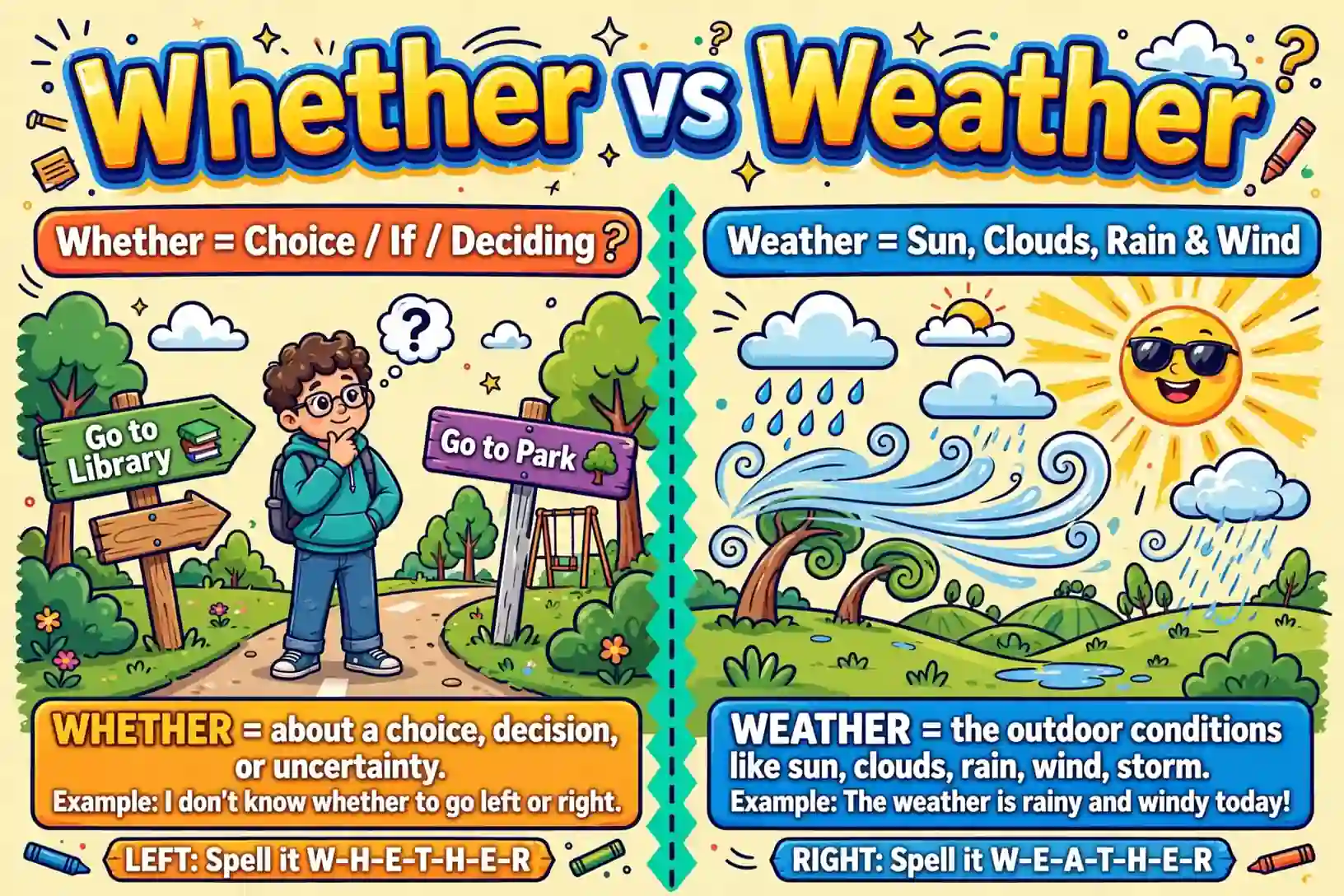
Whether and weather are pronounced identically, but they do completely different jobs in a sentence. Whether is a conjunction that introduces a choice or alternative — “whether you like it or not.” Weather is a noun for atmospheric conditions: rain, sun, wind, and snow. Swap them and “I don’t know whether it will rain” becomes a sentence about the atmosphere not knowing itself.
Quick Answer
| Word | Part of Speech | Main Meaning | Example |
|---|---|---|---|
| whether | Conjunction | Introduces a choice, alternative, or indirect question | “Decide whether you are coming.” |
| weather | Noun (also verb) | Atmospheric conditions; to endure (“weather a storm”) | “The weather is perfect today.” |
Simple rule: whether is for choices; weather is for rain.
What Does Whether Mean?
Whether is a conjunction used to express a choice between alternatives or to introduce an indirect question — situations where two or more outcomes are possible. It often appears in pairs (“whether… or…”) and in questions you cannot answer with a single fact. The Cambridge Dictionary definition confirms whether is used when there is a choice or doubt involved.
Examples:
- She asked whether we wanted tea or coffee.
- I can’t decide whether to stay or go.
- Whether you agree or not, the meeting is at noon.
- He wondered whether the train was on time.
- Whether it rains or shines, the match goes ahead.
What Does Weather Mean?
Weather is a noun describing the state of the atmosphere at a particular place and time — temperature, rain, wind, sunshine, and everything in between. As a verb, to weather means to endure or come safely through something difficult, as in “to weather a storm” or “to weather criticism.”
Examples:
- The weather forecast says it will rain all weekend.
- We had beautiful weather for the wedding.
- Pilots check the weather before every flight.
- The old barn has weathered a century of storms.
- The company weathered the recession without layoffs.
Whether vs. Weather: Key Differences
| Feature | whether | weather |
|---|---|---|
| Part of speech | Conjunction | Noun (also a verb) |
| Meaning | A choice or alternative | Atmospheric conditions; to endure |
| Pronunciation | /ˈwɛðər/ (WETH-er) | /ˈwɛðər/ (WETH-er) — identical |
| Typical pattern | “whether… or…” | “the weather,” “weather a storm” |
| Question test | Can be replaced by “if” in many sentences | Cannot be replaced by “if” |
| Spelling clue | Contains “whe” like when/what/where | Contains “a” like rain, hail, and atmosphere |
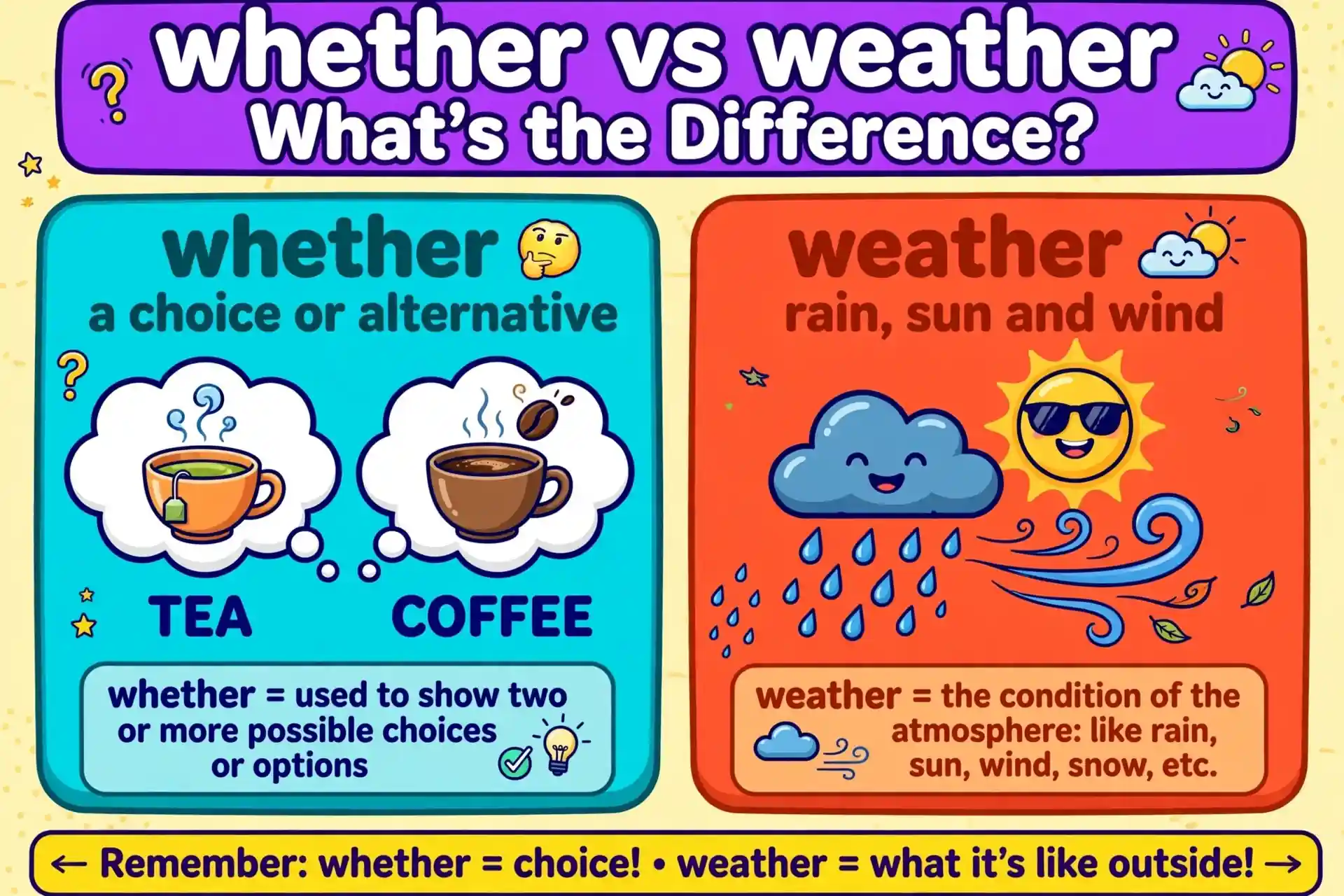
Sound gives you no help here — the spelling has to come from meaning. If the sentence involves a choice, it is whether; if it involves the sky, it is weather.
Whether and Weather in Real Sentences
At Home
Whether: “I asked whether anyone wanted pancakes or waffles.”
weather: “The weather is too nice to stay inside today.”
One offers a breakfast choice; the other describes the sky outside.
At Work
Whether: “The manager asked whether the report was ready.”
weather: “Bad weather delayed the morning deliveries.”
One is an indirect question; the other is a logistical problem.
In Conversation
Whether: “I don’t know whether he’s coming tonight.”
weather: “Did you see the weather? It snowed overnight!”
Uncertainty about a person takes whether; a fact about the atmosphere takes weather.
Common Mistakes
This is a classic homophone trap, right alongside desert or dessert and lier or liar. The identical sound fools even careful writers:
Mistake 1: “Weather” for a choice
❌ “I don’t know weather to laugh or cry.”
✅ “I don’t know whether to laugh or cry.”
Why: a choice between alternatives is always whether — the sky is not involved.
Mistake 2: “Whether” for the atmosphere
❌ “The whether is lovely today.”
✅ “The weather is lovely today.”
Why: weather (with an a, like rain) is the noun for atmospheric conditions.
Mistake 3: “Weather” in “whether or not”
❌ “Weather or not you come, we’ll start at seven.”
✅ “Whether or not you come, we’ll start at seven.”
Why: the set phrase “whether or not” always uses the conjunction whether.
Mistake 4: Forgetting the verb “to weather”
❌ “The startup couldn’t whether the downturn.”
✅ “The startup couldn’t weather the downturn.”
Why: to endure hardship is to weather — the metaphor is surviving a storm, so it takes the atmosphere spelling.
Pronunciation
Both words are pronounced /ˈwɛðər/ — “WETH-er.” They rhyme with “feather,” “leather,” and “together.” There is no difference in stress, vowel, or consonant between them in standard speech, so the choice is purely a spelling decision driven by meaning: choices get whether, the sky gets weather.
How to Remember the Difference
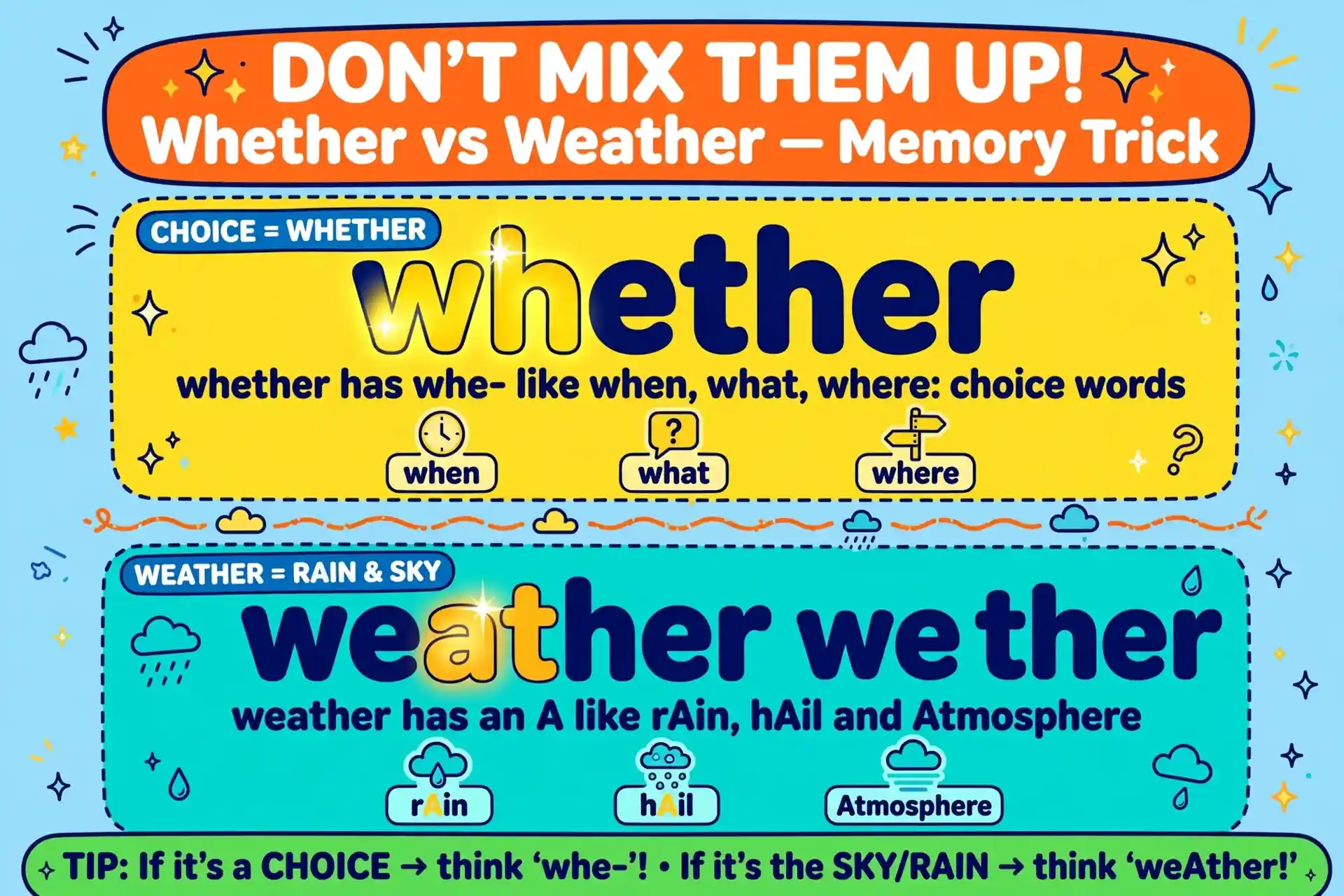
Whether starts with whe-, like the question words when, what, and where — and whether always poses a question or a choice. Weather has an a in it, like rain, hail, and the atmosphere — the things you see when you look at the sky.
- whether = choice (whe- like when, what, where)
- weather = sky (a like rain, hail, atmosphere)
- If you can substitute “if,” use whether: “whether it rains” = “if it rains”
Frequently Asked Questions
Is it whether or weather in “whether you like it or not”?
Whether. The phrase presents an alternative (like it / not), so the conjunction is required: “Whether you like it or not, we’re leaving.”
Can whether and weather ever be used interchangeably?
No. They are different words with different meanings and different parts of speech. Swapping them is always a spelling error, even though no one would hear the difference.
What is the difference between weather and climate?
Weather is short-term atmospheric conditions (today’s rain); climate is the long-term pattern (a region’s typical rainfall). Neither one is whether.
Is “to weather a storm” literal or figurative?
Both. Ships literally weather storms at sea, and the verb extends figuratively to enduring any hardship: “to weather criticism,” “to weather a scandal.”
Does whether always need “or”?
No. “Whether” works with an implied alternative: “I asked whether she was free” (or not) is complete on its own. The explicit “or not” is optional.
Conclusion
Whether introduces choices and indirect questions; weather describes the atmosphere — or, as a verb, the act of enduring it. They sound identical, but the spelling follows the meaning: choices get whether, the sky gets weather. Keep the whe-/a trick in mind and the mix-up disappears.