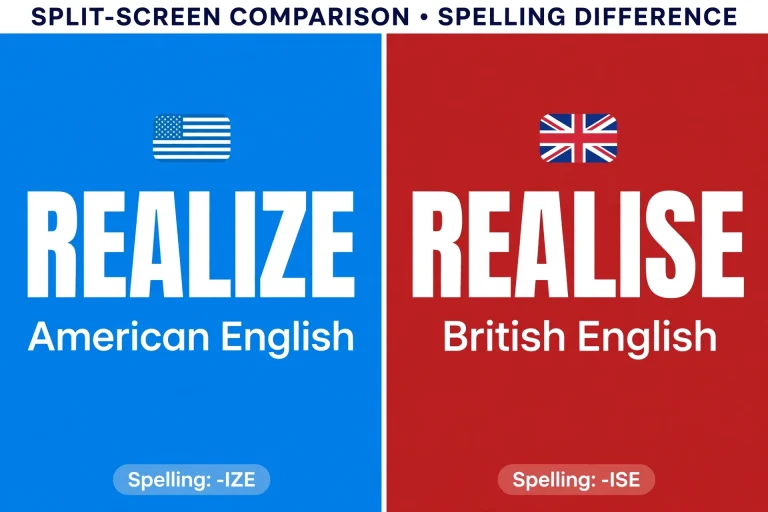
Practice or Practise: US vs UK Spelling Explained
Both practice and practise are correct — the difference is geography, not grammar. In the United States, practice handles everything: the noun (a doctor’s practice, piano practice) and the verb (to practice the piano). In the United Kingdom, the two jobs are split: practice with a C is the noun, while practise with an S is the verb. An American “practices medicine”; a Briton “practises medicine” at her “practice.”
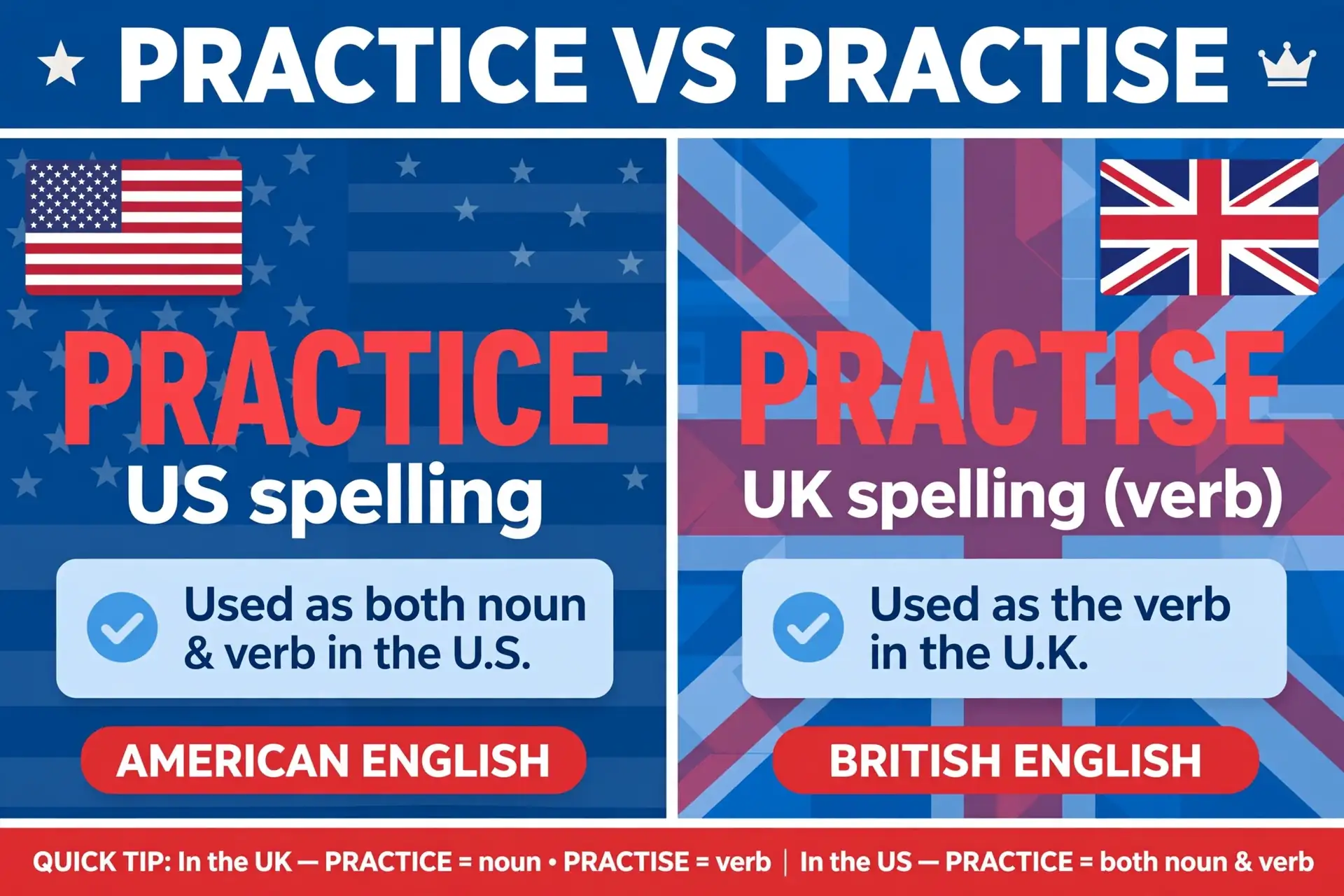
Table of Contents
Quick Answer
| Word | Spelling | Main Meaning | Example |
|---|---|---|---|
| Practice | US (noun + verb) | Repeated exercise; a profession or business; to rehearse or do repeatedly | “Piano practice starts at six.” / “She practices every day.” |
| Practice | UK (noun) | Repeated exercise; a doctor’s or lawyer’s business | “Piano practice starts at six.” |
| Practise | UK (verb) | To rehearse, train, or do repeatedly | “She practises every day.” |
Simple rule: in American English, always write practice; in British English, write practice with a C for the noun and practise with an S for the verb.
What Does Practice Mean?
In American English, practice is the all-purpose spelling. As a noun it means repeated exercise to improve a skill, a custom or habit, or a professional’s business (“a dental practice”). As a verb it means to rehearse, train, or carry out an activity regularly. The spelling never changes between the two.
Examples:
- The team’s soccer practice was cancelled because of the rain.
- She practices the violin for an hour every morning.
- He joined a law practice downtown after graduation.
- They practice what they preach about workplace safety.
What Does Practise Mean?
In British English, practise with an S is only the verb: to rehearse a skill, to train, to carry out a profession, or to follow a custom. The noun — the exercise session, the habit, the doctor’s business — is always practice with a C.
Examples:
- She practises her scales before breakfast.
- The firm practises law in three counties.
- They practise what they preach about data security.
- He needs to practise his interview answers.
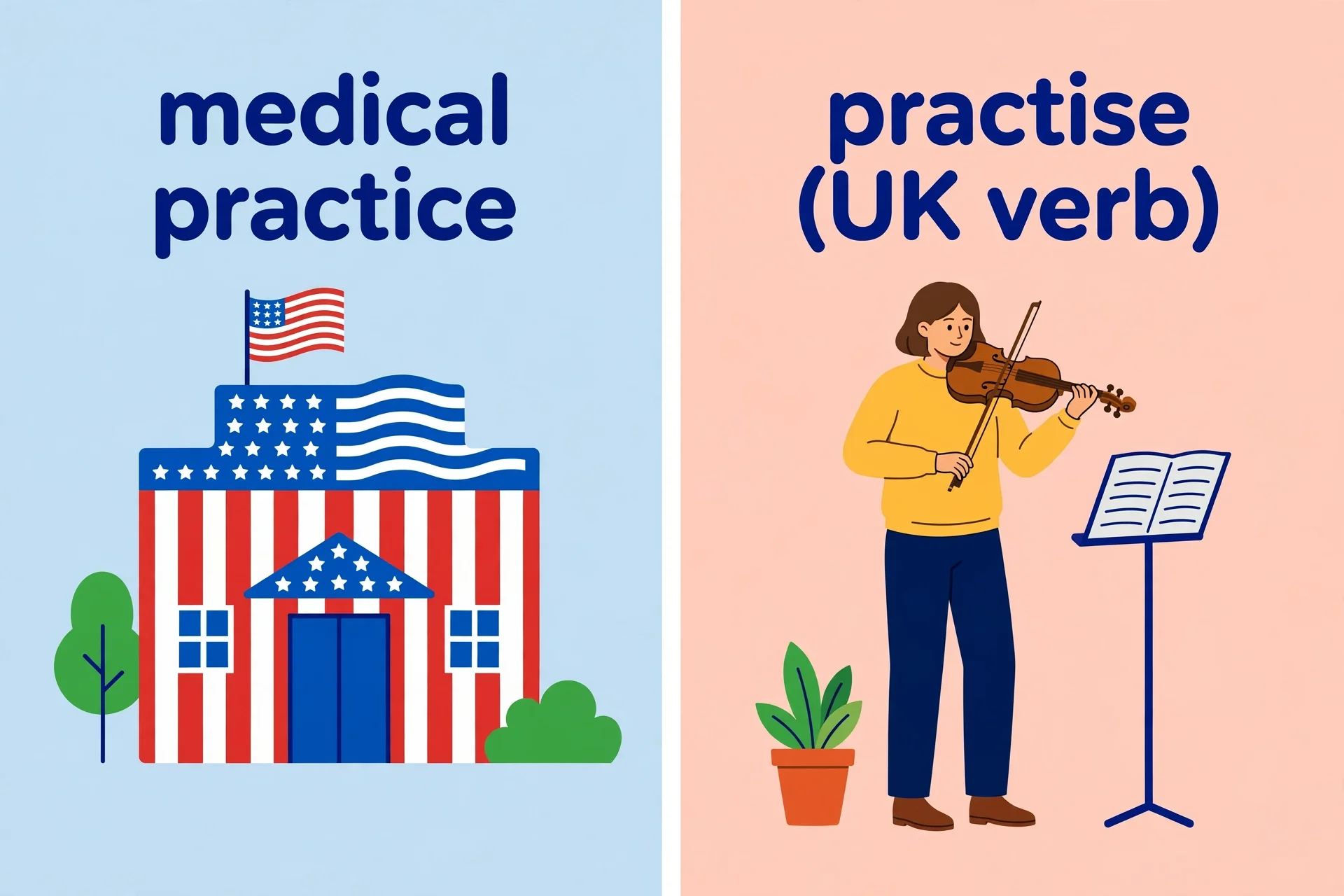
- Her medical practice employs twelve doctors. (noun — note the C)
Why Two Spellings?
Both forms come from the Old French practique (via Latin practica), and English writers used C and S spellings interchangeably for centuries. British English settled on the same tidy convention it uses elsewhere: nouns keep the -ce ending, verbs take -se — exactly the pattern of advice/advise and device/devise.
Noah Webster’s 1828 dictionary standardized American spelling around the single C form, and the US never looked back. That’s why Merriam-Webster’s entry for practice covers both noun and verb under one headword, while Oxford maintains two entries: practice (noun) and practise (verb).
Practice vs. Practise: Key Differences
| Feature | Practice (US) | Practice / Practise (UK) |
|---|---|---|
| Noun spelling | Practice — always with a C | Practice — always with a C |
| Verb spelling | Practice — also with a C | Practise — with an S, never a C |
| Pronunciation | Identical to the UK versions | Identical to the US version |
| “Doctor’s office” | “medical practice” | “medical practice” |
| “To rehearse” | “practice the piano” | “practise the piano” |
| What’s wrong | “Practise” looks like a typo in the US | “Practice” as a verb is wrong in the UK |
Notice the overlap: the noun is identical on both sides of the Atlantic — only the verb changes, which is why this pair trips up more writers than most.
Related US vs UK Word Pairs
| Pair | US | UK |
|---|---|---|
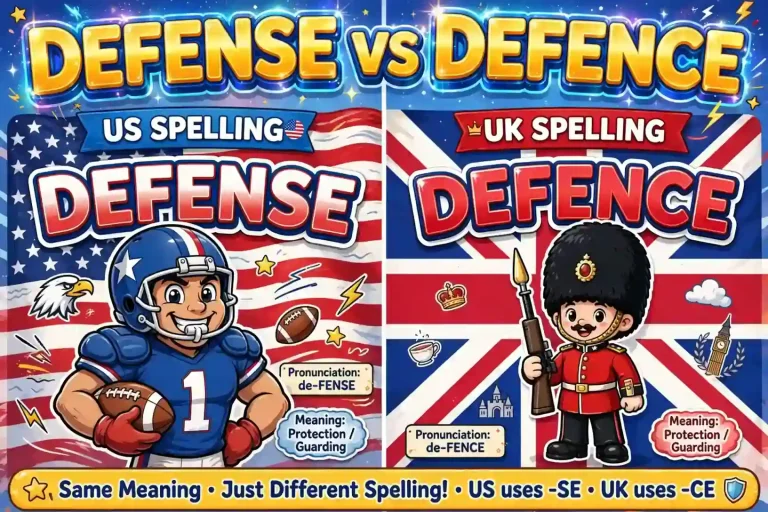
| Defense vs Defence | defense | defence |
| Modeling vs Modelling | modeling | modelling |
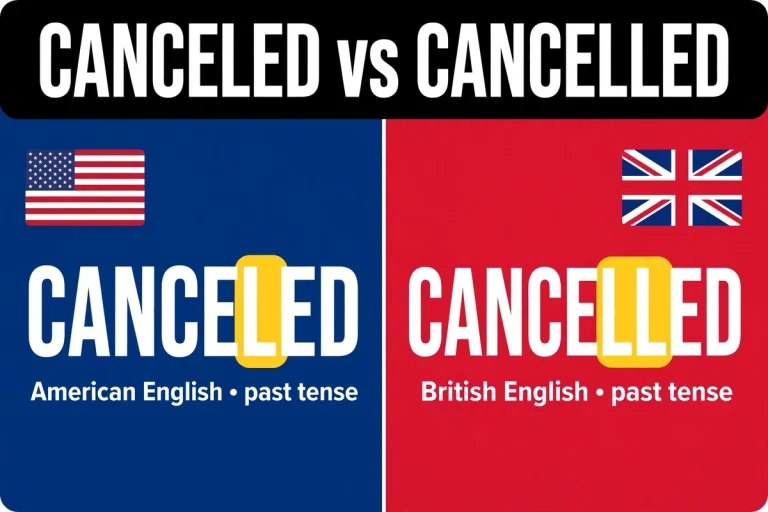
| Cancelled or Canceled | canceled | cancelled |
| Color or Colour | color | colour |
| Theatre vs Theater | theater | theatre |
Practice and Practise in Real Sentences
At Home
US: “Your piano practice starts in ten minutes — go practice your scales.”
UK: “Your piano practice starts in ten minutes — go practise your scales.”
The contrast: the noun (the session) is spelled identically, but the British verb switches to an S mid-sentence.
At Work
US: “Her dental practice is thriving, and she practices gentle dentistry.”
UK: “Her dental practice is thriving, and she practises gentle dentistry.”
The contrast: same successful dentist, same sentence shape — only the verb’s middle letter changes.
In Conversation
US: “I need to practice my Spanish before the trip to Mexico.”
UK: “I need to practise my Spanish before the trip to Spain.”
The contrast: both travellers are rehearsing the same language; only their home country’s spelling convention differs.
Common Mistakes
The noun/verb split in British English catches out even native speakers — the same trap appears in defense vs defence, where the noun and verb part ways, and the doubled-letter habit behind modeling vs modelling shows how small these Atlantic differences get. The usual errors:
Mistake 1: Using “practice” as a verb in British English
❌ “You should practice your presentation tonight.”
✅ “You should practise your presentation tonight.”
Why: in British English the verb takes an S — practice with a C can only be the noun.
Mistake 2: Using “practise” as a noun anywhere
❌ “His medical practise has a long waiting list.”
✅ “His medical practice has a long waiting list.”
Why: practise is never a noun in any variety of English — the doctor’s business always keeps the C.
Mistake 3: Using “practise” in American English
❌ “The band practises in the garage on weekends.”
✅ “The band practices in the garage on weekends.”
Why: American English has no S spelling at all — practice covers the verb as well as the noun.
Mistake 4: Mixing the two in one sentence
❌ “Football practise is good practice for the tournament.”
✅ UK: “Football practice is good practice for the tournament.” / (verb sense intended: “Practising football is good practice for the tournament.”)
Why: in British English both noun uses take the C; only switch to the S when the word is genuinely an action.
Pronunciation
Practice and practise are pronounced identically: “PRAK-tiss,” stressed on the first syllable. No listener can tell the two apart, which is exactly why the spelling split survives unnoticed in speech. It rhymes with cactus.
How to Remember the Difference
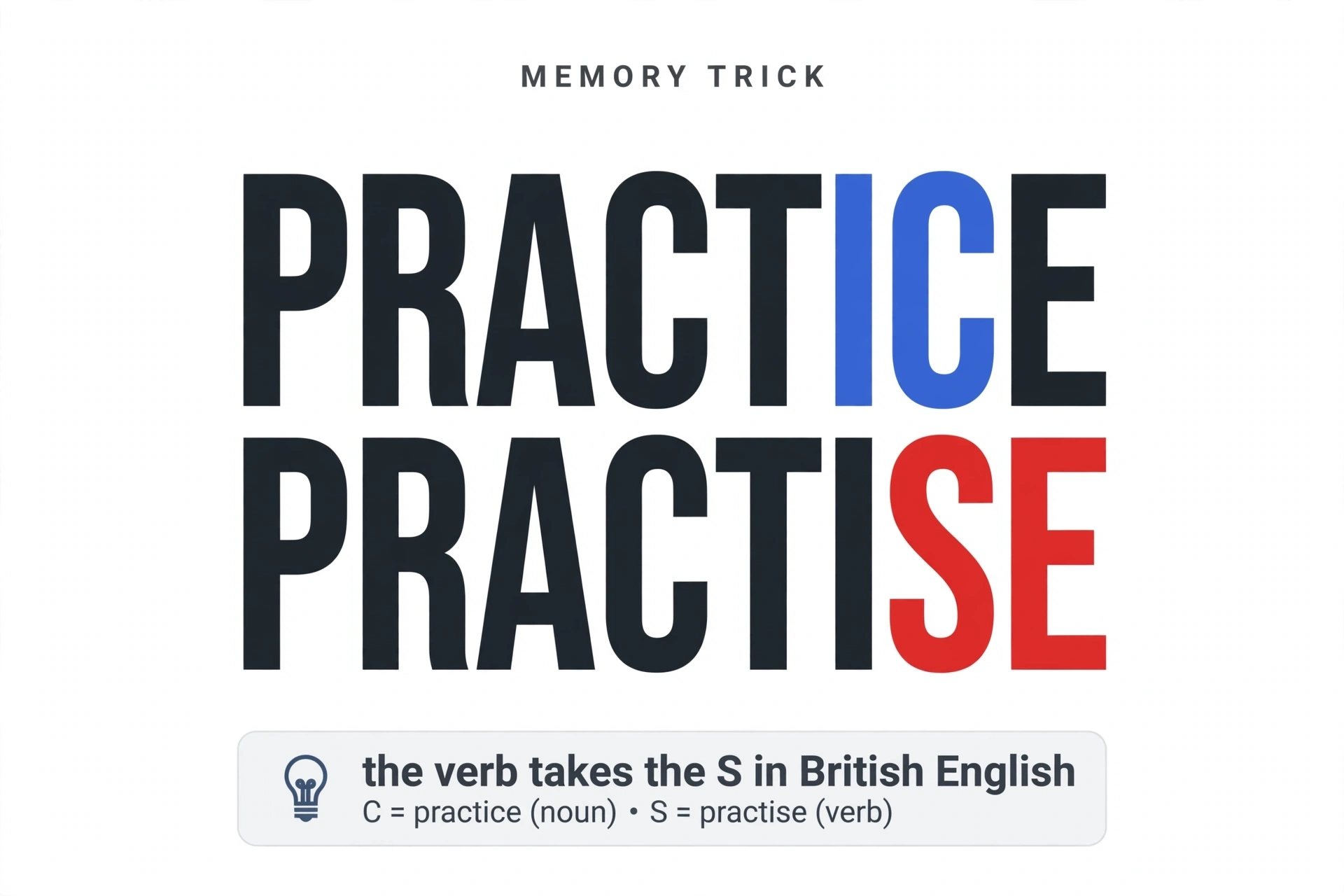
In British English, the noun ends in “ice” — like ice itself, and like advice and device, which are also nouns. The verb ends in “ise” — like advise, which is also a verb. Noun = ice (C), verb = advise (S).
- PractiCe (C) = the noun — the session, the habit, the business (“ice” is a thing).
- PractiSe (S) = the verb — the doing (like “advise“).
- In American English, practice with a C covers both.
Frequently Asked Questions
Is it practice or practise?
Both are correct. Americans always write practice. Britons write practice for the noun (the session, the business) and practise for the verb (the act of rehearsing).
Is practise ever correct in American English?
No. US dictionaries recognize only practice, so practise with an S reads as a misspelling to American readers. Stick with the C form for US audiences.
Which one do I use for a doctor’s office?
Always practice with a C, in both countries — “a medical practice,” “a GP practice.” It’s a noun, so even British English keeps the C.
Is it “practice makes perfect” or “practise makes perfect”?
The saying uses the noun, so it’s “practice makes perfect” everywhere. The verb version would be “practising makes perfect” — and note that British spelling keeps the S there.
Why does British English split them at all?
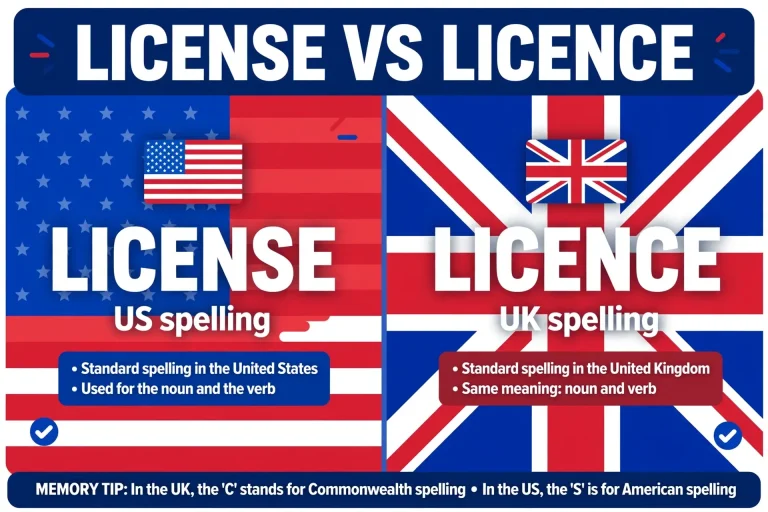
It’s a French legacy: British English kept the -ce noun / -se verb pattern for several word pairs (advice/advise, device/devise, licence/license). American spelling reformers under Noah Webster simplified most of these to a single form.
Is “practiced” or “practised” correct for the past tense?
American: “practiced.” British: “practised.” The past tense follows the same convention as the base verb — S in Britain, C in America.
Conclusion
Practice with a C is the universal noun and the American verb; practise with an S is the British verb. Keep the noun/verb split straight — C for the thing, S for the doing in Britain — and this pair will never trouble you again.