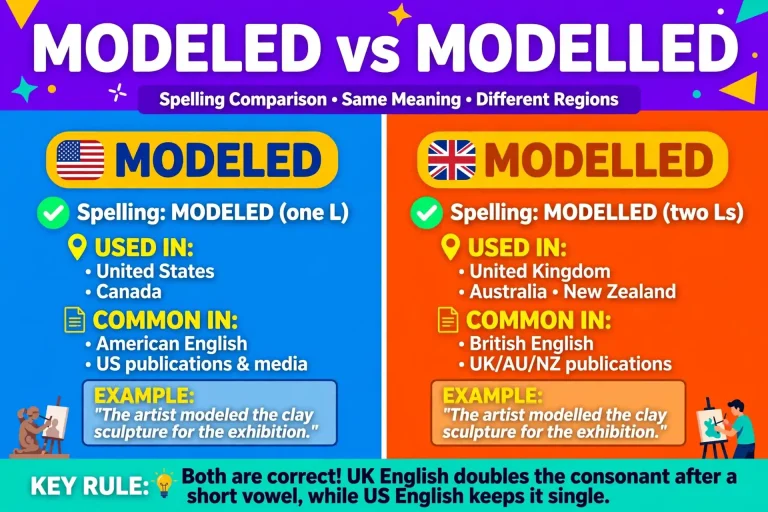
License or Licence: US vs UK Spelling Explained
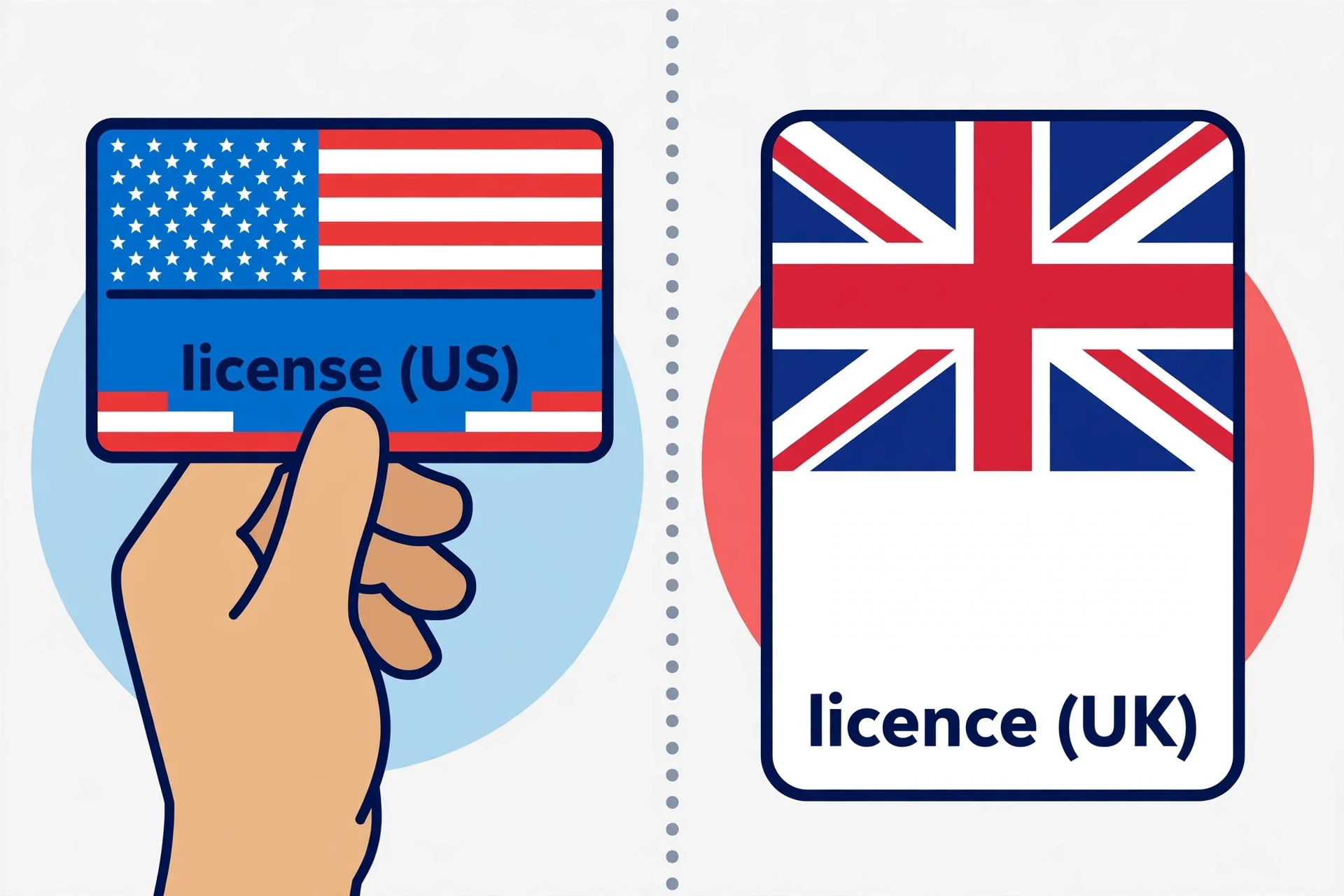
Both license and licence are correct — the difference is geography, not grammar. In the United States, license does double duty as both the noun and the verb. In the United Kingdom, the two jobs are split: licence (with a C) is the noun, while license (with an S) is the verb. You write “a driver’s license” in New York, but “a driving licence” in London.
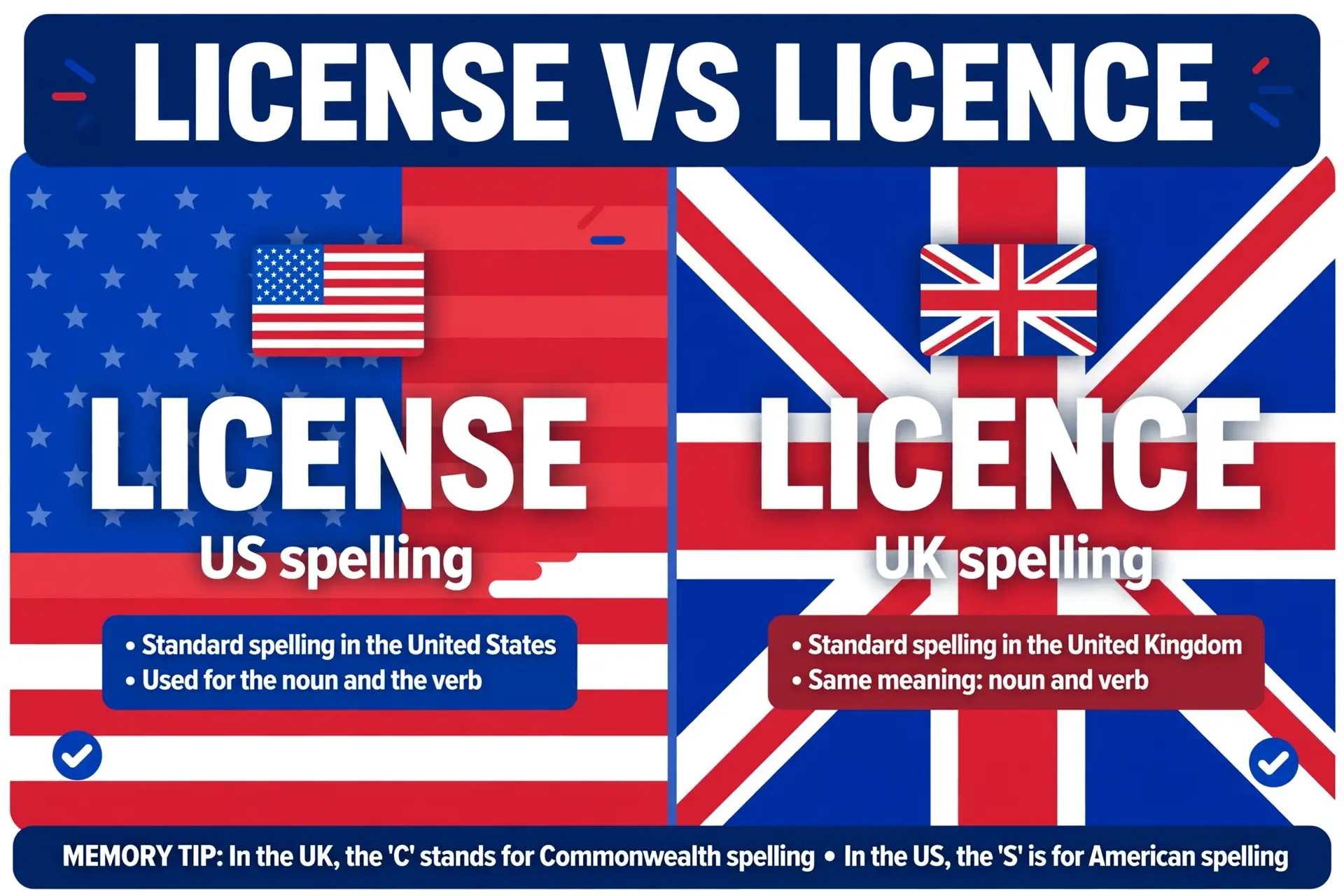
Table of Contents
Quick Answer
| Word | Spelling | Main Meaning | Example |
|---|---|---|---|
| License | US (noun + verb) | An official permit; to grant permission | “I renewed my driver’s license yesterday.” |
| Licence | UK (noun) | An official permit — the document or permission itself | “I renewed my driving licence yesterday.” |
| License | UK (verb) | To grant official permission | “The council licenses all the market stalls.” |
Simple rule: in American English, always write license; in British English, write licence with a C for the noun and license with an S for the verb.
What Does License Mean?
In American English, license covers the whole territory: it is both the noun — the permit card in your wallet — and the verb, the act of granting that permission. One spelling, two jobs.
Examples:
- She finally passed her test and got her driver’s license.
- The restaurant’s liquor license expires in June.
- The state licenses electricians through a separate board.
- They were licensed to sell fireworks only during the holiday week.
What Does Licence Mean?
In British English, licence is strictly the noun: the physical or legal permission — a driving licence, a TV licence, a marriage licence. The moment the word becomes an action, British spelling switches to license with an S. A British writer says “I have a licence” but “they license me to drive.”
Examples:
- He lost his driving licence after the speeding offence.
- The pub applied for a late-night licence.
- The BBC is funded by the television licence fee.
- The council refused to license the new nightclub. (verb — note the S)
Why Two Spellings?
Both words descend from the Old French licence, which came from the Latin licentia, meaning freedom or permission. For centuries, English used the two spellings interchangeably. British English eventually settled into a tidy pattern: nouns keep the French-style -ce ending, verbs take -se — the same logic behind advice/advise and device/devise.
Noah Webster, the American lexicographer whose 1828 dictionary shaped US spelling, swept the distinction away: American English kept the single S spelling for everything. That’s why Merriam-Webster’s entry for license lists both the noun and the verb under one headword, while Oxford keeps two entries: licence (noun) and license (verb).
License vs. Licence: Key Differences
| Feature | License (US) | Licence / License (UK) |
|---|---|---|
| Noun spelling | License — always with an S | Licence — always with a C |
| Verb spelling | License — also with an S | License — with an S, never a C |
| Pronunciation | Identical to the UK versions | Identical to the US version |
| Typical phrase | “driver’s license” | “driving licence” |
| Official documents | US states issue “licenses” | The UK issues “licences” |
| What’s wrong | “Licence” looks like a typo in the US | “Licence” as a verb is wrong everywhere |
Americans never need the C spelling, while Britons need both — C for the thing, S for the doing.
Related US vs UK Word Pairs
| Pair | US | UK |
|---|---|---|
| Defense vs Defence | defense | defence |
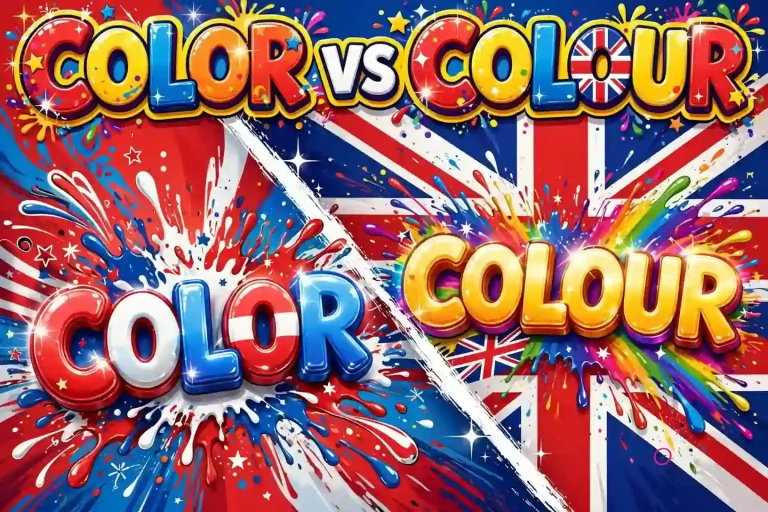
| Color or Colour | color | colour |
| Theatre vs Theater | theater | theatre |
| Armor vs Armour | armor | armour |
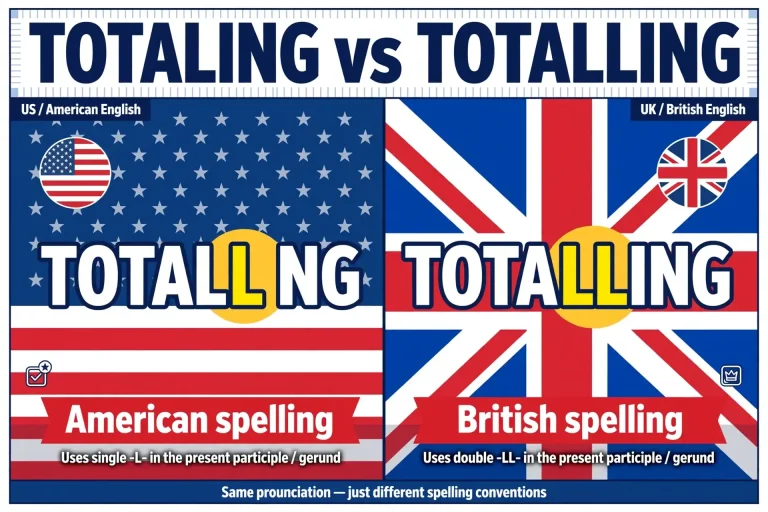
| Modeling vs Modelling | modeling | modelling |
License and Licence in Real Sentences
At Home
US: “Dad, can I borrow the car? My license arrived in the mail this morning.”
UK: “Dad, can I borrow the car? My licence arrived in the post this morning.”
The contrast: same proud moment, different letters — the American teen holds a license, the British teen a licence.
At Work
US: “We can’t ship the software until legal approves the license agreement.”
UK: “We can’t ship the software until legal approves the licence agreement.”
The contrast: the contract’s job doesn’t change across the Atlantic — only its C does.
In Conversation
US: “The city licenses food trucks on that corner every summer.”
UK: “The council licenses food trucks on that corner every summer.”
The contrast: here both sides write it with an S, because the word is a verb — granting permission — in both countries.
Common Mistakes
Mixing the two systems produces the same confusion people hit with defense vs defence, where the noun and verb drift apart in British English — and the same Atlantic habit shows up in theatre vs theater. Here are the slip-ups to watch for:
Mistake 1: Using “licence” as a verb
❌ “The council will licence the new café next month.”
✅ “The council will license the new café next month.”
Why: in British English the verb always takes an S — licence can never be an action.
Mistake 2: Writing “license” as a noun in British English
❌ “He showed the officer his driving license.”
✅ “He showed the officer his driving licence.”
Why: a British reader expects the noun with a C; the S spelling marks it as American.
Mistake 3: Using “licence” anywhere in American English
❌ “She applied for a business licence in Texas.”
✅ “She applied for a business license in Texas.”
Why: American English has no C spelling at all — license is the only form for noun and verb alike.
Mistake 4: Mixing the two in one document
❌ “This licence grants the holder a license to operate.”
✅ UK: “This licence grants the holder a licence to operate.” / US: “This license grants the holder a license to operate.”
Why: pick one country’s convention and stay with it — alternating spellings looks sloppy even when both words are real.
Pronunciation
License and licence sound exactly alike: “LYE-sense,” with the stress on the first syllable. The C-versus-S difference is purely visual, so in conversation nobody can tell which one you mean. It rhymes with sense and cents.
How to Remember the Difference
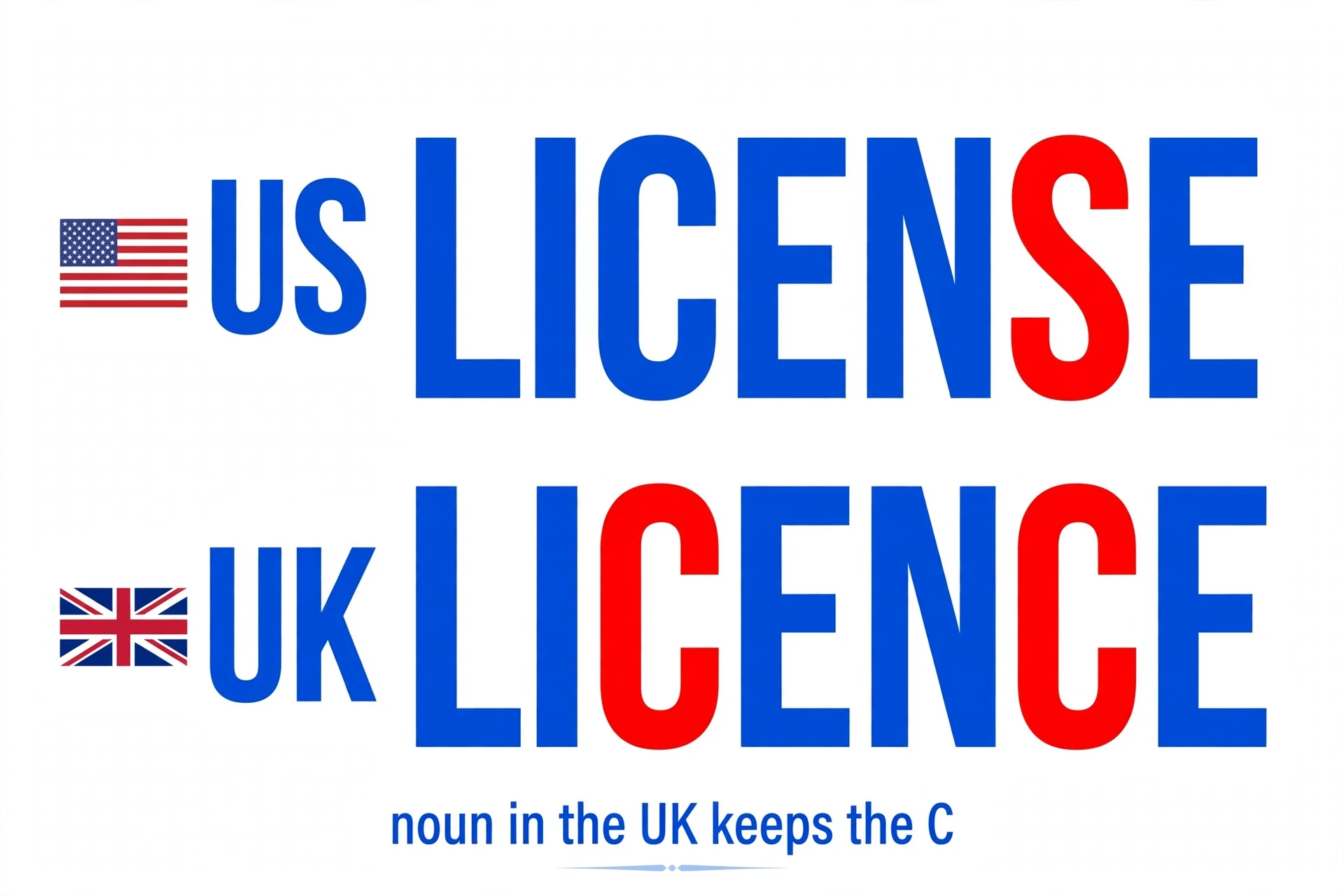
In Britain, the noun keeps the C — think C for “certificate,” the piece of paper itself. The verb takes the S — think S for “someone grants it.” Americans can skip the whole puzzle: one spelling, license with an S, every time.
- LicenCe (C) = the noun in British English — the certificate in your hand.
- LicenSe (S) = the verb everywhere — the act of granting permission.
- In American English, license with an S covers both meanings.
Frequently Asked Questions
Is it license or licence?
Both are correct — it depends on where you are and how the word is used. Americans always write license. Britons write licence for the noun (the permit) and license for the verb (granting the permit).
Is licence ever correct in American English?
Essentially no. US dictionaries and style guides use license for everything, so licence with a C reads as a spelling error to American eyes.
Can license be a noun in the UK?
In standard British English, no — the noun is spelled licence. American influence occasionally pushes license into British writing, but it isn’t accepted usage.
Which spelling appears on official UK documents?
Licence with a C. Your photocard says “driving licence,” the form asks for your “licence number,” and the fee is a “licence fee.” The verb form appears in phrases like “licensed premises.”
Do other words follow the same noun-with-C, verb-with-S pattern?
Yes — British English pairs advice/advise, device/devise, and practice/practise on the same model, while American English collapses them to a single spelling.
Is it “driver’s license” or “driving licence”?
Americans say and write “driver’s license“; Britons say and write “driving licence.” The phrasing differs as well as the spelling, so matching the right phrase to the right audience matters twice over.
Conclusion
License is the American all-rounder — noun and verb in one spelling. Licence is the British noun, paired with the S-spelled verb license. Remember the simple rule — C for the certificate in Britain, S everywhere else — and you’ll never mix them up again.