Judgment or Judgement: What’s the Difference?
Judgment without the E is the standard American spelling; judgement with the E is the standard British spelling. They are the same word — a decision, an opinion, or the ability to decide wisely — wearing different national uniforms. An American court hands down a judgment; a London newspaper praises someone’s judgement.
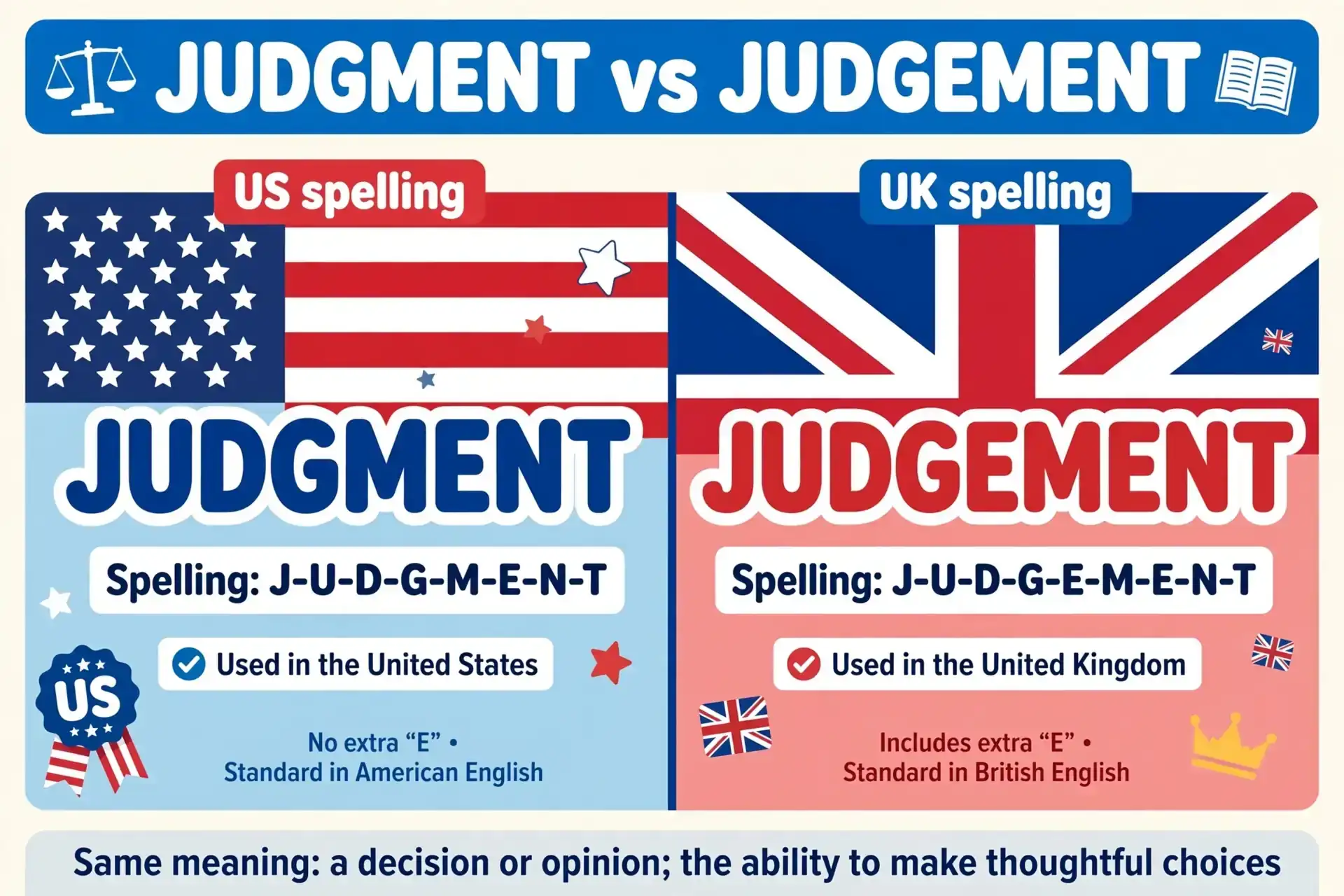
Table of Contents
Quick Answer
| Spelling | Region | Meaning | Example |
|---|---|---|---|
| judgment | United States | A decision; an opinion; the ability to decide wisely | ✅ “The court delivered its judgment on Friday.” (US) |
| judgement | United Kingdom & Commonwealth | A decision; an opinion; the ability to decide wisely | ✅ “The court handed down its judgement on Monday.” (UK) |
Simple rule: Writing for an American audience? Drop the E — judgment. Writing for a British one? Keep it — judgement.
What Does “Judgment” Mean?
Judgment is the standard American spelling of the word — and it carries three related meanings: a formal decision (the court’s judgment), a considered opinion (“in my judgment”), and the mental ability to decide well (“good judgment”). Every major American authority prefers the E-less form: the AP Stylebook, the Chicago Manual of Style, and US legal writing all use “judgment” exclusively. Merriam-Webster lists “judgment” as the standard spelling, with “judgement” noted only as a variant.
Examples:
- “The court delivered its judgment on Friday morning.”
- “In my judgment, the plan needs another month.”
- “She showed excellent judgment under pressure.”
- “The novel received harsh judgment from the critics.”
- “Don’t rush to judgment before you’ve heard both sides.”
In American English, “judgement” with an E is not wrong in the strictest sense — but it is nonstandard, most US spellcheckers flag it, and careful readers will assume it is a typo.
What Does “Judgement” Mean?
Judgement is the standard British spelling — same word, same three meanings, one extra E. It is the form you will see in British newspapers, novels, classrooms, and offices across the UK, Australia, New Zealand, and much of the Commonwealth. Canadian usage leans toward “judgement” in general writing too, though Canadian legal writing often follows the American “judgment.” Here is the twist: even in Britain, court decisions are traditionally spelled “judgment” — British law reports kept the E-less form long after everyday British English kept the E.
Examples:
- “The court handed down its judgement on Monday.” (UK general writing)
- “In my judgement, the plan needs another month.”
- “She showed excellent judgement under pressure.”
- “The tribunal’s judgement was widely quoted in the press.”
- “Good judgement comes from experience — and experience comes from bad judgement.”
So in Britain you get both: “judgement” everywhere in daily life, “judgment” in the law reports. The context decides which E-less or E-ful form appears.
Why Two Spellings?
The split is Noah Webster’s doing. In the early 1800s, the American lexicographer set out to simplify English spelling for the young United States, dropping letters he considered unnecessary: “colour” became “color,” “centre” became “center,” and “judgement” became “judgment.” Britain never adopted the reforms and kept the older, French-influenced form — “judgement” descends from the Old French “jugement,” E and all. Ironically, “judgement” with the E is the older spelling everywhere; America is the one that changed. The British legal tradition of writing “judgment” is a separate, older habit that simply never updated along with the rest of the language.
Judgment vs. Judgement: Key Differences
| Feature | Judgment (US) | Judgement (UK) |
|---|---|---|
| Region | United States | United Kingdom & Commonwealth |
| The extra E | Dropped | Kept |
| History | Webster’s 19th-century simplification | Older, French-influenced form |
| Style guides | AP Stylebook, Chicago Manual: “judgment” | Oxford, Cambridge: “judgement” |
| Legal writing | “judgment” always | Traditionally “judgment” even in the UK |
| Pronunciation & meaning | Identical — /ˈdʒʌdʒmənt/ | Identical — /ˈdʒʌdʒmənt/ |
Same word, same sound, same meaning — only the passport, and one letter, differs.
Related US vs UK Word Pairs
“Judgment” vs “judgement” is one member of a large family of transatlantic spelling splits. If you write for both audiences, these will look familiar:
| US Spelling | UK Spelling | Pattern |
|---|---|---|
| color | colour | Dropped U |
| honor | honour | Dropped U |
| center | centre | -er vs -re |
| organize | organise | -ize vs -ise |
| traveling | travelling | Single vs double L |
| apologize | apologise | -ize vs -ise |
| modeled | modelled | Single vs double L |
| judgment | judgement | Dropped E |
Spot the pattern: American spelling almost always takes the shorter road.
“Judgment” and “Judgement” in Real Sentences
At Home
✅ US: “Use your best judgment with the kids tonight.”
✅ UK: “Use your best judgement with the kids tonight.”
Both are correct — the mailing address decides, not the meaning.
At Work
✅ US memo: “The committee’s judgment was final.”
✅ UK memo: “The committee’s judgement was final.”
Multinational teams see both spellings in the same inbox; neither is a mistake as long as each document stays consistent.
In Conversation
✅ “That’s a fair judgment.”
✅ “That’s a fair judgement.”
Speech never reveals the spelling — this pair only exists on the page.
In Legal Writing
✅ “The court entered judgment for the plaintiff.”
✅ “The High Court gave judgment for the claimant.”
The one place even British English drops its own E: court reports on both sides of the Atlantic write “judgment.”
Common Mistakes
Transatlantic spelling trips up everyone eventually — the “jewelry” vs “jewellery” split follows the same US/UK fault line, and “modeling” vs “modelling” shows the double-letter version of the same story. The judgment traps:
Mistake 1: Mixing spellings in one document
❌ “In my judgement, the court’s judgment was sound.” (in a UK essay)
✅ “In my judgement, the court’s judgement was sound.”
Why: Consistency beats correctness here — pick one national spelling per document and stick with it. (In a UK legal brief, “judgment” throughout would be the consistent choice.)
Mistake 2: Using “judgement” in a US job application
❌ “My role required sound judgement under pressure.” (US résumé)
✅ “My role required sound judgment under pressure.”
Why: American readers — and American spellcheckers — will read the E as a typo, and a résumé is the worst place for that impression.
Mistake 3: “Correcting” the other country’s spelling
❌ Changing a British author’s “judgement” to “judgment” (or vice versa).
✅ Leave it — match the audience’s English, not your own.
Why: Neither spelling is wrong; each is correct somewhere. “Fixing” it just moves the error across the ocean.
Mistake 4: Forgetting the adjective follows the noun
❌ US text: “Don’t be so judgemental.” / UK text: “Don’t be so judgmental.”
✅ US: “judgmental” — UK: “judgemental.”
Why: The E (or its absence) runs through the whole word family. Keep it consistent from noun to adjective.
Pronunciation
Judgment and judgement are pronounced identically: “JUDJ-muhnt” (/ˈdʒʌdʒmənt/), with the stress on the first syllable — think “judge” plus “ment,” said briskly. There is no American or British difference in sound whatsoever; the E is silent in every accent, which is precisely why Webster felt safe deleting it.
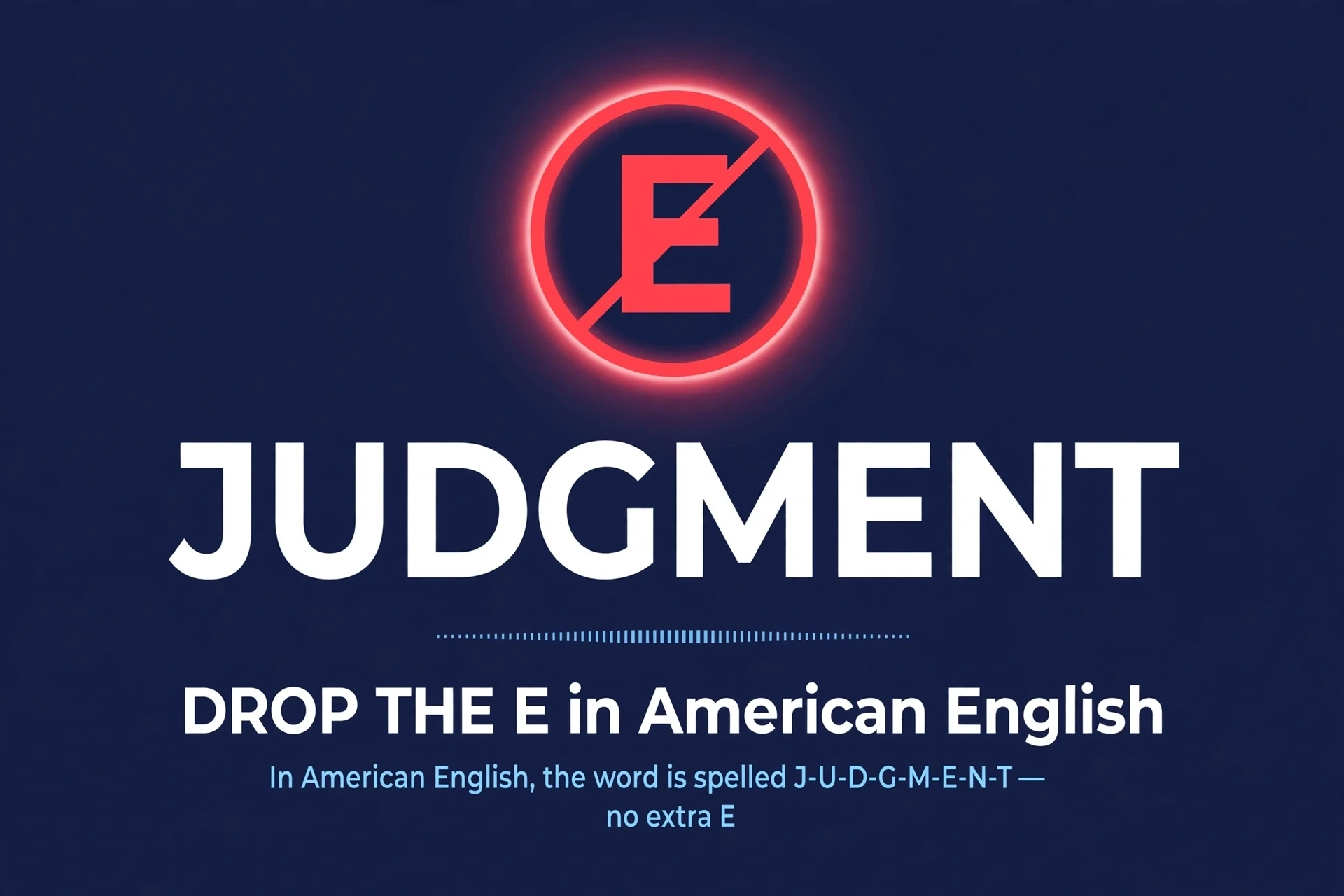
How to Remember the Difference
Americans drop things — they dropped the U from “colour” and the E from “judgement.” Britain keeps tradition, so it keeps the E. One letter, one ocean, one rule.
- E = England: see the extra E, think England — “judgement” is British.
- The US takes the shorter road: “color,” “center,” “judgment” — when in doubt, the American form is the shorter one.
- Courts drop the E worldwide: legal “judgment” keeps the old E-less form even in Britain — the courtroom is the exception that proves the rule.
- Match your reader: US audience, no E; UK audience, E; mixed audience, pick one and stay consistent.
Frequently Asked Questions
Is it “judgment” or “judgement”?
Both are correct — “judgment” (no E) is the American spelling and “judgement” (with E) is the British spelling. Same word, same meaning, different country.
Which spelling does America use?
“Judgment,” without the E. The AP Stylebook, the Chicago Manual of Style, and all major US dictionaries agree — it is the only standard form in American English.
Which spelling does the UK use?
“Judgement,” with the E, in everyday writing. The quirk: British legal writing traditionally uses “judgment” for court decisions, a habit older than the spelling split itself.
Is “judgement” wrong in American English?
Not wrong, but nonstandard — most US spellcheckers flag it, and careful American readers will assume it is a typo. Use “judgment” for US audiences.
What about “judgmental” vs “judgemental”?
Follow the noun: Americans write “judgmental,” the British write “judgemental.” The E (or its absence) runs through the whole word family.
Why does the E exist at all?
It came from the Old French “jugement.” Noah Webster dropped it in the US as part of his spelling reforms; Britain kept the older form — so the E is actually the original.
Conclusion
Judgment without the E is American; judgement with the E is British — same meaning, same pronunciation, one letter of difference. Match the spelling to your audience, keep it consistent, and remember that even British courts drop the E.