Discreet or Discrete: What’s the Difference?
Discreet with double -e- means careful, subtle, and tactful — a discreet waiter never eavesdrops. Discrete with -t- before the -e- means separate and distinct — a company has discrete departments that don’t overlap. Swap the middle letters and the meaning jumps from manners to mathematics.
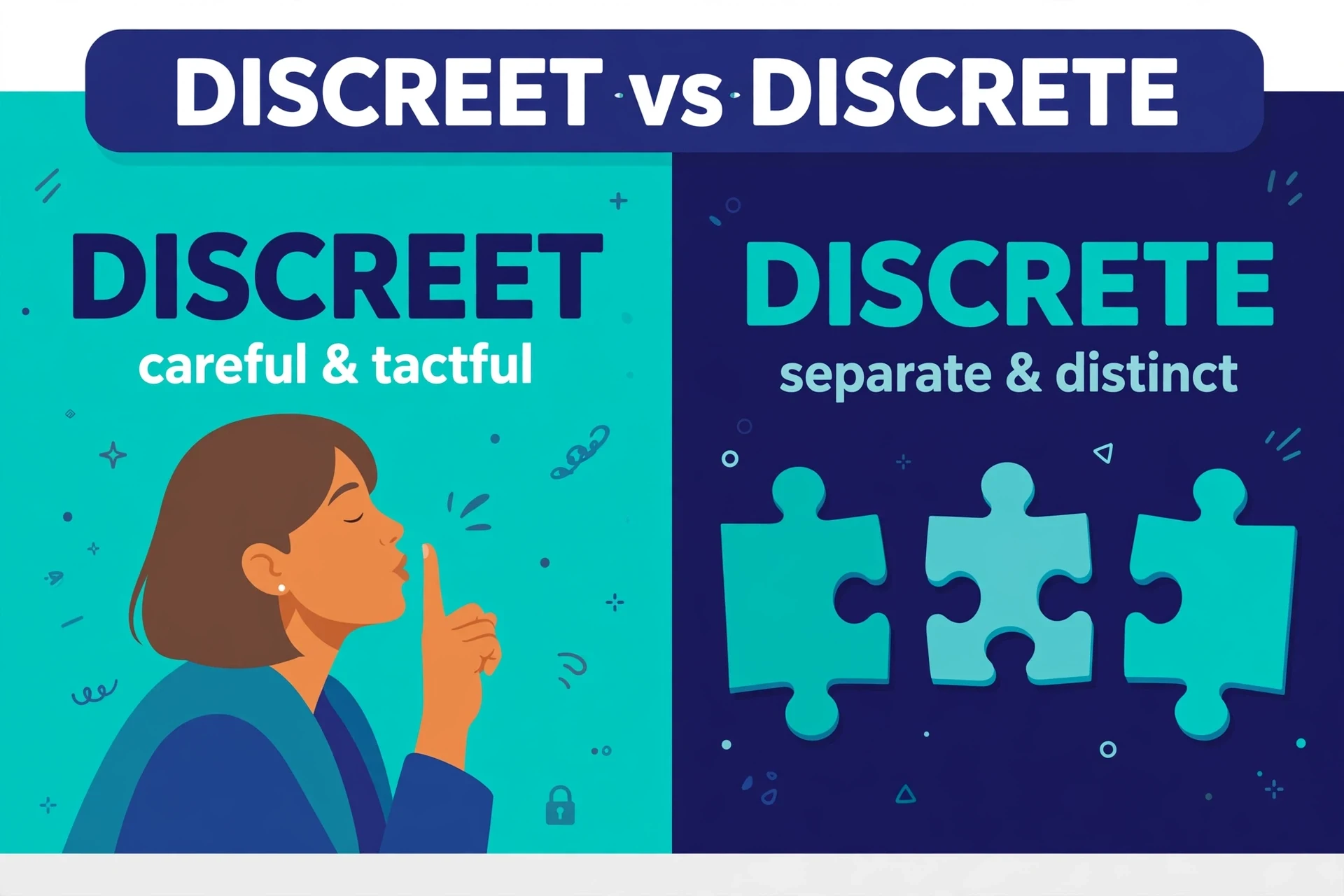
Quick Answer
| Word | Part of Speech | Main Meaning | Example |
|---|---|---|---|
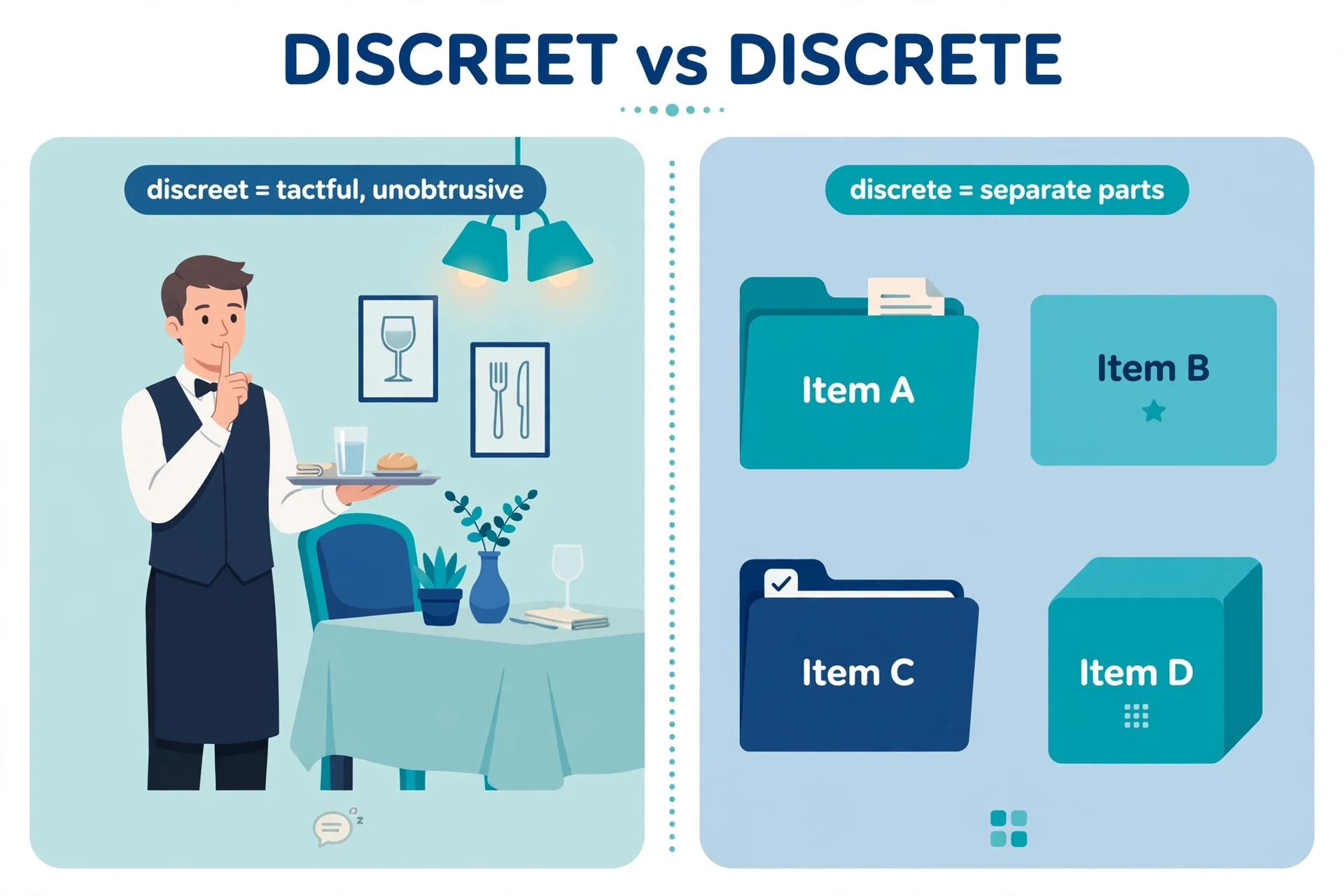
| discreet | Adjective | Careful, subtle, tactful; not drawing attention | ✅ “She was discreet about the surprise party.” |
| discrete | Adjective | Separate, distinct, individually distinct | ✅ “The course has three discrete modules.” |
Simple rule: If it’s about behaving carefully, write discreet with double -ee-; if it’s about things being separate, write discrete with -t- separating the vowels.
What Does Discreet Mean?
Discreet describes someone — or an action — that is careful, prudent, and tactful, especially about not attracting attention or revealing secrets. A discreet person keeps confidences, lowers their voice at the right moment, and handles delicate situations without making a scene. Merriam-Webster’s entry for “discreet” gives “marked by prudence or modesty” and “unobtrusive,” which captures the whole idea: good judgment, quietly applied.
Examples:
- “She was discreet about the surprise party and told no one.”
- “The hotel offers a discreet entrance for celebrity guests.”
- “He made a discreet inquiry about the job opening.”
- “A discreet cough from the back row ended the argument.”
- “Good managers give criticism in a discreet, private way.”
The noun form is “discretion” — as in “use your discretion,” meaning use your careful judgment. If you can substitute “tactful” or “careful” in the sentence, discreet is the word you want.
What Does Discrete Mean?
Discrete means separate, distinct, and individually separate from other things — not blended, not continuous. A playlist has discrete tracks, a building has discrete floors, and a project breaks into discrete phases. The word is a favorite in science and mathematics: “discrete data” comes in distinct countable chunks (like the number of students in a class) as opposed to continuous data (like temperature, which flows along a scale). Both words descend from the Latin discretus, “separated” — but only discrete kept the “separate” meaning.
Examples:
- “The report is divided into four discrete sections.”
- “Each department operates as a discrete unit.”
- “The experiment tested three discrete variables.”
- “She listed the discrete steps needed to fix the bug.”
- “In statistics, shoe size is discrete data — you can’t wear a size 8.37.”
The noun form is “discreteness,” and the adverb “discretely” means “separately.” If you can substitute “separate” or “distinct” in the sentence, discrete is the word you want.
Discreet vs. Discrete: Key Differences
| Feature | discreet | discrete |
|---|---|---|
| Meaning | Careful, tactful, unobtrusive | Separate, distinct, individual |
| Spelling clue | Double -ee- in the middle | -t- separates the e’s |
| Describes | People and their behavior | Things, parts, and categories |
| Noun form | discretion (careful judgment) | discreteness (the state of being separate) |
| Test swap | Replaceable with “tactful” | Replaceable with “separate” |
| Example | ✅ “a discreet nod” | ✅ “a discrete step” |
One word governs how you act; the other governs how things are divided. The spelling clue sits right in the middle of each word.
Discreet and Discrete in Real Sentences
At Work
✅ “Be discreet — the layoff news hasn’t been announced yet.”
✅ “The audit covered three discrete areas of the business.”
Offices demand both skills: keeping quiet about sensitive news and splitting big jobs into separate parts.
In Conversation
✅ “He gave me a discreet wink across the table.”
✅ “There are two discrete questions here, so let’s take them one at a time.”
A wink that nobody else notices is discreet; two questions that don’t overlap are discrete.
In Writing and School
✅ “The novelist is discreet about which characters are based on real people.”
✅ “The essay argues its thesis in three discrete paragraphs.”
Authors stay discreet about their sources while organizing arguments into discrete chunks.
In Science and Tech
✅ “The researchers were discreet about the unpublished results.”
✅ “Digital signals are discrete — they jump between distinct values.”
Labs need discretion with secrets and precision with data, which is why both words show up in the same papers.
Common Mistakes
Single-letter adjective swaps cause the same trouble across English — the “effective vs affective” adjective confusion is another one-vowel mix-up, and the “principal vs principle” classic word-pair mix-up shows how endings decide meaning. The discreet/discrete traps:
Mistake 1: Writing “discrete” when you mean tactful
❌ “Please be discrete about the merger.”
✅ “Please be discreet about the merger.”
Why: Keeping a secret is about careful behavior — discreet with double -e-. “Discrete about the merger” would mean the merger comes in separate pieces, which is nonsense here.
Mistake 2: Writing “discreet” when you mean separate
❌ “The system has three discreet components.”
✅ “The system has three discrete components.”
Why: Components that stand apart from each other are separate — discrete with the -t- in the middle. “Discreet components” would be components behaving politely, which is not what an engineer means.
Mistake 3: Mixing up “discretion” and “discreteness”
❌ “The data showed great discretion between groups.”
✅ “The data showed great discreteness between groups.” (or better: “the groups were clearly discrete.”)
Why: “Discretion” is careful judgment — it belongs to discreet. The noun for “being separate” is “discreteness,” from discrete. They sound related but serve different masters.
Mistake 4: Using “discreetly” for “separately”
❌ “The tasks were handled discreetly, one after another.”
✅ “The tasks were handled discretely, one after another.”
Why: “Discreetly” means “in a careful, unobtrusive manner”; “discretely” means “separately, as distinct units.” One letter changes the adverb’s entire job.
Pronunciation
Discreet and discrete are pronounced identically: dih-SKREET, rhyming with “concrete” and “complete.” The stress falls on the second syllable in both. Like so many confused pairs, the difference is invisible to the ear and only shows up in writing.
How to Remember the Difference
The middle letters are the whole trick:
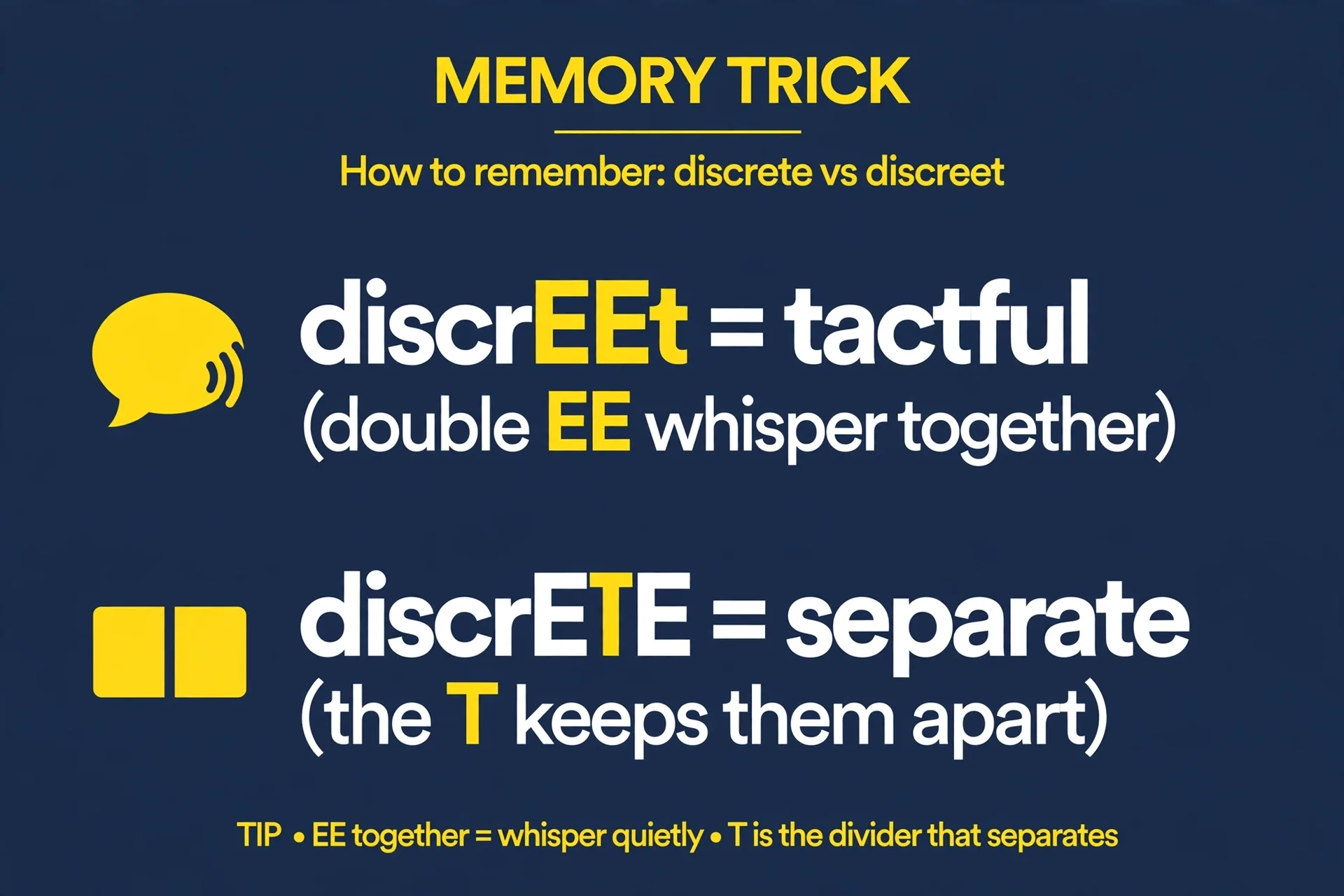
- Discreet has two es huddled together — like two people whispering exceedingly quietly. Tactful = discreet.
- Discrete has a t standing between the es, keeping them totally separate. The T separates — and “separate” is what discrete means.
- Substitution test: if “tactful” fits, pick discreet; if “separate” fits, pick discrete.
Frequently Asked Questions
Is it discreet or discrete inquiry?
Discreet inquiry — with double -e-. An inquiry made carefully and without drawing attention is tactful, so it takes discreet. (“A discreet inquiry” is practically a fixed phrase in business English.)
What is the difference between discreet and discrete?
Discreet means careful, subtle, and tactful in behavior. Discrete means separate, distinct, and individually divided. They are homophones with different spellings, meanings, and noun forms (discretion vs. discreteness).
Can “discreet” describe things, not just people?
Yes. Actions and objects can be discreet too: a discreet entrance, a discreet logo, a discreet notification sound. Anything designed not to attract attention earns the word.
Is “discrete” only used in math and science?
No, though it is common there. Everyday writing uses it whenever things come in separate parts: discrete chapters, discrete tasks, discrete flavors, discrete steps in a recipe.
What is the noun form of discreet?
“Discretion” — as in “reader discretion advised” or “at the manager’s discretion.” Don’t confuse it with “discreteness,” the noun form of discrete.
Are discreet and discrete ever interchangeable?
Never in careful writing. Their meanings — tactful behavior versus separate parts — don’t overlap, so swapping them always changes (or breaks) the sentence’s meaning.
Conclusion
Discreet with double -e- is about tactful, careful behavior, while discrete with a separating -t- is about things that stand apart. Keep the whispering e’s together for manners, and let the T divide for separate parts.