Hunny or Honey: What’s the Difference?
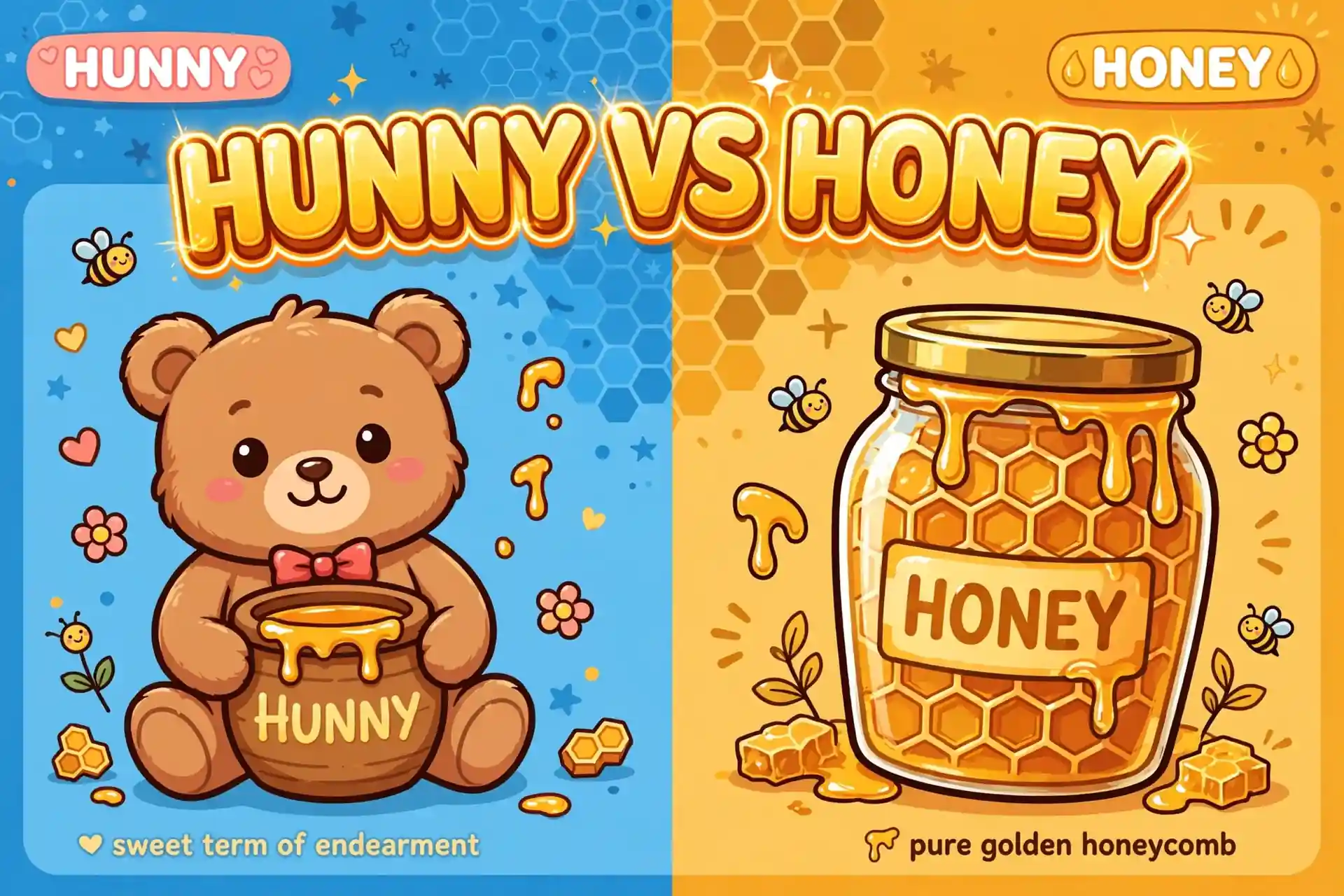
Honey is the standard word: the sweet food made by bees, and the classic term of endearment (“honey, I’m home”). Hunny is an informal, playful variant spelling used only as a sweet nickname for a loved one — never for the food in the jar.
For example, “Pass the honey” asks for the spread. “Good morning, hunny” is affectionate baby talk. One is standard English; the other is pure charm.
Quick Answer
| Word | Part of Speech | Main Meaning | Example |
|---|---|---|---|
| Honey | Noun | Bee-made sweetener; standard term of endearment | Drizzle honey on the toast. |
| Hunny | Noun (slang) | Playful pet name for a loved one | Good night, hunny! |
Simple rule: Talking about the food or writing formally? Use honey. Texting your sweetheart playfully? Hunny works.
What Does Honey Mean?
Honey is the standard English word with two jobs: naming the thick, sweet substance bees make, and serving as a warm term of endearment for someone you love.
Honey: The Food
- She stirred honey into her tea.
- The recipe calls for two tablespoons of honey.
- Local honey is sold at the farmers’ market.
Honey: The Term of Endearment
- Honey, could you help me with this?
- Happy anniversary, honey!
- Honey, dinner’s ready!
- Take care of yourself, honey.
For the full dictionary entry, see honey on Merriam-Webster.
What Does Hunny Mean?
Hunny is a deliberate, cutesy respelling of honey used as a pet name. It was popularized by Winnie the Pooh, who famously loves his “hunny pot,” and it survives in texts, cards, and nicknames.
Examples:
- Good morning, hunny! Did you sleep well?
- She saved his contact as “Hunny Bear” in her phone.
- Happy Valentine’s Day, hunny!
- He signed the card “love, your hunny.”
Hunny is never the correct spelling for the food. On a grocery list or a recipe, it would look like a mistake.

Hunny vs. Honey: Key Differences
| Feature | Honey | Hunny |
|---|---|---|
| Standard word? | Yes | No — slang variant |
| Means the food | Yes | No |
| Term of endearment | Yes (classic) | Yes (playful) |
| Formal writing | Fine | Avoid |
| Vibe | Warm, normal | Cutesy, intimate |
The pair works like other playful spellings such as loose vs lose: one standard form, one informal twist with a narrower job.
Examples in Real Sentences
In the Kitchen
Honey: “Add a spoonful of honey to the dressing.”
Hunny: “Thanks, hunny, for making breakfast!”
The food is always honey; the thank-you can be hunny.
Texting Your Partner
Hunny: “Miss you, hunny! See you at six.”
Honey: “Miss you, honey! See you at six.”
Both work as pet names here — hunny just reads more playful.
At Work
Honey: “The client loved the honey-glazed ham samples.”
Neither hunny spelling belongs in a work email about actual honey.
Common Mistakes With Hunny and Honey
Mistake 1: Writing “Hunny” for the Food
❌ Add two spoons of hunny to the tea.
✅ Add two spoons of honey to the tea.
Why: The food is always spelled honey. Hunny is only a nickname.
Mistake 2: Using “Hunny” in Formal Writing
❌ Dear Mrs. Carter, thank you hunny for your donation.
✅ Dear Mrs. Carter, thank you so much for your donation.
Why: Hunny is intimate slang. In formal writing, use honey — or better, neither as a pet name.
Mistake 3: Assuming “Hunny” Is Always Wrong
❌ “Hunny” is not a real word.
✅ “Hunny” is a real informal variant, perfect as a playful pet name.
Why: Dictionaries note the playful spelling. Context decides whether it fits, just as with dyeing vs dying, where context is everything.
Pronunciation: Hunny vs. Honey
Both are pronounced /ˈhʌni/, rhyming with funny and sunny — which is fitting, since hunny is meant to sound exactly like honey said sweetly.

How to Remember the Difference
Memory trick: Hunny with a U is for yoU — the person you love. Honey is what’s in the jar.
- Food, recipes, labels, formal writing → honey.
- Pet name in texts and cards → hunny or honey (your call).
If you could replace it with “sweetheart,” hunny fits. If you could spread it on toast, only honey works.
Frequently Asked Questions
Is it hunny or honey?
Use honey for the food and in all standard writing. Use hunny only as a playful, informal pet name for someone you love.
Is “hunny” a correct spelling?
As standard English, no — but as intentional slang, yes. It is a recognized playful variant of honey when used as a term of endearment, popularized by Winnie the Pooh’s “hunny pot.”
Why do people write “hunny” instead of “honey”?
The u spelling looks and feels cuter and more intimate — like baby talk in text form. It signals affection the way the standard spelling does not.
Can I call my partner “hunny”?
Absolutely, if they like it. As a private pet name it is charming; just keep it out of formal or professional messages.
Do “hunny” and “honey” sound the same?
Yes — both are pronounced /ˈhʌni/. The difference is purely in spelling and tone.
Is “hunny” in the dictionary?
Major dictionaries list honey as the headword; hunny is noted as an informal variant. It is recognized slang — charming in the right context, but not standard English.
Conclusion
Honey is the standard word for the food and the classic term of endearment. Hunny is its playful twin, reserved for sweet nicknames in texts and cards. Keep hunny out of the kitchen and out of formal writing, and you’ll use both perfectly.