Invision or Envision: Which Spelling Is Correct?
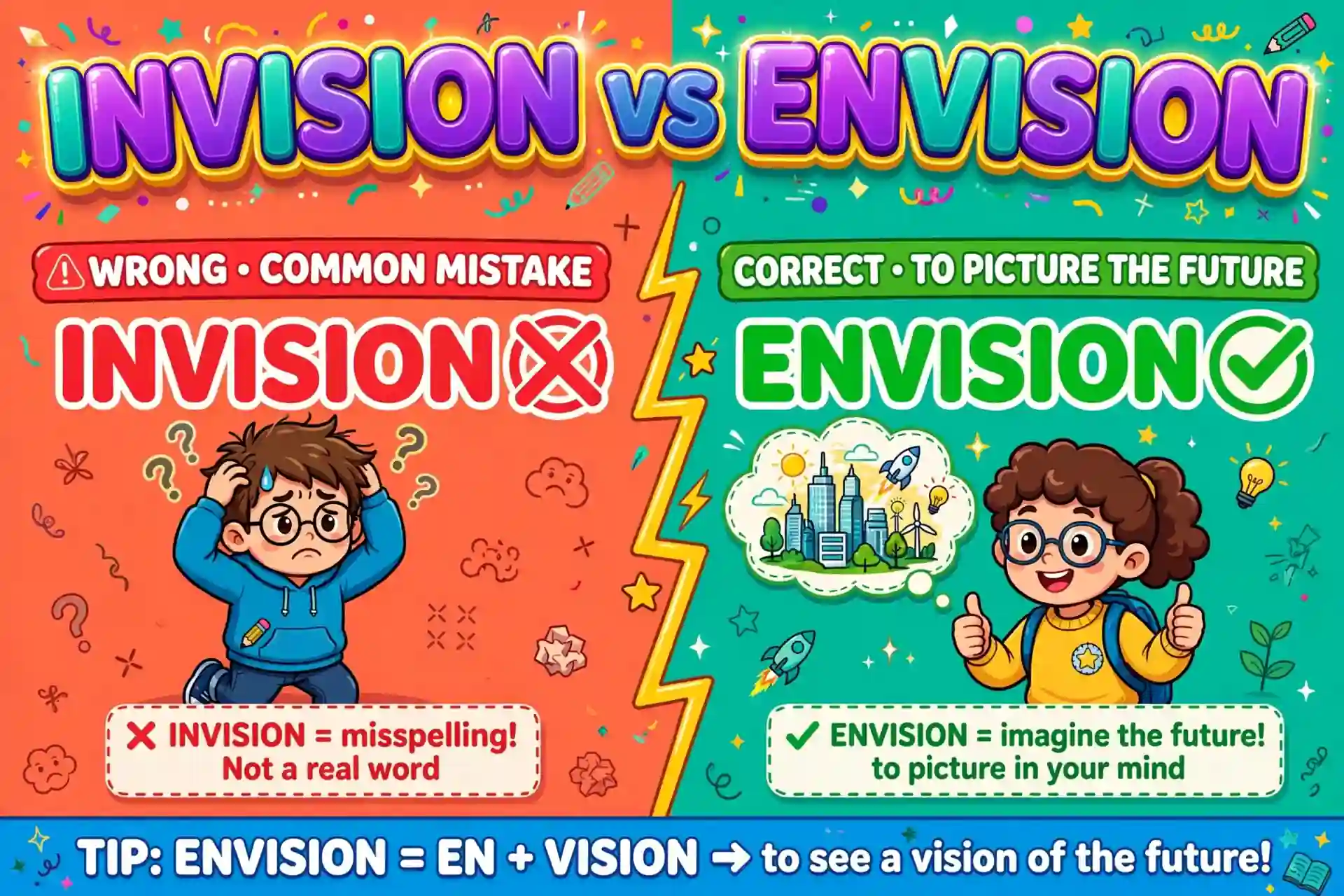
Envision is the correct English verb — it means to imagine or picture something in the mind. Invision is a misspelling, though you may recognize it as the name of a design software company (InVision), which is exactly where much of the confusion comes from.
For example, “She envisions a better future” is correct. The prefix mix-up here mirrors the one in preform vs perform — a small first-letter difference with a big meaning gap.
Quick Answer
| Word | Status | Meaning | Example |
|---|---|---|---|
| Envision | ✅ Correct | To imagine; to picture in the mind | They envision a greener city. |
| Invision | ❌ Misspelling* | — (*a company name) | Never use as a verb. |
Simple rule: The verb is always envision — with an e. “Invision” is only correct as the brand name InVision.
What Does Envision Mean?
Envision is a verb meaning to imagine something as a future possibility, or to picture it clearly in your mind. It comes from en- (to put into) + vision — literally “to put into vision”.
Examples:
- She envisions herself running her own bakery one day.
- The architects envisioned a park where the lot now stands.
- It is hard to envision life without smartphones.
- They envision the company doubling in size.
- He envisioned a world powered entirely by sunlight.
Why “Invision” Feels Familiar
Two things make “invision” tempting. First, English has many in- words (invite, invoke, inspire), so the prefix feels natural. Second — and more importantly — InVision is a well-known design and prototyping software company. Millions of people type “invision” when they mean the product, and the habit bleeds into everyday writing.
But a brand name is not a verb. In standard English, the word for imagining the future is envision, spelled with an e, just as dictionaries have recorded it for centuries. Spell-checkers flag “invision” for a reason.

Envision vs. Invision: Key Differences
| Feature | Envision | Invision |
|---|---|---|
| Status | Correct English verb | Misspelling (brand name only) |
| Meaning | To imagine, to picture | — |
| Prefix | En- (put into) | — |
| Capitalized? | No | Yes, as “InVision” (the company) |
| Example | Envision the possibilities. | Never as a verb. |
The en- prefix is the key: you envision something by putting it en (into) your vision.
Examples of Envision in Real Sentences
Talking About the Future
✅ She envisions a career in medicine.
❌ She invisions a career in medicine.
Future plans and dreams take envision.
In Business
✅ The founders envisioned a global brand.
❌ The founders invisioned a global brand.
Vision statements are built on envision — fittingly.
Creative Work
✅ He envisioned the mural before painting a single stroke.
❌ He invisioned the mural before painting a single stroke.
Artists and designers envision — even when they use InVision the software.
Common Mistakes With Envision
Mistake 1: Writing “Invision the Future”
❌ I invision a better tomorrow.
✅ I envision a better tomorrow.
Why: The verb starts with en-, not in-.
Mistake 2: Lowercasing the Brand
❌ We built the prototype in invision.
✅ We built the prototype in InVision.
Why: As a company name it is capitalized “InVision”. As a verb it does not exist — use envision.
Mistake 3: “Envision” vs. “Imagine”
❌ Envision and imagine mean exactly the same thing in every context.
✅ They overlap, but envision usually points to the future — picturing what could be — while imagine is broader.
Why: You envision a plan; you imagine a dragon. Related, not identical.
Pronunciation: Envision
Envision is pronounced /ɪnˈvɪʒən/ — “en-VIZH-un”, with the stress on the second syllable and a soft “zh” sound like the s in vision or measure.

How to Remember the Difference
Memory trick: Envision puts it en (into) your vision. The prefix en- means “to put into” — endanger, encourage, envision.
- Envision = put en (into) your vision → the verb.
- InVision = the company’s brand name → not a verb.
You put things en your vision — so the verb starts with en.
Frequently Asked Questions
Is it invision or envision?
The verb is always envision. “Invision” is a misspelling — except as the capitalized brand name InVision.
Is “invision” a word?
Not in standard English. It appears only as the proper noun InVision, the design software company. Dictionaries do not list “invision” as a verb.
What does “envision” mean?
To imagine or picture something, usually as a future possibility: “They envision a world without traffic.”
Why do people write “invision”?
Two reasons: the familiar in- prefix in English, and constant exposure to the InVision brand name. Both make the misspelling feel natural.
What is the noun form of “envision”?
There is no direct noun — use vision itself: “She has a clear vision for the project.”
Conclusion
Envision is the verb for imagining the future; invision is only the name of a software company. Remember en = “put into” your vision, and the e will never go missing. For the full dictionary entry, see envision on Merriam-Webster.