Synonyms for Then: 20+ Words With Examples
Then is a workhorse word: it orders events in time (“first this, then that”), points back to the past (“back then”), sets conditions (“if so, then…”), and even marks conclusions (“then it’s decided”). Essays repeat it dozens of times, and every repetition dulls the writing. These 20+ synonyms for then are grouped by sense with register notes, each with a plain definition and a real example sentence, so you can vary your wording without changing your meaning.
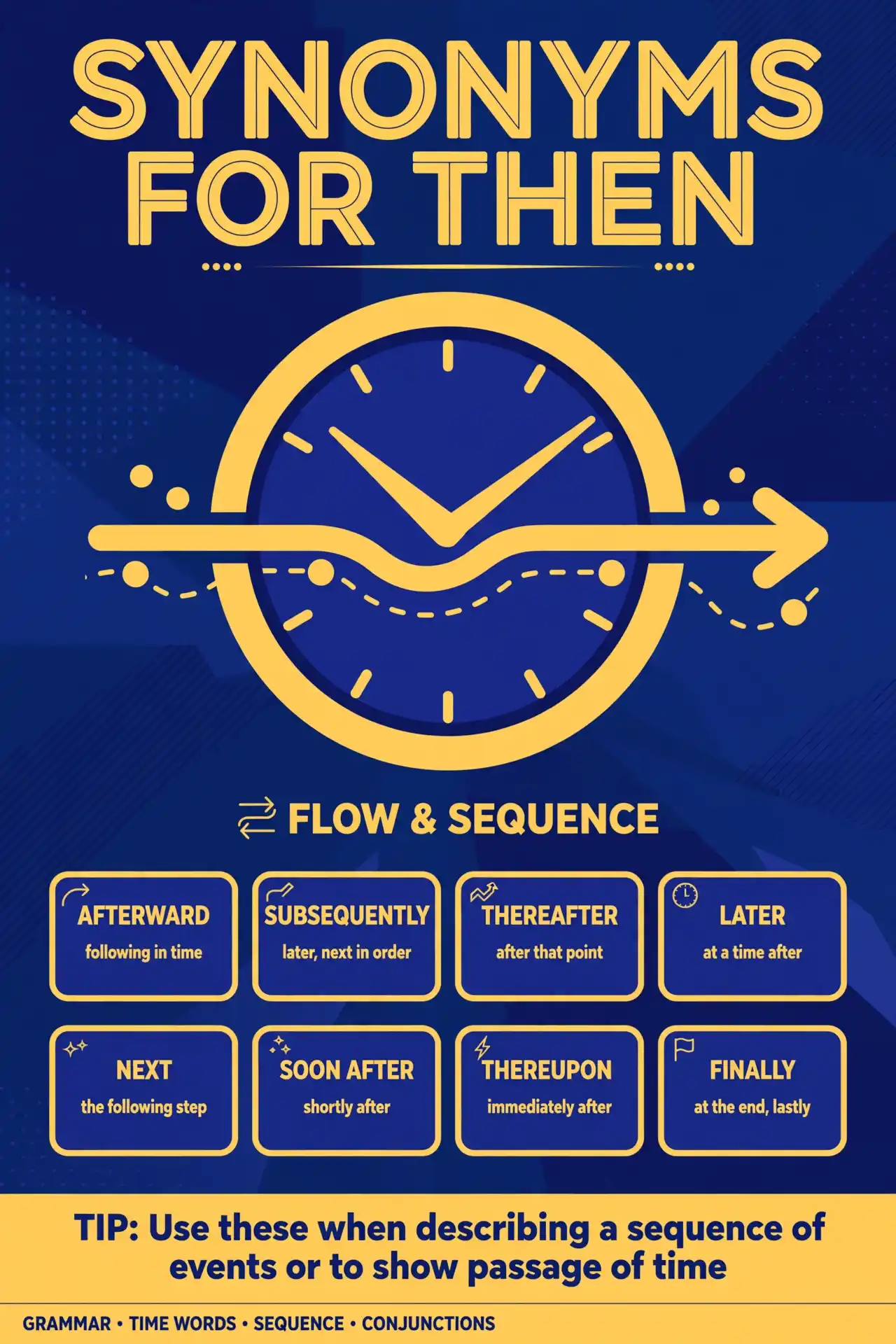
Table of Contents
Quick Answer
The best synonym for then depends on the sense. For sequence, use next, afterward, or subsequently (formal); for referring to a past period, use at that time or back then; for “in that case,” use if so or in that case; for a conclusion, use therefore or so.
| Word | Nuance / When to use it |
|---|---|
| next | The immediately following step; simple and direct |
| afterward | At a later time; neutral and widely usable |
| subsequently | Formal: at a later time, common in academic writing |
| later | At some future time; flexible and everyday |
| thereafter | Formal and legal: after that point, continuing on |
| at that time | During the period being discussed; neutral |
| back then | Casual: in that earlier period, often nostalgic |
| in those days | When describing a past era, often with contrast |
| in that case | Neutral set phrase meaning “if that is so” |
| if so | Short, clean conditional; good in speech and writing |
| under those circumstances | Formal: given that situation |
| therefore | Formal: as a logical consequence |
Simple rule: identify the job — next or afterward for what happens after, back then or at that time for the past, in that case for conditions, and therefore for conclusions.
Next in Time
These synonyms cover then’s most common job: marking what happens after something else. Merriam-Webster’s thesaurus entry for “then” lists afterward, later, and subsequently as the core sequence matches.
Next — the immediately following step; simple and direct. “We toured the museum; next, we had lunch by the river.”
Afterward — at a later time than something mentioned; neutral in register. “We met for coffee and talked for hours afterward.”
Afterwards — the same meaning as afterward; preferred in British English. “They argued, but they made up afterwards.”
Subsequently — formal: at a later time, especially in academic and report writing. “He resigned, and the deputy was subsequently promoted.”
Later — at some time after the present or a mentioned point; everyday and flexible. “She called back later that evening.”
Thereafter — formal and legal: after that point, continuing onward. “The treaty was signed, and the two nations were at peace thereafter.”
After that — plain and conversational sequence marker. “Finish your homework; after that, you can play.”
Following that — slightly formal: as the next thing in order. “The keynote ended, and following that, the workshops began.”

At That Time
Then also points back to a period in the past (“we lived there then”). These synonyms do that job with more color or precision.
At that time — during the specific period being discussed; neutral. “At that time, the village had no electricity.”
In those days — in that earlier era, often contrasted with today. “In those days, letters took weeks to arrive.”
Back then — casual and often nostalgic: in that earlier period. “Back then, everyone knew their neighbors.”
In that era — formal: during that historical period. “In that era, sea travel was the fastest way to cross the world.”
At that point — at that moment in a story or process. “At that point, she realized the keys were gone.”
In That Case
When then means “if that is so” — the conditional sense — these phrases carry the same meaning with clearer logic. Note the register: if so is clean and modern, while under those circumstances suits formal and legal writing.
In that case — the standard neutral phrase meaning “if that is true.” “You don’t like coffee? In that case, I’ll make tea.”
If so — short and modern; works in speech and writing. “If so, we should leave early to beat the traffic.”
Under those circumstances — formal: given that particular situation. “Under those circumstances, the committee had no choice but to resign.”
In that event — formal: if that happens. “In that event, the backup plan goes into effect.”
That being the case — slightly formal: since things are as stated. “That being the case, let’s postpone the meeting.”
As a Result
Then can also introduce a conclusion (“then it’s settled”). These words mark consequence and logical outcome.
So — the everyday conclusion marker; casual and conversational. “It was raining, so we stayed in.”
Therefore — formal: as a logical consequence; standard in essays. “The data was flawed; therefore, the conclusion was rejected.”
Hence — formal and slightly literary: for this reason. “He missed the deadline; hence the penalty.”
Thus — formal: in this way or as a result; common in academic prose. “The bridge collapsed, thus cutting off the only road.”
Common Mistakes
Short function words cause the most persistent mix-ups in English. Our quite vs quiet guide untangles one pair that sounds alike, and the whether or wether explainer fixes a spelling trap many writers hit. With then, these are the classic errors:
Mistake 1: Confusing “then” with “than”
❌ “She is taller then her brother.”
✅ “She is taller than her brother.”
Why: then marks time or sequence; than marks comparison. If you can substitute “in comparison to,” you want than.
Mistake 2: Using “then” for “at the same time”
❌ “He called then I was eating.” (meaning simultaneously)
✅ “He called while I was eating.”
Why: then means “after that,” not “during that.” For simultaneous events, use while, when, or at the same time.
Mistake 3: Starting every essay sentence with “then”
❌ “Then the experiment began. Then the results appeared. Then we analyzed them.”
✅ “The experiment began. Subsequently, the results appeared. Afterward, we analyzed them.”
Why: repeated then sounds choppy and elementary. Rotate in subsequently, afterward, following that, and later for smoother academic prose.
Mistake 4: Using “so” for sequence in formal writing
❌ “The sample was heated. So it was measured.” (formal report)
✅ “The sample was heated. It was subsequently measured.”
Why: so marks cause and effect, not sequence, and reads as casual. In formal writing, use subsequently, afterward, or following that for “what happened next.”
How to Choose the Right Synonym
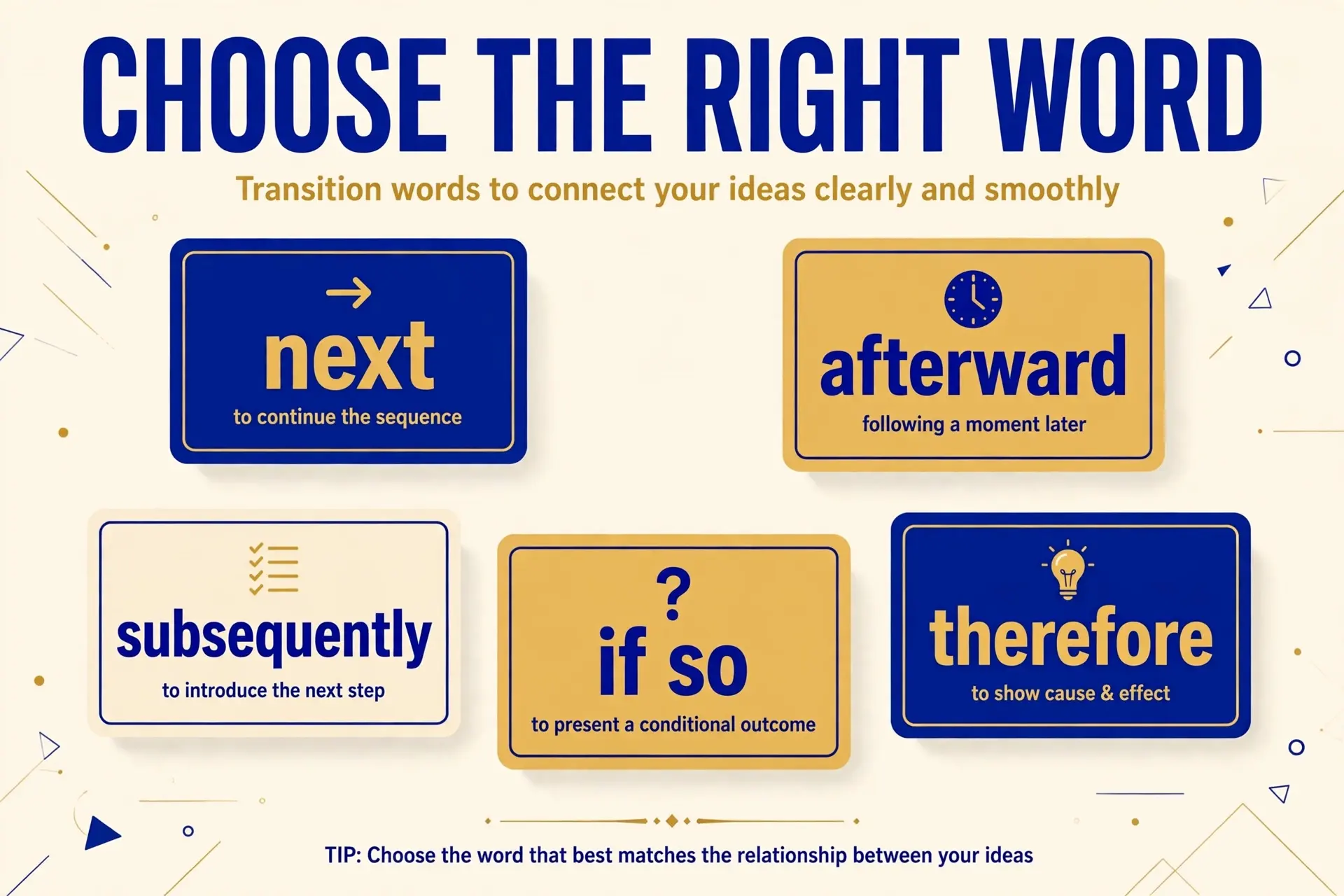
- Pin down the sense first. Is it sequence, past time, condition, or conclusion? Afterward can’t do “in that case,” and in that case can’t do “back then.”
- Set the register. Essays and reports call for subsequently, therefore, and under those circumstances; stories and speech suit next, later, back then, and so.
- Watch British vs. American preferences. Afterwards is standard in British English; American style guides prefer afterward. Pick one and stay consistent.
- Don’t stack sequence markers. “Then next, subsequently…” piles up — one marker per step is enough.
- Reserve “therefore” and “thus” for real logic. They claim a conclusion follows from evidence; using them for mere sequence (“I ate, therefore I slept”) sounds pompous.
Frequently Asked Questions
What is a synonym for then?
For sequence, the best options are next, afterward, and subsequently (formal). For past time use back then or at that time; for conditions use in that case; for conclusions use therefore.
What is the difference between then and than?
Then relates to time, sequence, or consequence (“we left then”); than is used only for comparisons (“taller than”). They sound alike but never overlap in meaning.
Is “subsequently” too formal for everyday writing?
For essays, reports, and professional writing it is perfect — precise and standard. In casual conversation or fiction, afterward, later, or after that sound more natural.
Can I start a sentence with “then”?
Yes, in informal writing and storytelling (“Then the lights went out”). In formal essays, prefer subsequently, afterward, or following that at the start of sentences.
What is a formal way to say “in that case”?
Under those circumstances and in that event are the standard formal options; that being the case is slightly less stiff. All three suit legal, academic, and business writing.
Conclusion
Then does four jobs — sequencing events, recalling the past, setting conditions, and drawing conclusions — and a precise synonym does each job better. Use next or subsequently for sequence, back then for the past, in that case for conditions, and therefore for conclusions. With 20+ options grouped by sense and register, your writing never has to lean on one tired word.