Buisness or Business: What’s the Difference?
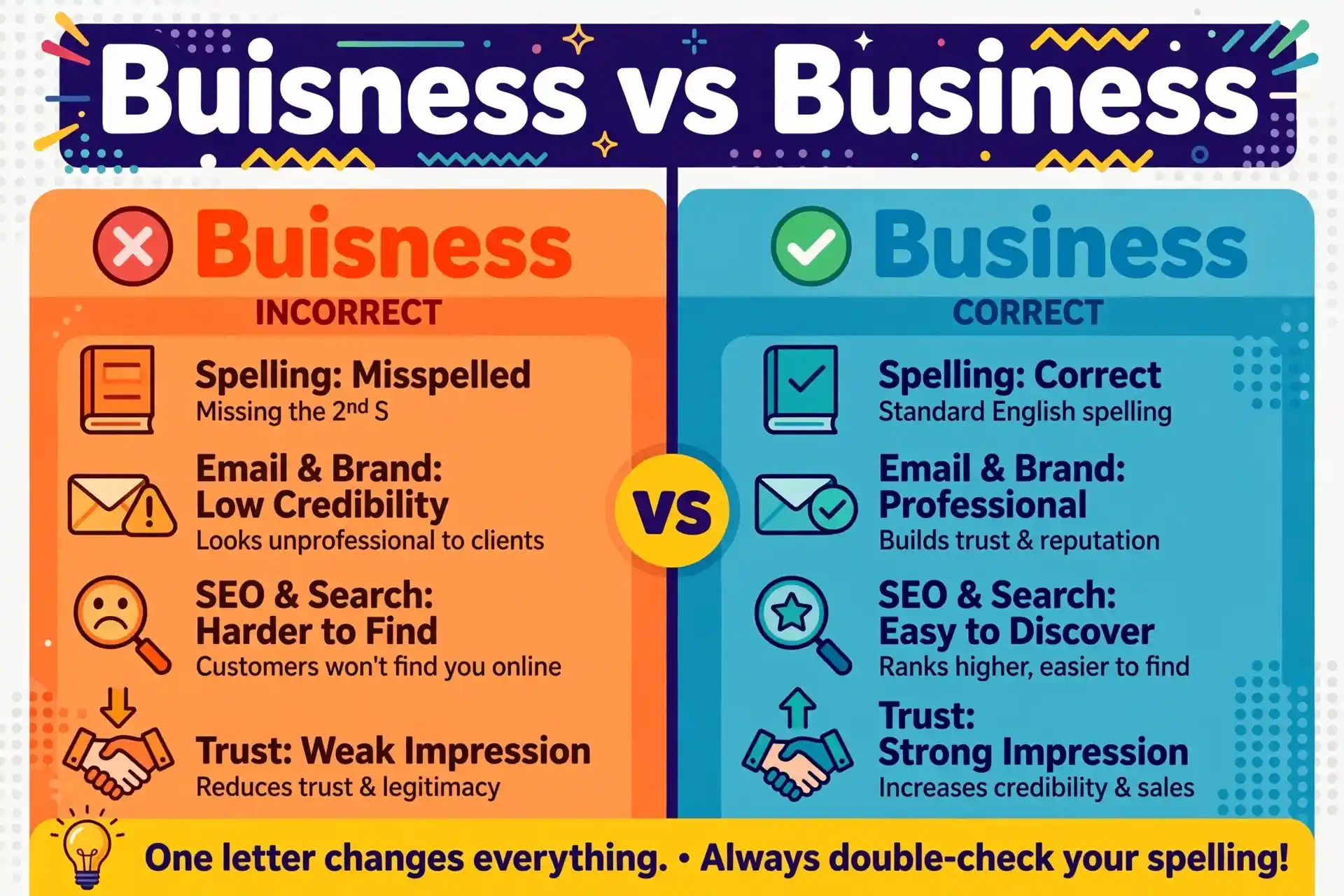
Buisness is one of the most embarrassing misspellings in English, because it usually appears on resumes, company websites, and business cards. The correct spelling is business — B-U-S-I-N-E-S-S. It means commercial activity, a company, or a matter someone needs to deal with: “She started her own business last year.”
Quick Answer
| Word | Part of Speech | Main Meaning | Example |
|---|---|---|---|
| buisness | — (misspelling) | Not a standard English word | ❌ “He runs a small buisness.” |
| business | Noun | Commerce; a company; a matter to handle | ✅ “He runs a small business.” |
Simple rule: Always write business — it starts with bus, not “bui.” The spelling buisness is never correct.
What Does Buisness Mean?
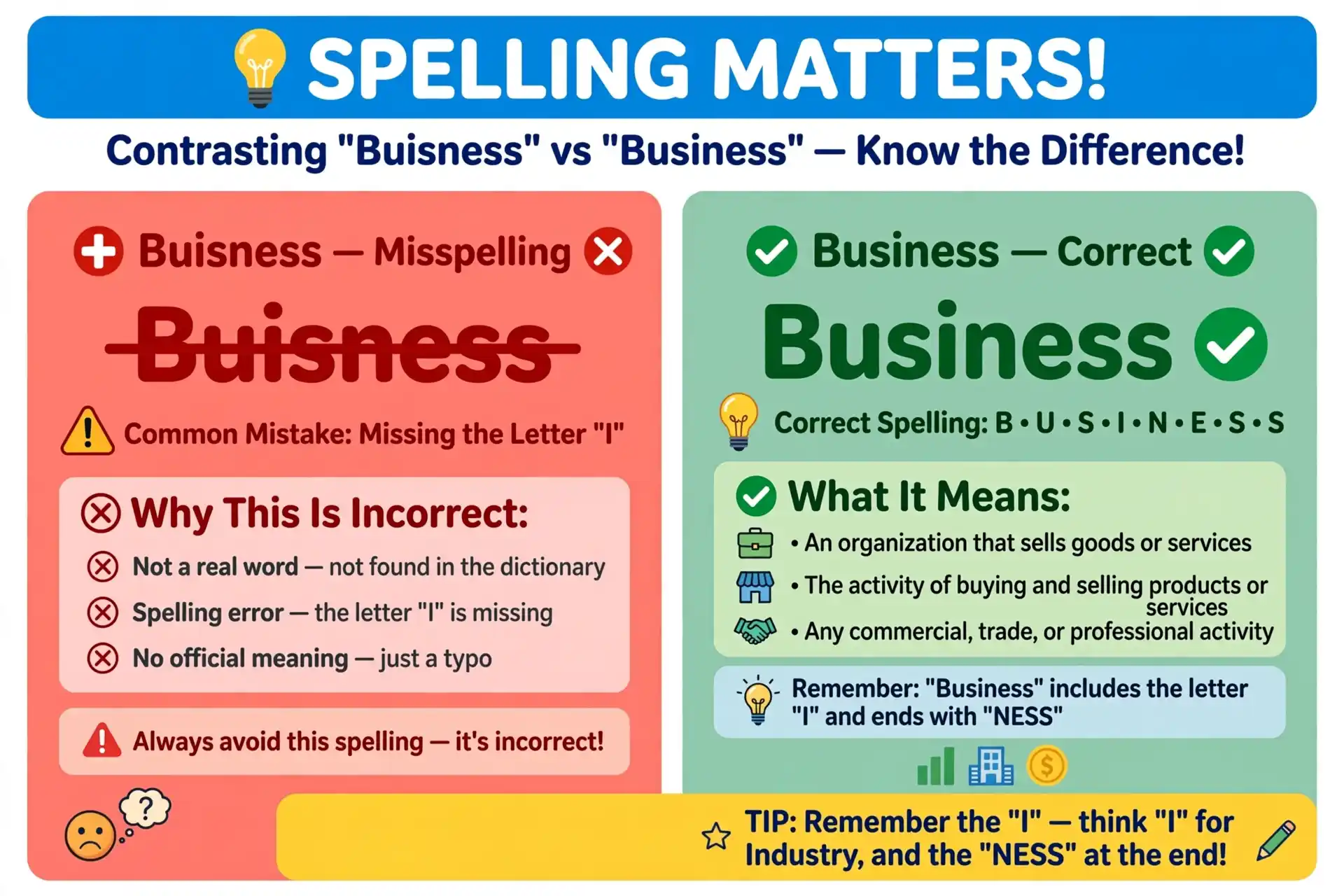
Nothing in standard English. Buisness is a common misspelling of business, and it happens because of the strange middle of the word. Writers hear “biz-ness” and their fingers produce “bui” — the U and I swap places or the I sneaks in where it does not belong. It is especially common among fast typists and non-native speakers.
Examples of how this misspelling appears (all incorrect):
- ❌ “She opened a new buisness downtown.”
- ❌ “This is a buisness meeting, not a social call.”
- ❌ “Mind your own buisness!”
- ❌ “He studied buisness administration in college.”
What makes this one painful is context: the word almost always appears in professional settings, where a spelling error does the most damage to credibility.
What Does Business Mean?
Business is a noun with three everyday senses: commercial activity (“doing business”), a company or enterprise (“a family business”), and a matter or concern (“mind your own business”). It comes from the Old English bisignes — literally “busyness,” the state of being busy — which explains the odd spelling: it is “busy” wearing a historical costume. Merriam-Webster’s entry for “business” lists all three senses with their full definitions.
Examples:
- “She started her own business selling handmade candles.”
- “The restaurant business is tougher than it looks.”
- “That’s none of your business — please drop it.”
- “He flew to Dubai on business last month.”
- “It’s a pleasure doing business with you.”
Buisness vs. Business: Key Differences
| Feature | Buisness | Business |
|---|---|---|
| Spelling status | Misspelling — not a real word | Correct standard spelling |
| Letter order | b-u-i-s-n-e-s-s | b-u-s-i-n-e-s-s |
| Root | — | From “busy” + “-ness” (busyness) |
| Pronunciation | — | BIZ-niss |
| Meanings | None | Commerce; a company; a personal matter |
| Example | ❌ “buisness plan” | ✅ “business plan” |
The difference is the order of the U and the I: business runs B-U-S-I, like “bus,” while buisness scrambles it into B-U-I. One transposed letter, one very visible mistake.
Buisness and Business in Real Sentences
At Work
❌ “Please send the buisness proposal by Friday.”
✅ “Please send the business proposal by Friday.”
Work emails are the number-one crime scene for this misspelling — and the setting where it costs the most.
At Home
❌ “Dad’s buisness trip got extended.”
✅ “Dad’s business trip got extended.”
Even casual family messages deserve the right spelling; it takes no extra effort once the pattern sticks.
In Conversation
❌ “It’s just buisness, nothing personal.”
✅ “It’s just business, nothing personal.”
The famous movie line only lands with the correct spelling — “buisness” would break the tough-guy effect instantly.
Common Mistakes
Scrambled middle letters fool everyone — the “recieve” vs “receive” spelling mix-up is the same kind of letter-order error, and the “cancelled” or “canceled” double-letter pattern shows how small spelling details carry weight. Watch for these traps:
Mistake 1: Swapping the U and I
❌ “buisness”
✅ “business”
Why: The “iz-ness” sound tempts the fingers to write “bui.” Say “bus-i-ness” in your head and the letters fall into place: b-u-s-i-n-e-s-s.
Mistake 2: Writing “busness” and dropping the I
❌ “He runs a small busness.”
✅ “He runs a small business.”
Why: The I is silent in speech (BIZ-niss), so writers leave it out. The I is doing quiet work in the spelling even though the mouth skips it.
Mistake 3: Trusting “it looks right” on a resume
❌ Submitting a resume with “buisness” anywhere in it.
✅ Proofread every professional document for this word specifically.
Why: Hiring managers notice this one fast. A single “buisness” can sink an otherwise strong application.
Mistake 4: Confusing “business” with “busy-ness” as two words
❌ “He was impressed by her busy ness.”
✅ “He was impressed by her busyness.”
Why: “Busyness” (the state of being busy) is a separate word spelled B-U-S-Y-N-E-S-S. Keep it apart from business, the commercial word.
Pronunciation
Business is pronounced BIZ-niss — the U and I both go silent, and the whole middle collapses into a “z” sound. It rhymes with “witness” minus the W. The gap between how it sounds (biz-ness) and how it is spelled (busi-ness) is exactly why the misspelling is so common.
How to Remember the Difference
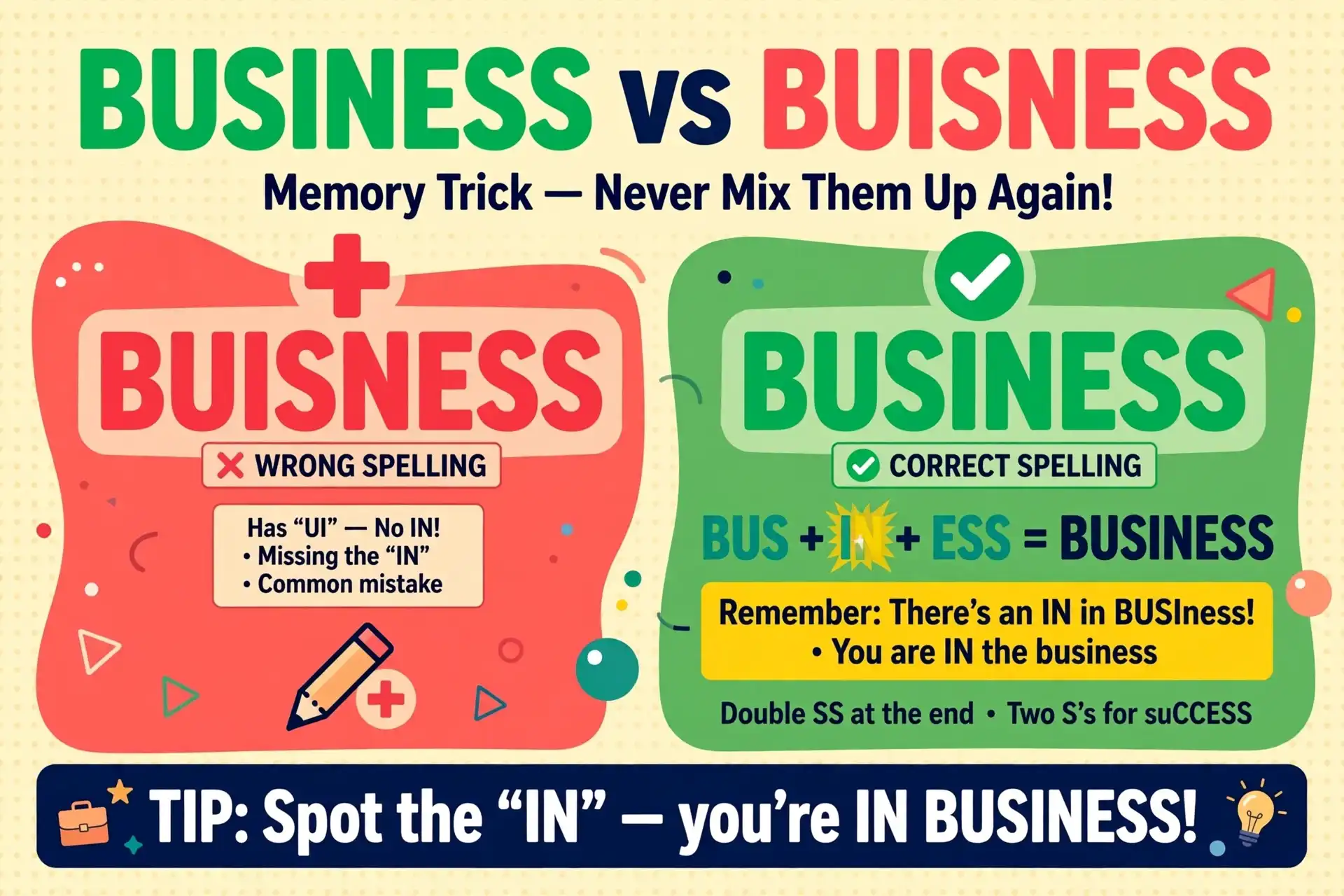
Business starts with BUS — picture a bus full of workers heading to the office. You would never write “buis” on the side of that bus, so don’t write it at the start of business either.
- Bus test: b-u-s-i-n-e-s-s. If it doesn’t start with “bus,” it’s wrong.
- Root link: business comes from “busy” — a busy person does business. Both start b-u-s.
- Silent I: the I is silent in speech but mandatory in spelling. Write it even though you don’t hear it.
Frequently Asked Questions
Is it buisness or business?
Business. Buisness is a misspelling and is never correct in standard English.
Is “buisness” ever acceptable?
No. No dictionary lists it, and it is not recognized as a variant in any register or region.
Why is “business” spelled so strangely?
It comes from the Old English “bisignes,” meaning busyness. Centuries of sound change simplified the pronunciation to “BIZ-niss” while the spelling kept its historical shape.
What does “mind your own business” mean?
It means “don’t interfere in other people’s affairs” — here business means “a personal matter or concern,” not commerce.
What is the plural of “business”?
Businesses: “She owns three successful businesses across the city.”
Is “business” countable or uncountable?
Both. “Business is booming” (uncountable, commercial activity) and “a business / two businesses” (countable, companies). Note that the countable plural businesses keeps the single-S spelling of the base word — never “buisnesses.”
Conclusion
Business is the only correct spelling — it starts with bus, keeps a silent I, and ends with a double S, while buisness scrambles the middle into nonsense. Picture the office bus, and the letters will never swap again.