Wont or Won’t: What’s the Correct Word? (Examples)
One tiny apostrophe separates two completely different words. Wont — no apostrophe — is a formal word meaning habit or custom. Won’t is simply the everyday contraction of ‘will not’.
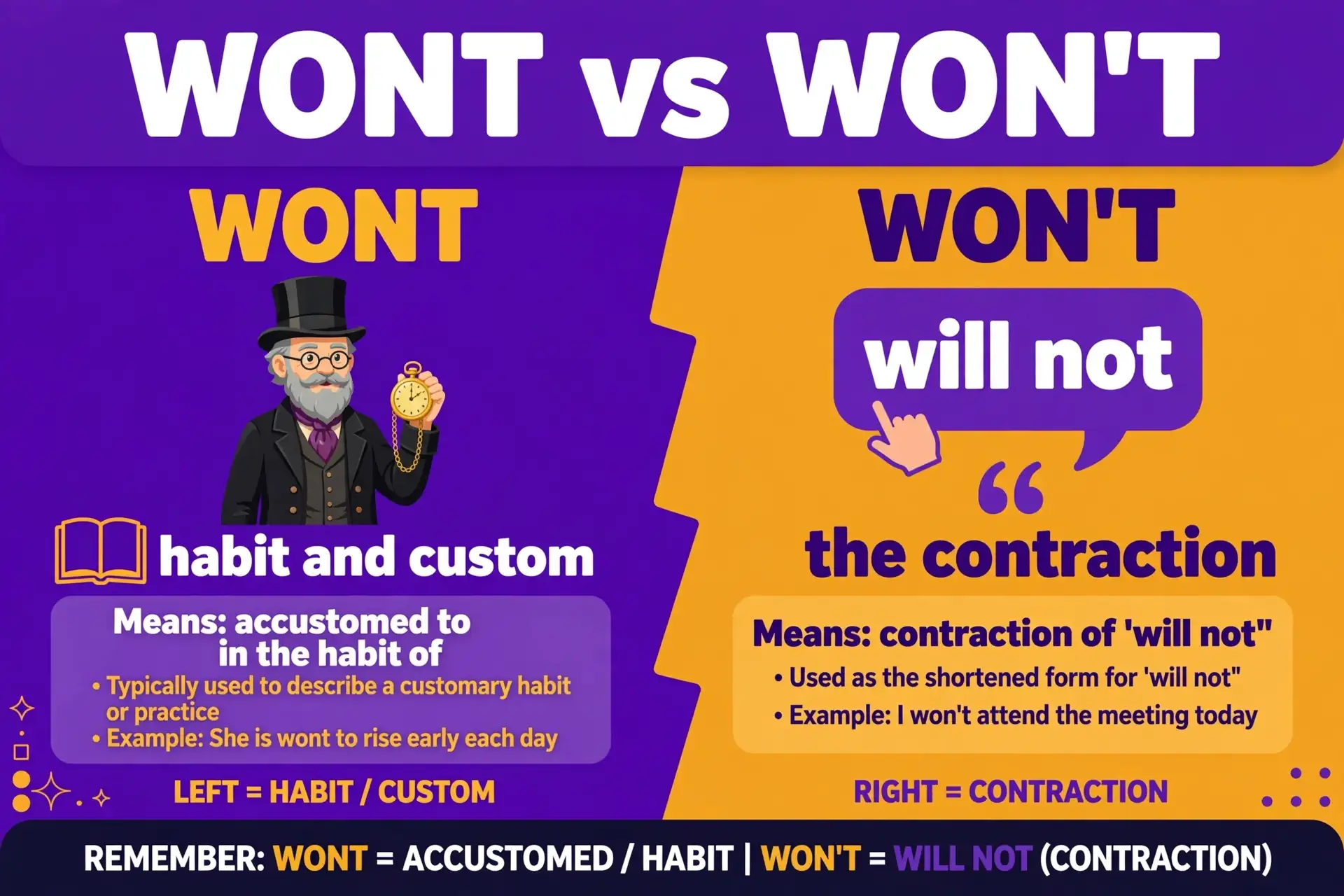
Table of Contents
Quick Answer
| Word | Part of Speech | Main Meaning | Example |
|---|---|---|---|
| wont | noun / adjective | habit or custom; accustomed | As is his wont, he arrived early. |
| won’t | contraction | will not | She won’t wait for latecomers. |
Simple rule: if you can expand it to “will not,” write won’t with the apostrophe; if you mean someone’s habit, write wont with none.
What Does Wont Mean?
Wont is a formal, slightly old-fashioned word for a person’s habit or custom. As a noun it means “one’s usual practice” (“It was her wont to rise at dawn”), and as an adjective it means “accustomed” (“He was wont to take long walks”). You will mostly meet it in literature, journalism, and the fixed phrase as is his/her wont. Merriam-Webster lists it as both noun and adjective with exactly this meaning of custom or habit.
Examples:
- As is her wont, she proofread the letter twice.
- He was wont to quote poetry at the dinner table.
- Skipping dessert is not his wont — he loves sweets.
- The old professor, wont to lecture past the hour, finally retired.
- True to her wont, she sent a thank-you note the same day.
- The cat, wont to nap in sunbeams, ignored its expensive bed.
What Does Won’t Mean?
Won’t is the contraction of “will not” — nothing more, nothing less. The apostrophe marks the letters dropped from will. It is one of the most common words in spoken and written English, used for refusals, promises, and predictions alike.
Examples:
- I won’t forget your birthday this time.
- The car won’t start in this cold.
- They won’t accept late applications.
- She won’t be home before eight.
- We won’t let a little rain ruin the picnic.
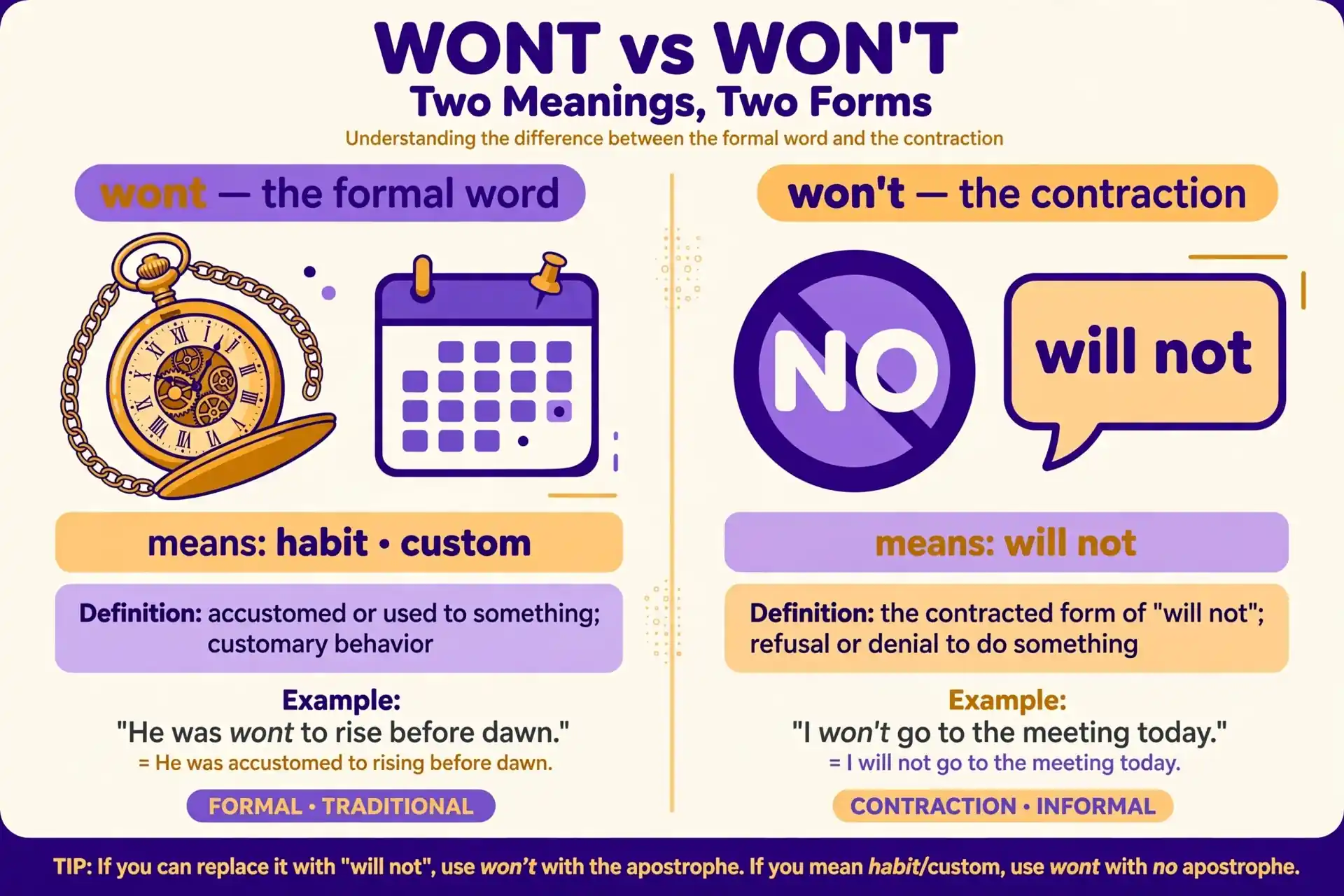
Wont vs. Won’t: Key Differences
| Feature | wont | won’t |
|---|---|---|
| Meaning | habit, custom; accustomed | will not |
| Apostrophe | never — no letters are missing | always — it replaces dropped letters |
| How common | rare, formal, literary | extremely common, everyday |
| Can be expanded? | no expansion possible | expands to “will not” |
| Typical setting | books, journalism, formal prose | any conversation or writing |
| Pronunciation | identical to won’t | identical to wont |
They sound exactly alike, so this is purely a spelling decision — and the expansion test (“can I say will not here?”) settles it every time.
Usage in Real Sentences
At Home
Wont: “As is his wont, Dad reads the paper cover to cover.”
Won’t: “Dad won’t let anyone touch the thermostat.”
The first describes a habit; the second is a refusal — expandable to “will not.”
At Work
Wont: “She was wont to double-check every figure before sending the report.”
Won’t: “The client won’t approve the budget without revisions.”
One is a formal way to say “accustomed to”; the other is a plain “will not.”
In Conversation
Wont: “True to her wont, she arrived with dessert in hand.”
Won’t: “She won’t stay long — she has an early flight.”
Use wont when praising someone’s habits, won’t when stating what will not happen.
In Writing
Wont: “The columnist, wont to open with an anecdote, began with a story about his grandfather.”
Won’t: “The editor won’t publish the piece without verified sources.”
Formal prose is the natural habitat of wont; won’t works everywhere from texts to legal contracts.
Common Mistakes
Small spelling differences with big meaning changes are an English specialty — the same care applies to pairs like desert or dessert and isle or aisle. Here are the classic wont/won’t errors.
Mistake 1: Writing wont for will not
❌ “I wont be able to make it.”
✅ “I won’t be able to make it.”
Why: this expands to “will not,” so the contraction with the apostrophe is required.
Mistake 2: Writing won’t in the habit phrase
❌ “As is his won’t, he left early.”
✅ “As is his wont, he left early.”
Why: the fixed phrase means “as is his habit” — no “will not” is involved, so no apostrophe.
Mistake 3: Confusing wont with want
❌ “It is my wont to visit Paris” written when meaning “It is what I want.”
✅ “I want to visit Paris.” / “It is my wont to travel each spring.”
Why: wont describes an established habit, not a wish — use want for desires.
Mistake 4: Using wont in casual writing
❌ “Per my wont, I’ll grab coffee” in a quick text message.
✅ “As usual, I’ll grab coffee.”
Why: wont is formal and literary; in everyday writing it sounds stiff, so “as usual” or “typically” reads more naturally.
Pronunciation
Wont and won’t are perfect homophones — both are pronounced “wohnt,” rhyming with don’t. Your ear gives you no help at all here, which is exactly why writers lean on the expansion test: if “will not” fits, the apostrophe belongs.
How to Remember the Difference
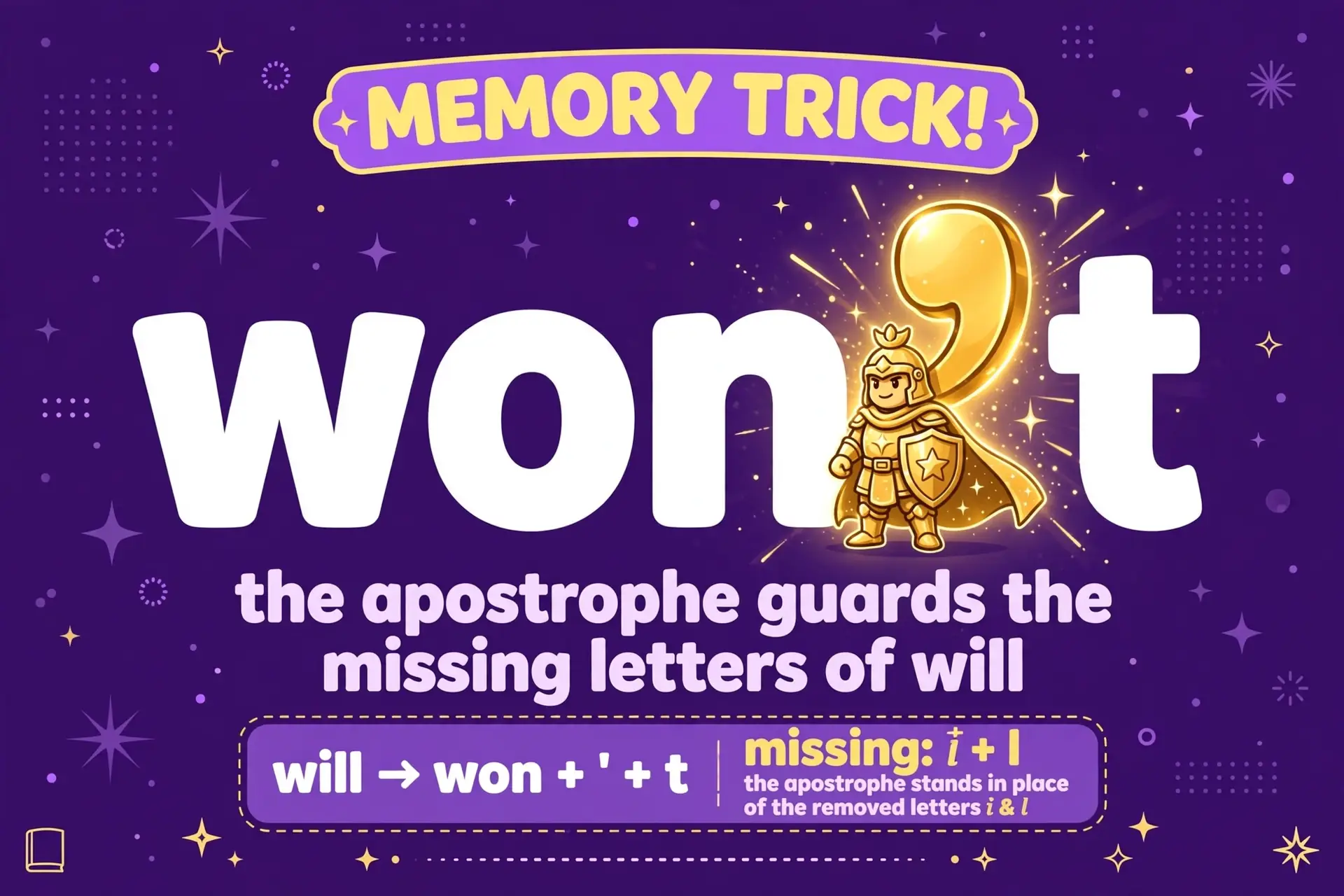
The apostrophe in won’t is a placeholder for the missing letters of “will” — something was taken out, so the mark stands guard. Wont lost nothing, so it needs no guard. Test every sentence: can you say “will not”? If yes, add the apostrophe; if no, leave it out.
- wont — habit or custom, no missing letters, no apostrophe
- won’t — will not, letters dropped, apostrophe marks the gap
- The expansion test never fails: “will not” fits → won’t; it doesn’t → wont
FAQ
Is it wont or won’t for “will not”?
Always won’t. The contraction of “will not” requires the apostrophe — wont without it means something entirely different, so writing “I wont go” tells your reader about your habits instead of your plans.
What does “as is his wont” mean?
It means “as is his habit” or “as he usually does” — for example, “As is his wont, he arrived early” simply says he habitually arrives early. It is the most common surviving use of wont, borrowed from formal and literary English, and it always takes his, her, or their before it.
Is wont still used today?
Yes, but mostly in formal writing, journalism, and literature — columnists and novelists love it for its weight. In everyday speech and casual writing, “as usual,” “typically,” or “in her typical fashion” sounds more natural and won’t raise eyebrows.
Do wont and won’t sound the same?
Yes — they are perfect homophones, both pronounced “wohnt” and rhyming with don’t. Your ear gives you no help at all here, which is exactly why writers lean on the expansion test: if “will not” fits the sentence, the apostrophe belongs.
Why is the contraction won’t and not “willn’t”?
Won’t comes from the older form woll not — centuries ago, woll was a variant of will — which contracted to won’t over time. It is one of English’s famous irregular contractions, in the same family as can’t (from “cannot”) and don’t.
Conclusion
Run the expansion test and you will never slip: won’t is “will not” in disguise, while wont is the formal word for habit. Two letters of punctuation have rarely carried so much meaning.