Synonyms for Often: 18+ Words With Examples
Often is one of the most repeated words in English writing — emails, essays, stories, and reports all lean on it whenever something happens more than once. This guide gives you 18 precise alternatives for often, grouped by nuance and formality, each with a one-line meaning and a natural example sentence. They line up with the range of meanings Merriam-Webster’s thesaurus entry for “often” lists, from neutral frequency to near-constant repetition.
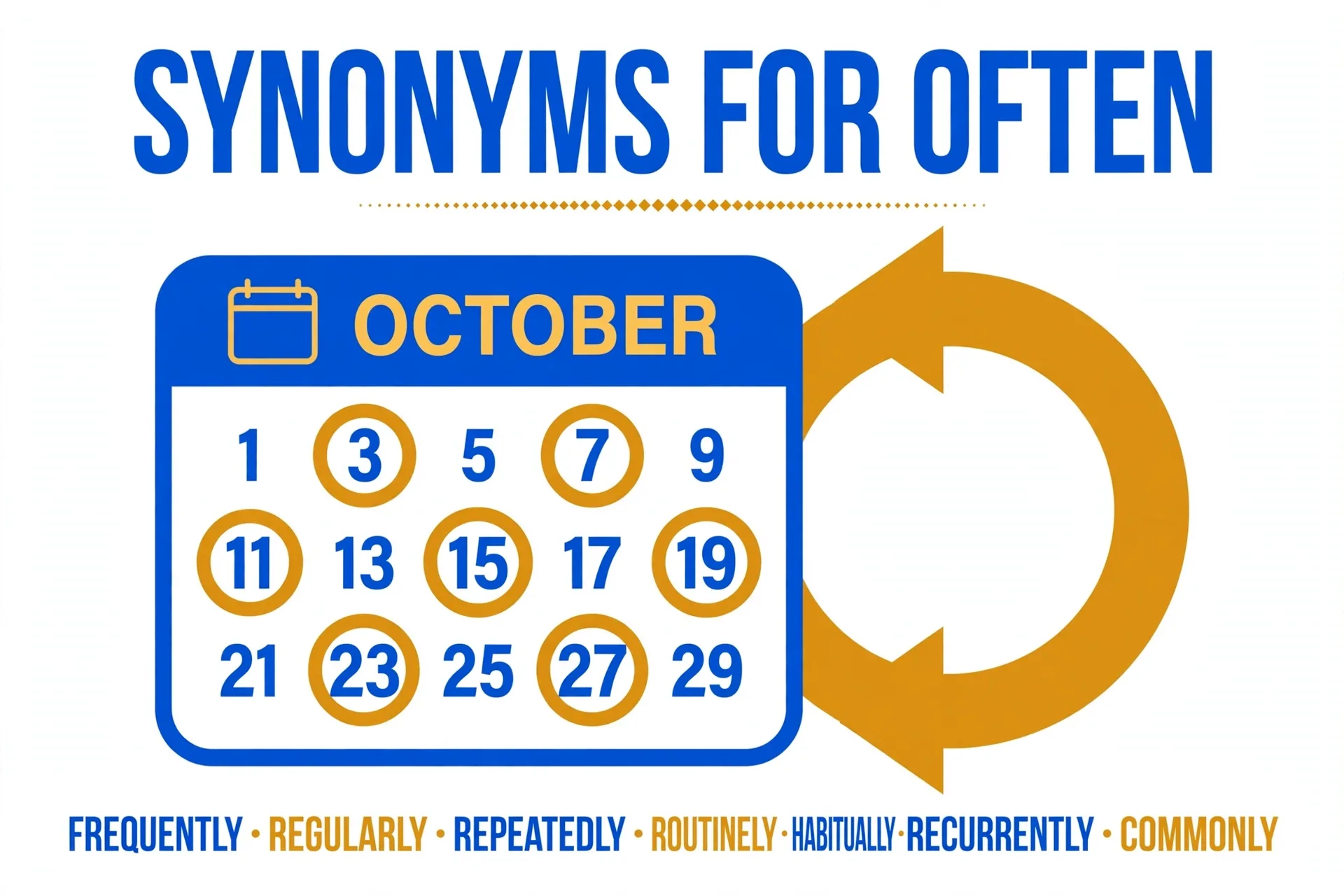
Table of Contents
Quick Answer
| Word | Nuance / When to use it |
|---|---|
| frequently | The neutral all-purpose swap — safe in almost any sentence |
| regularly | At fixed, predictable intervals — schedules and habits |
| repeatedly | More than once, with emphasis on the repetition itself |
| again and again | Time after time — stresses persistence or effort |
| commonly | In many cases — typical, widespread occurrences |
| oftentimes | Formal or literary variant, chiefly American English |
| habitually | As a settled personal habit |
| recurrently | Happening again at intervals — often problems or events |
| time and again | Repeatedly over a long period — patient endurance |
| constantly | Without pause — the strongest everyday option |
| continually | Recurring frequently over time, with breaks |
| usually | More often than not — describes the norm |
Simple rule: Use frequently or regularly in neutral writing, constantly or continually when something barely stops, and oftentimes or habitually when you want a formal, literary tone.
Everyday Synonyms
These are the workhorses — natural in conversation, emails, and most writing. Any of them can replace “often” without changing your register.
Frequently — happening at short intervals; the closest neutral synonym. She frequently forgets her keys when she is rushing out the door.
Regularly — at fixed, predictable intervals. He exercises regularly, every morning before work.
Repeatedly — more than once, with the emphasis on the repetition. The teacher repeatedly reminded the class about the deadline.
Again and again — time after time; stresses persistence. They rehearsed the scene again and again until it felt natural.
Commonly — in many cases; typical or widespread. This spelling error occurs commonly in first drafts.
Over and over — the same action done many times in succession. He played the song over and over until midnight.

Formal Synonyms
Academic papers, reports, and literary prose prefer these — they carry the same meaning with more polish.
Oftentimes — a formal, slightly literary variant of “often,” common in American English. Oftentimes the simplest solution is the one nobody tries first.
Habitually — as a matter of settled habit. She habitually arrives ten minutes before every meeting.
Recurrently — happening again at intervals; often used for problems, themes, or events. The issue recurrently appears in the quarterly safety reports.
Time and again — repeatedly over a long stretch of time; patient and slightly dignified. Time and again, voters have rejected the proposal.
Strong Frequency Synonyms
When “often” feels too weak — the thing barely ever stops — these words turn up the intensity.
Constantly — without pause; nearly always. The baby cried constantly through the night.
Continually — recurring frequently over time, with breaks in between. Software updates continually change the interface she trained on.
Invariably — without exception; always. He invariably orders the same dish at every restaurant.
Unfailingly — never failing; dependable to the point of certainty. She unfailingly sends a thank-you note after every interview.
Casual Synonyms
For texts, social posts, and relaxed conversation — the way people actually talk about frequency.
A lot — the everyday casual stand-in for “often.” We eat out a lot these days.
All the time — nearly always; conversational and emphatic. Kids are on their phones all the time now.
Usually — more often than not; describes what is normal. He usually takes the bus to work.
Routinely — as part of an established routine. Nurses routinely check vitals every four hours.
Common Mistakes
Frequency words look interchangeable, but each has a boundary — the same care that settles the principal-vs-principle confusion and US vs UK spellings like armor vs armour applies here: pick the word whose exact meaning matches your sentence.
Mistake 1: Using “always” when you mean “often”
❌ She is always late — well, often, anyway.
✅ She is often late, though not every single time.
Why: Always means 100% of the time with no exceptions. If exceptions exist, often, frequently, or usually is the honest word.
Mistake 2: Confusing “continually” with “continuously”
❌ The server crashes continuously throughout the day.
✅ The server crashes continually throughout the day.
Why: Continuously means without any interruption; continually means recurring frequently with breaks. A server that crashes, recovers, and crashes again is doing it continually.
Mistake 3: Dropping “oftentimes” into British formal writing
❌ Oftentimes, the committee defers the vote to the next session.
✅ The committee often defers the vote to the next session.
Why: Oftentimes is chiefly American and can sound inflated; in British English it is rare and slightly archaic. In formal UK writing, plain often or frequently reads better.
Mistake 4: Stacking intensifiers onto strong synonyms
❌ It very constantly rains in this region.
✅ It rains very often in this region. / It constantly rains in this region.
Why: Constantly already contains the intensity — pairing it with “very” is redundant. Put the intensifier with often (“very often”) or let the strong synonym stand alone.

How to Choose the Right Synonym
- Match the register: reports and essays want frequently or recurrently; messages to friends want a lot or all the time.
- Decide what you really mean: “many times” is repeatedly; “nearly always” is constantly; “at set intervals” is regularly.
- Use “usually” for the norm, not just frequency: it implies exceptions exist — “he usually walks” suggests sometimes he doesn’t.
- Reserve the emphatic phrases for emphasis: “again and again” and “time and again” draw attention to persistence, so don’t spend them on trivial repetition.
- Check for hidden redundancy: “very constantly,” “always often,” and “repeatedly again” all say the same thing twice — pick one.
Frequently Asked Questions
What is a synonym for often?
Frequently is the closest all-purpose synonym — it fits nearly any sentence where “often” fits. Regularly, repeatedly, and usually are the next most useful, each with a slightly different shade of meaning.
What is the difference between “often” and “frequently”?
Almost none in meaning — they are true synonyms. Frequently sounds a touch more formal and is slightly more common in written English, while often feels warmer and more conversational.
Is “oftentimes” a real word?
Yes. Oftentimes is a legitimate, chiefly American adverb meaning “often,” with a formal or literary flavor. It is not slang and not a mistake — just use it sparingly, since it can sound pompous in casual writing.
What is a formal synonym for “often”?
Recurrently, habitually, and oftentimes are the most formal options. In academic writing, frequently remains the safest and most natural choice.
Can I say “very often”?
Yes — “very often” is standard, correct English and a natural way to add emphasis. Just don’t pair “very” with already-intense synonyms like constantly or invariably.
Conclusion
Often will always have its place, but eighteen sharper alternatives let you say exactly how frequent “frequent” is — from the casual a lot to the formal recurrently to the relentless constantly. Match the word to your register and your real meaning, and the repetition in your sentences will be deliberate, not accidental.