Synonyms for Unfortunately: 18+ Words With Examples
Unfortunately opens bad news in emails, essays, and conversations — and because it appears so often, it starts to sound flat or even insincere. This guide gives you 18 precise alternatives for unfortunately, grouped by tone and intensity, each with a one-line meaning and a natural example sentence. They span the same range that Merriam-Webster’s thesaurus entry for “unfortunately” covers, from gentle regret to genuine dismay.
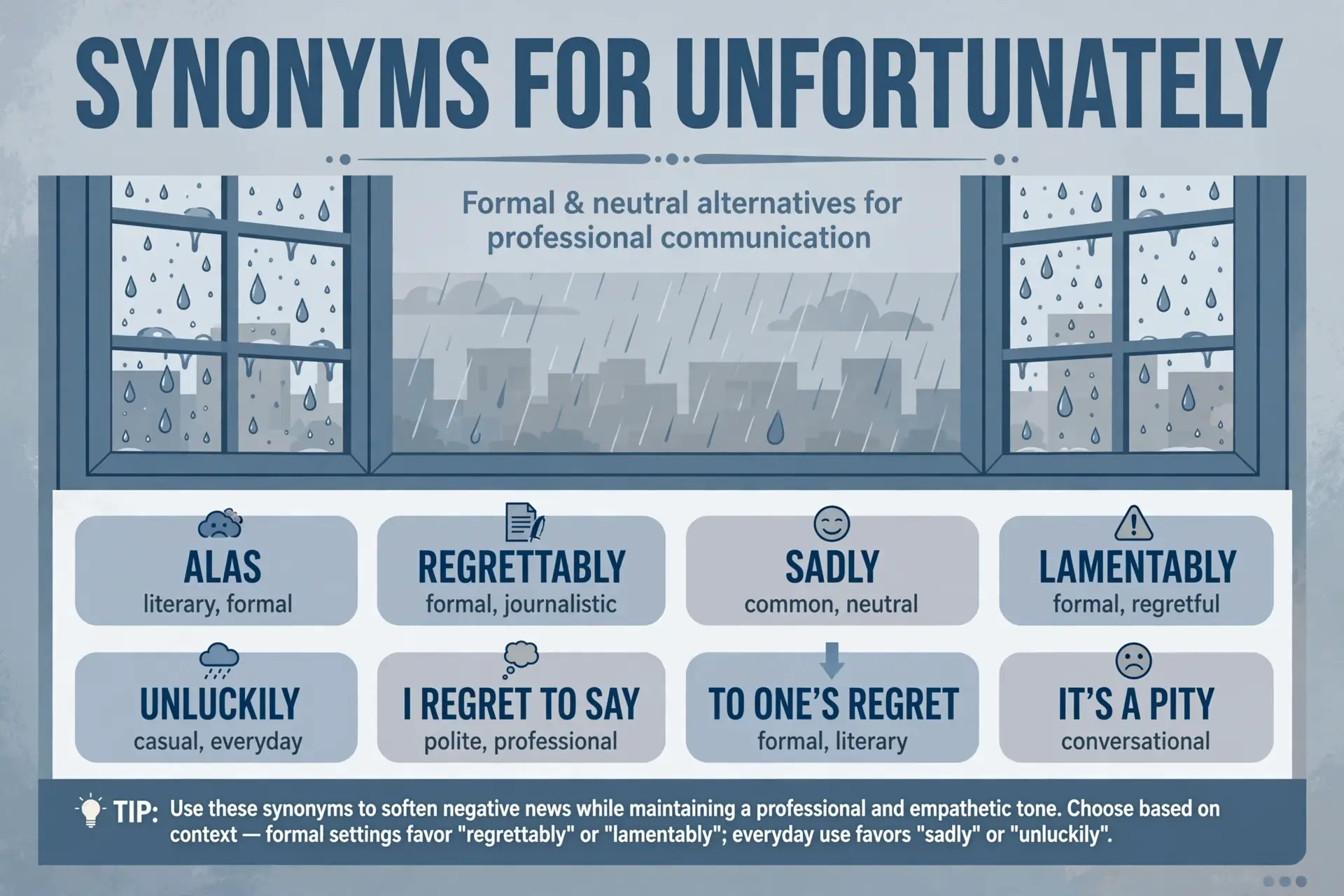
Table of Contents
Quick Answer
| Word | Nuance / When to use it |
|---|---|
| sadly | The closest all-purpose swap — mild, natural, works anywhere |
| regrettably | Formal regret — business writing, apologies, reports |
| unluckily | Bad luck specifically — chance went the wrong way |
| unhappily | Sorrow-tinged — literary and slightly old-fashioned |
| annoyingly | Mild irritation — everyday frustrations |
| irritatingly | A touch stronger than annoyingly — recurring problems |
| lamentably | Worthy of lament — formal, serious shortfalls |
| distressingly | Genuinely upsetting — bad news that unsettles |
| unsettlingly | Disturbing in a quiet way — trends, symptoms, silences |
| unpleasantly | Disagreeable facts — neutral, understated |
| tragically | Genuine tragedy — loss, disaster, wasted potential |
| dreadfully | Strong dismay — dramatic but still credible |
Simple rule: Use sadly for everyday bad news, regrettably when formality matters, unluckily when it’s really about luck, and save tragically and dreadfully for news that truly deserves the weight.
Unfortunately as Gentle Regret
When “unfortunately” just softens ordinary bad news — a missed call, a sold-out show, a small setback — these six keep it light and natural.
Sadly — expressing mild sorrow about a fact; the most natural everyday swap. Sadly, the bakery had already sold out of croissants.
Regrettably — formal expression of regret; standard in professional writing. Regrettably, we cannot process refunds after thirty days.
Unluckily — by bad fortune; use it when chance is genuinely the cause. Unluckily for us, the only train was cancelled.
Unhappily — with sorrow; slightly literary, softer than “sadly.” Unhappily, the old theater closed its doors last spring.
Annoyingly — causing mild irritation; perfect for everyday frustrations. Annoyingly, the printer jammed right before the deadline.
Irritatingly — persistently bothersome; a notch above “annoyingly.” Irritatingly, the app logs her out every single morning.
Unfortunately as Serious Dismay
When the news genuinely troubles you — a worrying trend, a serious failure, an upsetting fact — these words carry the right gravity.
Lamentably — deserving regret or disappointment; formal and weighty. Lamentably, the city’s recycling rate has fallen three years in a row.
Distressingly — causing real anxiety or sorrow. Distressingly, waiting times at the clinic have doubled since January.
Unsettlingly — quietly disturbing; the facts don’t sit right. Unsettlingly, the house was exactly as they had left it — except for the open window.
Unpleasantly — disagreeable in a plain, understated way. Unpleasantly, the water bill arrived the same week as the car repair.
Disturbingly — seriously troubling; stronger than “unsettlingly.” Disturbingly, half the surveyed teenagers reported sleeping fewer than six hours.
Shockingly — so bad it surprises; use sparingly or it loses force. Shockingly, the bridge inspection had been skipped for a decade.
Unfortunately as Strong Distress
When “unfortunately” would be laughably weak — real loss, disaster, or devastation — these words match the scale of the news.
Tragically — involving genuine tragedy; loss of life or wasted potential. Tragically, the young pianist never heard her final recording.
Dreadfully — causing strong fear or dismay; dramatic but credible. Dreadfully, the storm destroyed the entire harvest in one night.
Terribly — extremely bad; conversational and emphatic. Terribly, the rescue team arrived too late to save the cabin.
Awfully — very badly; casual, best for spoken English. Awfully, the whole trip was rained out.
Horribly — in a shocking, appalling way. Horribly, the factory fire could have been prevented with basic alarms.
Badly — plainly and bluntly unfortunate; no frills. Badly, the negotiations collapsed on the final day.
Common Mistakes
Bad-news words are easy to misuse because the wrong one can sound sarcastic, melodramatic, or cold. The same precision that settles the unphased-vs-unfazed pair and the dammit-vs-damnit mix-up applies here: match the word to the weight of the news.
Mistake 1: Editorializing neutral facts
❌ Unfortunately, the meeting is at 3 PM.
✅ The meeting is at 3 PM.
Why: A meeting time isn’t bad news — it’s just information. Adding unfortunately makes you sound negative for no reason.
Mistake 2: “Unfortunately” when you mean “ironically”
❌ Unfortunately, the fire station burned down.
✅ Ironically, the fire station burned down.
Why: The point of the sentence is the twist, not the sorrow. Ironically names what’s actually interesting; “unfortunately” buries it.
Mistake 3: “Regrettably” in casual chat
❌ Regrettably, I’m out of chips.
✅ Sadly, I’m out of chips.
Why: Regrettably is formal boardroom language. In a text to a friend it sounds stiff or sarcastic; sadly fits the register.
Mistake 4: “Alas” in modern professional writing
❌ Alas, the Wi-Fi is down again. — in a client email
✅ Unfortunately, the Wi-Fi is down again.
Why: Alas is archaic and poetic — in a work email it reads as a joke. Keep it for literature, and use unfortunately or sadly at work.

How to Choose the Right Synonym
- Weigh the news first. Minor hassle → sadly/annoyingly; genuinely troubling → lamentably/distressingly; real loss → tragically/dreadfully.
- Check the register. Regrettably and lamentably belong in formal writing; sadly, awfully, and terribly suit conversation.
- Ask whether it’s really luck. Unluckily is only right when chance caused the outcome — a cancelled train, a lost coin toss. For everything else, use a regret word.
- Don’t inflate small news. “Tragically, the café was closed” makes you sound melodramatic — sadly is honest and still sympathetic.
- Watch the sarcasm trap. “Unfortunately” and its cousins can read as passive-aggressive in emails (“Unfortunately, you missed the deadline”) — sometimes a plain statement is kinder.
Frequently Asked Questions
What is a synonym for unfortunately?
Sadly is the closest all-purpose synonym for “unfortunately.” For formal writing use regrettably, for bad luck use unluckily, and for serious news use lamentably or distressingly.
What is the difference between “sadly” and “unfortunately”?
Very little in practice — sadly is slightly warmer and more conversational, while unfortunately is slightly more formal and detached. “Sadly, she’s gone” feels personal; “Unfortunately, she’s unavailable” feels professional.
Is “unfortunately” too formal for everyday conversation?
Not at all — it’s perfectly natural in speech. But if you use it constantly, it starts to sound flat. Rotating in sadly, annoyingly, or unluckily keeps your speech sounding genuine.
Can I start a sentence with “unfortunately”?
Yes — sentence adverbs like unfortunately, sadly, and regrettably commonly open sentences, followed by a comma: “Unfortunately, the flight was delayed.” It is standard in both formal and informal English.
What is the opposite of “unfortunately”?
Fortunately and luckily are the direct opposites. Note the asymmetry: “fortunately” pairs with “unfortunately,” while happily is the natural opposite of sadly.
Conclusion
Unfortunately is a fine word that simply gets overused — and overuse makes bad news sound routine. Swap in sadly for everyday setbacks, regrettably for formal apologies, and tragically when the news truly earns it, and your sympathy will always sound sincere.