Synonyms for Time: Words With Examples
“Time” is one of the hardest-working words in English — it means a duration, a point on the clock, an occasion, and even an action (to time a race). That flexibility makes it vague in writing that needs precision. This guide gives you 18 real synonyms for time — grouped into periods and durations, occasions, and the verb “to schedule” — each with a meaning note and an example sentence. For the full thesaurus range, Merriam-Webster’s thesaurus entry for “time” lists even more, but the eighteen below are the ones working writers actually reach for.
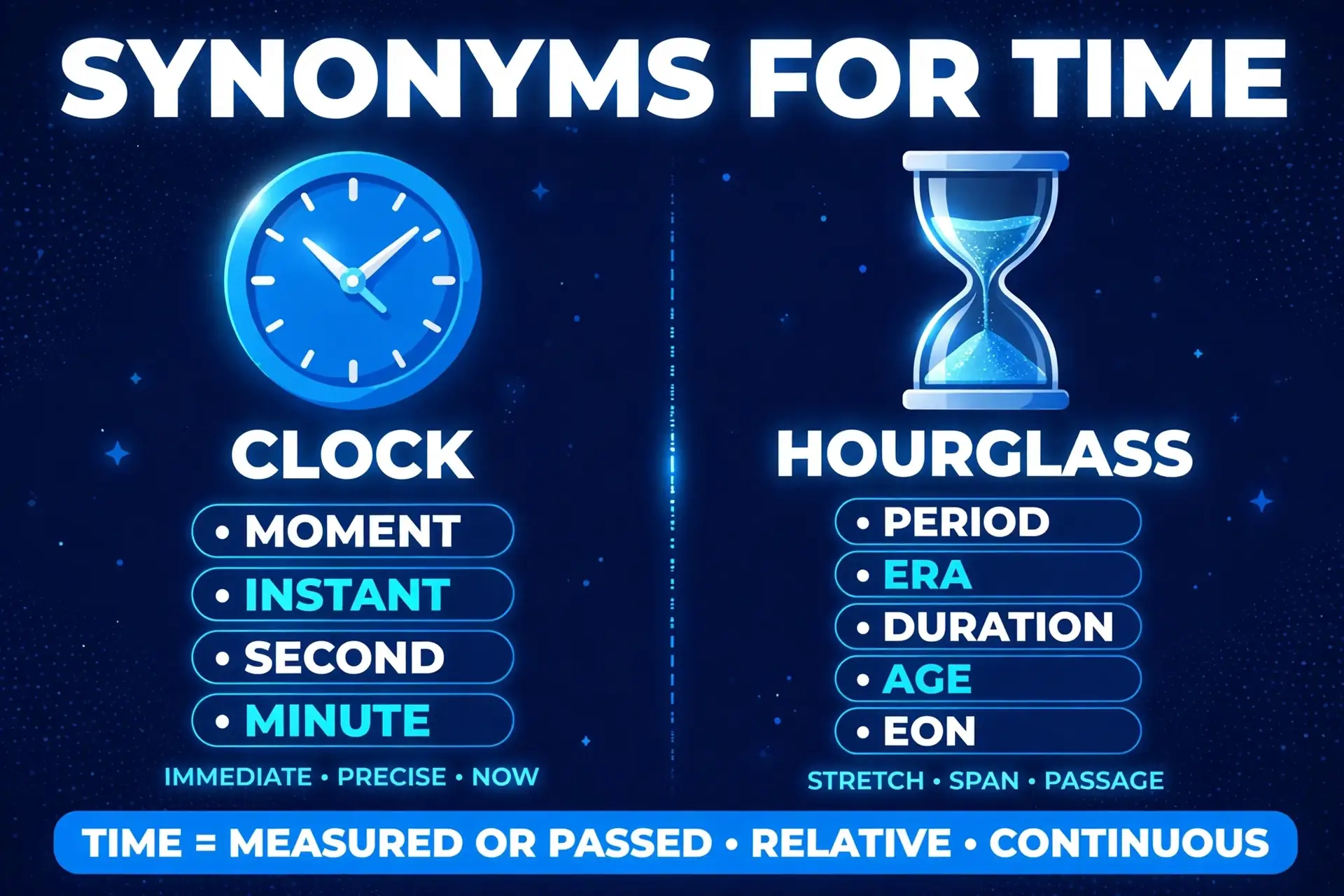
Table of Contents
Quick Answer
| Word | Nuance / When to use it |
|---|---|
| period | The neutral default — any defined length of time |
| duration | How long something lasts, measured start to finish |
| interval | A gap or pause between two points — regular or one-off |
| span | The full reach of something across time — a career, a bridge’s life |
| era | A long age defined by events or character — decades or more |
| moment | A brief point in time — an instant with feeling in it |
| occasion | A special or notable time — events, ceremonies, milestones |
| instance | One occurrence of something — formal, often “in this instance” |
| opportunity | A favorable time to act — a chance, not just a moment |
| schedule | The standard verb — to plan something for a specific time |
| book | To reserve — appointments, tickets, tables, venues |
| arrange | To organize the details — meetings, visits, plans |
Simple rule: Use a duration word (period, span, era) for lengths of time, an occasion word (moment, occasion, opportunity) for points or chances, and a scheduling verb (schedule, book, arrange) when time becomes an action.
A Period or Duration
These eight describe time as a stretch — from a coffee break to a geological age. Pick by length and by how formal the context is.
Period — any defined length of time; the neutral, all-purpose word. The store closed for a brief period during the renovation.
Duration — the measured length of something, start to finish. The flight’s duration was just under six hours.
Interval — a gap or pause between two points in time. Trains run at twenty-minute intervals on this line.
Span — the full extent of something across time. Over a career spanning forty years, she published twelve novels.
Stretch — an unbroken run of time; slightly informal. He worked a twelve-hour stretch without a single break.
Spell — a short, often temporary period; common in British English. We had a cold spell in March that killed the early blossoms.
Era — a long age marked by distinctive events or character. The Victorian era transformed the city from a port into a metropolis.
Epoch — an even longer, history-defining period; more formal than era. The invention of writing marked a new epoch in human civilization.
An Occasion
Here “time” means a point or chance, not a length. These five separate a mere moment from a meaningful one.
Occasion — a special or notable time; events, ceremonies, milestones. Their fiftieth anniversary was a grand occasion for the whole family.
Moment — a brief point in time, often with emotional weight. She paused for a moment before answering the difficult question.
Instance — a single occurrence; formal and precise. In this instance, the usual rules do not apply.
Opportunity — a favorable time to act; a chance, not just a moment. The internship was a rare opportunity to learn the trade.
Juncture — a critical point where things change; formal. At this juncture, the company had to choose between growth and survival.
To Schedule (Verb)
“Time” is also a verb — to time a race, to time a joke. These five cover its scheduling sense, from formal planning to casual arrangements.
Schedule — to plan something for a specific time; the standard verb. They scheduled the surgery for early Tuesday morning.
Book — to reserve in advance; appointments, tickets, tables. We booked a table for eight at the new Italian place.
Slot — to fit something into a timetable or lineup; informal. Can we slot in a quick call before the board meeting?
Arrange — to organize the details of a meeting or plan. Her assistant arranged interviews with three candidates.
Set — to fix a time; simple and direct. Let’s set a date for the product launch next month.
Common Mistakes
Time words look interchangeable but carry strict limits of length, formality, and meaning. Matching the word to the context is the same precision habit behind was vs were and fourth vs forth: close isn’t correct.
Mistake 1: Calling five years an “era”
❌ The social media era of 2019–2024 changed everything.
✅ The social media period of 2019–2024 changed everything.
Why: An era spans decades and is defined by character, not a date range. Five years is a period or a stretch; inflating it to an era sounds grandiose.
Mistake 2: Using “instance” when you mean a chance
❌ This is a great instance to start your own business.
✅ This is a great opportunity to start your own business.
Why: An instance is one occurrence of something — neutral, no promise in it. An opportunity is a favorable chance. Mixing them up promises nothing when you meant to promise something.
Mistake 3: “Booking” a casual plan
❌ Let’s book a time to grab coffee next week.
✅ Let’s arrange a time to grab coffee next week.
Why: Book implies a reservation system — tickets, tables, appointments. For informal plans, arrange or set sounds natural instead of corporate.
Mistake 4: Using “duration” for a point in time
❌ At the duration of the meeting, she raised the budget question.
✅ At one moment during the meeting, she raised the budget question.
Why: Duration is a length (the meeting lasted two hours), not a point. For a point within it, use moment, point, or juncture.
How to Choose the Right Synonym
- Ask: length or point? Lengths take period, duration, span, era. Points and chances take moment, occasion, opportunity, juncture.
- Scale the length honestly. A spell is days, a stretch is hours, a period is flexible, an era is decades — don’t promote a week to an epoch.
- Match the formality. Instance and juncture suit reports and essays; spell and slot suit conversation and casual writing.
- Keep the verb precise. Schedule for plans, book for reservations, arrange for organizing details, set for fixing a date — each implies a different kind of action.
- Don’t let “time” do everything. One sentence can hold two senses (“at that time, in a short time”), which is exactly when a synonym earns its place.
Frequently Asked Questions
What is a synonym for time?
It depends on the sense: period for a length of time, moment for a point in time, and schedule for the verb. Duration is the safest all-round noun.
What is the difference between period and era?
A period is any defined length of time, neutral and flexible. An era is a long age — decades or more — defined by distinctive events or character, like the Victorian era.
Is “moment” a synonym for time?
Only for the “point in time” sense — a brief instant. Moment never works for durations: “a moment of silence” is fine, but “the moment of the project” is not.
What is a formal synonym for “a long time”?
Duration is the standard formal choice (“the duration of the trial”). For historical scale, era or epoch carry the weight.
What verb can replace “time” as in “time the meeting”?
Schedule is the direct replacement for planning. Use book for reservations, arrange for organizing details, and set for fixing a date.
Is “while” a synonym for time?
As a noun, yes in one construction — “a while” means a period of time (“rest for a while”). Outside that phrase, while is a conjunction, not a synonym.
Conclusion
“Time” stretches across durations, points, occasions, and actions — no single synonym covers all of them. Once you sort its senses, the right word is usually obvious: period for the length, moment for the instant, opportunity for the chance, and schedule when time becomes something you do.