Synonyms for Not Telling the Truth: Words With Examples
Few topics reward precision like describing dishonesty: calling something a “lie” when someone merely misled you can land you in an argument you didn’t intend. This guide collects 20 exact synonyms for not telling the truth, grouped by how directly the falsehood is stated and how serious it sounds. Each word comes with its nuance and an example sentence, so you can choose precisely the right one.
Quick Answer
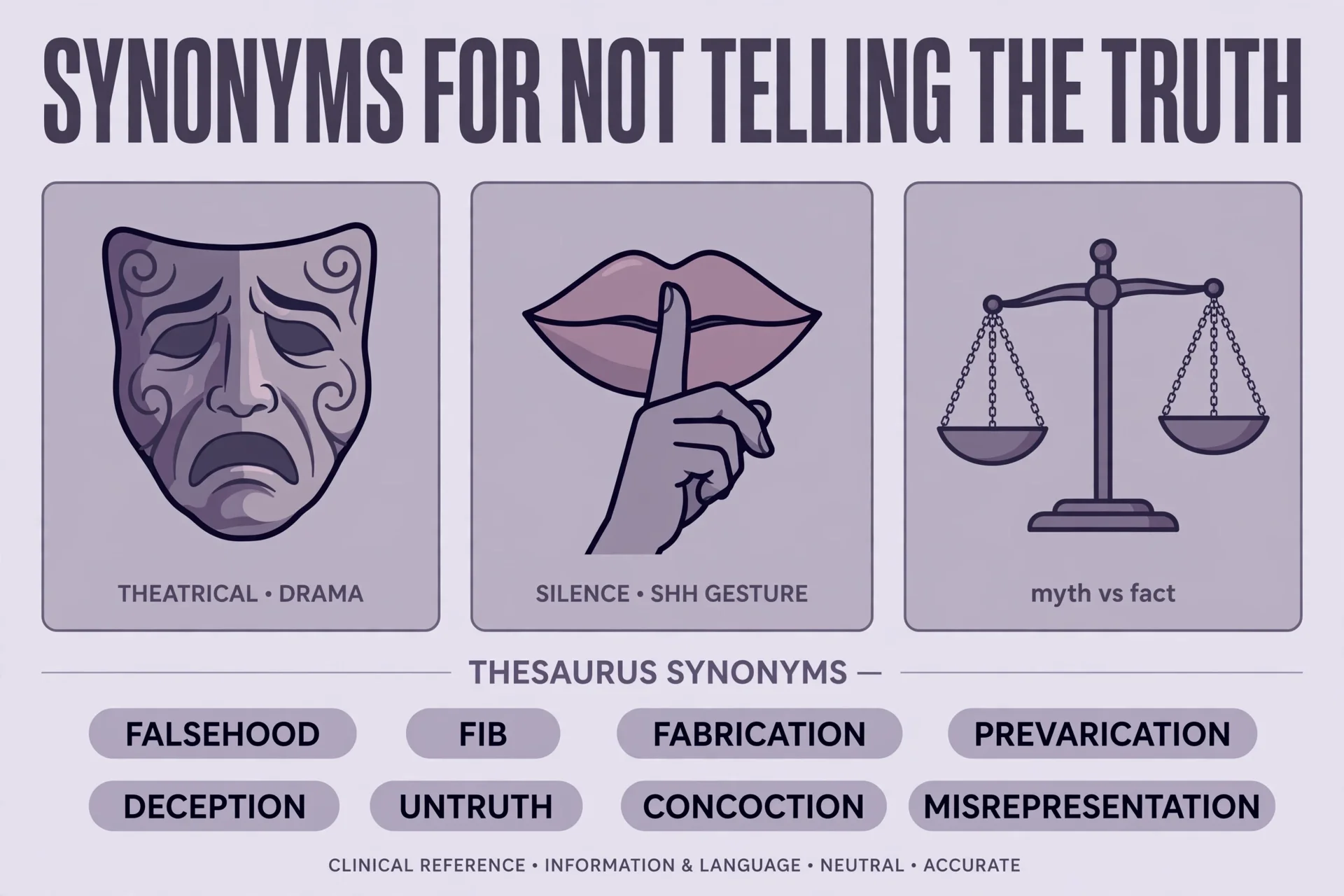
| Word | Nuance / When to use it |
|---|---|
| lying | The default word: stating something you know is false. |
| fibbing | A small, often harmless lie; light and casual tone. |
| fabricating | Inventing information wholesale and presenting it as fact. |
| misleading | Arranging facts or omissions so someone draws the wrong conclusion. |
| deceiving | Deliberately causing someone to believe what is false. |
| distorting | Twisting real facts so they give a false impression. |
| equivocating | Using vague language to avoid giving a straight answer. |
| evading | Dodging questions or the truth entirely. |
| dishonest | The plain adjective for someone or something not honest. |
| deceitful | Habitually inclined to mislead others. |
| untruthful | Formal, neutral way to say “not telling the truth.” |
| mendacious | Literary and formal: given to lying. |
Simple rule: match the word to the act — use “lying” words for stated falsehoods, “misleading” words for selective truth, and formal words like “mendacious” only in serious writing.
Lying Directly
These words describe someone stating something they know is not true — the plainest form of not telling the truth.
- lying — stating something you know to be false. “She was lying when she said she had never met him.”
- fibbing — telling a small, often harmless lie. “He fibbed about his age on the membership form.”
- fabricating — inventing information and presenting it as true. “The witness was accused of fabricating evidence.”
- making things up — inventing facts spontaneously, usually on the spot. “Stop making things up and just say you forgot.”
- stretching the truth — exaggerating facts until they mislead. “Saying you ran a marathon when you jogged five miles is stretching the truth.”
- perjury — the formal, legal term for lying under oath. “The official faced perjury charges after contradicting her earlier testimony.”
Misleading Without Stating It
Sometimes the truth is avoided without a single false statement — through spin, omission, or evasion. These words cover that territory.
- misleading — causing someone to believe something untrue without stating a direct lie. “The ad was misleading: the ‘free’ trial required a credit card.”
- deceiving — deliberately causing someone to accept something false as true. “He was deceiving his partner about the scale of his debts.”
- distorting — twisting facts so they give a false impression. “The report distorted the survey results to support its conclusion.”
- misrepresenting — giving a false account of something. “She was misrepresenting her qualifications on her résumé.”
- falsifying — deliberately altering records or information to make them false. “Falsifying financial records is a criminal offense.”
- equivocating — using vague or ambiguous language to avoid a straight answer. “The minister kept equivocating instead of answering the question.”
- evading — avoiding a direct answer or sidestepping the truth. “He spent the whole interview evading questions about the missing funds.”
- prevaricating — the formal term for speaking evasively to dodge the truth. “Stop prevaricating and tell us what actually happened.”
Dishonest Character
These adjectives describe a person, statement, or pattern of behavior marked by a lack of truthfulness.
- dishonest — not honest; prone to lying or cheating. “It was dishonest of him to take credit for her work.”
- deceitful — given to deceiving; habitually misleading others. “The deceitful salesman hid the car’s accident history.”
- untruthful — not telling the truth; the neutral, formal adjective. “Her untruthful account fell apart under questioning.”
- mendacious — given to lying; literary and formal in tone. “The editorial accused the company of mendacious advertising.”
- duplicitous — deceitful in speech and action; two-faced. “The duplicitous advisor was secretly briefing both sides.”
- false — not true or genuine; the plain adjective for untrue statements. “He checked into the hotel under a false name.”
Common Mistakes
Writers often reach for a dramatic synonym when a plain one fits better — the same kind of word-pair confusion behind our liar vs lier guide — or they grab an intensifier that doesn’t quite fit, the way writers stumble over truly. Watch for these four errors.
Mistake 1: Calling every small lie “perjury”
❌ “He committed perjury when he said he was too busy to come.”
✅ “He was fibbing when he said he was too busy to come.”
Why: perjury is a specific legal term for lying under oath in court. Using it for an everyday excuse makes the error worse than the lie.
Mistake 2: Calling serious fraud “fibbing”
❌ “The executive was just fibbing about the company’s finances.”
✅ “The executive was fabricating the company’s financial statements.”
Why: fibbing describes a small, harmless lie. Invented claims on a serious scale need fabricating or falsifying.
Mistake 3: Confusing “equivocating” with “lying”
❌ “She was lying when she refused to answer the question.”
✅ “She was equivocating when she refused to answer the question.”
Why: refusing or dodging an answer is not the same as stating a falsehood. Equivocating names the evasion precisely.
Mistake 4: Using “mendacious” in casual writing
❌ “My mendacious little brother ate the last cookie.”
✅ “My deceitful little brother ate the last cookie.”
Why: mendacious is formal and literary. In everyday contexts, deceitful or dishonest fits the register better.
How to Choose the Right Synonym
- Match directness: stated falsehoods get lying, fibbing, or fabricating; evasions get equivocating or evading.
- Match the scale: fibbing suits white lies, while fabricating and falsifying suit invented facts and altered records.
- Mind the register: mendacious and prevaricating are formal; making things up is conversational.
- Reserve legal terms: perjury applies only to sworn statements — never use it casually.
- Check the subject: adjectives like dishonest and deceitful describe people; verbs like misleading and distorting describe acts.
Frequently Asked Questions
What is a synonym for not telling the truth?
“Lying” is the most direct synonym. “Misleading” and “deceiving” cover cases where the truth is bent without an outright false statement.
What is the difference between lying and misleading?
Lying states something known to be false. Misleading arranges true facts, or leaves out key ones, so the listener draws a false conclusion anyway.
Is “fibbing” a real word?
Yes. It means telling a small or trivial lie, and it carries a much lighter tone than “lying” — think playground excuses, not fraud.
What do you call someone who lies constantly?
In everyday language: dishonest, deceitful, or (formal) mendacious. Clinicians use “pathological liar” for compulsive, uncontrollable lying.
What is a formal synonym for lying?
“Prevaricating” suits formal writing about evasion, “mendacious” works as a literary adjective, and “perjury” names lying under oath specifically.
Conclusion
From a casual fib to formal perjury, English offers a precise word for every shade of untruth. Choose the one that matches both the act and the register, and your writing stays accurate and credible. For the complete entry, browse the Merriam-Webster thesaurus page for “lying”.