Synonyms for So: 18 Words With Examples
So is tiny, useful, and dangerously vague — it can mean “therefore,” “also,” “very,” or “certainly” depending on the sentence. These 18 synonyms for so are grouped by meaning, each with a clear definition and a natural example, and the Merriam-Webster thesaurus entry for so confirms every one of them as a genuine synonym.
Quick Answer
| Word | Nuance / When to use it |
|---|---|
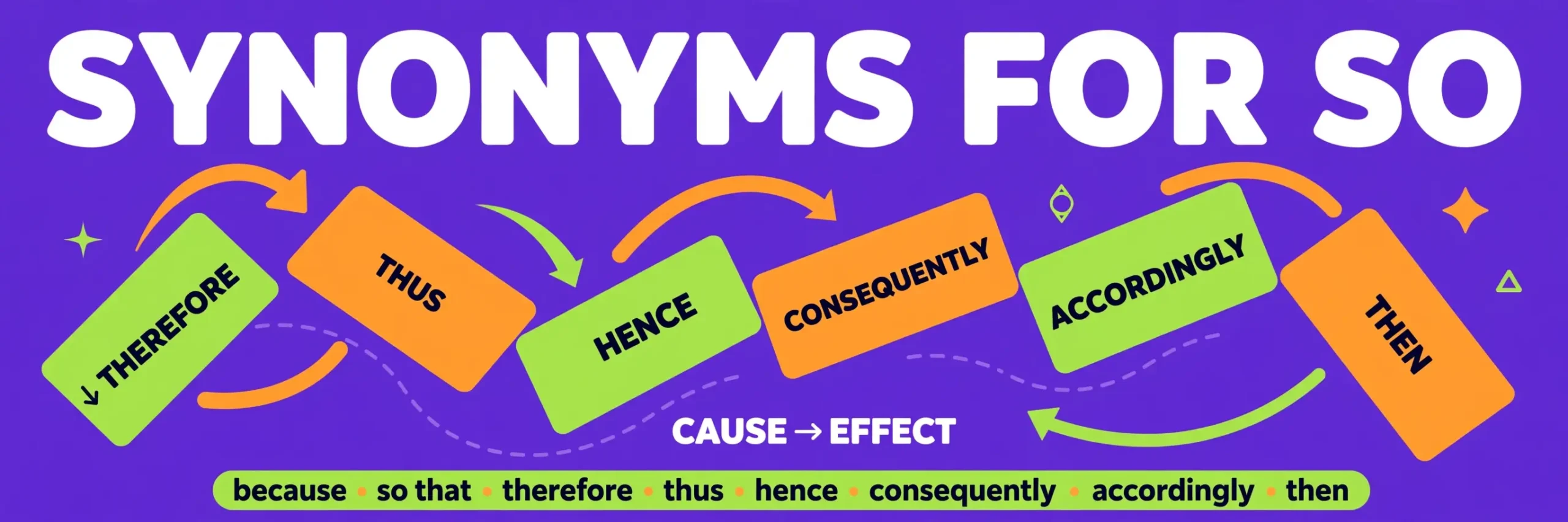
| therefore | For this reason; the formal, logical replacement for “so” |
| thus | In this way, as a result; formal, common in academic writing |
| hence | From this point or reason; formal, slightly old-fashioned |
| consequently | As a direct result; emphasizes cause and effect |
| also | In addition; replaces “so” when it means “in like manner” |
| too | As well; the everyday spoken equivalent of “also” |
| likewise | In the same way; polished and slightly formal |
| very | To a high degree; the plain intensifier “so” often stands in for |
| extremely | To an exceptional degree; stronger and more precise than “very” |
| incredibly | To a remarkable degree; energetic and emphatic |
| certainly | Without any question; replaces “so” when it signals strong agreement |
| surely | Without doubt; confident and slightly more formal than “certainly” |
Simple rule: replace so with therefore or thus for cause-and-effect, also or too for addition, very or extremely for emphasis, and certainly for strong agreement.
So Meaning “Therefore”
- therefore — for this or that reason; the classic formal substitute. Example: It was raining, therefore we stayed inside.
- thus — as a result of what was just stated. Example: The engine failed, thus delaying the flight by three hours.
- hence — for this reason, or from this point onward. Example: The bridge is closed; hence the long detour.
- consequently — as a direct consequence of something. Example: He missed the deadline and consequently lost the contract.
- accordingly — in a way that matches the situation. Example: Sales are down, so we will adjust our prices accordingly.

So Meaning “Also”
- also — in addition; in like manner. Example: The boss works very hard, and everyone else also puts in long hours.
- too — as well; the conversational twin of “also.” Example: I love spicy food, and my brother does too.
- likewise — in the same way; polished and professional. Example: She wished them luck, and they likewise wished her well.
- similarly — in a comparable manner. Example: The northern rivers dried up, and the southern ones similarly shrank.
So Meaning “Very”
- very — to a great degree; the plain, safe intensifier. Example: It is very cold outside this morning.
- extremely — to an exceptional, extreme degree. Example: The exam was extremely difficult this year.
- highly — to a large or favorable degree. Example: She is a highly respected surgeon.
- incredibly — to a remarkable, almost unbelievable degree. Example: The view from the summit was incredibly beautiful.
- remarkably — to a degree worth noticing or remarking on. Example: He stayed remarkably calm during the crisis.
So Meaning “Certainly”
- certainly — without any question; firm agreement. Example: You are certainly welcome to join us for dinner.
- surely — without doubt; confident assertion. Example: Surely you remember the night we met.
- indeed — truly; confirms or strengthens a statement. Example: The results were indeed better than anyone had hoped.
- truly — genuinely; sincere and emphatic. Example: I am truly grateful for all your help.
Common Mistakes
Because so wears so many hats, its synonyms get swapped into the wrong sentences constantly. Confusable pairs like quite or quiet and further or farther cause the same kind of trouble — the words look interchangeable, but only one fits.
Mistake 1: therefore as an intensifier
❌ The soup was therefore hot.
✅ The soup was so hot.
Why: therefore means “for that reason” — it explains a cause, never intensity. For emphasis, use very or extremely instead.
Mistake 2: also for cause-and-effect
❌ It rained, also we stayed home.
✅ It rained, so we stayed home.
Why: also adds a new item; it never shows that one thing caused another. The sentence needs a consequence word like so or therefore.
Mistake 3: thus in casual speech
❌ I was tired, thus I went to bed early. (in a text message)
✅ I was tired, so I went to bed early.
Why: thus is formal and academic — it sounds stiff in conversation and texts. So is the natural spoken choice.
Mistake 4: such instead of so
❌ It was such late that we missed the bus.
✅ It was so late that we missed the bus.
Why: such modifies noun phrases (“such a late hour”), while so modifies adjectives and adverbs (“so late”). Mixing them up is one of the most common learner errors.
How to Choose the Right Synonym
- Name the meaning first. Ask what so is doing in your sentence — showing a result, adding information, intensifying, or agreeing — then pick from that group.
- Match the formality. Therefore, thus, and consequently belong in essays and reports; so, too, and very belong in conversation.
- Do not upgrade “very” by accident. Swapping so for extremely or incredibly raises the intensity — only do it when you truly mean more.
- Watch sentence position. Therefore and consequently often start a clause with a comma; so flows mid-sentence without one.
- Keep “also” additive. If there is no cause-and-effect, reach for also, too, or likewise — never therefore.
- When in doubt, keep so. In speech and informal writing, so is perfectly fine; its synonyms exist for variety and precision, not because so is wrong.
Frequently Asked Questions
What is a synonym for so?
It depends on the meaning: therefore, thus, and consequently for cause-and-effect; also, too, and likewise for addition; very, extremely, and incredibly for emphasis; certainly and surely for strong agreement.
What is the difference between so and therefore?
Both can show a result, but therefore is formal and explicitly logical, while so is casual and conversational. “It rained, so we stayed home” is everyday speech; “therefore we stayed home” suits an essay.
Is “thus” too formal for everyday writing?
For most everyday writing, yes — thus belongs in academic and professional prose. In emails, blogs, and texts, so or therefore reads more naturally.
Can a sentence start with “so”?
In speech and informal writing, absolutely — “So, what happened next?” is standard. In formal essays, starting with so can look loose; therefore or thus is safer there.
What is the difference between so and very?
They overlap as intensifiers (“so tired” vs “very tired”), but so is more emotional and often pairs with “that” (“so tired that I slept”). Very is the calmer, more neutral choice.
Conclusion
So is four words in one — a connector of causes, an adder of ideas, an intensifier, and a stamp of certainty. Once you know which so you mean, the right synonym is obvious: therefore for logic, also for addition, very for emphasis, certainly for agreement. Your sentences get sharper, and so gets to rest.