Synonyms for Justice: 18+ Words With Examples
Writers reach for justice in essays, speeches, legal writing, and everyday arguments — and because the word carries such moral weight, repeating it dulls its force. This guide gives you 18 precise alternatives for justice, grouped by nuance, each with a one-line meaning and a natural example sentence. They are drawn from the same family of meanings that Merriam-Webster’s thesaurus entry for “justice” lists under fairness, moral rightness, and impartial judgment.
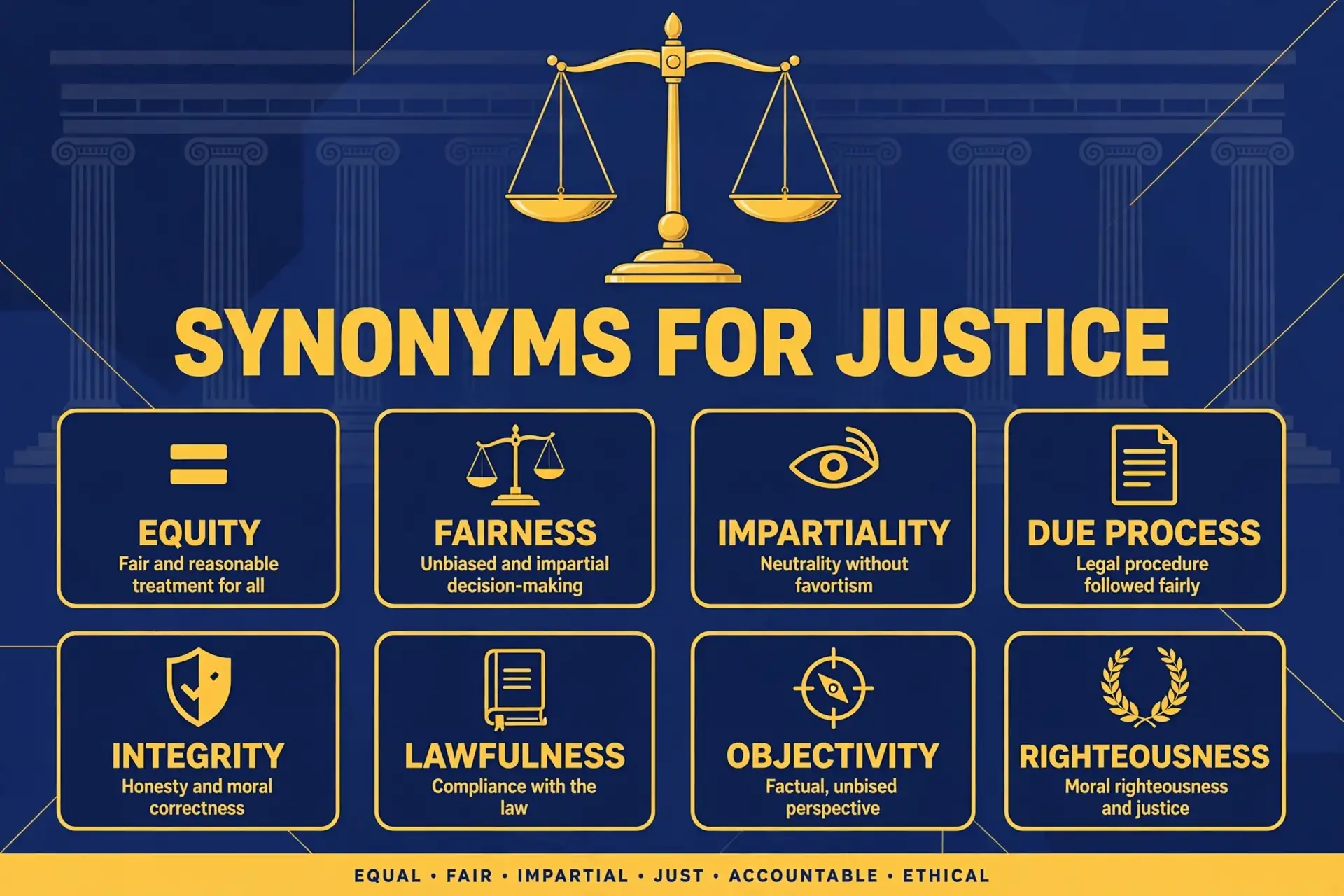
Table of Contents
Quick Answer
| Word | Nuance / When to use it |
|---|---|
| fairness | The closest all-purpose swap — treating people as they deserve |
| equity | Fairness adjusted to circumstances and needs |
| impartiality | Not favoring either side — judges, referees, mediators |
| evenhandedness | Equal treatment in practice — policies, managers, parents |
| righteousness | Moral rightness of character or cause |
| uprightness | Honest, honorable conduct — slightly old-fashioned, dignified |
| integrity | Wholeness of moral character — doing right when unseen |
| virtue | Moral excellence as a trait — classical, literary tone |
| neutrality | Refusing to take sides — diplomacy, journalism, mediation |
| objectivity | Judgment based on facts, not feelings — research, reporting |
| fair-mindedness | The habit of judging people and issues fairly |
| equitability | Formal term for the quality of being equitable — legal and policy writing |
Simple rule: Use fairness or equity for everyday unfairness, righteousness or integrity for moral character, and impartiality or objectivity when someone must judge without favoring a side.
Justice as Fairness
When “justice” means giving people what they are due — fair shares, fair treatment, fair outcomes — these six words are sharper and more specific.
Fairness — the quality of treating people equally and reasonably. The fairness of the grading system convinced even the skeptical students.
Equity — fairness that accounts for different needs and starting points. The scholarship program was designed around equity, giving more support to students from underfunded schools.
Impartiality — treating all sides alike, without bias. The committee praised the chair’s impartiality during the heated budget debate.
Evenhandedness — consistent fairness in how rules are applied. Parents noticed the teacher’s evenhandedness — every child got the same chance to answer.
Fair-mindedness — the personal habit of judging people and issues justly. His fair-mindedness made him the person everyone trusted to settle arguments.
Equitability — the formal, legalistic term for being equitable. The lawyers argued over the equitability of the settlement for weeks.

Justice as Moral Righteousness
When “justice” means moral rightness — the goodness of a person, a cause, or an action — reach for these.
Righteousness — the state of being morally right or justifiable. She spoke with the quiet righteousness of someone who had witnessed the accident herself.
Uprightness — honest, honorable behavior; slightly formal and old-fashioned. Neighbors respected him for a lifetime of uprightness in business.
Integrity — firm moral principles that hold even when nobody is watching. The auditor’s integrity kept the charity’s finances beyond reproach.
Virtue — moral excellence as a personal quality; classical and literary in tone. The novel celebrates patience as the highest virtue.
Honor — the respect earned through principled conduct. He returned the lost wallet out of simple honor.
Goodness — plain moral rightness, warm and uncomplicated. There was a basic goodness in the way she treated every customer.
Justice as Impartial Judgment
When “justice” means judging without favoritism — in courts, newsrooms, negotiations, and research — these words name the exact quality.
Neutrality — refusing to favor any side in a dispute. The country’s neutrality kept it out of the regional conflict for decades.
Objectivity — basing judgment on observable facts rather than feelings. The study’s objectivity was its strength — the data spoke for itself.
Disinterest — freedom from personal stake in the outcome (not lack of interest). The mediator’s disinterest in the property made both families trust her.
Detachment — emotional distance that allows clear judgment. A surgeon’s detachment helps in the operating room, though patients prefer warmth at the bedside.
Nonpartisanship — independence from political parties or factions. The election commission guarded its nonpartisanship fiercely.
Open-mindedness — willingness to consider all sides before deciding. The judge’s open-mindedness gave the defense team real hope.
Common Mistakes
Justice is a big word, and big words attract sloppy swaps. The same precision that settles the principal-vs-principle pair and the effective-vs-affective mix-up applies here: each near-synonym has a boundary, and crossing it changes your meaning.
Mistake 1: Using “vengeance” for justice
❌ He got justice by keying his rival’s car.
✅ He got vengeance by keying his rival’s car — justice would have meant reporting the theft.
Why: Justice is about fairness and rightness through proper means; vengeance is personal payback. Calling revenge “justice” confuses the two.
Mistake 2: Confusing “equity” with “equality”
❌ The policy ensures equity — every department gets exactly the same budget.
✅ The policy ensures equality — every department gets exactly the same budget.
Why: Equity means fair distribution based on need; equality means identical treatment. The sentence describes equality, not equity.
Mistake 3: Using “indifference” for “impartiality”
❌ The jury showed admirable impartiality — they clearly didn’t care about the case at all.
✅ The jury showed admirable impartiality — they weighed both sides’ evidence carefully.
Why: Impartiality is engaged fairness toward both sides; indifference is not caring. A jury that doesn’t care is a failure, not a virtue.
Mistake 4: Using “righteousness” for moral smugness
❌ He lectured everyone from his righteousness, clearly enjoying their discomfort.
✅ He lectured everyone with obvious self-righteousness, clearly enjoying their discomfort.
Why: Righteousness is genuine moral rightness; the smug, look-down version is self-righteousness — a criticism, not a compliment.
How to Choose the Right Synonym
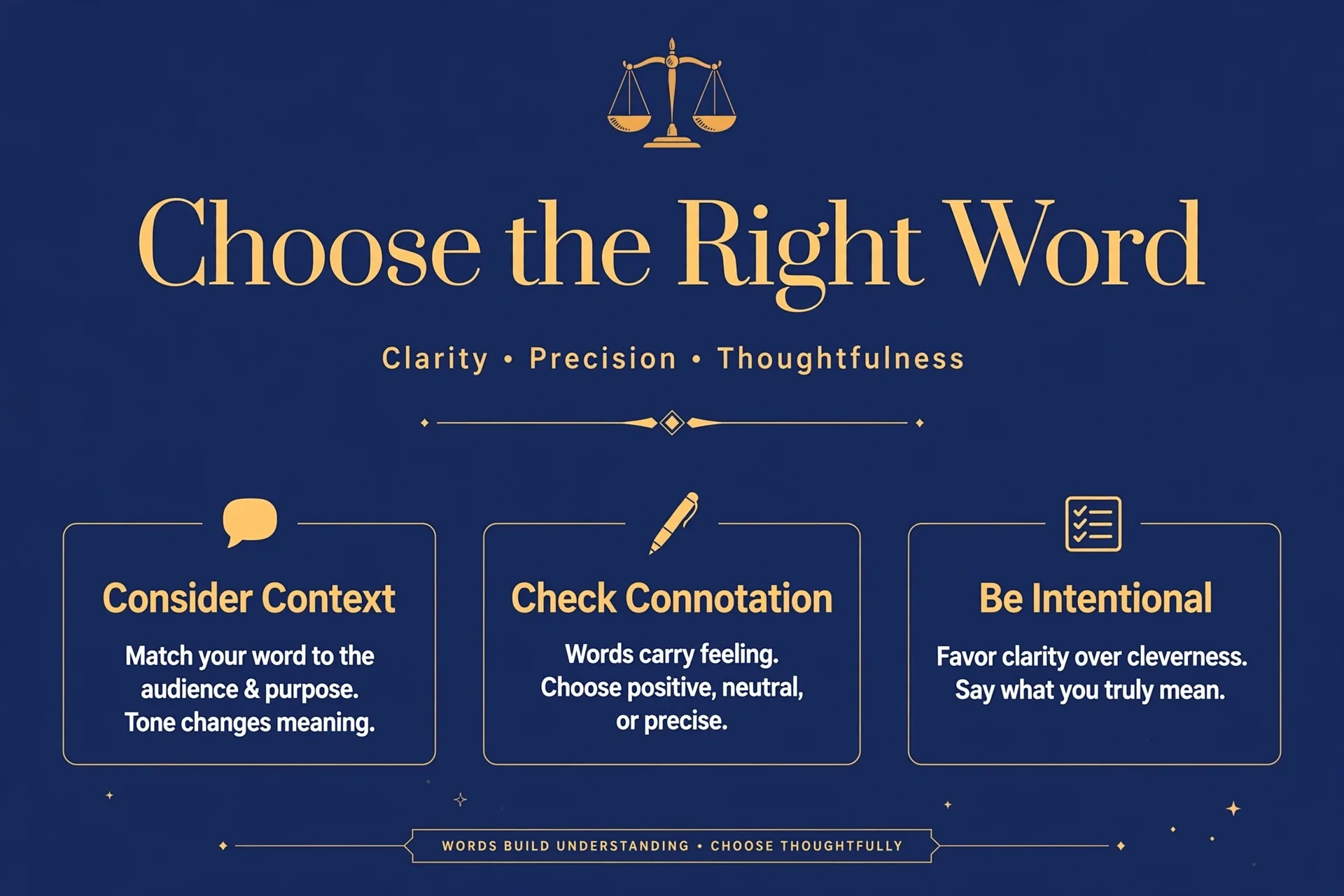
- Name the situation first. Unfair outcome → fairness/equity; moral character → righteousness/integrity; judging a dispute → impartiality/objectivity; staying out of a conflict → neutrality.
- Check the register. Equitability, nonpartisanship, and disinterest belong in legal and formal writing; fairness, honor, and goodness suit everyday prose.
- Watch the connotation traps. Vengeance is not justice, indifference is not impartiality, and self-righteousness is the opposite of righteousness.
- Equity vs. equality is the classic tripwire. If everyone gets the same thing, that’s equality; if shares are adjusted to need, that’s equity — mixing them up undermines your whole argument.
- Don’t inflate the word. “Justice” carries moral thunder; if you only mean “a fair process,” fairness says it more honestly and lands harder.
Frequently Asked Questions
What is a synonym for justice?
Fairness is the closest all-purpose synonym for “justice.” For moral character use righteousness or integrity; for unbiased judgment use impartiality or objectivity.
What is the difference between justice and equity?
Justice is the broad principle of giving people their due; equity is one way of achieving it — fairness adjusted to people’s different needs and circumstances. Equality, by contrast, means identical treatment regardless of need.
Is justice the same as revenge?
No. Justice seeks a fair, proportionate, morally right outcome through legitimate means; revenge (or vengeance) is personal retaliation. Calling revenge “justice” is one of the most common misuses of the word.
What is a formal synonym for justice?
In legal and academic writing, equity, impartiality, and equitability carry the most formal weight. Righteousness sounds formal too but leans moral rather than legal.
Can “justice” be used as a verb?
No — “justice” is a noun (and, in “a justice of the peace,” a title). There is no standard verb form; use verbs like right a wrong, avenge, or rectify depending on your meaning.
Conclusion
Justice is a powerful word precisely because it covers so much — fairness, moral rightness, and impartial judgment. Choosing fairness for outcomes, integrity for character, and impartiality for judgment lets each sentence say exactly which kind of justice you mean.