Synonyms for Water
Water is both a noun and a verb, and each job has its own family of synonyms. As a noun it names the liquid itself — almost impossible to rename — but as a verb it bursts into life: irrigate, douse, soak, dilute. Below are 14 synonyms for water grouped by sense, each with a definition and an example.
Table of Contents
Quick Answer
| Word | Nuance / When to use it |
|---|---|
| aqua | Formal or poetic name for water |
| H2O | Scientific and technical contexts |
| irrigate | Supply water to crops and fields |
| douse | Pour water over something suddenly |
| soak | Leave in water until fully saturated |
| sprinkle | Scatter small drops lightly |
| drench | Soak completely, usually unexpectedly |
| moisten | Make slightly wet — gentle and controlled |
| wet | Plain everyday verb — make wet |
| dilute | Thin a liquid by adding water |
| weaken | Reduce strength — of drinks or ideas |
| thin | Make less thick by adding liquid |
Simple rule: for the liquid itself you have only aqua and H2O — don’t force substitutes. For the verb, match the method: irrigate fields, sprinkle plants, douse fires. See the full entry in the Merriam-Webster thesaurus for more.
The Substance (Noun)
As a noun, water has almost no true synonyms — most “alternatives” are types of water (rainwater, seawater, tap water), not true equivalents. Only two words genuinely stand in for the substance itself.
aqua — a formal or poetic word for water, borrowed from Latin. Example: The spa brochure promised pure aqua drawn from deep mountain springs.
H2O — the chemical formula of water, used in scientific and technical writing. Example: The lab report confirmed the sample was pure H2O with no contaminants.

To Water (Verb — Give Water To)
As a verb meaning “to supply with water,” water has a rich set of synonyms that differ by method and intensity.
irrigate — to supply water to crops or land through channels or pipes. Example: Farmers irrigate the fields before the dry season begins.
douse — to pour water over something quickly and completely, often to put out fire. Example: She doused the campfire with a bucket of water.
soak — to leave something in liquid until it is fully saturated. Example: He soaked the beans overnight before cooking them.
sprinkle — to scatter small drops of water lightly over a surface. Example: She sprinkled the seedlings every morning.
drench — to soak thoroughly, often suddenly or unpleasantly. Example: The storm drenched the hikers within minutes.
moisten — to make slightly wet in a gentle, controlled way. Example: Moisten the cloth before wiping the screen.
wet — the plain everyday verb meaning to make something wet. Example: He wet the sponge and wiped the counter.
hose down — to wash or spray with a hose. Example: They hosed down the driveway after the barbecue.
Water Down (Phrasal Verb)
Water down means to thin something by adding water — and by extension, to weaken anything: a drink, a policy, an argument.
dilute — to make thinner or weaker by adding liquid. Example: The bartender diluted the juice with sparkling water.
weaken — to reduce the strength or force of something, literal or figurative. Example: Critics said the new rules would weaken the original law.
thin — to make less thick or concentrated by adding liquid. Example: Thin the paint with a little water before applying the second coat.
water down — to weaken by adding water, or to soften an idea so it offends no one. Example: The committee watered down the proposal until it meant nothing.
Common Mistakes
Just as lazer vs laser confuses spellers and gluing vs glueing splits even native writers, water‘s family hides a few traps. Three are worth naming.
Mistake 1: Forcing synonyms for the noun “water”
❌ Wrong: She drank a glass of aqua after her run. (sounds absurd in everyday speech)
✅ Better: She drank a glass of water after her run.
Why: The noun water has almost no true synonyms — only aqua (poetic/formal) and H2O (scientific). Words like rainwater or seawater are types, not equivalents. In ordinary sentences, just say water.
Mistake 2: Using “irrigate” for houseplants
❌ Wrong: He irrigated his succulents twice a week.
✅ Better: He watered his succulents twice a week.
Why: Irrigate belongs to fields, farms, and engineered systems — canals, pipes, sprinklers over acres. For pots and garden beds, plain water (or sprinkle) is natural and correct.
Mistake 3: Treating “drown” as a synonym
❌ Wrong: The rain drowned the garden. (meant as “watered heavily”)
✅ Better: The rain drenched the garden.
Why: Drown means to die or kill by submersion in water — it is about death, not watering. For heavy watering use drench, soak, or douse.
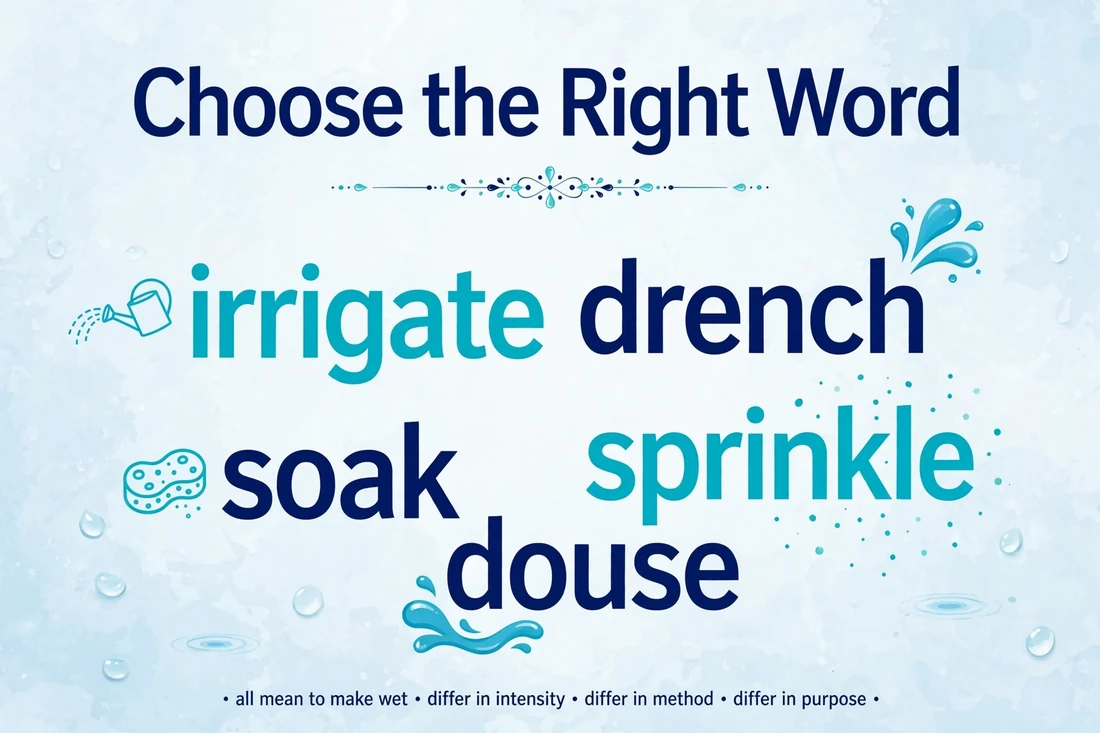
How to Choose the Right Synonym
- Noun or verb first: if you mean the liquid, stick with water (or aqua/H2O in special registers). If you mean the action, pick from the verb set.
- Match the scale: irrigate is for fields and crops; water or sprinkle is for plants and gardens.
- Match the force: moisten is gentle, soak is patient, douse is sudden, drench is total.
- Figurative watering: for weakened ideas or drinks, use dilute, thin, or water down — never literal verbs like soak.
- Keep drown out: drown is about dying in water, never about giving water to something.
Frequently Asked Questions
What is a synonym for water?
As a noun, the only true synonyms are aqua (poetic) and H2O (scientific). As a verb, common synonyms include irrigate, douse, soak, sprinkle, drench, and moisten.
What is a fancy word for water?
Aqua is the classic elegant choice — it appears in branding, spas, and poetry. In science, H2O is the standard formal term.
Is “irrigate” the same as “water”?
Not exactly. Irrigate means supplying water to crops or land through a system of channels or pipes. For houseplants or a garden, water is the natural word.
What does “water down” mean?
Literally, to thin a liquid by adding water — and figuratively, to weaken anything: a drink, a policy, or an argument. Synonyms include dilute, thin, and weaken.
Can “drown” be used as a synonym for watering heavily?
No. Drown means to die or be killed by water. For heavy watering, use drench, soak, or douse.
Conclusion
Water the noun stands nearly alone — reach for aqua or H2O only in special registers. Water the verb gives you real choice: irrigate the fields, sprinkle the seedlings, dilute the drink. Match the word to the sense and the scale, and your writing stays precise.