Synonyms for Fat
Writers look for synonyms for fat for delicate reasons: the word is blunt, and describing bodies demands care. This guide gives you 20 alternatives in a clinical thesaurus tone — neutral terms first, formal ones next, and the mocking words clearly marked as offensive so you know to avoid them. Each word gets a plain meaning and a natural example sentence. Merriam-Webster’s thesaurus entry for fat confirms the range from neutral “plump” to the terms below flagged with ⚠️ — treat those flags seriously.
Table of Contents
Quick Answer
| Word | Nuance / When to use it |
|---|---|
| overweight | The neutral default; above a healthy weight |
| plump | Softly rounded; often warm or affectionate |
| chubby | Mildly fat; common for children and cheeks |
| heavyset | Neutral; large, solid build |
| portly | Formal; stout in a dignified way, usually men |
| stocky | Short, broad, and solidly built |
| corpulent | Very formal/literary for excessively fat |
| stout | Thick-set and sturdy; slightly old-fashioned |
| rotund | Round in shape; often gently humorous |
| pudgy | Slightly fat in a soft, harmless way |
| burly | Large and muscular as well as heavy |
| hefty | Large and heavy; weight with presence |
Simple rule: Default to overweight or heavyset for neutrality, plump or chubby for warmth, corpulent or portly for formal writing — and never use the ⚠️ words in the “Words to Avoid” section about a real person.
Neutral and Clinical
When you need accuracy without judgment — health writing, journalism, forms — start here.
Overweight — weighing more than is considered healthy; the neutral standard term. The study followed overweight adults over a period of five years.
Heavyset — having a large, solid body build; neutral and respectful. Police described the suspect as a heavyset man in his forties.
Corpulent — excessively fat; very formal, mostly literary or medical-historical. The corpulent king struggled to mount his horse in the old chronicles.
Stocky — short, broad, and solidly built; neutral. The stocky defender was nearly impossible to push off the ball.
Obese — a clinical term for significantly above healthy weight; use only in medical contexts. Doctors classify patients as obese based on body mass index ranges.
Softer, Often Affectionate
These carry warmth rather than judgment — common in fiction, family descriptions, and friendly writing.
Plump — pleasantly rounded and full; often affectionate. The plump cushions made the old sofa the best seat in the house.
Chubby — mildly fat in a harmless, often endearing way. The chubby toddler waddled across the lawn, giggling.
Pudgy — slightly fat and soft; gentle. He patted his pudgy belly and laughed at himself.
Zaftig — full-figured and shapely; admiring, usually of women. The zaftig actress became famous for celebrating her curves.
Fleshy — having ample flesh; descriptive and neutral-ish. The boxer’s fleshy face showed every one of his forty years.
Formal and Descriptive
For literature, character description, and formal prose, these offer precision and polish.
Portly — stout with a dignified air; traditionally used of men. The portly gentleman tipped his hat and wished us good morning.
Stout — thick-set, sturdy, and solid; slightly old-fashioned. A stout woman in a red coat directed the choir with authority.
Rotund — round and plump in shape; often gently humorous. The rotund chef tasted every dish before it left the kitchen.
Burly — large, strong, and heavy; implies muscle as well as size. Two burly security guards stood by the stage door.
Hefty — large and heavy, with a sense of presence. The hefty linebacker charged through the defensive line.
Words to Avoid
Every one of these is a real synonym of “fat” — and every one will offend if used about a person. Know them so you can avoid them.
⚠️ Tubby — offensive when aimed at people; childish and mocking. Fine for a tubby kitten in a cartoon; cruel for a colleague.
⚠️ Porky — offensive; compares a person to a pig. Never acceptable as a description of someone, even jokingly.
⚠️ Flabby — insulting; implies soft, sagging flesh and laziness. A judgment disguised as a description.
⚠️ Blubbery — offensive; likens human flesh to whale blubber. Dehumanizing by design.
⚠️ Fatty — a slur as a noun; using “fat” as a label for a person (“a fatty”) reduces them to the trait. Always describe the body, never label the person.
Common Mistakes
Body-description words carry social weight, so precision matters — the same care that settles donut-vs-doughnut and desert-vs-dessert applies here: pick the word whose connotation you actually intend.
Mistake 1: Using “tubby” or “porky” casually
❌ Our tubby neighbor finally started jogging.
✅ Our heavyset neighbor finally started jogging.
Why: Tubby and porky are mocking words, not neutral ones. If you wouldn’t say it to the person’s face, don’t write it — use heavyset or overweight.
Mistake 2: Dropping “obese” into casual conversation
❌ He’s gotten pretty obese since college.
✅ He’s gotten pretty heavyset since college.
Why: Obese is a clinical classification, not small talk. Outside medical writing it lands as a diagnosis and an insult. Keep it in the clinic.
Mistake 3: “Thick” as a neutral synonym
❌ She described herself as thick in the interview.
✅ She described herself as curvy in the interview.
Why: In slang, thick means attractively curvy — a compliment in some circles, confusing in formal ones. It is not a neutral synonym of fat; curvy or full-figured says what you mean.
Mistake 4: “Phat” for “fat”
❌ That car is phat. (meant as “impressive” — correct, actually)
✅ That car is impressive.
Why: This one’s a spelling trap, not a synonym: phat (with a ph) is slang for excellent, while fat means having excess body weight. Same sound, unrelated meanings — write the one you mean.
How to Choose the Right Synonym
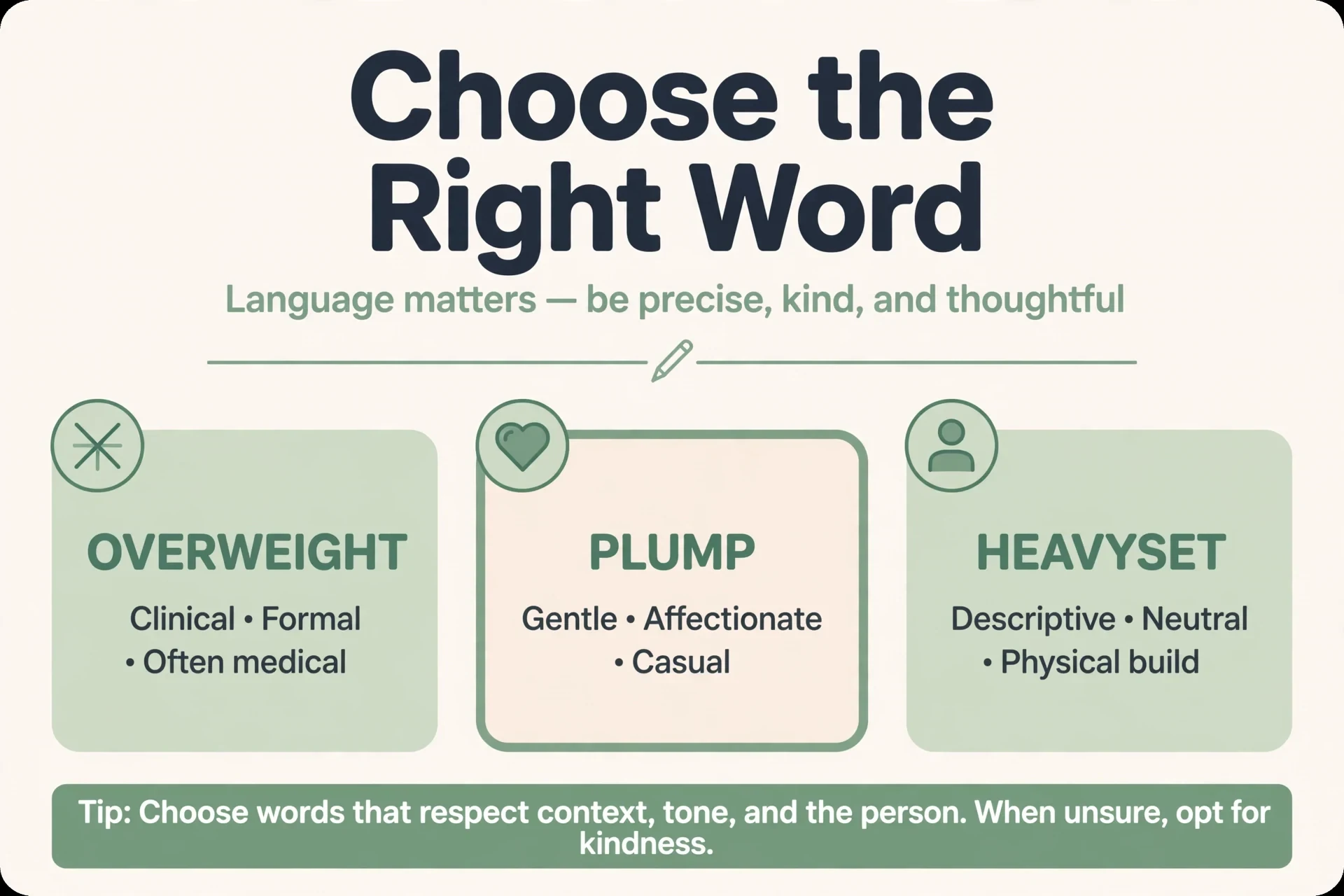
- Lead with neutral. Overweight and heavyset describe without judging — they’re the safe defaults in journalism, health writing, and everyday description.
- Match warmth to relationship. Plump, chubby, and pudgy are affectionate — fine for loved ones and fiction, presumptuous for strangers.
- Reserve the clinical terms. Obese and corpulent belong in medical or formal historical writing, not in conversation about real people.
- Treat the ⚠️ words as off-limits. Tubby, porky, flabby, blubbery, and fatty-as-noun mock or dehumanize. Knowing them helps you avoid them, not use them.
- Describe the body, not the person. “A heavyset man” describes; “a fatty” labels. The grammar choice is also an ethics choice.
- Consider not describing at all. If the person’s weight is irrelevant to your point, leave it out — the kindest synonym is sometimes silence.
Frequently Asked Questions
What is a synonym for fat?
Overweight is the most neutral synonym for “fat.” For warmth use plump or chubby; for a solid build use heavyset or stocky; for formal writing use corpulent or portly.
What is a polite word for fat?
Heavyset is the most reliably polite option, followed by overweight. Plump and chubby are gentle but can feel patronizing to adults — context and relationship matter.
Is “chubby” offensive?
Usually not — chubby is one of the softest words in this family and is standard for children (“chubby cheeks”). Applied to adults it can still sting, so heavyset is safer with strangers.
What is the clinical term for being fat?
Obese is the clinical term, defined by body mass index ranges in medical practice. It belongs in health writing and doctor’s offices — not in casual conversation, where it sounds like a judgment.
Is it okay to call someone “fat”?
Many people now reclaim “fat” as a neutral descriptor, but many others experience it as an insult. Unless someone has told you they prefer it, choose a neutral synonym like overweight or heavyset — or skip the description entirely.
What’s the difference between “fat” and “obese”?
Fat is everyday language for having excess body weight; obese is a specific medical classification. All obese people would be described as fat in plain speech, but “fat” covers a much wider range and carries no clinical precision.
Conclusion
English offers a full shelf of words for this topic — from neutral overweight and heavyset to warm plump and formal corpulent. Choose with care, leave the ⚠️ words on the shelf, and remember that describing a body is always also a decision about respect.